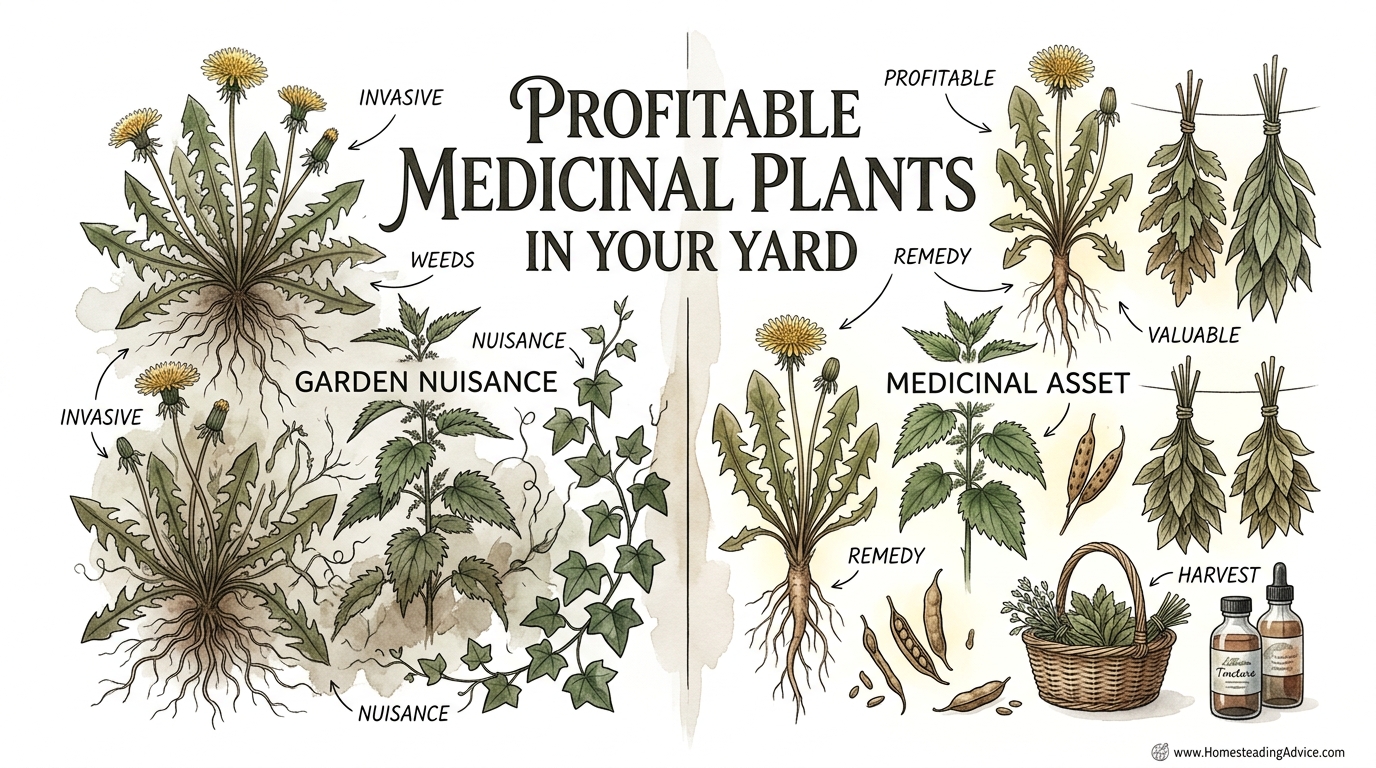
The ‘weeds’ you’re trying to kill are actually the most profitable plants on your entire property. Most people see dandelions and plantain as a nuisance, but savvy homesteaders see an apothecary waiting to be harvested. Stop fighting nature and start bottling it – medicinal tinctures and salves are high-demand homestead products.
If you have a yard, you likely have a goldmine growing right under your feet. This is not just about survival or old-world charm; it is about recognizing that “weeds” are often just highly resilient plants with concentrated medicinal compounds. By shifting your perspective, you can turn a Saturday morning chore of weeding into a high-value harvest session.
Working with the land instead of against it allows you to produce potent remedies that people are increasingly seeking out. Whether you want to stock your own medicine cabinet or sell small batches at a local market, understanding these plants is the first step toward self-reliance and extra income.
Profitable Medicinal Plants In Your Yard
Profitable medicinal plants are common “weeds” that possess verified therapeutic properties and hold significant market value when processed correctly. In the world of herbalism, these are often referred to as “backyard botanicals.” They exist everywhere from suburban lawns to wild acreage, thriving without the need for fertilizers, irrigation, or expensive seeds.
These plants are used in real-world applications ranging from digestive bitters and respiratory syrups to skin-healing salves. For instance, while a homeowner might spend $50.00 USD on herbicides to kill dandelions, an herbalist sees a plant where 1 lb (454 g) of the dried root can retail for $25.00 to $40.00 USD.
The most profitable plants for a backyard apothecary typically include:
- Dandelion (Taraxacum officinale): Every part is useful. The roots support liver health, the leaves act as a powerful diuretic, and the flowers are infused into oils for sore muscle balms.
- Plantain (Plantago major): Known as the “band-aid” plant. It contains allantoin, which promotes skin cell regeneration, making it a staple for stings, bites, and minor cuts.
- Stinging Nettle (Urtica dioica): A nutrient powerhouse rich in iron and minerals. It is highly sought after for seasonal allergy relief and as a nourishing tonic tea.
- Mullein (Verbascum thapsus): The leaves are a traditional remedy for respiratory support, often used in teas or smoked for lung congestion.
- Yarrow (Achillea millefolium): A master at stopping bleeding and reducing fevers. Its feathery leaves and white flower clusters are unmistakable once you know what to look for.
- Chickweed (Stellaria media): A cooling herb used in salves to soothe itchy skin conditions like eczema or hot rashes.
How to Harvest and Process Your Wild Wealth
Turning a weed into a product requires a specific process to ensure potency and safety. You cannot simply pull a plant and put it in a jar; you must follow the laws of herbal preparation.
1. Identification and Timing
Correct identification is non-negotiable. Use at least two reputable field guides to confirm the plant’s identity. Timing also matters: harvest roots in the autumn when the plant’s energy has moved underground, and pick leaves and flowers in the morning after the dew has dried but before the midday sun leaches out the volatile oils.
2. Cleaning and Drying
Shake off excess soil and wash roots thoroughly. For leaves and flowers, a light rinse is usually sufficient. To dry them, use a dehydrator set to a low temperature—around 95°F to 100°F (35°C to 38°C)—or hang them in small bundles in a dark, well-ventilated area. Drying is complete when the leaves “snap” rather than bend.
3. Making a Tincture (The Alcohol Method)
Tinctures are concentrated liquid extracts. Place your dried herbs in a glass jar and cover them with a high-proof alcohol, such as 80-to-100 proof vodka. A common ratio is 1:5, meaning 1 part herb by weight to 5 parts alcohol by volume. Let this sit in a cool, dark place for 4 to 6 weeks, shaking daily, then strain through cheesecloth.
4. Infusing Oils and Making Salves
To make a salve, first infuse dried herbs in a carrier oil like olive or almond oil. You can use the “solar method” by letting the jar sit in a sunny window for 2 weeks, or the “heat method” by warming the oil and herbs in a double boiler at roughly 110°F (43°C) for several hours. Once strained, melt 1 oz (28 g) of beeswax for every 4 to 5 oz (118 to 148 ml) of oil to create a firm, spreadable balm.
Benefits of Utilizing Backyard Botanicals
Choosing to harvest from your yard offers distinct advantages over purchasing store-bought supplements or synthetic alternatives. The primary benefit is **freshness and potency**. Many store-bought herbs have been sitting in warehouses for months or years, losing their active compounds.
Harvesting your own ensures a “closed-loop” system where you know exactly what has—and hasn’t—been sprayed on your plants. This is particularly important for medicinal products where purity is the goal. Additionally, the cost of production is remarkably low. Your “raw materials” are free, meaning your only expenses are jars, carrier oils, or alcohol.
From a homesteading perspective, this practice builds **biological resilience**. Instead of relying on a fragile global supply chain for basic first aid, you are developing the skill to find medicine in a ditch. This ancestral wisdom provides a sense of security that no store-bought product can match.
Challenges and Common Mistakes
The most frequent error beginners make is harvesting from contaminated areas. Plants growing near busy roadsides can accumulate heavy metals from exhaust, and those near old buildings may be growing in lead-contaminated soil. Always ensure your harvest site is at least 50 feet (15 meters) away from major roads and has no history of pesticide application.
Another common pitfall is the “moisture trap.” If you try to make a medicinal oil with fresh herbs that still contain water, your oil will likely grow mold within days. You must either wilt the herbs for 24 hours to remove moisture or use fully dried plant material to ensure a shelf-stable product.
Failure to label properly is a mistake that can lead to wasted effort. A jar of clear liquid might look like a dandelion tincture today, but in six months, you may not remember what it is or how strong it was. Always label with the common name, botanical name, part used, type of solvent, and the date of bottling.
Limitations and When to Avoid Foraging
While yard medicine is powerful, it has its boundaries. Wildcrafting is not ideal if you live in a high-density urban area where soil quality is unknown or if your neighbors frequently spray their lawns with chemicals that can drift onto your property.
Furthermore, some plants have **toxic look-alikes**. For example, Yarrow can be confused with Poison Hemlock by an untrained eye. If you are not 100% certain of an identification, do not harvest it. The risk of accidental poisoning far outweighs the potential medicinal benefit.
There are also legal limitations. In many regions, selling herbal products as “cures” for specific diseases is illegal without FDA approval. You must be careful with your labeling, using phrases like “supports healthy digestion” rather than “cures stomach ulcers” to stay within the legal framework for dietary supplements.
GARDEN NUISANCE vs MEDICINAL ASSET
Understanding the shift from seeing a plant as a pest to seeing it as a resource is best illustrated by comparing the two perspectives.
| Factor | Garden Nuisance Perspective | Medicinal Asset Perspective |
|---|---|---|
| Economic Impact | Costs money for removal (herbicides, labor). | Generates income ($20-$60 per lb of dried herb). |
| Maintenance | Requires constant fighting to eradicate. | Requires minimal oversight; harvest when ready. |
| Soil Health | Often removed, leaving soil bare or poisoned. | Deep roots (dandelion/burdock) pull up minerals. |
| Practical Use | Zero; intended for the compost or trash. | High; used for salves, tinctures, and teas. |
Practical Tips for Best Results
To maximize the profit and potency of your yard apothecary, follow these best practices:
- Use Small Batch Methods: Start with pint-sized (473 ml) jars to test your recipes. This prevents wasting expensive oils or alcohol if a batch goes wrong.
- Invest in a Scale: Measurements by weight are far more accurate than measurements by volume. Use a digital scale that measures in both grams and ounces.
- Store in Amber Glass: Light is the enemy of herbal medicine. Store your finished tinctures and oils in dark amber or cobalt glass bottles to prevent UV degradation.
- Focus on the “Big Three”: If you are selling, focus on Dandelion, Plantain, and Nettle. These are the most recognized by customers and have the widest range of uses.
Advanced Considerations for Practitioners
Once you have mastered simple tinctures, you can explore **double-extraction methods**. This is particularly useful for woody mushrooms or roots where some compounds are alcohol-soluble and others are water-soluble. You first tincture the material in alcohol, then simmer the remains in water to create a decoction, finally combining the two for a “full spectrum” extract.
Scaling your production also requires attention to **Good Manufacturing Practices (GMP)**. This includes keeping a clean workspace, documenting every batch with a lot number, and ensuring your sourcing is consistent. If you plan to sell beyond a local farmers market, look into your local state’s “Cottage Food” or “Commercial Feed” laws, as regulations vary significantly by region.
Profit Scenario: The Dandelion Root ROI
Let’s look at a realistic example of how this translates into value. Imagine you spend four hours digging up dandelions from a 1/4 acre (0.1 hectare) backyard.
After cleaning and processing, you may end up with 2 lbs (0.9 kg) of fresh root. Once dried, this shrinks to roughly 0.5 lbs (226 g) of dried root. If you sell this as bulk dried herb, you might earn $15.00 to $20.00 USD.
However, if you turn that 0.5 lbs of dried root into a 1:5 tincture, you will produce approximately 40 oz (1.18 liters) of extract. Bottled into 2 oz (59 ml) dropper bottles, you have 20 units. At a conservative market price of $12.00 USD per bottle, your gross revenue is $240.00 USD. Subtracting $40.00 for bottles and $20.00 for alcohol, you have a profit of $180.00 for a few hours of “weeding.”
Final Thoughts
The most profitable plants on your property are often the ones you have been trying to get rid of. By applying the principles of wildcrafting and traditional herbalism, you can transform a nuisance into a valuable medicinal asset. This process requires patience, careful identification, and a respect for the natural cycles of the land.
As you begin to harvest and process your own backyard apothecary, you will find that the yard becomes less of a chore and more of a sanctuary. Whether you use these remedies to keep your family healthy or to supplement your income, the skills you develop are a permanent investment in your own self-reliance.
Start small, stay observant, and soon you will see your property not just as a patch of grass, but as a thriving pharmacy waiting to be bottled. Experiment with different blends, keep meticulous records, and enjoy the satisfaction of knowing that the best medicine is often grown right at home.