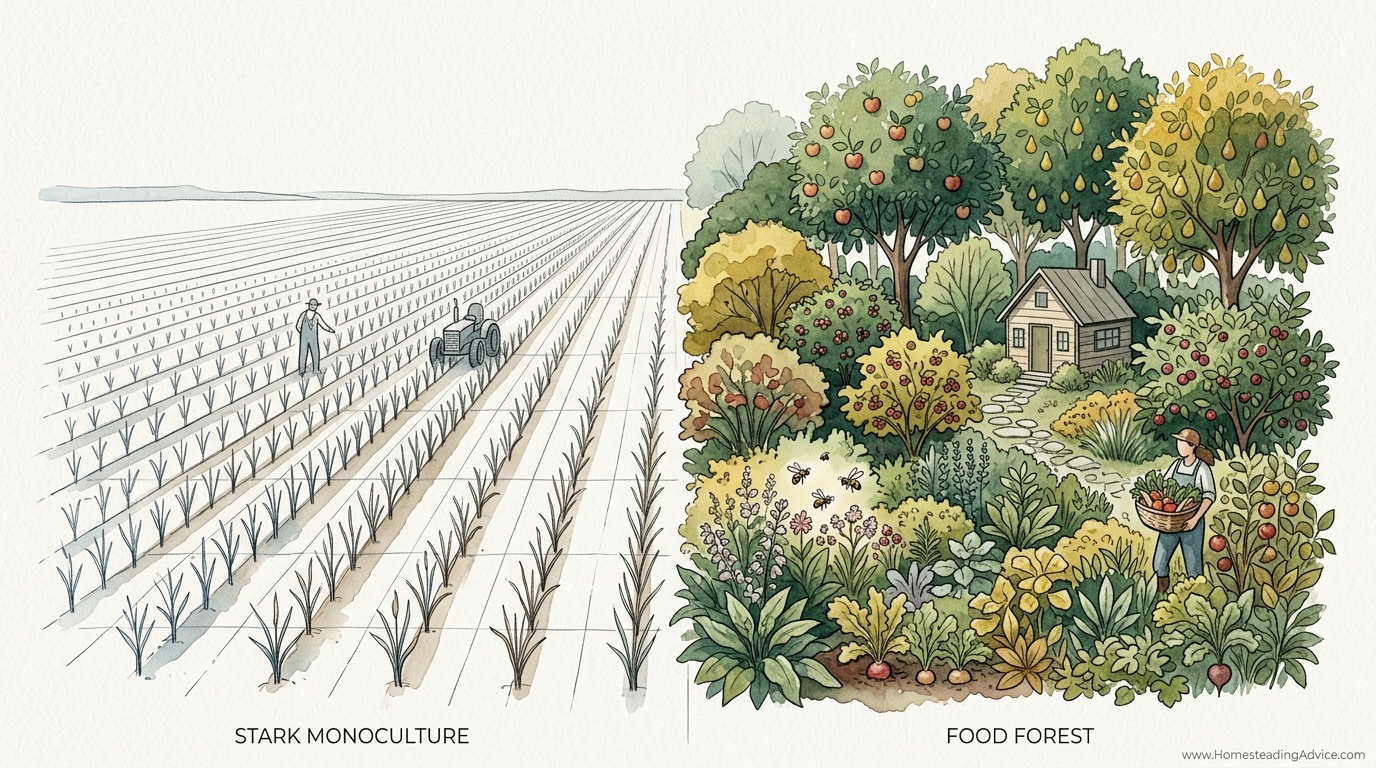
A standard orchard harvests once a year; a food forest harvests something every week. Why settle for one crop when you can have five on the same square footage? By mimicking a natural forest, you can harvest nuts from the canopy, fruit from the mid-story, berries from the shrubs, and medicinal herbs from the ground. It’s not just more resilient; it’s a multi-stream revenue machine that works with nature instead of fighting it.
Designing an edible landscape is about more than just planting trees. It is about stacking functions and building an ecosystem that yields more than the sum of its parts. This approach moves away from the fragility of STARK MONOCULTURE and embraces the stability of DENSE POLYCULTURE. When you plant in layers, you aren’t just growing food; you are building a legacy that grows in value every season.
Food Forest Profit Strategy
A food forest profit strategy is a management system that treats a perennial garden like a high-yield investment portfolio. Instead of relying on a single harvest of corn or soy, a food forest owner diversifies across seven or more vertical layers. This approach is used in regenerative agriculture and permaculture to maximize calorie production per square foot (0.09 square meters) while minimizing the need for external inputs like synthetic fertilizers and heavy machinery.
In a traditional 0.8-hectare (approx. 2-acre) food forest model, the system is designed to provide fresh produce, value-added goods, and educational opportunities. Real-world case studies show that while initial setup costs can be significant—often around 10 lakhs (approx. $12,000 USD) per acre in some regions—annual revenue can exceed $10,000 USD per acre once the system matures [1.1.7].
The strategy exists to solve the problem of agricultural exhaustion. Modern industrial farming relies on “mining” the soil. A food forest “builds” it. It operates on the principle of biological synergy, where a nitrogen-fixing tree supports a fruit tree, which in turn provides shade for medicinal herbs. This reduces the farmer’s overhead by letting nature handle pest control and fertilization.
The Seven Layers of Abundance
To turn a patch of dirt into a profit-generating ecosystem, you must understand the architecture of a forest. Each layer represents a different niche in the sunlight and soil spectrum.
1. The Overstory (Canopy Layer)
This layer consists of large trees reaching 30 to 60 feet (9 to 18 meters) or more. In temperate climates, these are often nut trees like Black Walnut or Chinese Chestnut. A single farm in Ohio recently transitioned 650 acres to chestnuts, planting 51,000 trees to capture this long-term revenue stream [1.1.6]. These trees provide the “bones” of the system, acting as windbreaks and nutrient anchors.
2. The Understory (Sub-Canopy Layer)
Medium-sized trees ranging from 10 to 30 feet (3 to 9 meters) occupy this space. This is where your primary fruit production lives—apples, pears, peaches, and plums. In tropical climates, papayas are a powerhouse here, with each plant capable of yielding 30 to 50 kilograms (66 to 110 pounds) of fruit annually [1.2.7].
3. The Shrub Layer
Berries and woody perennials thrive here, growing between 3 and 15 feet (1 to 4.5 meters). Blueberries, currants, and elderberries are the stars of this layer. Elderberries, in particular, are prized for value-added products like syrups and tinctures, which command high prices at farmers’ markets [1.6.3].
4. The Herbaceous Layer
Non-woody plants like comfrey, yarrow, and perennial vegetables fill the gaps. Comfrey is a “dynamic accumulator,” reaching deep into the subsoil with its taproot to pull up minerals. When the leaves are chopped and dropped, they fertilize the upper layers for free.
5. The Rhizosphere (Root Layer)
Underground crops like ginger, turmeric, and garlic provide a hidden harvest. These crops are often high-value and can be tucked into the root zones of larger trees without competing for space.
6. The Soil Surface (Ground Cover Layer)
Living mulches like strawberries and clover protect the soil from erosion and moisture loss. Clover acts as a nitrogen fixer, pulling nutrients from the air and depositing them into the soil through its roots.
7. The Vertical Layer (Vines)
Grapes, kiwi, and passionfruit climb the trunks of the canopy trees. This utilizes vertical space that would otherwise go to waste, essentially giving you an extra crop on the same footprint.
How to Design and Implement Your Food Forest
Planning a food forest requires more patience than a standard garden but pays off in lower maintenance down the line. Follow these steps to ensure your system is built for both biology and business.
Site Analysis and Water Management
Observation is your first tool. Spend time on your land to see where water pools and where the sun hits longest. Establishing swales—level trenches dug on the contour of a hill—can catch and hold thousands of gallons of rainwater, hydrating your trees during dry spells without a pump.
The Guild Building Process
Never plant a tree alone. Surround your “anchor” fruit tree with a “guild” of supporting plants. A classic apple tree guild might include chives (to repel pests), comfrey (to build soil), and clover (to provide nitrogen). This community-based planting reduces the need for weeding and spraying.
Phased Implementation
Do not try to plant all seven layers at once. Start with the canopy and sub-canopy “anchor” trees first. As they establish, add the shrubs and ground covers. This staggered approach spreads out your labor and capital costs. Over a four to seven-year period, the system will begin to “stack” itself into a self-sustaining whole [1.2.2].
Revenue Streams: Diversifying Your Income
Profit in a food forest doesn’t just come from selling raw fruit. To make the system truly viable, you must think like an entrepreneur.
Fresh Produce and CSAs: Weekly boxes of diverse fruits, nuts, and greens provide steady cash flow. Unlike monoculture farms that have one massive harvest, a food forest offers variety throughout the season.
Value-Added Products: Turn surplus berries into jams or chestnuts into flour. Processing your harvest on-site increases your profit margins significantly. For example, dried medicinal herbs can sell for five times the price of fresh ones.
Nursery Sales: As your forest grows, you will have an abundance of cuttings, seeds, and “pups.” Selling these plants to other aspiring forest gardeners is a high-margin revenue stream that requires little more than some pots and potting soil.
Education and Agri-Tourism: Many successful food foresters generate 30% or more of their income from workshops, tours, and consulting [1.1.1]. People are hungry for the knowledge of how to grow their own food, and your forest becomes your best classroom.
Benefits of the Food Forest Model
Choosing a polyculture over a monoculture offers several practical advantages that improve the bottom line over time.
Resilience to Climate Extremes: Because the soil is always covered and the trees provide a cooling microclimate, food forests are more resistant to drought and heatwaves. Studies show that mature food forests can be several degrees cooler than the surrounding open fields [1.1.8].
Low Input Costs: Once established, a food forest requires no tilling, no synthetic fertilizers, and very little irrigation. The “waste” from one layer becomes the “food” for another, closing the nutrient loop.
Increased Biodiversity: A diverse system attracts beneficial insects that manage pests naturally. You won’t need to spend money on expensive chemical sprays when the ladybugs and predatory wasps are doing the work for you.
Challenges and Common Mistakes
While the rewards are high, many beginners stumble because they underestimate the complexity of a living system.
Overcrowding: One of the most frequent errors is planting trees too close together. While you want density, plants still need airflow and light. Follow the mature-width guidelines for your trees—a 20-foot (6-meter) wide apple tree needs its space, even when it is a small sapling.
Lack of Harvest Access: If you plant a dense thicket of shrubs, you might find it impossible to reach the fruit in the middle. Design “keyhole” paths or wide alleys to ensure you can get your harvest out without trampling the ground covers [1.3.3].
Underestimating Labor in the Early Years: A food forest is “low maintenance” only after the first three to five years. In the beginning, you will spend considerable time mulching, weeding, and protecting young trees from deer and rodents.
Limitations and Realistic Expectations
A food forest is not a “get rich quick” scheme. It is a slow-burn investment in the health of the land.
Delayed ROI: It can take five to ten years for nut trees to reach commercial production levels [1.6.2]. If you need immediate income to pay a mortgage, you will need to intercrop with annual vegetables or mushrooms in the early years to bridge the gap.
Market Immatureness: Selling 500 pounds (226 kilograms) of “standard” apples is easy. Selling 500 pounds of pawpaws or medlars requires educating your customer base. You must be willing to market your unique crops.
Land Access: Because trees are permanent, you need long-term security. A food forest on a short-term lease is a recipe for heartbreak.
Monoculture vs. Dense Polyculture
| Feature | STARK MONOCULTURE | DENSE POLYCULTURE |
|---|---|---|
| Species Diversity | One species over hundreds of acres. | 15 to 30+ species per quarter acre (1,000 m²) [1.2.2]. |
| Maintenance | High (Tilling, spraying, fertilizing). | Low (Mulching, pruning, observation). |
| Harvest Cycle | One large harvest per year. | Staggered harvests from spring to late fall. |
| Risk Level | High (One pest can wipe out the crop). | Low (Diversity provides a “biological insurance”). |
| Input Efficiency | Machine-heavy, high fossil fuel use. | Biology-heavy, human/animal-scale. |
Practical Tips for Success
Start small and expand as you learn the rhythms of your land. A well-managed quarter-acre (1,000 square meters) will yield more than a neglected ten-acre plot.
- Use “Support Species” First: Plant fast-growing nitrogen fixers like Alder or Acacia to provide “nurse shade” for your delicate fruit trees. You can chop these back once the fruit trees are established.
- Focus on the Soil Food Web: Inoculate your mulch with edible mushrooms like Wine Cap (Stropharia rugosoannulata). They break down the wood chips faster and provide a gourmet crop in the process.
- Label Everything: It is easy to forget which variety of pear you planted five years ago. Use permanent metal tags to keep your “inventory” organized for future sales.
- Mulch Heavily: Apply at least 4 to 6 inches (10 to 15 centimeters) of wood chips or straw around young trees. This suppresses grass, which is the main competitor for a tree’s nutrients [1.5.5].
Advanced Considerations: Syntropic Farming
For those looking to scale, look into “Syntropic Farming.” This method uses heavy pruning and high-density planting to accelerate forest succession. By aggressively pruning the canopy and using the biomass to mulch the floor, you mimic the natural “disturbance” that triggers rapid growth in a forest. This requires more labor but can significantly shorten the time it takes for your forest to reach peak productivity.
Genetics also matter. Choose cultivars that are bred for your specific region and disease resistance. An heirloom apple might taste wonderful, but if it requires weekly spraying to survive your local pests, it will eat into your profits.
Example Scenario: The 1-Acre Revenue Model
Imagine a one-acre (approx. 0.4-hectare) plot divided into managed rows. The overstory features 30 Chestnut trees. Between them, 60 semi-dwarf Apple and Pear trees provide the mid-story. Underneath, 200 Elderberry and Currant shrubs line the rows.
In the early years, the floor is planted with high-value Garlic and Medicinal Herbs like Goldenseal ($30-$50 per pound dried). By year seven, the chestnuts begin to drop, providing a high-calorie staple crop. Value-added sales of chestnut flour and elderberry syrup, combined with a small on-site nursery and weekend pruning workshops, create a resilient, multi-layered income that grossed over $15,000 last season.
Final Thoughts
Building a food forest is an act of defiance against the fragile, chemical-dependent systems of the modern world. It is a return to a way of life that values long-term stability over short-term gain. By working with the layers of the forest, you create a system that feeds you, your family, and your community while restoring the earth.
The most important step is the first one. You don’t need a thousand trees to start; you just need one. Plant it today, surround it with friends, and watch as your “multi-stream revenue machine” begins to grow, one leaf at a time. The wisdom of the ancestors was never lost; it was just waiting for us to pick up the shovel again.