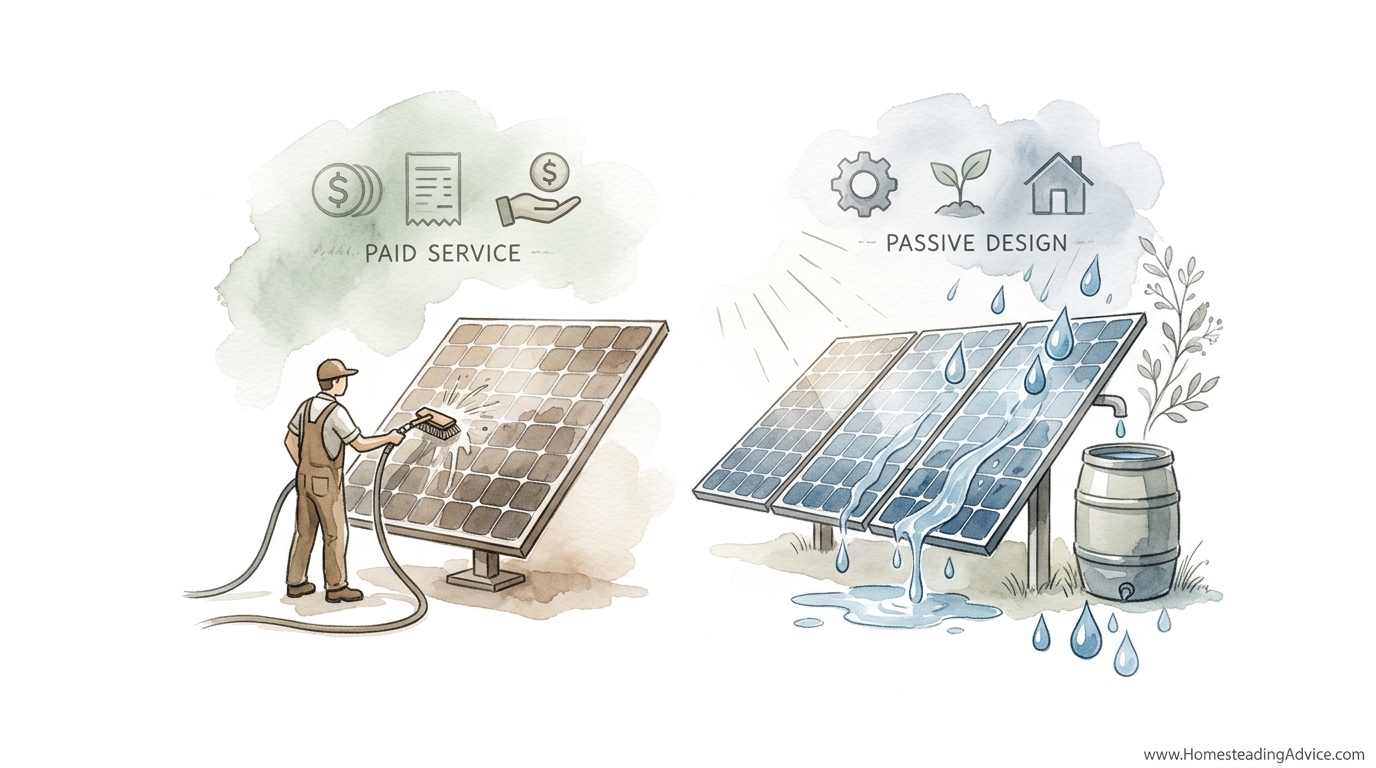
You are losing 20% of your power to simple dust, but you don’t need a $300 cleaning crew to get it back. Most homeowners are told they need professional cleaning every six months. In reality, a simple shift in how you mount your panels and a one-time coating can let gravity and the weather do the work for you. Stop paying for labor and start using physics.
The solar industry has a dirty little secret that most installers won’t tell you during the sales pitch. While they promise decades of “maintenance-free” energy, the reality of the outdoors is far less forgiving. Pollen, soot from nearby highways, desert sand, and bird droppings act like a heavy curtain drawn across your windows to the sun. This layer of grime, known in the industry as soiling, can slash your energy production by anywhere from 10% to 30% in a matter of months.
Many folks react to this drop in power by reaching for their wallets. They sign up for subscription cleaning services or buy expensive motorized brushes. But if you look at how the old-timers managed their homesteads, you’ll find a different approach. They didn’t fight nature; they designed their systems to let nature do the chores. By understanding how water, wind, and gravity interact with glass, you can create a setup that stays clean without you ever lifting a finger or a checkbook.
This guide isn’t just about saving a few bucks. It is about self-reliance. It is about building a system that is as resilient as the spirit that led you to go solar in the first place. Whether you are dealing with the sticky salt air of the coast or the fine silt of the plains, there is a passive design solution that will keep your meters spinning at full tilt for the cost of exactly zero dollars in ongoing labor.
How To Clean Solar Panels For Free
Cleaning solar panels for free is not about finding a “hack” or a secret soap recipe. It is about implementing passive maintenance strategies that rely on the environment to remove debris. This concept is rooted in the principle of self-cleaning design. Instead of viewing rain or wind as an annoyance, we view them as the labor force. When a system is designed correctly, every storm becomes a high-pressure wash, and every breeze becomes a leaf blower.
The primary tool for free cleaning is the earth’s gravity. When solar panels are mounted at a flat or very shallow angle, water pools on the surface. As that water evaporates, it leaves behind a concentrated ring of mineral deposits and dirt. Over time, this creates a “cementation” effect where the dust is literally baked onto the glass. To clean for free, you must eliminate the conditions that allow this cementation to occur. This means ensuring your panels have enough of a tilt that gravity pulls the water and the dirt off the edge before the sun has a chance to bake it on.
In real-world terms, this approach is used by large-scale solar farms in remote areas where sending a human crew is too expensive. They rely on specific coatings and optimized tilt angles to keep the glass clear. For a homeowner, this means moving away from the idea of “maintenance” as an action you perform and toward “design” as a state you maintain. If your panels are currently flat or poorly positioned, a one-time adjustment can grant you a lifetime of free cleaning.
The Physics of Passive Cleaning: Tilt and Rain
If you want the weather to work for you, you have to give it the right workspace. The most common reason people lose power to dirt is a shallow mounting angle. Research from the Clean Energy Council and various renewable energy laboratories suggests that a minimum tilt of 10 degrees is required to facilitate any kind of self-cleaning by rainfall. However, if you really want to see results, aim for a tilt of 15 degrees or more.
At 15 degrees (about 26 centimeters of rise for every meter of width, or 3 inches of rise for every foot), rainwater has enough velocity to carry away medium-sized particles like pollen and light dust. When the rain hits the top of the panel, it forms a sheet that moves downward. If the panel is too flat, that sheet of water moves slowly, allowing the dirt to settle into the microscopic imperfections of the glass. At a steeper angle, the water stays in a high-energy state, scrubbing the surface as it descends.
Consider the difference between a paved driveway and a steep mountain road during a storm. The driveway might have puddles where silt collects, but the mountain road stays clear because the water never stops moving. Your solar panels should be the mountain road. If you are currently at a 5-degree tilt because you wanted to fit more panels on a flat roof, you are essentially creating a silt pond. Raising those panels just a few inches can increase your annual yield by 5% to 10% simply by letting the rain do its job.
The Problem of the Frame Lip
Even with a good tilt, many panels have an aluminum frame that sits slightly higher than the glass. This creates a tiny dam at the bottom edge. Water gathers there, and as it dries, it leaves a “mud line” along the bottom row of solar cells. Since solar cells are often wired in series, a mud line covering just the bottom inch of the panel can choke the performance of the entire unit.
To solve this for free, you can install simple “drainage clips.” These are small plastic or metal pieces that snap onto the bottom frame. They use capillary action to “pull” the water over the edge of the frame, preventing the puddle from forming in the first place. While the clips might cost a few dollars once, they ensure that the “free labor” provided by the rain isn’t stopped by a millimeter-thick piece of aluminum.
Self-Cleaning Coatings: The One-Time Investment
While the goal is to clean for free, sometimes a small upfront adjustment acts as a force multiplier for nature. Self-cleaning coatings are the most effective way to help your panels stay clear in environments where rain is infrequent. There are two main types of technology here: hydrophobic and hydrophilic. Both work by changing how water interacts with the glass, but they do it in opposite ways.
Hydrophobic coatings work like the wax on a car. They make water “bead up.” When a raindrop hits a hydrophobic-treated solar panel, it forms a tight sphere and rolls down the glass. As it rolls, it picks up dust particles like a tiny snowball. This is known as the “Lotus Effect,” named after the lotus leaf which stays clean in muddy waters using this exact mechanism. This is ideal for regions with occasional light rain, as every single drop becomes a cleaning tool.
Hydrophilic coatings, on the other hand, love water. They make the water spread out into a thin, uniform sheet. This sheet of water goes under the dirt and lifts it off the surface, allowing it to be washed away easily. Many high-end panels now come with a factory-applied hydrophilic layer of Titanium Dioxide (TiO2). This material also reacts with sunlight to break down organic matter like bird droppings or tree sap, making them easier for the next rain to rinse away.
Applying a nanocoating yourself can be done for a fraction of the cost of a single professional cleaning. Once applied, these coatings typically last between two and five years. During that time, the panels will stay 90% as clean as a freshly scrubbed panel, with zero manual intervention required.
Benefits of a Passive Cleaning Strategy
Choosing a passive, design-focused cleaning strategy over a manual service offers more than just financial savings. It fundamentally changes your relationship with your energy system. When you don’t have to worry about the cost or the scheduling of a cleaning crew, you can focus on the performance of the system itself.
- Reduced Risk of Damage: Every time a human steps on your roof or drags a brush across your panels, there is a risk of micro-cracks. These tiny fractures in the silicon cells are invisible to the eye but create “dead zones” that permanently reduce efficiency. Passive cleaning involves no physical contact, preserving the integrity of the cells.
- Consistent Performance: A professional cleaning might happen twice a year. In between those visits, your efficiency is slowly declining. A passive system cleans every time it rains, meaning your “average” efficiency throughout the year is often higher than a system that is cleaned manually on a long cycle.
- Water Conservation: Manual cleaning often requires significant amounts of water, sometimes up to 20 liters (5 gallons) per panel. In drought-prone areas, this is a heavy environmental cost. Passive design uses the water that is already falling from the sky.
- Safety: Rooftops are dangerous places. Falls are one of the leading causes of home maintenance injuries. By setting up your system to be self-cleaning, you keep yourself and others off the ladder.
Challenges and Common Mistakes
The biggest challenge to cleaning for free is “cementation.” This happens when dust is allowed to sit on a panel during a high-humidity night. The moisture in the air mixes with the dust to create a paste. When the sun comes up, it bakes that paste into a hard crust. If you live in an area with high humidity but low rainfall, like parts of the Central Valley in California or the Australian Outback, gravity alone might not be enough.
One common mistake is relying on a standard garden hose to “help” the process. Most tap water is “hard,” meaning it contains minerals like calcium and magnesium. When you spray your panels with a hose and let them air dry, you are essentially trading a layer of dust for a layer of limescale. This scale is much harder to remove than dust and can eventually etch the glass, permanently reducing its transparency.
Another mistake is cleaning the panels during the middle of the day. Solar glass gets incredibly hot under the sun, often reaching temperatures above 65°C (150°F). If you hit that hot glass with cool water—even rainwater—the thermal shock can cause the glass to shatter or create micro-cracks in the cells. Always let nature (or your manual intervention) do its work in the early morning or late evening when the glass is cool.
Limitations of Passive Cleaning
Passive cleaning has its boundaries. It is not a magic solution for every environment. If your home is located directly under a flight path, near a major freeway, or downwind from a heavy industrial site, you are dealing with “oily” soiling. The soot from jet engines and diesel trucks contains hydrocarbons that act like glue. Rainwater, even at a 15-degree tilt, struggle to break the chemical bond between oil and glass.
In these scenarios, a passive design will still help, but it may only keep you at 85% efficiency instead of 95%. You might find that once every year or two, a deeper cleaning is required to strip away the oily film. However, the passive measures you’ve taken will still save you thousands of dollars over the system’s life by extending the time between those deep cleans.
Environmental constraints also include extreme droughts. If you go six months without a single drop of rain, no amount of tilt will keep the panels clean. In these regions, “free” cleaning might involve a simple DIY gravity-fed system that uses stored rainwater, which we will discuss in the advanced section below.
Comparison: Passive Design vs. Paid Cleaning Service
| Factor | Passive Design (Free) | Paid Cleaning Service |
|---|---|---|
| Ongoing Cost | $0 | $200 – $500 per visit |
| Frequency | Every time it rains/winds | Bi-annually (typical) |
| Labor Level | Zero labor after setup | High (hiring/scheduling) |
| Efficiency Curve | Steady, minor fluctuations | Saw-tooth (peaks after clean) |
| Risk of Damage | Very Low | Moderate (human error) |
Practical Tips for Maintaining Efficiency
If you are ready to implement a free cleaning strategy, start with these actionable steps. These are the “best practices” that separate a high-performing DIY system from one that struggles.
- Monitor Your Output: You can’t manage what you don’t measure. Use your inverter’s app to track daily production. If you notice a gradual 10% dip over a sunny month with no rain, you know the dust is winning.
- Bird-Proof the Perimeter: Bird droppings are the most aggressive form of soiling because they are acidic and opaque. Installing “bird blockers” (a mesh that goes around the gap between the roof and the panel) prevents birds from nesting underneath. If they aren’t nesting there, they aren’t pooping there.
- Trim Back Overhanging Branches: Sap and bird activity are both concentrated under trees. Keeping a 3-meter (10-foot) clearance between branches and panels will significantly reduce the “stickiness” of the debris on your glass.
- Use Deionized Water for Spot Checks: If you absolutely must rinse a stubborn spot, use deionized or distilled water. You can often collect this for free from the drain line of your air conditioning unit or a dehumidifier. This water has no minerals and won’t leave spots.
Advanced Considerations: The DIY Rain-Harvest Rinse
For those who want to take self-reliance to the next level, you can build a passive rinsing system using simple plumbing and gravity. This is particularly useful in “dry-dust” climates where it doesn’t rain often, but you have a barn or shed with a roof. By mounting a rain barrel higher than your solar panels, you can store water from the rare storms and use it during the dry weeks.
A simple 1/2-inch PVC pipe run along the top of your solar array with small “sprinkler” holes drilled every 15 centimeters (6 inches) acts as a wash bar. Connect this to your elevated rain barrel with a simple manual valve. Once a week, during the cool of the morning, open the valve for 60 seconds. Gravity will push the stored rainwater through the pipe, creating a gentle sheet of water that rinses away the week’s dust. Since it is rainwater, there are no minerals to worry about, and since it is gravity-fed, there are no pumps or electricity costs.
This system mimics the expensive “automatic wash” systems used on commercial buildings but costs less than $50 in parts from a local hardware store. It turns the “Passive Design” philosophy into an “Automated Passive” system, giving you the ultimate control over your energy production without the recurring expense of a service contract.
Example Scenario: Desert vs. Coastal
Let’s look at how this works in practice. Imagine two homeowners: Sarah in the Arizona desert and Jack on the coast of Oregon. Sarah deals with fine dust and no rain for months. If she mounts her panels flat, she will lose 25% of her power by mid-summer. By mounting them at 20 degrees and using a hydrophobic coating, the dust doesn’t “stick.” It sits loosely on the surface. When the afternoon wind kicks up, it actually blows a significant portion of the dust off. Her “free” cleaning comes from the wind, enabled by the steep tilt.
Jack, on the other hand, has plenty of rain but deals with salt spray and moss. For Jack, the 15-degree tilt is mandatory to ensure the salt doesn’t crust. He uses a hydrophilic coating, which allows the frequent Oregon mist to form a sheet that constantly bathes the panels, preventing moss from getting a foothold in the corners. Jack hasn’t touched a brush in five years, yet his panels look brand new. Both homeowners are using physics to bypass a $300 labor charge.
Final Thoughts
The transition to solar energy is often sold as a high-tech solution, but the secret to keeping it running efficiently is decidedly low-tech. We have spent decades trying to engineer complex machines to solve problems that gravity and a bit of rainwater can handle for free. By shifting your focus from “how do I clean this?” to “how do I keep this from getting dirty?”, you reclaim both your time and your money.
A well-tilted panel, a thoughtful coating, and a simple bird deterrent are the hallmarks of a system built for the long haul. This approach reflects a broader wisdom: true efficiency doesn’t come from working harder or spending more; it comes from aligning your life with the natural forces already at play. Start by checking your tilt, and let the next rainstorm be your last “cleaning crew.”
As you master the art of passive maintenance, you might find other areas of your home where the same principles apply. From rainwater harvesting to passive solar heating, the path to self-sufficiency is paved with the understanding that nature is not an obstacle to be overcome, but a partner to be engaged.