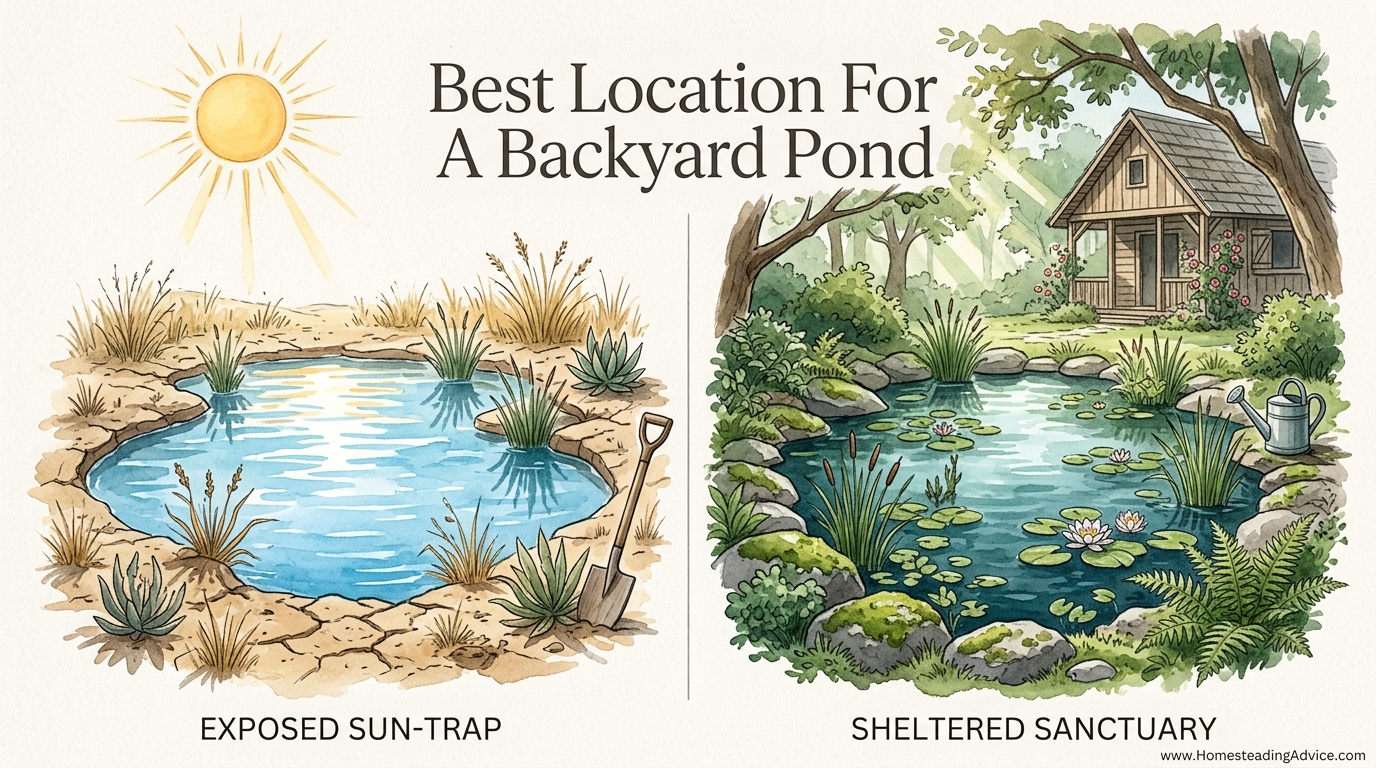
Location is the difference between a thriving oasis and a stagnant mud hole. The biggest mistake in pond building is putting it where the sun can bake it all day. A sheltered pond stays 10 degrees cooler, holds more oxygen, and naturally suppresses algae without you lifting a finger. Choosing the right spot is not just about where the water looks best from your porch; it is about working with the land’s natural rhythm to create a self-sustaining ecosystem.
Building a pond is an act of stewardship. You are carving out a permanent home for living things, and like any home, the foundation and surroundings determine its longevity. If you place your pond in a high-traffic area with poor drainage or under the relentless glare of the midday sun, you are signing up for years of scrubbing rocks and pouring in chemicals. If you tuck it into a sheltered sanctuary, you are letting nature do the heavy lifting for you.
Best Location For A Backyard Pond
The best location for a backyard pond is a spot that receives four to six hours of sunlight, stays protected from heavy wind, and sits on high enough ground to avoid polluted runoff. It exists at the intersection of practical accessibility and biological stability. In the real world, this means finding a balance between the needs of your aquatic plants, the health of your fish, and the convenience of maintenance.
Most people assume a pond belongs at the lowest point of the yard because that is where water naturally gathers. This is a trap. The lowest point is where every drop of rain carries lawn fertilizers, pesticides, and silt. A properly sited pond should be slightly elevated or protected by a berm to ensure only the water you want enters the system. It should also be close enough to your home to be enjoyed and monitored, yet far enough from utility lines and invasive root systems to remain structurally sound for decades.
How to Site Your Pond: The Four-Pillar Method
Selecting a site requires more than just a quick glance at the grass. You must observe the land through the seasons and the hours of the day. Using the four-pillar method—Sun, Soil, Safety, and Sight—helps ensure the location is viable for the long haul.
Sun Exposure and Thermal Management
Sunlight is the engine of your pond, but too much fuel causes an explosion of algae. Most flowering water plants, such as the hardy water lily, require at least 6 hours of direct sun to bloom properly. However, water that sits in the sun all day can reach temperatures that are dangerous for fish. Warm water holds significantly less dissolved oxygen than cool water; for example, water in the 40s°F (4-9°C) carries nearly 60% more oxygen than water in the upper 80s°F (27-32°C).
Soil and Topography
Examine the slope of your yard. You want a level area or one that can be easily leveled. Digging into a steep hill requires retaining walls and complex drainage. Furthermore, the soil type matters if you are considering a natural clay-bottom pond, though most backyard enthusiasts will use an EPDM or RPE liner. Avoid areas with “muck” or high water tables, as these can cause “hippoing,” where groundwater gets trapped under your liner and pushes it upward.
Safety and Utilities
Before you break ground, you must know what lies beneath. Contact local utility services to mark gas, water, and electrical lines. A puncture in a main line is a costly and dangerous mistake. Additionally, consider the proximity to an outdoor GFCI outlet. Running long extension cords is neither safe nor efficient for powering pumps and aerators.
Line of Sight
A pond is a visual masterpiece. It should be visible from the areas where you spend the most time, such as a kitchen window or a back deck. If you tuck it away in a far corner of the property, you will miss the early warning signs of a leak or a predator, and you won’t get the stress-relieving benefits of watching the water.
The Vital Link: Sunlight, Temperature, and Oxygen
Understanding the physics of water is essential for successful siting. Sunlight does not just illuminate the pond; it penetrates the surface and heats the water column. In a shallow pond—anything less than 24 inches (60 cm) deep—the entire volume can heat up rapidly. This creates a “sun-trap” effect where the water becomes a breeding ground for single-celled algae, often called “green water” or “pea soup.”
The primary danger of high temperatures is the loss of dissolved oxygen. Fish like koi and goldfish are resilient, but they begin to show signs of stress when dissolved oxygen levels drop below 4 mg/L. During a heatwave, a pond in full sun can experience a “nighttime oxygen crash.” This happens because plants and algae, which produce oxygen during the day via photosynthesis, switch to consuming oxygen at night. If the water is already warm and oxygen-depleted, the fish may not survive until morning.
A sheltered sanctuary uses natural or man-made shade to mitigate this risk. By placing the pond where it receives morning sun but afternoon shade, you provide enough light for plants while keeping the water’s peak temperature manageable. This stability is the secret to a crystal-clear pond that requires minimal intervention.
Navigating Trees: Friends or Foes?
One of the most debated topics in pond building is whether to site a pond near trees. While trees provide the “sheltered sanctuary” effect by offering shade and protection from the wind, they also bring challenges.
The Case for Siting Near Trees
Trees act as natural umbrellas. They hide the reflection of the water from aerial predators like herons and owls, making your fish feel more secure. Shaded ponds naturally stay cooler and have fewer algae blooms. Additionally, tree roots that grow near the water can help stabilize the surrounding soil, and the aesthetic of a pond framed by old-growth branches is unmatched.
The Case Against Siting Near Trees
The most obvious downside is leaf litter. Decaying organic matter in the bottom of a pond consumes oxygen and releases gases that can be toxic to fish in high concentrations. Furthermore, certain trees are more troublesome than others. Silver Maples and Willows have aggressive, “water-seeking” roots that can travel long distances to find a leak. While roots rarely pierce a healthy rubber liner, they can buckle the soil beneath it or pry open plumbing fittings.
If you choose to site near a tree, try to stay outside the “drip line” (the outermost circumference of the branches). Use a high-quality skimmer or an intake bay to catch falling leaves before they sink to the bottom. This allows you to enjoy the shade without the headache of constant manual cleaning.
Benefits of a Sheltered Sanctuary
Choosing a sheltered, well-thought-out location provides measurable advantages over a randomly placed “sun-trap” pond.
- Reduced Evaporation: A pond in the shade loses significantly less water to the atmosphere, saving you money on water bills and keeping the water chemistry more stable.
- Natural Algae Suppression: Without excessive sunlight to fuel photosynthesis, algae struggles to take over, meaning you spend less on UV clarifiers and algaecides.
- Fish Longevity: Lower temperatures and higher oxygen levels reduce the metabolic stress on fish, leading to faster growth and more vibrant colors.
- Aesthetic Integration: A pond tucked into a sheltered corner often looks like it has been there for a century, blending seamlessly with the landscape rather than looking like an after-thought in the middle of a lawn.
Challenges and Common Siting Pitfalls
Even with the best intentions, certain environmental factors can ruin a pond location.
The “Bottom of the Bowl” Mistake: As mentioned previously, placing a pond at the lowest point of a yard is the most common error. When a heavy rain hits, the pond becomes a collection basin for everything on your lawn. This includes toxic lawn chemicals and debris that can clog filters in minutes. Always ensure the edges of the pond are at least 2 to 3 inches (5-8 cm) higher than the surrounding soil.
Ignoring Wind Exposure: A pond placed in a wind tunnel will lose water to evaporation much faster. Wind also blows debris into the water and can interfere with the spray pattern of fountains or the efficiency of surface skimmers. Using a fence, hedge, or the house itself as a windbreak is a wise move.
Underestimating Size: Many beginners choose a small spot because it seems easier to manage. In reality, larger bodies of water are more stable. A 1,000-gallon (3,785-liter) pond is much harder to “mess up” than a 100-gallon (378-liter) pre-formed tub. Ensure your chosen location has enough room for a pond that is at least 8 by 11 feet (2.4 by 3.3 meters) if you plan on keeping koi.
Limitations: When Perfect Placement Isn’t Possible
Not every yard has the perfect mix of morning sun and afternoon shade. If you are forced to build in a less-than-ideal spot, you must compensate with technology or design changes.
If You Must Build in Full Sun: You will need to increase the depth. A pond in full sun should be at least 3 to 4 feet (90-120 cm) deep. This provides a “cool zone” at the bottom where fish can retreat during the hottest part of the day. You should also aim for 50% to 60% surface coverage with floating plants like water lilies or water lettuce to provide artificial shade.
If You Must Build in Full Shade: You will be limited in your plant choices. Most lilies will not bloom without sun. Instead, focus on “marginal” plants that thrive in low light, such as Creeping Jenny, Variegated Sweet Flag, or certain types of ferns. You will also need to be more diligent about removing leaves, as there won’t be as much biological activity from sun-loving bacteria to break them down.
Technical Comparison: Sun-Trap vs. Sheltered Sanctuary
| Feature | Exposed Sun-Trap | Sheltered Sanctuary |
|---|---|---|
| Average Temp | Higher (75°F – 85°F / 24°C – 29°C) | Lower (65°F – 75°F / 18°C – 24°C) |
| Algae Growth | High / Rapid | Low / Natural Suppression |
| Oxygen Levels | Low / Fluctuating | High / Stable |
| Maintenance | Frequent (Chemicals/Scrubbing) | Minimal (Occasional Skimming) |
| Fish Health | High Stress Potential | Optimal Thrive Zone |
Practical Tips for Immediate Application
Before you pick up a shovel, perform these three tests to confirm your location is the best it can be.
- The Shadow Test: On a sunny day, place stakes at the corners of your proposed pond. Check the area at 9:00 AM, 12:00 PM, and 4:00 PM. Note where the shadows fall. If the area is in deep shade all morning and scorching sun all afternoon, you may want to shift it ten feet in either direction.
- The Hose Test: Lay out a garden hose in the shape of the pond. Leave it there for a few days. Walk around it, look at it from your windows, and see if it interrupts the natural flow of your yard. It is much easier to move a hose than a hole.
- The Drainage Test: During a rainstorm, go outside and watch the water move across your yard. If you see “rivers” of water flowing directly toward your proposed pond site, you must plan for a French drain or a diversion berm.
Advanced Considerations: Thermal Mass and Bog Filtration
For the serious practitioner, siting a pond is also about managing its “thermal mass.” Thermal mass refers to the ability of the pond to hold and regulate heat. A deeper pond with large underwater boulders has more thermal mass, meaning its temperature changes more slowly. This stability is vital for the beneficial bacteria that live in your filters.
When siting, consider adding a bog filter (also known as a wetland filter) at the pond’s edge. A bog filter is a shallow area filled with gravel and specific plants that act as a natural kidneys for the pond. Siting the bog in a sunny spot while keeping the main pond shaded is an advanced technique. The plants in the sun-drenched bog will grow aggressively, pulling nutrients like nitrates and phosphates out of the water, while the main pond stays cool and algae-free in the shade.
Furthermore, if you live in a region with extreme winters, such as Maine or the Upper Midwest (USA), your location must account for the frost line. A pond in a “sheltered” spot near the house may benefit from the heat radiating from the foundation, preventing the water from freezing solid to the bottom.
Example Scenario: The Urban Shade Pond
Consider a homeowner in a city with a small, 20×30 foot backyard. The yard is bordered by a tall wooden fence and a large oak tree. Most builders would avoid the oak tree, fearing the roots. However, by siting the pond 10 feet (3 meters) away from the trunk, using an intake bay to manage the leaves, and digging to a depth of 3 feet (90 cm), the homeowner creates a masterpiece.
Because the pond is sheltered by the fence and the tree, the water stays at a consistent 68°F (20°C) even in the height of July. The fish are active and healthy, and the lack of direct afternoon sun means the water stays clear without the use of expensive UV lights. The organic debris from the tree is managed by a weekly 5-minute cleaning of the intake bay, a small price to pay for the natural beauty of the setting.
Final Thoughts
Building a pond is a commitment to a living system. By choosing a location that emphasizes shelter over exposure, you are choosing a path of less resistance and greater reward. A pond that is properly sited will reward you with clear water, healthy fish, and a peaceful atmosphere that feels like a natural part of the earth.
Do not rush the planning phase. Spend time in your yard, watch the light, and respect the way water moves across the land. The wisdom of the past tells us that we cannot fight nature; we can only partner with it. A sheltered sanctuary is the ultimate expression of that partnership.
As you move forward, remember that every yard is unique. Use these principles as a guide, but trust your observations. Whether you are building a small wildlife pool or a sprawling koi habitat, the right location is the bedrock upon which your success will be built. Experiment with your plant choices, monitor your water temperatures, and enjoy the process of bringing a thriving oasis to life in your own backyard.