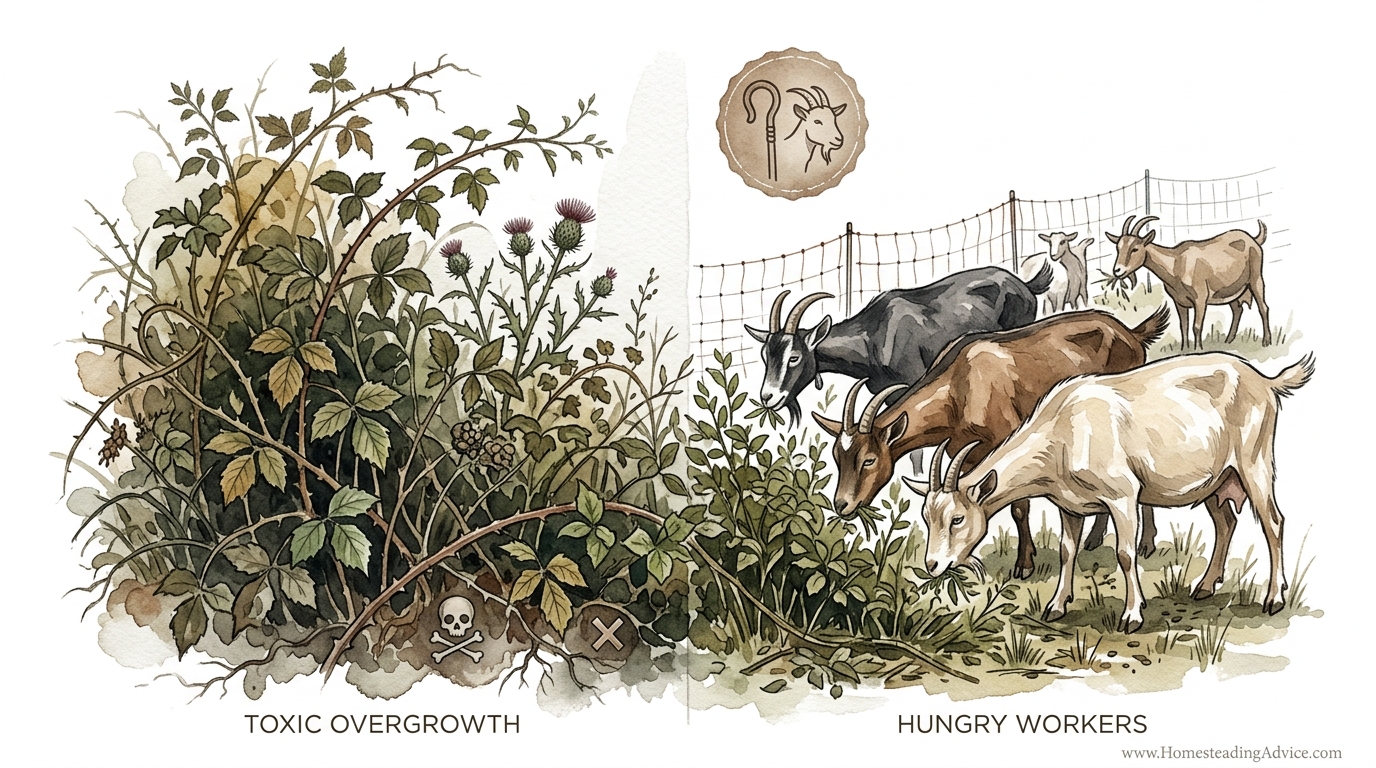
Your neighbor’s biggest landscaping nightmare is actually a free buffet for your most profitable employees. Forget herbicides and heavy machinery. People are lining up to pay for ‘goat power’ to clear their land. You get paid for the service, and your goats get a high-protein meal for free.
Starting a goat grazing business is about more than just owning a few animals. It is a return to an older way of managing the earth. You are providing a professional service that solves modern problems with ancestral solutions.
Landowners today are tired of toxic overgrowth and the roar of fossil-fueled mowers. They want a quiet, effective, and chemical-free way to reclaim their property. This guide will show you exactly how to turn a hungry herd into a thriving commercial operation.
How To Start A Goat Grazing Business
A goat grazing business is a professional service where a herd of goats is hired to clear unwanted vegetation. This practice is often called targeted grazing or goatscaping. It involves moving a specific number of animals to a property for a set period to achieve a clear landscape goal.
Goats are uniquely suited for this work because they are browsers rather than grazers. While a cow or sheep prefers to eat grass at ground level, a goat looks up. They prioritize brush, woody vines, and broadleaf weeds that mechanical mowers often struggle to reach.
This business exists because it solves the problem of invasive species and wildfire fuel without using poison. In places like California or the Mediterranean, goats are now essential workers for fire prevention. They can traverse 45-degree slopes and rocky ravines where no tractor could ever go safely.
You are not just a farmer in this role; you are a land manager. You will need to understand plant biology, animal behavior, and local logistics. Success depends on your ability to move your “employees” safely and ensure they are eating the right things at the right time.
How It Works: The Logistics of Goat Power
Operating a professional grazing service requires a system for transportation and containment. You cannot simply drop goats in a field and hope for the best. You must create a secure, temporary environment that keeps the goats in and predators out.
The first step is a site assessment. You need to identify the target plants and check for any vegetation that could be toxic to the herd. Measure the area in acres or square meters (1 acre is approximately 4,046 square meters).
Containment is usually handled with portable electric netting. Most professionals use 164-foot (50-meter) rolls of electronet that stand 42 inches (107 centimeters) high. These nets are supported by built-in posts and powered by a solar-charged energizer.
Water is the most critical daily resource. Goats need 1 to 3 gallons (3.8 to 11.4 liters) of water per day depending on the temperature and the moisture content of the plants they are eating. You will likely need to haul water to the site in a dedicated tank or trailer.
Choosing the Right Herd for the Job
Not every goat is cut out for the hard labor of land clearing. A delicate dairy goat might struggle with the thorns and thickets found on a commercial job site. You need hardy breeds that possess a strong “pioneer” constitution.
Spanish goats are a top choice for many professional grazers. These animals were shaped by the American landscape and are famous for their toughness and disease resistance. They have a high drive for browsing and can maintain their body condition on rough forage.
Kiko goats, originally from New Zealand, are another excellent option. They were bred for high growth rates and survivability without constant human intervention. Their feet are typically more resistant to rot in damp environments than other breeds.
Boer goats are often included in a grazing herd for their size and muscle. While they require a bit more management than a Spanish goat, their weight allows them to push down taller saplings. A mix of breeds often works best to ensure every level of vegetation is addressed.
Equipment and Startup Costs
Building a professional operation requires an initial investment in infrastructure. You need a way to move 20 to 50 goats at once. A stock trailer between 16 and 20 feet (4.8 to 6 meters) in length is the standard for most mid-sized operations.
Electric fencing will be your most frequent hands-on tool. Expect to pay between $150 and $200 per 164-foot (50-meter) roll of high-quality netting. A starter herd of 30 goats will typically require at least 10 to 15 rolls to create flexible paddocks.
Solar energizers must be powerful enough to push a charge through thick weeds. Look for units that offer at least 1 to 2 output joules. A weak fence is a dinner invitation for local coyotes or loose neighborhood dogs.
Startup costs for a small commercial herd can range from $10,000 to $30,000. This includes the purchase of the animals, a used stock trailer, fencing, and initial insurance premiums. Professional liability insurance is non-negotiable when working on client properties.
Benefits of Targeted Grazing
The most immediate benefit is the total lack of chemical residue. Herbicides can leach into the groundwater and harm local pollinators. Goats provide a biological solution that leaves the soil healthier than they found it.
Goat hooves act as natural aerators for the ground. As they move, they press organic matter and seeds into the soil, encouraging the return of native grasses. Their waste is a high-nitrogen fertilizer that is delivered in a slow-release form.
Machinery often leaves behind “ladder fuels” that can contribute to intense forest fires. Goats eat the low-hanging branches and tall brush, breaking the path a fire needs to climb into the tree canopy. This service is a life-saving tool for homeowners in fire-prone regions.
Noise pollution is also a factor in urban settings. A herd of goats is significantly quieter than a crew with chainsaws and brush hogs. Residents often enjoy watching the goats work, which provides a marketing boost for the landowner.
Challenges and Common Mistakes
Escaped goats are the fastest way to lose your professional reputation. Goats are intelligent and will test a fence for any weakness. If the solar battery dies or a branch falls on the line, the herd will find the exit.
Predators are a constant threat that must be taken seriously. Coyotes, bobcats, and domestic dogs can decimate a herd in a single night. Many professionals keep a Livestock Guardian Dog (LGD) like a Great Pyrenees or Anatolian Shepherd with the goats at all times.
Poor plant identification can lead to tragedy. Common ornamental plants like rhododendron, azalea, and yew are highly toxic to goats. Ingesting even a small amount can cause permanent damage or death within hours.
Undercharging for your time is a mistake many beginners make. You are not just selling goat appetite; you are selling the transport, the fencing labor, and the risk management. Factor in the time it takes to set up and tear down the site.
Limitations and Realistic Constraints
Goats are not a “one and done” solution for every property. Some invasive species, like certain types of thistle or mature trees, require multiple grazing passes over several years. You must manage client expectations regarding how the land will look immediately after the goats leave.
Weather can halt operations or make transport dangerous. Heavy rain can turn a job site into a mud pit, which is bad for the goats’ feet and the landowner’s soil. Extreme heat requires you to provide extra shade and massive amounts of water.
Regulatory hurdles can vary wildly between municipalities. Some cities have “livestock” bans that do not distinguish between a permanent farm and a temporary service. You may need to apply for temporary use permits or lobby for zoning changes.
The work is physically demanding and requires a high level of fitness. You will be hauling heavy water jugs and dragging fencing through thorns in the humidity. This is a lifestyle business that demands daily attention to animal welfare.
Goats vs. Traditional Methods
| Factor | Goat Grazing | Herbicides | Machinery |
|---|---|---|---|
| Environmental Impact | Positive; adds fertilizer and aerates. | Negative; chemical runoff risk. | Neutral to Negative; soil compaction. |
| Terrain Accessibility | Excellent; thrives on steep slopes. | Moderate; depends on spray reach. | Poor; limited to flat or low grades. |
| Residue Left Behind | None; seeds are usually sterilized. | Chemical markers on soil/plants. | Slash piles and wood chips. |
| Noise Level | Low; very quiet operation. | Low. | High; disrupts neighbors. |
Practical Tips and Best Practices
Always perform a “perimeter sweep” before setting up your fence. Look for old wire, trash, or holes that could trap a goat. Removing these hazards takes a few minutes but can save a goat’s life.
Develop a clear contract that outlines who is responsible for water and daily checks. Some owners enjoy checking the water troughs themselves, while others want a full-service experience. Having this in writing prevents misunderstandings.
Condition your goats to come to a specific sound, like a bell or a bucket of grain. This “call-back” training is vital if a fence ever fails. It allows you to lead the herd back to the trailer without the stress of a chase.
Monitor the “body condition score” of your goats regularly. Browsing on low-quality brush can be nutritionally taxing. You may need to provide supplemental minerals or hay during the winter months or between jobs.
Advanced Considerations: Scaling Up
Scaling your business often means moving from private residential lots to municipal or state contracts. These larger jobs might involve hundreds of goats clearing 50 acres (20 hectares) or more. You will need a more robust trailer and potentially H-2A visa employees for herding.
Municipalities often require specific insurance riders and proof of performance. Keeping detailed records of your “acres cleared per day” will help you bid accurately on these large projects. Data is your best friend when competing for high-value government work.
Collaborating with solar farms is a massive growth area for the industry. Solar companies need low-growing vegetation management that doesn’t kick up rocks or damage panels. Sheep are often preferred for the panels themselves, but goats are used for the perimeter brush.
Carbon credits and sustainability reporting are becoming relevant for land managers. Documenting the reduction in herbicide use and carbon emissions can make your service more attractive to corporate clients. You are selling a verifiable “green” solution.
Example Scenario: Clearing a Suburban Lot
Imagine a homeowner with a half-acre (0.2 hectare) backyard that has been overtaken by English Ivy and Himalayan Blackberry. The terrain is too steep for a mower and too close to a stream for chemical spray. This is a perfect scenario for a small goat grazing business.
You arrive with a 16-foot (4.8 meter) trailer holding 20 goats. You spend 45 minutes setting up 300 feet (91 meters) of electric netting and a solar energizer. You place a 50-gallon (190 liter) water trough in a shaded corner.
The goats strip the ivy and blackberry leaves within three days. They even eat the small woody stems, leaving the ground clear for the homeowner to plant native shrubs. You charge a flat fee of $600 for the project plus a $100 transport fee.
The homeowner is thrilled because the noise was minimal and their pets are safe to play in the yard immediately. You have provided a valuable service, fed your herd for free, and cleared a healthy profit for three days of work.
Final Thoughts
Building a goat grazing business is a journey back to a more sensible relationship with the land. You are leveraging the natural instincts of an animal to solve a problem that humans have struggled to manage with steel and poison. It is rewarding work that builds soil health and community resilience.
Success in this field requires a blend of animal husbandry and business savvy. You must be as comfortable negotiating a contract as you are trimming a goat’s hoof. If you treat your herd well and respect the land, the business will sustain you for years to come.
Start small and learn the language of your goats and your local flora. Every property you clear is a testament to the power of a simpler, more biological approach. There is plenty of work to be done, and the goats are ready to get started.