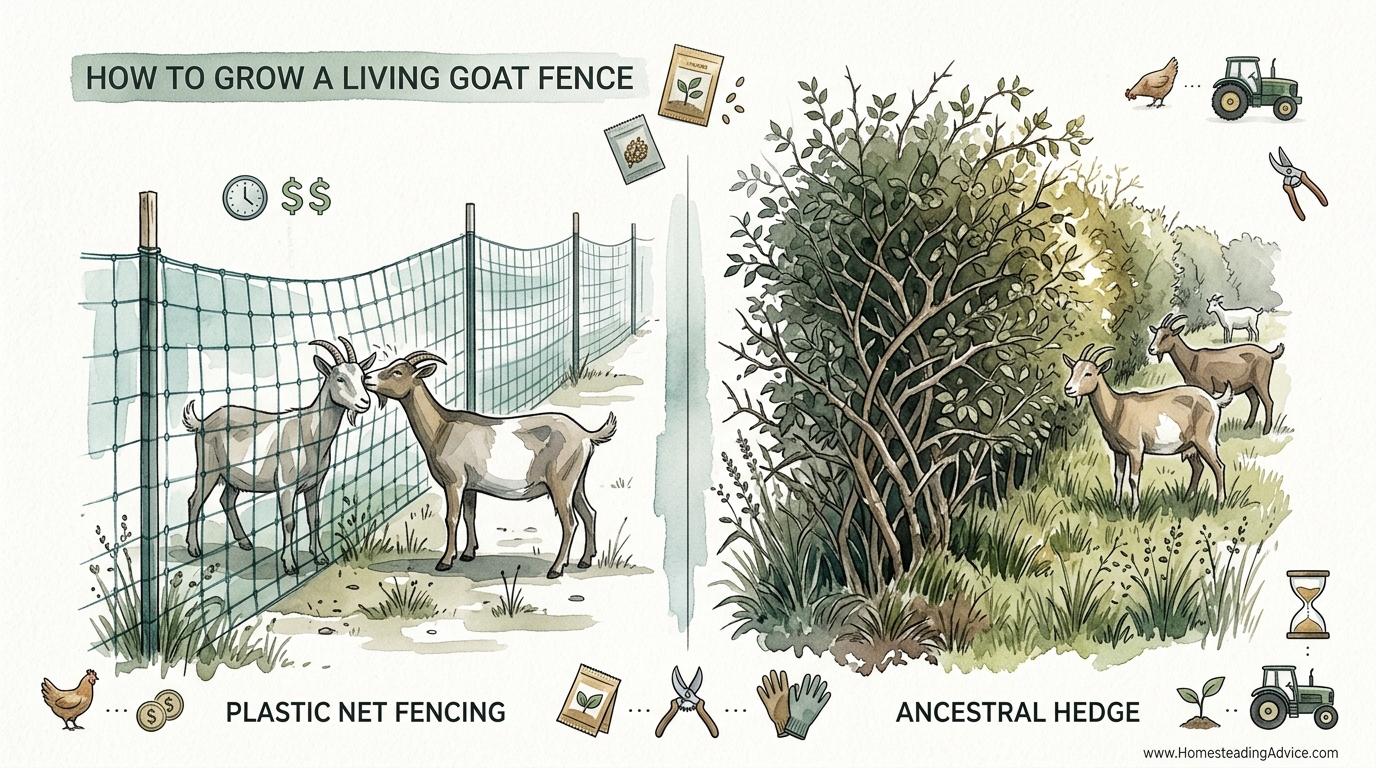
Can a row of trees really hold back a goat better than a 2000-volt wire? Modern plastic fencing is a tangled nightmare that eventually ends up in a landfill. Our ancestors used ‘hedge-laying’ to create fences that grow stronger over time and double as a high-protein buffet for their herd. It’s time to return to the living fence.
You have likely spent hours untangling poly-wire or cursing at a solar energizer that failed during a week of overcast skies. While modern technology offers a quick fix for containment, it lacks the resilience and multi-purpose utility of an ancestral hedge. A living fence does more than just stop a stubborn doe from escaping; it provides shade, windbreaks, and a steady supply of medicine and minerals that no bag of commercial minerals can match.
The transition from PLASTIC NET vs ANCESTRAL HEDGE is not just about changing materials. It is a shift in mindset from fighting against nature to partnering with it. By planting and laying a hedge, you are building a legacy that can last for centuries, provided you have the patience to see it through its first few seasons of growth.
This guide will walk you through the process of establishing, training, and maintaining a goat-proof barrier using traditional techniques. Whether you have a small backyard herd or a large-scale grazing operation, understanding the mechanics of a living fence is a vital step toward true self-reliance.
How To Grow A Living Goat Fence
A living goat fence, often called a “laid hedge” or “ancestral hedge,” is a dense, woven barrier made of living trees and shrubs. Unlike a standard ornamental hedge that is simply trimmed for shape, a living fence is structurally engineered through a process called pleaching. This involves partially cutting the stems of young trees and bending them at an angle to create a thick, impenetrable lattice of wood and thorns.
The practice dates back to the Roman occupation of Europe and was the primary method of livestock containment for centuries. Farmers used the materials already growing on their land—typically hawthorn, blackthorn, and willow—to weave boundaries that could withstand the pressure of heavy cattle and the clever maneuvering of goats. In the modern world, these hedges serve as vital corridors for wildlife and massive carbon sinks, while simultaneously acting as a “living haystack” for your livestock.
Goats are notoriously hard on fences because they are browsers, not grazers. They prefer to eat at eye level and will stand on their hind legs to reach tasty leaves. A standard wire fence eventually sags and snaps under this constant pressure. A living fence, however, responds to this pressure by growing thicker and more resilient. The more the goats nibble the tips, the more the plant is encouraged to branch out, creating an even denser wall over time.
The Mechanics of Hedge-Laying
Building a living fence is a two-stage process: the Establishment Phase and the Laying Phase. You cannot simply plant a row of trees and expect it to stop a goat the following week. This is a long-term investment in your land’s infrastructure.
The Establishment Phase
Success begins with high-density planting. To create a barrier that a goat cannot squeeze through, you should plant your bare-root whips in a double-staggered row. Aim for 5 to 7 plants per linear meter (approximately 2 to 3 plants per linear foot). This close spacing forces the plants to compete for light, growing straight and tall, which provides the “pleachers” you will need for laying later on.
During the first 3 to 5 years, the young plants must be protected from the very animals they will eventually contain. Goats will treat young hawthorn or mulberry whips as an all-you-can-eat buffet. You must use temporary fencing—such as woven wire or electric netting—placed at least 1 meter (3.3 feet) away from the hedge line. This allows the trees to establish a deep root system and reach a height of 2.5 to 3 meters (8 to 10 feet) before they are ready to be worked.
The Laying Phase (Pleaching)
Once your trees are roughly the thickness of a man’s wrist, it is time to lay them. This is typically done during the winter dormancy period when the sap is low. Using a sharp billhook or a small axe, you make a diagonal cut about 75% of the way through the base of each tree. This is the “pleach.” The goal is to leave a thin strip of bark and sapwood intact—this “hinge” keeps the tree alive while allowing you to bend it over to a 30-degree or 45-degree angle.
As you bend each tree over, you weave it into the previous one. This creates a continuous, horizontal “beam” of living wood. To hold everything in place, you drive vertical stakes (often made of hazel or ash) into the ground every 45 centimeters (18 inches). Finally, you weave long, flexible “binders” or “heathers” across the top of the stakes to lock the entire structure together. Within one growing season, new shoots will sprout vertically from the entire length of the laid stem, filling in any gaps and creating a solid wall of greenery.
Best Species for a Fodder Hedge
Choosing the right plants is critical. You need species that are physically strong, tolerant of heavy pruning, and nutritionally beneficial for your goats. A monoculture is rarely the best choice; a mix of species provides better structural integrity and a more balanced diet for the herd.
- Hawthorn (Crataegus monogyna): The backbone of most living fences. It has sharp thorns that deter goats from pushing through and produces dense, interlocking growth.
- Blackthorn (Prunus spinosa): Even more formidable than hawthorn, blackthorn grows into a “thicket” that is virtually impossible to penetrate. However, it can be invasive and may require more management to keep it from spreading into your pasture.
- Osage Orange (Maclura pomifera): In North America, this was the “original” living fence. It is incredibly tough, grows rapidly, and features large thorns. It is nearly rot-proof and can withstand extreme heat.
- Mulberry (Morus alba): An exceptional “fodder” tree. Mulberry leaves can contain up to 23% crude protein, rivaling alfalfa. While it is not as thorny, it is highly palatable and thrives under a coppice or pollard management system.
- Willow (Salix spp.): Useful for wet areas. Willow is extremely flexible and easy to pleach. It also contains salicin, a natural precursor to aspirin, which goats will seek out if they are feeling unwell.
Practical Benefits of the Ancestral Hedge
The primary advantage of a living fence is its durability and self-repairing nature. If a tree falls on a wire fence, the wire snaps and the posts shatter. If a tree falls on a living hedge, the hedge often absorbs the blow, and the plants simply grow around the obstruction. In fact, a well-maintained laid hedge can last for 100 years or more, whereas a modern galvanized wire fence may only last 20 to 30 years before rust and fatigue take their toll.
Beyond containment, you are creating a microclimate. A thick hedge acts as a massive windbreak, reducing wind speeds by up to 50% on the leeward side. For goats, which are notoriously sensitive to cold, damp winds, this can significantly reduce metabolic stress and feed requirements during the winter months. In the summer, the hedge provides deep shade, preventing heat stress and protecting the soil from drying out.
From a nutritional standpoint, the hedge is a mineral-rich supplement. Trees have much deeper root systems than pasture grasses. They pull up minerals like zinc, copper, and manganese from the subsoil and store them in their leaves. When your goats browse the hedge, they are accessing a level of nutrition that simply isn’t available in most pastures. This “tree hay” can be harvested in late summer and dried for winter fodder, providing a high-protein boost when grass quality is low.
Challenges and Common Mistakes
The most common mistake beginners make is neglecting the establishment phase. Because we live in a world of instant gratification, many people remove their temporary protection too early. A goat can strip the bark off a five-year-old tree in minutes, killing the plant. You must ensure the trunks are thick enough and the canopy is high enough that the goats cannot “ring-bark” the tree or destroy the main leader before it is laid.
Another frequent error is improper pleaching technique. If you cut too deep, you kill the tree. If you don’t cut deep enough, the wood will snap when you try to bend it. The “hinge” is the most delicate part of the operation. It must be thin enough to be flexible but thick enough to carry nutrients to the rest of the tree. Beginners should practice on “trash” trees or wild saplings before attempting to lay their main perimeter fence.
Timing is also critical. Never attempt to lay a hedge during the peak of the growing season. The bark is “loose” in the spring and summer, meaning it will peel away from the wood easily. If you damage the bark during these months, the tree is much more likely to succumb to fungal infections or pests. Stick to the cold months when the plant is sleeping.
Limitations and Environmental Constraints
A living fence is not a “set it and forget it” solution. It requires active management. Every year, you will need to trim the growth to maintain its shape, and every 10 to 15 years, the hedge may need to be re-laid to prevent it from becoming “gappy” at the bottom. If you are looking for a maintenance-free option, a living fence is not for you.
There are also environmental limitations to consider. In extremely arid regions with less than 250mm (10 inches) of annual rainfall, establishing a dense hedge without significant irrigation is nearly impossible. Similarly, in high-altitude environments with very short growing seasons, the plants may not grow fast enough to provide a viable barrier within a reasonable timeframe.
Finally, space is a factor. A wire fence takes up only a few inches of width. A fully established living goat fence can easily be 1 to 1.5 meters (3 to 5 feet) wide. If you are working on a very small urban lot, you may find that the hedge consumes too much of your productive pasture space. You must weigh the benefits of fodder and shelter against the loss of grazing area.
Comparison: Plastic Netting vs. Living Fence
| Feature | Modern Plastic Netting | Ancestral Living Hedge |
|---|---|---|
| Installation Time | Instant (Minutes) | Long-term (3-7 Years) |
| Durability | 5-7 Years (UV degradation) | 50-150+ Years |
| Maintenance | Frequent (fixing shorts, clearing grass) | Annual (Trimming) / Decadal (Laying) |
| Nutritional Value | None | High (Protein & Minerals) |
| End-of-Life | Landfill (Microplastics) | Firewood or Mulch (Biodegradable) |
| Cost Over 20 Years | High (Replacement costs) | Low (Initial plants + labor) |
Practical Tips for Success
If you are ready to begin, start small. Plant a 20-meter (65-foot) trial run along a property line or a sheltered paddock. This will allow you to learn the growth habits of your chosen species and practice your pleaching technique before committing to a mile of fencing.
Invest in quality tools. A dull billhook is dangerous and will create ragged cuts that invite disease. Keep your tools “shaving sharp” and clean them with a mild bleach solution or alcohol between trees to prevent the spread of pathogens. A traditional “Yorkshire” or “Midland” style billhook is ideal for this work because the curved blade allows you to hook and pull stems into position easily.
- Mulch heavily during the first three years. Use wood chips, straw, or even old wool to keep moisture in the soil and suppress grass competition.
- Monitor for pests. Voles and rabbits love the tender bark of young whips. Use mesh guards or plastic spirals if rodent pressure is high in your area.
- Join a community. Hedge-laying is a dying art, but there are still societies and guilds (particularly in the UK and parts of the US) that offer workshops. Hands-on experience is worth more than a thousand YouTube videos.
Advanced Considerations: Rotational Browsing
Once your living fence is established, you can integrate it into a rotational browsing system. Instead of allowing goats constant access to the entire hedge line, use temporary electric strands to “pulse” their access. This prevents them from over-browsing specific sections and ensures the hedge has time to recover and regenerate its leaf biomass.
Serious practitioners often use the Midland Bullock Style of laying. In this style, all the “brush” or bushy growth is pushed to one side of the hedge (the side with the livestock), while the other side is kept clean and straight. This creates a physical barrier of thorns and branches that protects the main trunks and new regrowth from being nibbled too aggressively by the goats.
Consider pollarding a few trees within the hedge line every year. Pollarding is the practice of cutting the top branches of a tree above the reach of livestock. This encourages the tree to produce a massive amount of “water sprouts”—straight, fast-growing stems. These can be harvested for “tree hay,” weaving materials, or even tool handles, all while the main body of the tree continues to serve as a fence.
Example Scenario: The 30-Meter Perimeter
Imagine you have a 30-meter (100-foot) stretch of pasture that needs a permanent, predator-resistant barrier. You decide to plant an ancestral hedge consisting of 70% Hawthorn, 20% Mulberry, and 10% Willow.
In Year 1, you purchase 180 bare-root whips. You dig a trench 60cm (2 feet) wide and plant them in two staggered rows, spacing the plants 30cm (1 foot) apart. You mulch the line and install a temporary electric net 1.5 meters away. Total cost for plants: approximately $250 – $400 depending on the nursery.
By Year 4, the Hawthorn has reached 2.5 meters in height. The Mulberry is even taller but less dense. You spend a weekend in late January laying the hedge. You cut 15 hazel stakes from a nearby woodlot and use a billhook to pleach the stems. You weave the flexible willow branches into the top as “binders” to lock the structure.
By Year 6, the temporary electric netting is removed. The hedge is now a solid wall of greenery. The goats spend their afternoons browsing the mulberry leaves and scratching their backs against the sturdy hawthorn trunks. You no longer worry about power outages or plastic degradation. You have created a permanent, living asset for your farm.
Final Thoughts
Returning to the living fence is a commitment to the slow, steady rhythm of the land. It requires us to trade the convenience of the “quick fix” for the deep security of ancestral wisdom. A row of trees may take years to become a fence, but once it arrives, it serves you with a loyalty that no factory-made product can match.
The beauty of this system lies in its reciprocity. You care for the hedge, and the hedge cares for your goats. It feeds them, shelters them, and keeps them safe. In return, the goats provide the very pressure that keeps the hedge vigorous and healthy. It is a closed loop, a perfect circle of self-reliance that strengthens with every passing season.
Start today by identifying the native, thorny species already growing on your property. Observe how they react to being cut and how the goats interact with them. The path back to the living fence begins with a single whip and the patience to watch it grow. Experiment, learn the language of the billhook, and build a boundary that your grandchildren will still be using a century from now.