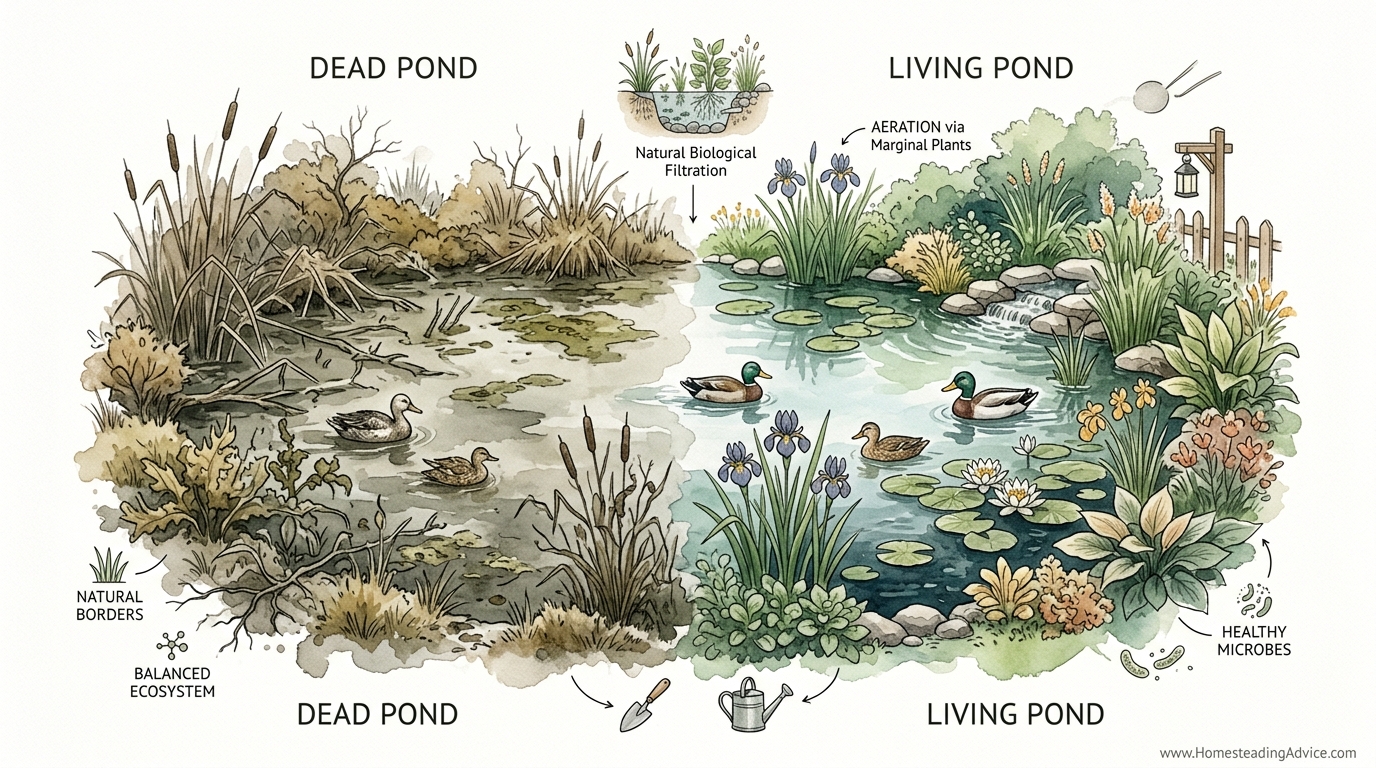
If you are scrubbing a plastic pool every morning, you are fighting physics instead of using it. Stagnant water is a chore; dynamic water is an ecosystem. Learn how to use gravity and plants to create a duck paradise that never needs a scrub brush.
Every homesteader remembers the first week they brought home ducklings. You likely started with a galvanized tub or a blue plastic kiddy pool, thinking it would be a simple joy to watch them splash. Within twelve hours, that water turned into a thick, gray soup of manure and mud. Within twenty-four, the smell began to drift toward the kitchen window. You found yourself dumping, scrubbing, and refilling every single day, wasting hundreds of gallons of water just to keep your birds from swimming in their own filth.
There is a better way that respects the hard-won wisdom of the land. Our ancestors didn’t have plastic pools; they had farm ponds and slow-moving streams. These natural systems didn’t need a human with a scrub brush because they relied on a biological partnership between water, bacteria, and plants. By mimicking these patterns, you can build a system where the “waste” from your ducks becomes the fuel for a lush, green landscape.
Transitioning from a DEAD POND to a LIVING POND isn’t just about saving your back from labor. It is about creating a resilient habitat where the ducks thrive and the water remains clear. This guide will walk you through the mechanics of natural filtration and the honest work required to set up a system that eventually manages itself.
Low Maintenance Duck Pond Design Guide
A low-maintenance duck pond is a managed ecosystem designed to process the high nitrogen load produced by waterfowl without constant manual intervention. Unlike a swimming pool that relies on chemicals to kill life, a natural duck pond encourages specific forms of life—bacteria and plants—to digest waste. In the permaculture world, this is often called “closing the loop,” where the problem (manure) becomes the solution (fertilizer for plants).
In a standard backyard setup, ducks are often the messiest residents. A single duck can produce upwards of 130 grams (0.28 lbs) of waste every day. In a small, stagnant pool, this waste has nowhere to go. It settles, rots, and fuels the growth of harmful pathogens like Clostridium botulinum, which can be fatal to your flock. A designed living pond uses a pump or gravity to move this nutrient-rich water through a biological filter, usually a “bog” or a “constructed wetland.”
These systems are used everywhere from small-scale homesteads to large-scale municipal wastewater treatment facilities. The principle is the same: water flows over the roots of hungry plants and through a bed of gravel where beneficial bacteria live. The bacteria break down the toxic ammonia from the duck droppings into nitrites and then into nitrates. The plants then “eat” those nitrates to grow, effectively stripping the pollutants out of the water before it returns to the ducks’ swimming area.
How It Works: The Three-Stage Living Filter
A truly self-cleaning system does not happen by accident. It requires three distinct stages to handle the unique “muck” that ducks create. If you skip any of these, the system will eventually clog and fail.
1. The Sedimentation Basin (The Heavy Lifter)
Ducks don’t just poop; they carry mud on their feet and “drill” into the ground near the water’s edge. This creates a high volume of heavy solids that will quickly choke a biological filter. A sedimentation basin is a deep, accessible area—often the main pond itself or a separate pre-chamber—where the water slows down enough for heavy solids to sink to the bottom. This area should have a smooth bottom (concrete or a clean liner) and a bottom drain or a way to easily “vortex” the solids out every few weeks.
2. The Bog Filter (The Biological Kidneys)
This is where the magic happens. A bog filter is a shallow basin, usually 12 to 18 inches (30 to 45 cm) deep, filled with various sizes of gravel. Water is pumped into the bottom of this gravel bed and forced to rise upward. This is known as an upflow bog. As the water rises, it passes through millions of beneficial bacteria colonizing the surface of the stones. These microbes are the primary laborers, converting raw waste into plant food. By the time the water reaches the surface, it is significantly cleaner and flows over a spillway back into the main pond.
3. Plant Uptake (The Nutrient Exporter)
The final step of the process is the plants growing in the bog. Without plants, the nitrates would simply build up in the water, eventually causing massive algae blooms. Plants like Yellow Flag Iris, Cattails, and Rushes are “nutrient sponges.” They grow rapidly by sucking up the nitrates that the bacteria have prepared for them. To keep the system “low maintenance,” you simply wait until the end of the growing season and harvest the dead plant material. By removing the hay or stalks, you are physically removing the nitrogen from your pond system and moving it to your compost pile or garden.
Benefits of a Natural Ecosystem Design
Choosing a biological approach over a mechanical or chemical one offers practical, measurable advantages for the serious practitioner. The primary benefit is the drastic reduction in water waste. Instead of dumping 500 gallons (1,892 liters) every day, you only add water to account for evaporation. This is critical for those living in arid regions or those relying on a limited well supply.
Beyond water savings, the health of the birds improves noticeably. Ducks that have access to clean, moving water have fewer eye infections and cleaner feathers. The act of “preening”—where a duck spreads oil from its gland over its feathers—is much more effective when the water isn’t laden with bacteria-rich sludge. You will also find that the surrounding landscape thrives, as the overflow from a natural pond is essentially “liquid gold” for your fruit trees and vegetable beds.
Finally, there is the benefit of aesthetics and peace of mind. A well-designed pond doesn’t smell like a sewer; it smells like a fresh marsh. It becomes a focal point of the homestead rather than a hidden chore that you dread completing. The movement of water through a waterfall or spillway adds oxygen to the system, which further helps break down waste and creates a soothing sound that masks road noise or neighboring activity.
Challenges and Common Mistakes
The most frequent error in duck pond design is undersizing the filter. For a standard goldfish pond, a bog filter might only need to be 10% of the pond’s surface area. For ducks, you need to increase that significantly. A safe rule of thumb is 25% to 30% of the pond’s volume should be dedicated to the filtration zone. If you have twenty ducks in a 1,000-gallon (3,785-liter) pond, a tiny bucket filter will be overwhelmed in forty-eight hours.
Another pitfall is the use of exposed pond liners and mud edges. Ducks have incredibly powerful feet and bills. If they can reach the edge of a rubber liner, they will often peck at it or pull it down, causing leaks. Furthermore, if you leave a dirt edge near the water, the ducks will turn it into a quagmire within a single afternoon. To avoid this, every inch of the pond’s perimeter should be “hardscaped” with large, smooth river rocks or concrete. This prevents the ducks from digging into the bank and clouding the water with silt.
Lastly, many builders forget to install a cleanout port. Over years of operation, the very bottom of a bog filter will eventually accumulate fine silt that the bacteria can’t process. Without a way to flush this out (usually a vertical pipe that goes to the bottom of the bog), you would have to shovel out tons of gravel to fix a clog. A simple 4-inch (10 cm) PVC pipe with a removable cap allows you to drop a dirty-water pump down to the bottom once a year and suck out the concentrated sludge.
Limitations and Realistic Constraints
While a natural pond is superior to a plastic tub, it is not a “magic” solution that requires zero work. In regions with harsh winters, the biology of the pond will slow down or stop entirely. When temperatures drop below 50°F (10°C), the nitrifying bacteria become dormant. During these months, you may need to reduce your flock size or accept that the water will not be as clear. You must also ensure that your pumps and pipes are protected from freezing, which can add complexity to your plumbing design.
Space is another constraint. A truly self-cleaning pond for a large flock requires a significant footprint. If you only have a 10×10 foot (3×3 meter) backyard, you may struggle to fit both the swimming area and a large enough bog filter to handle more than two or three ducks. In these tight spaces, you might be forced to rely on more frequent partial water changes despite your best design efforts.
Finally, there is the “duck destruction” factor. Ducks are notorious for eating the very plants you need for filtration. If you plant your bog filter where the ducks can swim, they will eat the irises and pull up the rushes. To make this system work, the filtration area must be physically separated from the swimming area by a fence or a height difference (such as an elevated bog that spills down into the pond). The ducks get the clean water, but they don’t get to eat the “kidneys” of the system.
Comparison: Natural Ecosystem vs. Plastic Tub
When deciding which path to take, it helps to look at the long-term investment of time and resources. Below is a comparison based on a typical 5-duck flock over one year.
| Feature | Plastic Kiddy Pool | Living Bog Pond |
|---|---|---|
| Weekly Labor | 7-10 hours (Scrubbing/Filling) | 30 mins (Skimming/Checking pump) |
| Water Usage | High (Daily drainage) | Low (Evaporation top-off only) |
| Bird Health | Moderate (Fluctuates daily) | High (Consistent water quality) |
| Setup Cost | $20 – $50 | $500 – $1,500 |
| Longevity | 1-2 Seasons (UV damage) | 15-20+ Years (Properly built) |
Practical Tips and Best Practices
When you begin your build, start with the edges. The transition between land and water is the most vulnerable part of any pond. Use a “shelf” design: a shallow area about 6 inches (15 cm) deep filled with large cobbles (2-4 inches / 5-10 cm in diameter). This creates a “rumble strip” that knocks mud off the ducks’ feet before they enter the deep water. It also provides a safe, non-slip exit for ducklings that might otherwise struggle with steep, slippery sides.
For the pump, avoid “high-pressure” pool pumps that use a lot of electricity. Instead, look for an asynchronous pond pump designed for continuous 24/7 use. These pumps are designed to handle small solids (up to 1/4 inch or 6 mm) without clogging and use about the same amount of power as a couple of old-fashioned light bulbs. Ensure your pump is housed in a “pump vault” or a protective mesh bag to prevent duck feathers and large debris from burning out the motor.
Choose your plants based on your specific climate, but always include a variety of Oxygenators and Marginals. Marginal plants like Pickerel Weed and Horsetail Reed do the heavy lifting of nutrient removal. Submerged oxygenators, such as Anacharis or Hornwort, live entirely underwater and compete with algae for nutrients while pumping oxygen into the water column. If your ducks eat the submerged plants, consider growing them in a protected “basket” or within the bog filter area itself.
Advanced Considerations: Going Off-Grid and Scaling
For those looking to deepen their self-reliance, solar-powered circulation is a viable option. Modern DC pumps can be connected directly to a solar panel. While the water will move slower on cloudy days, this aligns with the biological needs of the pond; on sunny days when algae growth is highest, the pump will be at its maximum flow, moving water through the filter to keep the system balanced. Adding a small battery backup can keep the “breather pipe” or aerator going through the night to maintain oxygen levels for the bacteria.
If you are scaling up for a large flock of 50 or more ducks, you should consider integrated swales. Instead of just returning the water to the pond, you can divert the “dirty” water from the sedimentation basin through a series of level-bottomed trenches (swales) planted with high-value crops like elderberries, comfrey, or fruit trees. This effectively turns your duck pond into the “heart” of a fertigation system, where the birds are the primary labor force in fertilizing your entire orchard.
Finally, consider the use of beneficial additives. While a balanced system shouldn’t need chemicals, adding “sludge-eating” bacteria (available in water-soluble packets) can help jump-start a new pond or assist a system that has been overtaxed by a temporary increase in flock size. These specialized microbes are selected for their ability to digest the cellulose found in duck manure and can prevent the buildup of anaerobic “black muck” at the bottom of the pond.
Example Scenario: The 150-Gallon Backyard Haven
Imagine a small homestead with four Pekin ducks. The owner digs a main pond that is 4 feet by 6 feet (1.2 x 1.8 meters) and 2 feet (60 cm) deep. This provides roughly 150 gallons (567 liters) of swimming space. Adjacent to this, they build a raised wooden planter box lined with a pond liner, measuring 2 feet by 4 feet (0.6 x 1.2 meters), filled with pea gravel. This is the bog filter.
A small 500 gallon-per-hour (1,892 LPH) pump sits in the main pond, protected by a mesh cage. It pushes water into the bottom of the gravel box. The water rises through the gravel, which is planted with Yellow Flag Iris and Water Cannas. The clean water then overflows back into the pond via a small stone waterfall. Because the bog is 18 inches (45 cm) high, the ducks cannot jump into it to eat the plants. The owner skims the surface for feathers once a week and adds a few gallons of water with the garden hose every Sunday. The water stays clear enough to see the bottom throughout the summer.
In this scenario, the owner has replaced five hours of weekly scrubbing with five minutes of observation. They have also gained a beautiful waterfall and a thriving stand of flowers that they can use for mulch or compost at the end of the season. This is the practical application of using physics instead of fighting it.
Final Thoughts
Building a low-maintenance duck pond is an act of stewardship. It requires an initial investment of time and a humble willingness to learn from the way water moves in nature. By moving away from the “dead pond” model of plastic and chemicals, you create a space that is healthy for your birds and restorative for your land. You are no longer a janitor for your ducks; you are the manager of a tiny, thriving wetland.
The transition from a chore-based homestead to a system-based one is the hallmark of a serious practitioner. It may take a season to get the balance of plants and bacteria exactly right, but the rewards are measured in years of clear water and healthy flocks. Start small, protect your edges, and let the biology do the heavy lifting. Your ducks—and your back—will thank you for the wisdom of a living system.
As you master the water, you may find yourself looking at other parts of your homestead through the same lens. Whether it is managing deep litter in the coop or integrated pest management in the garden, the goal remains the same: use the natural tendencies of the animals and the environment to create abundance with minimal waste. The path of the pioneer is not about working harder; it is about working with the grain of the world.