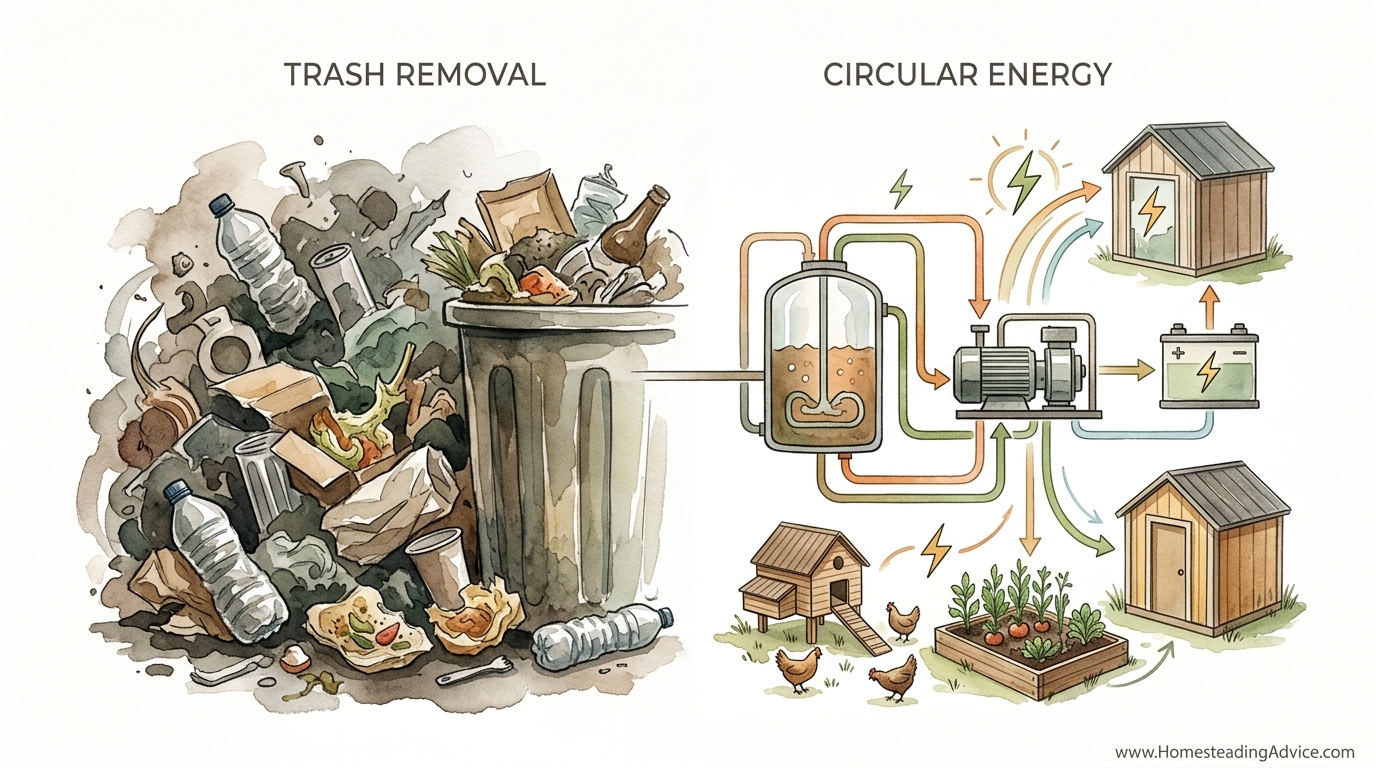
You’re paying someone to take away the very thing that could be powering your stove. We’ve been trained to view food scraps as a ‘nuisance’ that needs to be hauled away by a truck. This is active waste: it costs you time, money, and effort. A home biogas system creates a passive cycle where ‘waste’ never leaves your property – it simply changes form. One end takes the scraps, the other provides the gas. No trucks, no bills, no heavy lifting.
Most people assume that high-tech energy solutions require solar panels or wind turbines. While those are excellent, they rely on the sun and wind. A home biogas system relies on something you produce every single day: leftovers. Whether it is a few potato peels or the remains of a Sunday dinner, your organic waste is a dense battery of chemical energy waiting to be tapped.
Transitioning to this system is a return to a more sensible way of living. It mimics the natural cycles that have existed for millions of years. In nature, there is no such thing as trash. Everything that dies or is discarded becomes fuel for something else. By setting up a biodigester, you are simply giving nature a dedicated space to do its work more efficiently.
How To Turn Your Trash Into A Home Power Plant
A home biogas system is essentially an artificial stomach. It is a sealed, airtight container where organic matter is broken down by specialized bacteria in the absence of oxygen. This process is called anaerobic digestion. As these microorganisms eat your food scraps, they release a mixture of gases, primarily methane and carbon dioxide. This mixture is what we call biogas.
These systems are used across the globe, from small farms in Southeast Asia to modern eco-homes in Europe and North America. In a residential setting, the system usually consists of a large tank (the digester) and a gas storage bag. You feed your kitchen scraps into one end, and through the magic of biology, a clean-burning flame comes out of your stovetop at the other.
Think of it as a living appliance. Unlike a mechanical generator, it doesn’t have moving parts that wear out quickly. It relies on a stable colony of microbes that, if kept warm and well-fed, will provide you with fuel indefinitely. It is the ultimate expression of self-reliance, turning a daily chore into a primary utility.
How the Biology of Biogas Works
The process inside the tank happens in several distinct stages. First, complex organic materials like proteins and fats are broken down into simpler sugars and amino acids. This stage is called hydrolysis. It prepares the “food” for the next group of bacteria to take over.
Once the matter is simplified, a different set of microbes converts these pieces into organic acids. This is the acidogenesis phase. If you have ever smelled a compost pile that has gone “sour,” you are smelling these acids. In a healthy biogas system, these acids are quickly consumed by another group of organisms called methanogens.
Methanogens are the stars of the show. These ancient organisms, technically known as Archaea, are what actually produce the methane. They are sensitive creatures that require an environment free of oxygen and a stable temperature to thrive. When they are happy, they produce a gas that is roughly 60% to 70% methane, which is high enough to burn beautifully on a standard stove.
Setting Up Your Home Biogas System
Starting a system requires a bit of preparation, but the rewards are immediate. Most modern home kits are designed to be “plug-and-play,” meaning you don’t need a degree in engineering to get them running. You simply find a sunny spot in your yard, assemble the frame, and fill the tank with water.
The most critical step is the “inoculation.” You cannot just throw food into a tank of water and expect gas. You need to introduce the right bacteria. This is usually done by adding about 100 liters (26 gallons) of fresh animal manure or a specialized bacterial starter culture. This provides the initial colony of methanogens that will colonize the tank.
After the initial setup, you must wait for the bacteria to wake up. This can take anywhere from three weeks to a month depending on the ambient temperature. During this time, the system will produce mostly carbon dioxide. Once the gas becomes flammable—indicated by a steady blue flame on your burner—you can begin regular feeding.
Feeding and Daily Operation
A standard household system can handle about 6 liters (1.5 gallons) of food waste per day. It is important to realize that the bacteria prefer a balanced diet. High-energy foods like fats, oils, and sugars will produce a lot of gas quickly. Fibrous materials like stalks or heavy rinds take longer to break down.
Mixing your waste with an equal amount of water before pouring it into the inlet is a best practice. This creates a slurry that the bacteria can move through easily. Avoid large chunks; if you can chop your scraps into pieces smaller than 2 centimeters (roughly 1 inch), the surface area increases, and the bacteria work much faster.
Daily feeding is better than a large weekly dump. Large amounts of food added at once can cause a “spike” in acidity, which can stall the methanogens. Consistency is the key to a steady gas supply. If you treat your digester like a pet that needs a daily meal, it will reward you with a consistent flame for your morning coffee.
The Practical Benefits of Biogas
The most obvious benefit is the reduction of your energy bills. A well-functioning system can provide 2 to 3 hours of cooking gas every day. For many households, this is enough to cover the majority of their stovetop needs. Over the course of a year, the savings on propane or natural gas can be substantial.
Beyond the gas, you get a secondary product that is often just as valuable: liquid bio-fertilizer. For every liter of waste and water you put in, a liter of nutrient-rich “slurry” comes out of the overflow. This liquid is packed with nitrogen, phosphorus, and potassium in a form that plants can absorb almost instantly. It is far superior to standard compost for rapid garden growth.
Environmental benefits are also significant. When food scraps rot in a landfill, they release methane directly into the atmosphere, where it is over 25 times more potent than carbon dioxide as a greenhouse gas. By capturing that methane and burning it for fuel, you are effectively neutralizing its climate impact while also preventing the need for more fossil fuel extraction.
Common Challenges and Pitfalls
Temperature is the biggest hurdle for most home users. Methanogens are most active when the slurry is between 20°C and 40°C (68°F to 104°F). If the temperature drops below 15°C (59°F), gas production will slow down significantly. In colder regions, this means you must insulate your tank or keep it in a greenhouse to maintain production during the winter months.
A “sour” tank is another common issue. This happens when you overfeed the system, causing the acid-producing bacteria to outpace the methane producers. If your gas starts to smell like rotten eggs (hydrogen sulfide) or if the flame becomes yellow and weak, your pH might be too low. Adding a bit of baking soda can help neutralize the acid and bring the system back into balance.
Physical clogs can also occur if you feed the system materials that are too large or too fibrous. Woody stems, heavy bones, or large pits should stay out of the digester. These items won’t break down easily and can eventually take up valuable space in the tank or block the inlet and outlet pipes. Stick to soft kitchen scraps for the best results.
Limitations to Consider
Space is a primary constraint. A standard home biogas system takes up about the same footprint as a small garden shed. It needs to be placed on level ground and ideally in a spot that receives plenty of sunlight. For apartment dwellers or those with very small urban lots, finding a suitable location can be difficult.
Legal and zoning regulations can vary wildly. Some municipalities view these systems as simple composting units, while others may have strict rules about “gas storage” on residential property. It is always a good idea to check your local codes before installation. In most cases, because the gas is stored at very low pressure, it is actually safer than the propane tanks many people already have for their grills.
Winter performance is the most significant limitation for those in northern climates. While you can use “booster kits” that include insulation and heating cables, the energy required to keep the tank warm might sometimes outweigh the energy gained from the gas. In these areas, biogas is often a seasonal solution that runs from spring through autumn.
Comparing Biogas to Traditional Methods
| Feature | Home Biogas | Traditional Composting | Propane/Natural Gas |
|---|---|---|---|
| Primary Output | Cooking Gas & Liquid Fertilizer | Solid Soil Amendment | Cooking Fuel Only |
| Waste Handling | Sealed, no smells or pests | Open, can attract rodents | None (Waste goes to landfill) |
| Maintenance | Daily feeding, annual filter swap | Weekly turning | None (except paying the bill) |
| Complexity | Moderate | Low | High (Infrastructure dependent) |
Practical Best Practices
Always dilute your bio-fertilizer before using it on your plants. The liquid coming out of the digester is very concentrated. A common ratio is 1 part fertilizer to 3 parts water. Applying it directly to sensitive plants can “burn” the roots due to the high nitrogen content.
Install a moisture trap in your gas line. Biogas is naturally wet, and condensation will collect in the hose over time. If water pools in the line, it can block the flow of gas and cause your flame to sputter. A simple U-bend or a dedicated water-trap valve at the lowest point of the hose will solve this easily.
Use a sulfur filter to keep your kitchen smelling clean. Biogas contains trace amounts of hydrogen sulfide, which has a distinct “rotten egg” odor. Most commercial home systems come with a charcoal filter that scrubs this out. Remember to replace the activated carbon every 6 to 12 months to ensure your cooking experience remains pleasant.
Advanced Considerations: Scaling Up
For those with larger properties or livestock, scaling a biogas system can lead to total energy independence. If you have a single cow, its daily manure can produce roughly 2.4 cubic meters (85 cubic feet) of biogas. This is enough to provide about 3 to 4 hours of cooking fuel or even run a small gas-powered generator for electricity.
Scaling up often involves switching from a simple “bag” system to a “fixed dome” or “floating drum” design. Fixed dome systems are usually buried underground, which provides natural insulation and saves surface space. They are more permanent and can last for decades, but they require professional masonry and careful engineering to ensure they remain airtight under pressure.
If you produce more gas than you can use for cooking, you can look into gas scrubbing and compression. While home compression is difficult because biogas doesn’t liquefy easily like propane, you can still use low-pressure storage bags to hold extra fuel for heavy-use days. Some practitioners even use the gas to heat greenhouses or water for outdoor showers.
Real-World Scenario: The Suburban Homestead
Imagine a family of four living on a quarter-acre lot. They produce about 1 kilogram (2.2 lbs) of food scraps a day. By feeding this into a 2-cubic-meter (70-cubic-foot) digester, they generate roughly 200 liters (53 gallons) of biogas daily. This is enough to boil several large pots of water and cook three meals on a single burner.
In the spring, they use the liquid overflow to feed their backyard vegetable garden. Because the fertilizer is liquid, it penetrates deep into the soil, reaching the roots more effectively than solid compost. Their tomato plants grow larger and produce more fruit than in previous years when they relied on store-bought pellets.
By the end of the year, this family has diverted over 350 kilograms (770 lbs) of waste from the landfill. They have saved the equivalent of three or four large propane tanks in fuel costs. Most importantly, they have gained the security of knowing that even if the local grid fails or the supply chain breaks, they can still cook a hot meal for their children.
Final Thoughts
Rethinking waste is the first step toward true self-reliance. When you stop seeing food scraps as trash and start seeing them as a fuel source, your entire relationship with your home changes. You become a producer rather than just a consumer. The home biogas system is a silent, steady partner in this transition, working around the clock to turn yesterday’s dinner into tomorrow’s fuel.
Starting small is perfectly fine. Most people find that once they see that first blue flame, they become hooked on the efficiency of the cycle. It is a satisfying, visceral experience to cook a meal using the energy provided by the previous one. It grounds you in the reality of how energy is made and used.
If you have a bit of sunny space and a desire to close the loop on your household waste, a biodigester is one of the most rewarding projects you can undertake. It is an investment in your garden, your wallet, and your peace of mind. Experiment with different feedstocks, watch your garden thrive on the bio-slurry, and enjoy the independence that comes from powering your own home plant.