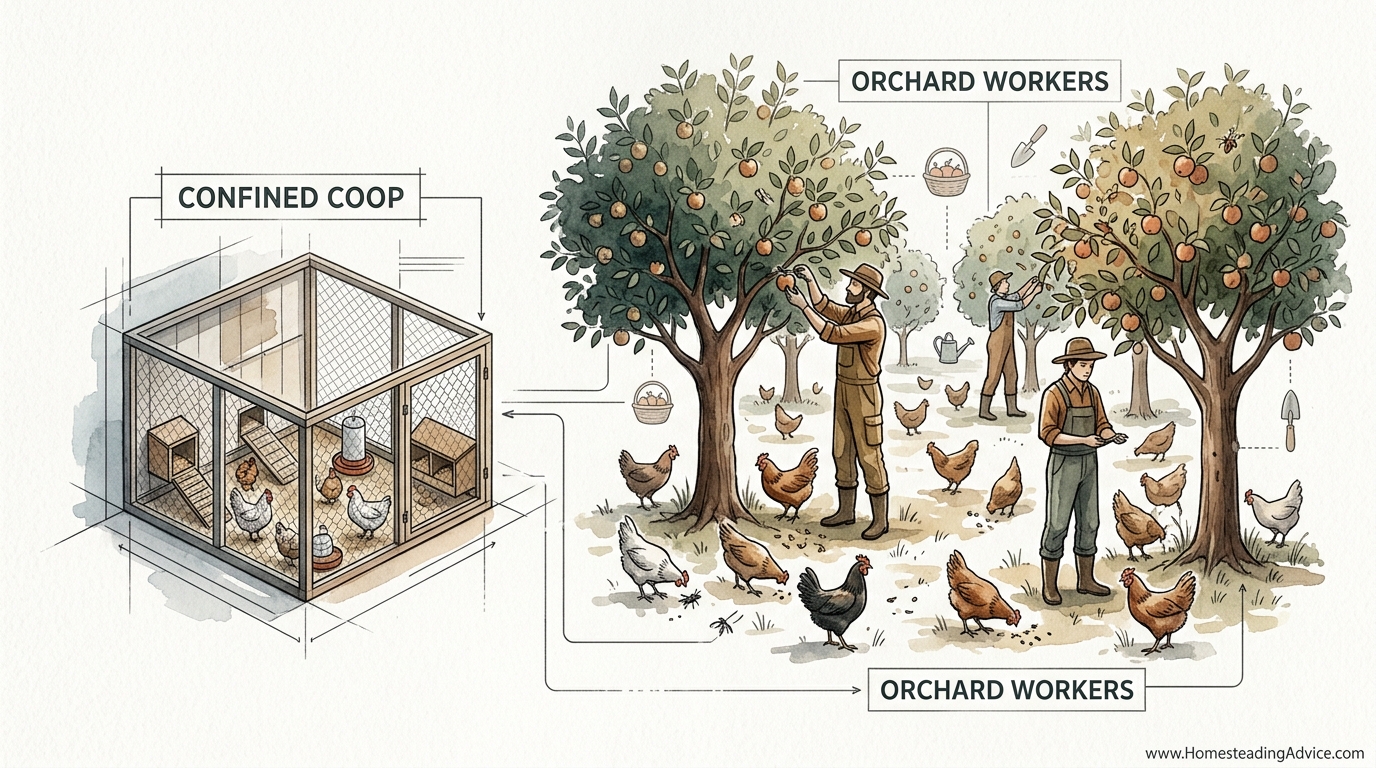
Why pay for feed when your ‘pests’ are actually high-protein livestock fuel? Stop treating your livestock and your orchard as two separate expenses. Integrating them ensures the ‘pests’ that ruin your fruit become the free feed that produces your premium meat and eggs. It’s not just farming; it’s a self-sustaining income loop.
Managing a fruit orchard often feels like an endless battle against nature. You spend your spring spraying for moths and your summer mowing the grass, only to watch a significant portion of your harvest rot on the ground or fall prey to larvae. This traditional approach treats every challenge as an isolated problem with a chemical or mechanical solution. However, there is a better way that relies on the ancient synergy between trees and birds.
Using poultry as orchard workers transforms your land into a closed-loop system. Instead of viewing a codling moth or a plum curculio as a disaster, you view them as a resource. These insects represent high-density protein that your birds are genetically hardwired to find. When you allow your flock to work the rows of your orchard, you are not just controlling pests; you are harvesting profit from the very things that used to cost you money.
Using Poultry For Orchard Pest Control Profits
This method involves the intentional placement of chickens, ducks, geese, or turkeys within an orchard to manage insect populations, weeds, and fallen fruit. It is a form of silvopasture, an agricultural practice that combines trees, forage, and livestock. While a CONFINED COOP keeps birds isolated from their natural diet, orchard workers are given the opportunity to forage for the biological “waste” of the fruit-growing process.
In the real world, this looks like a mobile coop or “chicken tractor” moving through rows of apple, peach, or citrus trees. The birds scratch the soil surface, consume larvae that are overwintering, and eat the “drops”—the pest-infested fruit that falls prematurely. This interrupts the life cycle of the most common orchard pests before they can hatch and re-infest your trees the following season.
Profitability in this system comes from two directions. First, you significantly reduce your input costs. You spend less on commercial feed because the birds are eating insects and fallen fruit. You also spend less on pesticides and fertilizers because the birds provide those services naturally. Second, you create a premium product. Eggs and meat from poultry raised on a diverse diet of orchard pests and forage often command a higher market price than standard pasture-raised products.
How It Works: Interrupting the Pest Cycle
Success in the orchard depends on understanding how your poultry interacts with specific pest life cycles. Most fruit pests spend a significant portion of their lives on or just under the soil surface. This is where your poultry becomes your most effective tool.
The Mechanics of Foraging
Chickens are the quintessential scratchers. They use their powerful legs to turn over the top 2 to 5 centimeters (1 to 2 inches) of soil and mulch. This action exposes pupating larvae and eggs to the elements and the birds’ keen eyesight. Ducks, on the other hand, are “shovels.” They use their bills to probe soft mud and tall grass, making them superior for controlling slugs and snails that thrive in the damp environment under a leafy canopy.
Targeting Specific Pests
The codling moth is perhaps the most famous enemy of the apple grower. Its larvae often crawl out of the fruit and hide in the bark of the tree or the litter at the base of the trunk to pupate. Chickens will diligently pick these larvae out of the ground-level bark and soil. The plum curculio, a beetle that affects stone fruits, drops to the ground to pupate in the soil. By running poultry through the orchard during the “June drop”—when trees naturally shed excess, often infested fruit—you ensure those beetles never reach adulthood.
Waste Management as Pest Control
Fallen fruit, or “drops,” are a major vector for disease and pest resurgence. If left to rot, they provide a nursery for the next generation of insects and a breeding ground for fungal spores like apple scab. Poultry see these drops as a delicacy. As they consume the fallen fruit, they also consume the larvae inside, effectively cleaning the orchard floor. This sanitization process is far more efficient and cost-effective than manual fruit collection.
The Seasonal Strategy for Orchard Management
You cannot simply turn a flock of birds loose in an orchard year-round and expect perfect results. Timing is everything. You must synchronize the birds’ presence with the stages of tree growth and the emergence of pests.
Early Spring: Pre-Emergence Clean-up
The first phase begins in late winter or early spring, just as the ground thaws. At this stage, many pests are still in their pupal or larval stages in the soil. Running your flock through the orchard now allows them to “vacuum” the soil before the adults emerge to lay eggs on your blossoms. This early intervention is the most critical step in reducing the overall pest pressure for the coming year.
Late Spring to Mid-Summer: The Maintenance Phase
Once the trees have bloomed and the fruit is set, the primary goal shifts to managing the “drops.” This period coincides with the emergence of many beetle species. You should move the birds through the orchard frequently to ensure they cover every tree. Using mobile fencing, such as electric netting, allows you to concentrate the birds in specific sections where pest pressure is highest.
The Harvest Gap: A Mandatory Break
Safety protocols require you to remove poultry from the orchard several weeks before the fruit is harvested for human consumption. This prevents the contamination of fruit with fresh manure. Most organic standards suggest a 90-day gap for fruit that does not touch the ground and a 120-day gap for fruit that does. During this time, the birds should be moved to a separate pasture or a dedicated fallow area.
Post-Harvest: The Final Sweep
After the harvest is complete, bring the birds back for a final sweep. They will eat any missed fruit and prepare the ground for winter. This post-harvest phase is essential for reducing the number of pests that will attempt to overwinter in your orchard soil.
Selecting Your Orchard Workers: Species and Breeds
Different species of poultry offer different “skill sets” in an orchard environment. A balanced system might include a mix of birds to cover all bases of pest and weed management.
- Chickens: Best for general insect control and soil aeration. Heavy breeds like Orpingtons or Australorps are less likely to fly into the lower branches of trees, which protects your ripening fruit.
- Ducks: Specifically Indian Runners or Khaki Campbells are famous for their “slug patrol.” They are less destructive to the soil than chickens but highly effective at finding pests in damp grass.
- Geese: These are your “weeder geese.” They are primarily herbivores and will graze on grass and weeds between the rows. They are less interested in insects but can save you hundreds of hours in mowing time.
- Guinea Fowl: These birds are the “elite scouts.” They are incredibly effective at finding ticks and hard-shelled beetles that other birds might ignore. However, they are loud and can be difficult to contain.
- Turkeys: Large and observant, turkeys can cover a lot of ground and are excellent at spotting larger insects like grasshoppers and June bugs.
Benefits of Integrated Orchard Poultry Systems
Integrating poultry into your orchard offers a suite of benefits that go far beyond simple pest control. This approach rebuilds the ecological health of your land while increasing your bottom line.
Significant Feed Savings: A healthy orchard provides a massive amount of high-quality protein and carbohydrates. In many cases, you can reduce your commercial grain inputs by 30% to 50% during the peak of the foraging season. This makes your livestock operation much more resilient to spikes in grain prices.
Natural Fertilization: A single laying hen produces about 10 kilograms (22 pounds) of manure per year. This manure is rich in nitrogen, phosphorus, and potassium. By allowing the birds to distribute this manure directly under the trees, you are providing a slow-release fertilizer that feeds the soil microbiology without the risk of the “nutrient runoff” often associated with synthetic fertilizers.
Improved Fruit Quality: Reducing the pest load naturally leads to less fruit damage and higher yields of “grade A” fruit. Furthermore, the increased soil health resulting from the birds’ presence often leads to fruit with better flavor and nutrient density.
Diversified Income: Instead of relying solely on a once-a-year fruit harvest, you now have a weekly or daily income from the sale of eggs and meat. This diversification provides a financial safety net that can carry a farm through a year where the fruit crop might be light due to late frosts or weather events.
Challenges and Common Mistakes
While the benefits are clear, this system requires active management. Simply throwing birds into the woods and hoping for the best is a recipe for disaster.
Overgrazing and Soil Compaction
Leaving birds in one area for too long can lead to “hot” soil. The high nitrogen content of poultry manure is beneficial in small amounts, but too much can burn the roots of your trees. Additionally, if the birds scratch too deeply or pack the soil down too much, they can damage the fine feeder roots near the surface. You must rotate the birds frequently—ideally every 3 to 7 days—to prevent this.
Predation Pressure
An orchard offers plenty of cover for birds, but it also offers cover for predators like foxes, hawks, and raccoons. Using a mobile coop that can be securely locked at night is non-negotiable. Many practitioners also find that using livestock guardian dogs or electric netting is essential to keeping the “orchard workers” safe from the surrounding wildlife.
Fruit Damage
Chickens are opportunistic eaters. If fruit is hanging low enough, they will jump up to peck at it. This not only ruins the fruit but can also teach the birds a habit that is hard to break. Maintaining a “browse line” through pruning—keeping your fruit branches at least 1.5 meters (5 feet) off the ground—is a simple way to prevent this conflict.
Limitations and Environmental Constraints
Integrated systems are not a “one size fits all” solution. Certain environments and orchard types may require significant adjustments.
Young orchards are particularly vulnerable. A flock of energetic chickens can easily scratch up the shallow roots of a newly planted sapling or even girdle the trunk if the bark is soft. In a new orchard, you must use trunk guards made of hardware cloth or plastic to protect the trees until they are well-established.
Water availability is another constraint. Poultry, especially ducks, require a reliable source of clean water. In large orchards, moving water troughs along with the mobile coop can be a logistical challenge. You may need to invest in a portable water tank or a gravity-fed irrigation system that can be accessed from multiple points in the orchard.
Climatic factors also play a role. In extremely hot regions, the shade of the orchard is a benefit for the birds, but they may still struggle with heat stress. In very wet climates, the constant presence of poultry can lead to muddy conditions that promote foot rot and other diseases. You must tailor your stocking density to the specific conditions of your site.
Comparison: Traditional Orchard vs. Poultry Integration
The differences between a conventional orchard and one integrated with poultry can be measured in terms of labor, cost, and ecological impact.
| Factor | Traditional Orchard | Integrated Poultry System |
|---|---|---|
| Pest Control Cost | High (Chemicals & Labor) | Low (Pests become Feed) |
| Fertilization | Synthetic Inputs Required | Natural Manure Cycling |
| Weed Management | Mowing or Herbicides | Biological Grazing |
| Soil Health | Often Degraded Over Time | Improved Organic Matter |
| Profit Streams | Single (Fruit) | Multiple (Fruit, Meat, Eggs) |
Practical Tips and Best Practices
If you are ready to implement this system, these actionable steps will help you get started correctly.
- Start with a Mobile Setup: Use a “chicken tractor” or a coop on wheels. This allows you to manage the impact on the soil and ensures the birds always have fresh ground to forage.
- Use Electric Netting: Lightweight, portable electric fences are the best way to keep birds where you want them. They also serve as a powerful deterrent against ground-based predators.
- Protect Your Trees: For young trees, wrap the bottom 60 centimeters (24 inches) of the trunk in hardware cloth. This prevents chickens from pecking at the bark and ducks from rubbing against it.
- Monitor Manure Loads: If you see a buildup of manure that isn’t breaking down within a few days, your stocking density is too high or your rotation is too slow. Aim for a light dusting of manure rather than a thick layer.
- Observe Your Birds: Spend time watching which insects your birds are targeting. This will help you adjust your timing for the following year to coincide with the peaks of specific pest populations.
Advanced Considerations: Stocking Density and Scaling
Serious practitioners eventually need to calculate exactly how many birds their orchard can support. While commercial guidelines for pasture-raised poultry exist, orchard environments are different because the “forage” is three-dimensional.
Stocking density generally ranges from 100 to 250 birds per hectare (40 to 100 per acre) for long-term residency. However, if you are using the birds for a “flash grazing” technique—where they are moved very quickly to tackle a specific pest outbreak—you can briefly increase this to 1,000 birds per hectare (400 per acre). The key is the duration of their stay. The goal is to maximize pest consumption while minimizing soil compaction and root damage.
Scaling this system requires thinking about “paddocks.” Divide your orchard into zones based on tree maturity and fruit type. You might have a group of “weeder geese” in your mature walnut grove and a team of “slug-patrol ducks” in your damp plum orchard. Using different species in different zones allows you to fine-tune your management to the specific needs of each tree variety.
Example: The Apple Orchard Solution
Consider a small 1-hectare (2.5-acre) apple orchard plagued by the codling moth. Traditionally, the grower might spend $500 on pheromone traps and another $1,000 on organic sprays, plus the labor to apply them.
Instead, the grower introduces 50 Orpington chickens. These birds are rotated through the orchard rows using electric netting. Over the course of the season, they consume 40% of their diet in insects and fallen “drops.” This saves the grower roughly $400 in feed costs. By the end of the season, the codling moth population is reduced by 70% without a single spray. The grower also harvests 1,200 dozen eggs, creating a new income stream of $6,000. The “pests” have not only been controlled but have been converted into high-value food and soil fertility.
Final Thoughts
The integration of poultry into an orchard is a return to a more logical, self-reliant way of farming. By viewing your land as an ecosystem rather than a factory, you unlock efficiencies that are impossible to achieve with monoculture. The birds find health in the orchard, and the orchard finds health through the birds.
Success in this venture requires you to be a student of nature. You must watch the insects, understand the trees, and learn the habits of your birds. It is a more engaged form of farming, but the rewards are measured in healthier soil, lower costs, and a more resilient farm business.
Whether you are managing three trees in a backyard or three hundred in a commercial grove, the principles remain the same. Stop fighting the “pests” and start feeding them to your future profits. Experiment with a small flock, observe the results, and let the ancestral wisdom of the integrated farm guide your path toward true self-sufficiency.