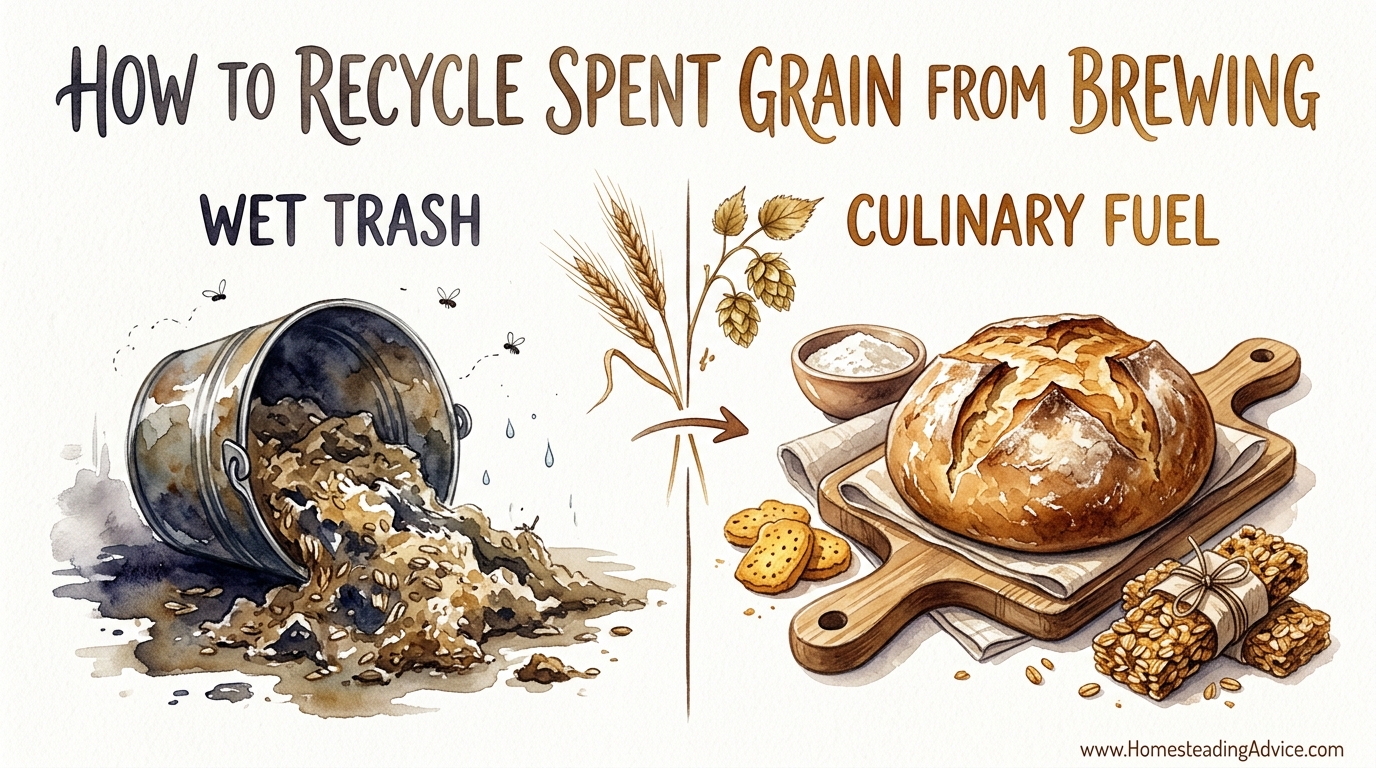
The most valuable ingredient in your beer is currently sitting in your trash can waiting for the garbage truck. Every 5-gallon batch of beer leaves behind 10+ pounds of high-protein, high-fiber ‘waste.’ See how we turn that soggy mess into gourmet bread, dog treats, and even profit.
For most homebrewers, the end of a brew day is a celebration of the liquid gold headed for the fermenter. But for the self-reliant practitioner, the real treasure is the mountain of steaming, sweet-smelling grain left in the mash tun. This material, often dismissed as wet trash, is actually a culinary fuel that has sustained livestock and farmhouses for centuries.
When you brew, you are essentially making a massive batch of grain tea. You extract the sugars for the alcohol, but you leave behind the structural integrity of the grain. What remains is a powerhouse of nutrition—high in protein, loaded with fiber, and ready to be upcycled into everything from artisan flour to nutrient-dense animal feed. Learning to handle this resource is a hallmark of the modern pioneer who refuses to let good energy go to waste.
How To Recycle Spent Grain From Brewing
Recycling spent grain, technically known as Brewer’s Spent Grain (BSG), is the process of reclaiming the malted barley, wheat, or rye used during the mashing stage of beer production. In a typical brew, these grains are steeped in hot water (145–158°F / 63–70°C) to convert starches into fermentable sugars. Once the liquid wort is drained away, you are left with a moist, husked byproduct that represents about 85% of the total solid waste of the brewing process.
In the real world, this material is a vital link in the circular economy of traditional agriculture. Large-scale breweries often have standing agreements with local farmers who haul away tons of BSG to feed cattle. For the home-scale brewer, recycling this grain means intercepting it before spoilage begins—usually within the first 24 hours—and converting it into a stable form or feeding it directly to backyard livestock. It is a practice of ancestral wisdom that treats the brewery not as a standalone factory, but as a component of a larger, productive ecosystem.
The nutritional profile of this “waste” is staggering. While the sugar is gone, the protein and fiber are concentrated. Dried spent grain often contains 20% to 30% protein and up to 70% dietary fiber. This makes it a superior additive for baking and a high-value supplement for animals that require slow-burning energy and gut-healthy roughage.
Processing Spent Grain: The Drying and Storage Pipeline
The greatest enemy of spent grain is moisture. With a water content usually exceeding 70%, wet grain will begin to sour and smell like a swamp within 24 to 48 hours if left at room temperature. To truly recycle it for human or long-term use, you must remove the water or halt the biological clock through temperature control.
Drying in the Oven
Oven drying is the most accessible method for turning soggy grain into a shelf-stable ingredient. Start by squeezing as much liquid as possible from the grain using a fine-mesh bag or a kitchen towel. Spread the grain in a thin layer—no more than 1/4 inch (6 mm) thick—on large baking sheets. Set your oven to its lowest possible setting, ideally between 150°F and 175°F (65°C to 80°C). If your oven does not go that low, prop the door open slightly with a wooden spoon.
Expect the drying process to take anywhere from 6 to 10 hours. Every 2 hours, use a spatula to stir and flip the grain to ensure even dehydration. The grain is finished when it feels light, brittle, and makes a “clinking” sound when dropped onto the pan. Once cool, these dried husks can be stored in airtight jars for months or ground into flour.
Milling Into Flour
If you intend to use the grain for human consumption, milling it into flour is the gold standard. Use a high-powered blender, a coffee grinder, or a dedicated grain mill to pulverize the dried husks. The resulting flour is darker and more fibrous than all-purpose wheat flour. Because the husks are tough, you may want to sift the flour through a fine-mesh strainer to remove any remaining large “shards” that can lead to a gritty texture in delicate pastries.
Freezing for Short-Term Use
If you don’t have 10 hours to tend an oven on brew day, freezing is your best friend. Portioned into 1-pound (450 g) vacuum-sealed bags or freezer bags, wet spent grain will stay fresh for up to 6 months. This is ideal for bakers who want to add wet grain directly to sourdough or pizza dough for a rustic, chewy texture without the labor of drying and milling.
Benefits of Upcycling Your Mash
The advantages of recycling your brewing byproducts extend beyond simple waste reduction. It is a multi-layered win for your health, your wallet, and your homestead’s efficiency.
- Nutritional Density: Spent grain flour contains nearly triple the fiber of whole wheat flour and significantly more protein. It is also rich in minerals like calcium, iron, and magnesium that were preserved during the mash.
- Cost Efficiency: A 50-lb (22.7 kg) bag of base malt for brewing costs roughly the same as a bag of high-end organic flour. By upcycling the grain, you are effectively getting two products for the price of one.
- Environmental Stewardship: Organic waste in landfills produces methane. By keeping your grain at home, you reduce your carbon footprint and lighten the load on municipal waste systems.
- Livestock Health: For those with chickens or goats, spent grain provides a “free” protein boost that improves egg quality and coat health.
Beyond the measurable metrics, there is a profound sense of satisfaction in the self-reliance this practice fosters. You are participating in a tradition that predates industrial food systems, where nothing is wasted and every byproduct has a purpose.
Challenges and Common Mistakes
While the process is straightforward, beginners often stumble on a few key points that can turn a productive afternoon into a moldy mess. The most frequent error is improper drying depth. If you pile the wet grain too deep on a baking sheet, the bottom layer will steam rather than dry, creating a breeding ground for bacteria before the moisture can escape.
Another pitfall is ignoring the hop schedule. Never use spent grain for food or animal feed if it has come into contact with hops. In some brewing methods, such as “Mash Hopping,” hops are added directly to the grain bed. Hops are toxic to dogs and can impart a bitter, medicinal flavor to baked goods. Always harvest your grain before any hops enter the vessel.
Lastly, be wary of spoilage speed. If you cannot process the grain immediately, you must refrigerate it. Leaving a bucket of wet grain in a warm garage overnight is a recipe for a foul-smelling disaster. If it smells like vinegar or old gym socks, the grain is past the point of salvage and should be sent to the compost pile rather than the oven.
Limitations and Realistic Constraints
Recycling spent grain is a labor of love, and it is important to acknowledge where the method may not be practical. The most significant limitation is time and energy cost. Running an oven for 8 hours to produce two pounds of flour may not be economically viable if your local electricity rates are sky-high. In these cases, a solar dehydrator or feeding the grain wet to animals is a more logical path.
Texture is another boundary. Spent grain is naturally “husk-heavy.” Even when finely milled, it cannot completely replace white flour in a recipe. It lacks the gluten structure required for high-rising loaves. Generally, a 10% to 15% substitution rate is the limit before the bread becomes overly dense or crumbly. If you are looking for a light, airy brioche, spent grain is not the right tool for the job.
Scale also matters. A homebrewer produces 10–15 lbs (4.5–6.8 kg) of grain every few weeks, which is manageable. However, if you are brewing 30-gallon (114 L) batches, you will quickly find yourself buried in more grain than your family or pets can consume. Without a local farmer or a massive composting operation, the sheer volume can become a logistical hurdle.
Comparing Utilization Methods: Wet vs. Dry
Choosing whether to use your grain wet or dry depends on your available equipment and your end goal. Use the table below to determine which path fits your current setup.
| Feature | Wet Utilization | Dry Utilization (Flour) |
|---|---|---|
| Shelf Life | 24–48 hours (refrigerated) | 6–12 months (airtight jar) |
| Labor Level | Low (direct use) | High (drying and milling) |
| Best Use Case | Dog treats, compost, wet mash bread | Fine pastries, granola, storage |
| Storage Space | High (bulky and heavy) | Low (concentrated powder) |
| Nutrition | Hydrated, easy to digest for animals | Concentrated, high fiber per gram |
Practical Tips for Success
If you want to master the art of the “Second Harvest,” follow these best practices learned from years of trial and error in the brewhouse kitchen.
- The Squeeze Test: Before drying, place your wet grain in a clean pillowcase and wring it out with all your might. Every drop of water you remove by hand saves you 15 minutes of oven time.
- Mind the Malt: Grains from a Stout or Porter will have a roasty, chocolatey flavor that is incredible in brownies or dark breads. Grains from a Pilsner or IPA are more neutral and work better for general-purpose baking.
- Dog Treat Safety: When making treats for your canine companions, ensure your peanut butter does not contain Xylitol, which is lethal to dogs. Stick to simple ingredients: grain, flour, peanut butter, and eggs.
- Sift Twice: If you find your flour is still too “woody,” sift it through a fine-mesh sieve a second time. The remaining “husk bran” is excellent for adding to garden soil but can be unpleasant in a cookie.
Advanced Considerations: Mushrooms and Soil
For those who have mastered flour and animal feed, the next level of grain recycling involves biology. Spent grain is an exceptional substrate for gourmet mushroom cultivation, particularly Oyster mushrooms. Because the grain has been boiled (pasteurized) during the brewing process, it is a clean medium for mushroom mycelium to take hold.
Mix your fresh, wet grain with pasteurized straw or sawdust at a 1:4 ratio to create a nutrient-rich “fruiting block.” The mushrooms will break down the tough cellulose in the grain husks, turning “waste” into expensive, high-quality protein. Once the mushrooms are finished fruiting, the remaining block is an even more potent compost for your garden, as the fungi have already begun the decomposition process.
Scaling these efforts requires thinking like a system designer. If you brew frequently, consider building a solar kiln or a dedicated dehydrator rack. Serious practitioners often trade their spent grain with local bakeries in exchange for fresh loaves, turning their brewing byproduct into a local currency of sorts.
Scenario: The 5-Gallon Batch Workflow
Let’s look at how a typical Saturday brew day translates into a week of food. You’ve just finished mashing 12 lbs (5.4 kg) of pale malt for an Amber Ale. After lautering, you have a bucket of warm, sweet grain.
First, you scoop out 4 cups of the wet grain to make a double batch of Spent Grain Dog Treats. These go into the oven at 350°F (177°C) for 30 minutes, then stay in at a low 200°F (93°C) for 2 hours to harden. Your dog is now set for a month.
Next, you take 2 lbs (900 g) of the wet grain and mix it directly into a large batch of no-knead sourdough. The moisture in the grain counts toward your dough’s hydration, and the whole grains add a rustic, nutty crunch to the crust.
The remaining 8 lbs (3.6 kg) are spread onto trays and dried overnight. On Sunday morning, you mill this into 3 lbs (1.4 kg) of dark, aromatic flour. This flour is tucked away in the pantry, ready to replace a portion of the wheat in your morning pancakes and weekend muffins for the next six weeks. Not a single kernel touched the trash can.
Final Thoughts
Recycling spent grain is about more than just making the most of your malt; it is about closing the loop on your household’s energy consumption. When you stop seeing the mash tun as a source of waste and start seeing it as a source of high-protein fuel, your entire approach to brewing shifts. You become a producer rather than just a consumer.
This path requires a bit of extra grit and a willingness to spend a few hours tending to the oven or the mill. However, the rewards—the smell of fresh spent-grain bread, the excitement of your livestock, and the knowledge that your hobby is producing zero waste—are worth every minute of the effort. Experiment with your recipes, share your treats with neighbors, and reclaim the “trash” that the rest of the world is throwing away.