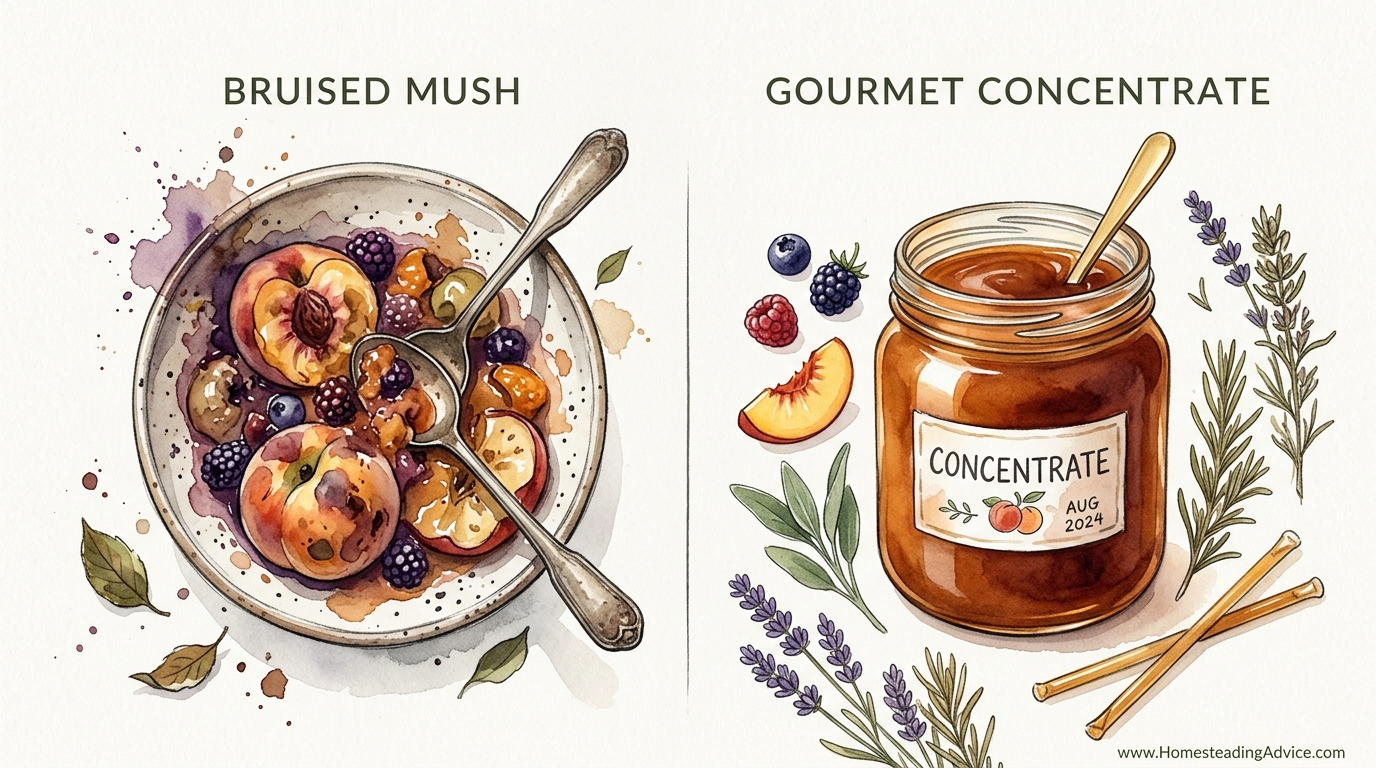
That ‘garbage’ fruit on your counter is actually the secret to the most intense flavors in your entire pantry. Most people see a bruised peach and head for the compost bin. A master canner sees the highest sugar content and the richest flavor profile. Don’t let your harvest’s ‘ugly’ stage go to waste; learn how to turn produce nuisances into your most valuable pantry assets.
Getting the most out of a harvest requires a shift in perspective. We are taught to prize the firm, the unblemished, and the symmetrical. While those traits are fine for fresh eating or making pretty fruit slices in a jar, they often lack the depth of character found in fruit that has spent a few extra days under the sun. When fruit reaches that softened, slightly bruised stage, the starches have fully converted to sugars, and the aromatic compounds are at their peak.
This guide will walk you through the nuances of preserving produce that has moved past its “prime” but hasn’t yet crossed the line into spoilage. It is about understanding the delicate balance between peak flavor and food safety, ensuring that your winter larder is filled with concentrates that put store-bought preserves to shame.
How To Can Overripe Fruit
Canning overripe fruit is the process of taking produce that has surpassed its firm-ripe stage and preserving it through acidification and heat processing. In the world of home preservation, “overripe” refers to fruit that is soft to the touch, perhaps slightly bruised or shriveled, but still free from mold, fermentation, or rot.
In a real-world kitchen, this situation often arises when a whole bushel of peaches ripens at once, or when a flat of strawberries is forgotten in the back of the pantry for an extra day. Instead of losing the investment of time and money, these fruits can be transitioned into products where texture is secondary to flavor. While firm fruit is essential for canning whole halves or slices, overripe fruit excels in applications where the fruit is crushed, pureed, or juiced.
The core concept relies on the fact that as fruit matures, its cell walls break down. This makes the fruit “mushy,” but it also releases the juices and sugars that were previously locked inside the cellular structure. By capturing this at the right moment, you are essentially creating a gourmet concentrate. This is where the transition from “bruised mush” to “premium preserve” happens.
The Science of Ripeness and Preservation
To understand why overripe fruit behaves differently in the jar, we have to look at two main components: pectin and acidity.
Pectin Degradation
Pectin is the natural “glue” that holds fruit cells together. In under-ripe or just-ripe fruit, pectin levels are high, which is why those fruits have a firm snap. As fruit continues to ripen, enzymes begin to break down these long-chain pectin molecules into pectic acid. Pectic acid does not have the same gelling power as pectin. This is why overripe fruit often fails to “set” when making traditional jams without added commercial pectin.
Sugar and Soluble Solids
The “Brix” level, or the measurement of sugar content in a liquid, increases as fruit ripens. This increase in natural sugar is what gives overripe fruit its intense sweetness and “concentrated” flavor. When you can this fruit, you are working with a higher base level of natural sugar, which can sometimes allow for a reduction in the amount of granulated sugar added to the recipe, provided you are using a recipe that doesn’t rely on sugar for its safety (which is true for most high-acid fruit canning).
Acidity Shifts
Perhaps the most critical factor for the home canner is the pH level. As fruit ripens, its natural acidity often decreases. For safe water-bath canning, the food must have a pH of 4.6 or lower. Some fruits, like tomatoes and figs, can hover right on the edge of safety even when perfectly ripe. When they become overripe, their pH can rise above 4.6, making them unsafe for water-bath canning without significant acidification.
How to Do It: Step-by-Step Process
Preserving overripe fruit requires a slightly different approach than preserving firm fruit. Follow these steps to ensure a high-quality, shelf-stable product.
Step 1: The Safety Inspection
Examine each piece of fruit. You are looking for softness and bruising, which are fine. You must discard anything with visible mold, “off” smells (like alcohol or vinegar), or skin that has broken and allowed insects or dirt to enter the flesh. If a fruit has a single small bruise, you can cut it away, but if the fruit is leaking fermented juice, it belongs in the compost.
Step 2: Preparation and Cleaning
Wash the fruit gently in cool water. For soft fruit like peaches or plums, avoid soaking them as they can absorb water and lose flavor. Peel the fruit if the recipe calls for it, though many “overripe” recipes like fruit butters actually benefit from the extra pectin found in the skins if they are pureed finely enough.
Step 3: Creating the Base
Since overripe fruit is already soft, it is best used as a puree or a “mash.”
- For Fruit Butters: Cook the fruit down with a splash of water or juice until it is soft enough to pass through a food mill or sieve. This removes skins and seeds while creating a silky smooth base.
- For Syrups: Crush the fruit and let it sit with a small amount of sugar to draw out the juices, then strain through a jelly bag.
- For Jams: Mash the fruit thoroughly. Expect a softer set or plan to use a “No-Sugar Needed” pectin, which relies on calcium rather than sugar and natural pectin to create a gel.
Step 4: Acidification
Because the acidity of overripe fruit is lower, always add bottled lemon juice or citric acid. A general rule for fruit butters and purees is to add 1 tablespoon (15 ml) of bottled lemon juice per pint (500 ml) of fruit pulp. This ensures the pH stays well below the 4.6 safety threshold.
Step 5: Heat Processing
Fill your clean, hot jars, leaving the recommended headspace—usually 1/2 inch (1.25 cm). Remove air bubbles, wipe the rims, and apply the lids. Process in a boiling water bath canner. Most fruit butters and purees require 10 to 15 minutes of processing at sea level (under 1,000 feet / 305 meters). Always adjust for your specific altitude.
Benefits of Using Overripe Fruit
Choosing to can fruit at this stage offers several distinct advantages that the grocery store cannot replicate.
- Superior Flavor Intensity: The aromatic profile of a fruit changes as it over-ripens. The “esters”—the compounds responsible for fruit scent—are most volatile and potent at this stage.
- Reduced Waste and Cost: Using fruit that might otherwise be tossed is the height of kitchen economy. Many orchards sell “seconds” or “utility grade” fruit at a fraction of the cost, which is perfect for these methods.
- Natural Sweetness: Because the natural sugar content is higher, you can often produce a much richer flavor without having to rely heavily on corn syrup or excessive refined sugar.
- Texture Versatility: Overripe fruit is the ideal candidate for fruit leathers, syrups, and sauces where a smooth, “melt-in-your-mouth” texture is the goal.
Challenges and Common Mistakes
Working with over-mature produce is not without its hurdles. Being aware of these can save a batch of preserves.
The “No-Set” Problem
The most frequent complaint is that the jam didn’t thicken. Because the natural pectin has degraded, you cannot rely on old-fashioned “long-boil” methods that work with slightly under-ripe fruit. To fix this, use commercial pectin specifically formulated for low-sugar or overripe fruit, or pivot the recipe into a fruit butter.
Scorching the Pulp
Overripe fruit has more sugar and less structural water. When cooking down a puree into a butter, it is very easy to burn the bottom of the pot. Use a heavy-bottomed stainless steel or enameled cast iron pot and stir frequently. A slow cooker can also be used for the “cooking down” phase to minimize the risk of scorching.
Ignoring pH Changes
The biggest mistake is assuming that because it’s a “fruit,” it is automatically safe for a water bath. As mentioned, overripe tomatoes, figs, and melons lose acidity quickly. If you are canning these specific items, you must follow a tested recipe that includes specific acidification measurements.
Limitations: When To Walk Away
There are times when fruit has simply gone too far. Understanding these boundaries is what separates a master preserver from a risky cook.
| Feature | Canning-Safe (Overripe) | Discard (Spoiled) |
|---|---|---|
| Smell | Intensely sweet, floral | Sour, vinegary, or “boozy” |
| Skin | Wrinkled or slightly bruised | Moldy, slimy, or weeping gray fluid |
| Texture | Soft, yields to thumb pressure | Liquid centers, mush that falls apart when touched |
| Insects | None or superficial on skin | Fruit flies inside the flesh or larva present |
Another limitation is the “Fruit Puree Rule.” According to the National Center for Home Food Preservation (NCHFP), you should not can purees of certain fruits like cantaloupe, elderberries, or bananas because there are no safe, tested processing times that ensure heat penetration to the center of the jar for these specific densities.
Practical Tips for Success
Applying these best practices will elevate your canning game from “making do” to “crafting excellence.”
- The 75/25 Rule: If you want a traditional jam set but want the flavor of overripe fruit, use a mix of 75% fully ripe/overripe fruit and 25% slightly under-ripe fruit. The under-ripe portion provides the pectin, while the overripe portion provides the flavor.
- Use a Food Mill: For overripe stone fruits, don’t bother peeling them first. Cook them whole (with pits removed), then run the hot mass through a food mill. The skins will stay behind, and you’ll get every bit of the flavorful pulp.
- Check Your Altitude: For every 1,000 feet (305 meters) above sea level, you must increase your boiling water processing time. This is non-negotiable for safety.
- Brighten the Color: Overripe fruit can sometimes look a bit dull or brown. Adding a bit of ascorbic acid (Vitamin C) or a little extra lemon juice can help maintain a vibrant color in the jar.
Advanced Considerations: Beyond the Jar
For the serious practitioner, overripe fruit opens the door to preservation methods that go beyond simple canning.
Fruit Vinegars and Shrubs
If the fruit has just started to ferment, it may no longer be suitable for canning, but it is perfect for fruit vinegars or “shrubs” (drinking vinegars). The natural sugars provide the fuel for acetic acid bacteria. Simply macerate the fruit in sugar, strain, and mix the syrup with a high-quality vinegar. This creates a shelf-stable concentrate for cocktails or sodas.
Steam Juicing
A steam juicer is an incredible tool for overripe berries and grapes. The gentle steam extracts the clear juice without the need for squeezing, which can make juice cloudy. This juice can then be canned as a concentrate or used for jelly later.
Low-Sugar Spreads
Since overripe fruit is naturally sweeter, it is the perfect candidate for Pomona’s Universal Pectin. This specific type of pectin is activated by calcium, not sugar. This allows you to create a spread that tastes like the fruit itself rather than a sugar-syrup.
Example Scenario: The “Compost Pile” Peach Butter
Imagine you have 10 pounds (4.5 kg) of peaches that reached peak ripeness while you were away for the weekend. They are too soft to slice and some have large, soft bruises.
Preparation: Wash the peaches. Cut away any dark, soft bruises. Remove the pits. Do not worry about peeling.
Cooking: Place the peach chunks in a large pot with 1/2 cup (120 ml) of water or apple cider to prevent sticking. Simmer until the peaches are a soft mush.
Pureeing: Run the mixture through a food mill. You now have a thick, fragrant peach puree.
The “Concentrate” Phase: Measure your puree. For every 4 cups (1 liter) of puree, add 1 cup (200 g) of sugar (adjust to taste) and 2 tablespoons (30 ml) of bottled lemon juice. Add a pinch of cinnamon and cloves.
The Reduction: Simmer in a wide, shallow pan or a slow cooker with the lid ajar until the mixture is thick enough to hold its shape on a spoon.
Processing: Ladle into half-pint (250 ml) jars, leaving 1/4 inch (0.6 cm) headspace. Process in a boiling water bath for 10 minutes.
The result is a peach butter that is far more flavorful than anything made with firm, “perfect” fruit.
Final Thoughts
Learning how to can overripe fruit is a vital skill for anyone pursuing a self-reliant lifestyle. It is an acknowledgment that nature’s cycles don’t always align with our schedules and that beauty—and flavor—often lie in the stages we are taught to overlook. By mastering the science of pectin and the necessity of acidification, you can turn a potential loss into a pantry full of “gourmet concentrates.”
The intense sweetness and complex aromatics of over-mature fruit are assets, not liabilities. Whether you are cooking down a thick, spiced fruit butter or straining a crystal-clear syrup, you are capturing the very essence of the harvest at its most potent moment.
Don’t be afraid to experiment with these “ugly” fruits. As long as you stay within the boundaries of safety—discarding mold and ensuring proper acidity—you will find that the best jars in your cellar are often the ones that started as a “nuisance” on your counter. Turn that bruised mush into your most prized pantry asset and enjoy the deep, nostalgic flavors of a harvest fully realized.