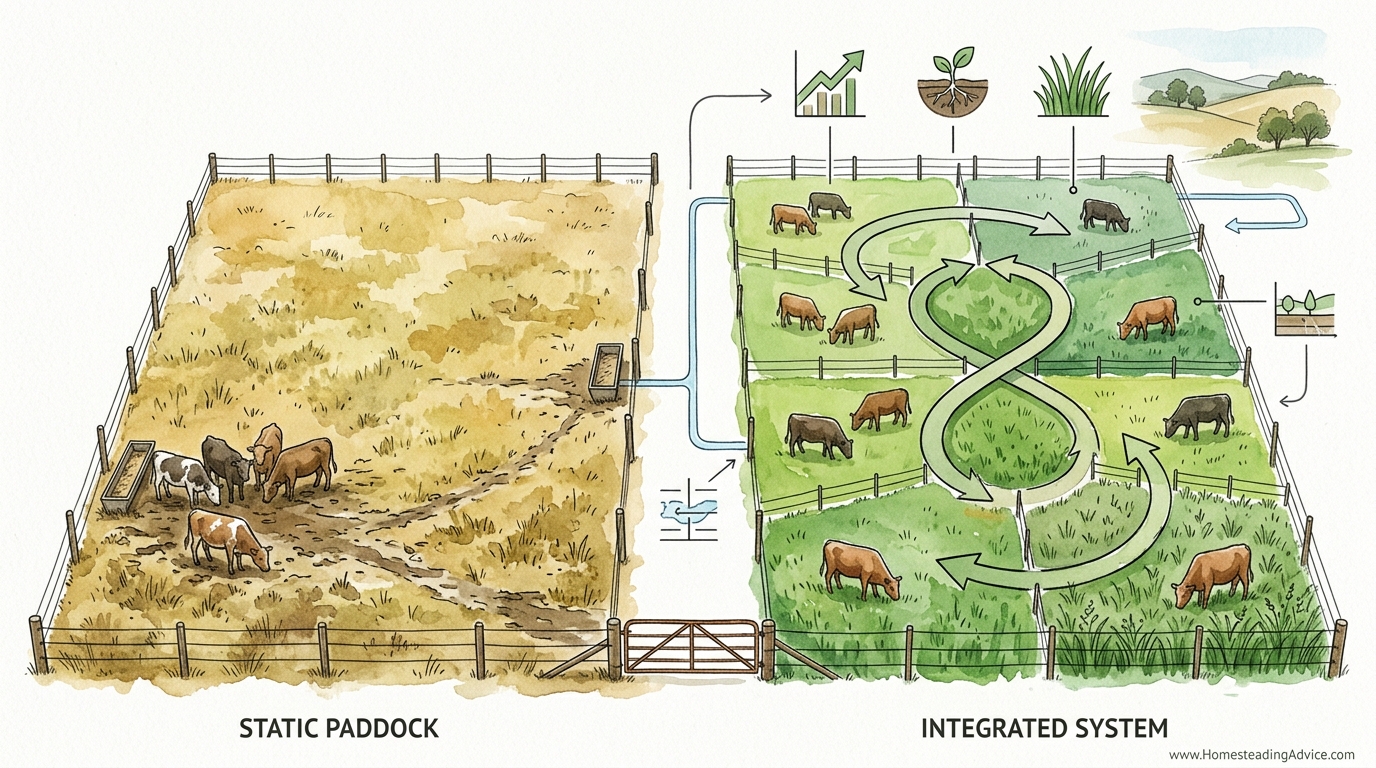
One fence creates a desert, while the other creates a paradise – is your grazing strategy building soil or destroying it? Most cattle owners treat their fields like a giant lawn that needs mowing, but that’s how you end up with a dust bowl. By switching from isolated paddocks to an integrated, high-density rotation, you turn your cattle into biological tillers that heal the earth while they eat. It’s the difference between fighting nature and letting nature do the heavy lifting for you.
For generations, the standard practice has been to open the gate and let the herd roam wherever they please. This continuous grazing seems easy on the surface, but it forces the cattle to become picky eaters. They return to the same delicious clover and tender shoots every few days, never giving the plant a chance to recover. Eventually, the good forage dies out, replaced by weeds and bare ground. Shifting your mindset toward rotational management changes the entire ecosystem of your farm.
Every acre of land has the potential to be a thriving sponge that captures carbon and holds water. Your cattle are the primary tools for unlocking this potential. When you manage their movement with intention, you mimic the great migratory herds of the past. These animals would arrive in massive numbers, graze intensely, tramp organic matter into the soil, and then move on—not returning for months. This period of rest is where the real magic happens.
How To Start Rotational Grazing For Cattle
Rotational grazing is the practice of dividing a large pasture into smaller sections, called paddocks, and moving livestock through them in a planned sequence. This method ensures that while one portion of the land is being grazed, the rest is resting and regenerating. In the real world, this looks like a herd of cows concentrated in a small area for a short time, often just one to three days, before being moved to fresh grass.
Starting this journey requires a shift from being a “cowboy” to being a “grass farmer.” You must begin to see your cattle not just as the product, but as the workers. Their hooves break the soil crust to allow seeds to germinate, and their manure provides a high-powered fertilizer that is spread evenly across the field. If you leave them in one spot too long, they overgraze. If you move them too quickly, they miss out on the benefits of the “herd effect.”
Think of your pasture like a battery. Every time a cow bites a blade of grass, it drains a little bit of energy from the roots. If the cow bites it again before the plant has grown back to its full height, the battery dies. Rotational grazing is simply the process of letting that battery recharge to 100% before you use it again. This is essential for long-term sustainability, whether you have five head of cattle on a small homestead or five hundred on a commercial ranch.
The Basic Workflow of a New Grazing Plan
Implementing a system for the first time can feel overwhelming, but it follows a logical progression of observation and infrastructure. You do not need to build twenty permanent paddocks on day one. Most successful graziers start with their existing perimeter and use temporary tools to test the waters.
Assessing Your Current Forage Base
Look closely at what is currently growing in your fields. Are there bare spots? Are there specific areas where the cattle always congregate? You need to identify your “sacrifice areas”—the places where the soil is compacted and nothing grows—and plan to heal them. Use a grazing stick or a simple ruler to measure the height of your forage across the entire farm. This provides a baseline for your starting point.
Mapping the Paddock Layout
Square paddocks are generally more efficient than long, narrow ones. Cattle tend to graze the ends of rectangular paddocks more heavily while ignoring the far corners. If you have steep slopes, try to run your fences along the contour of the land rather than straight up and down. This prevents the cattle from creating “cow paths” that turn into erosion gullies during heavy rains.
The Role of Infrastructure
Fencing and water are the two pillars of any rotational system. High-tensile perimeter fencing is the gold standard for security, but interior divisions are best handled with polywire and geared reels. These tools allow you to change the size of your paddocks based on the season. If the grass is growing fast in the spring, you might make the paddocks larger. In the heat of summer when growth slows, you might shrink them down or move the cattle faster to prevent them from eating the “heart” out of the grass.
The Mathematics of the Meadow: Calculating Stocking Rates
Success in rotational grazing depends on getting the numbers right. You need to understand the difference between your stocking rate and your stock density. The stocking rate is the number of animals you have on your total acreage for the whole year. Stock density is the number of pounds of animal you have on one specific acre at a specific moment.
Determining Animal Units (AU)
Standardize your herd by using the Animal Unit measurement. One AU is typically defined as a 1,000-pound (454 kg) cow, with or without a calf. A larger 1,400-pound (635 kg) cow would be 1.4 AU. Calculating your total AU helps you determine how much forage you need. A single AU generally consumes about 2.5% to 3% of its body weight in dry matter every day.
The “Take Half, Leave Half” Rule
This is the golden rule of regenerative grazing. You should never allow your cattle to eat more than 50% of the available forage in a paddock. The top half of the plant is the most nutritious, but the bottom half is necessary for the plant to photosynthesize and regrow. If you graze a plant down to the dirt, the roots stop growing entirely to send energy upward. If you leave 4 inches (10 cm) of residual, the roots stay deep and the grass bounces back in half the time.
Calculating Paddock Size
Determine how many days you want the cattle to stay in one spot. For beginners, a three-day rotation is a great starting point. Take your total daily herd requirement in pounds of forage and multiply it by the number of days. Then, estimate how much forage you have per acre (a typical lush pasture might have 2,000 to 3,000 pounds of available dry matter per acre). This math will tell you exactly how many square feet or acres each paddock needs to be.
Practical Benefits of High-Density Grazing
The reasons for making this switch go far beyond just “growing more grass.” You are rebuilding an entire biological engine that has likely been dormant for decades. When the system is clicking, you will see changes in the soil, the animals, and your bank account.
- Increased Carrying Capacity: Many farms find they can increase their herd size by 30% to 50% without buying more land, simply by managing the grass they already have.
- Drought Resilience: Soils with high organic matter hold significantly more water. Every 1% increase in soil organic matter allows an acre of land to hold an additional 20,000 gallons (75,000 liters) of water.
- Better Manure Distribution: In a big open field, cows leave 80% of their manure near the water tank or under a shade tree. In a small paddock, they spread that “black gold” evenly across the grass where it can actually be used.
- Weed Control: High-density grazing forces cattle to be less selective. They will often stomp down or even eat weeds that they would normally ignore, eventually out-competing the undesirable plants with healthy grass.
Common Pitfalls and How to Avoid Them
Even with the best intentions, it is easy to make mistakes that can set your pasture back. Most of these errors stem from being too rigid or not watching the land closely enough.
The “Calendar” Trap
Never move your cows just because the calendar says it’s Tuesday. Growth rates change based on rainfall and temperature. In the spring, you might need to move them every 24 hours. In a dry autumn, they might need to stay in a larger area for five days. Let the grass tell you when it’s time to move, not a schedule on the fridge.
Ignoring the Water Source
Cattle will not graze effectively if they have to walk more than 800 feet (244 meters) to get a drink. If the water is too far away, they will spend all their energy walking back and forth, creating dirt paths and ignoring the forage at the far end of the paddock. Portable water troughs and quick-connect hoses are the solution to this problem.
Grazing Too Short
Leaving the cattle in a paddock until the ground looks like a golf course is a recipe for disaster. This exposes the soil to the sun, which kills the microbes and causes moisture to evaporate. Always aim to leave enough “armor” on the soil. The ground should still be mostly covered with trampled grass even after the cows move out.
Limitations and Environmental Constraints
Rotational grazing is not a magic wand that works the same way in every climate. You must adapt the principles to your specific environment.
In arid regions with low rainfall, the rest periods might need to be incredibly long—sometimes a full year or more between grazing events. If you try to rotate too quickly in a desert environment, you will kill the brittle vegetation. Conversely, in very wet, tropical environments, the grass can become “rank” or overly mature and lose its nutritional value in just a few weeks. You have to be fast enough to catch the grass at its peak protein levels.
Labor is another real constraint. If you work a full-time job off the farm, a daily move might not be feasible. In this case, a four-day or even a seven-day rotation is still significantly better than no rotation at all. The goal is progress, not perfection.
Comparing Grazing Strategies
Understanding where you sit on the spectrum of management helps you set realistic goals. Most people start on the left and work their way toward the right as their skills and infrastructure improve.
| Feature | Continuous Grazing | Standard Rotational | Management-Intensive (MiG) |
|---|---|---|---|
| Move Frequency | None (Seasonal) | 3 to 7 Days | Daily or Multi-daily |
| Infrastructure Cost | Low | Moderate | High (Initially) |
| Forage Utilization | 30-40% | 50-60% | 70% or more |
| Soil Health Impact | Negative/Stagnant | Positive | Rapidly Regenerative |
Practical Tips for Daily Success
Small adjustments in how you handle your gear and your animals can save hours of frustration.
- Train the Herd: Cattle are creatures of habit. If you use a consistent whistle or call every time you open a fresh paddock, they will eventually come running. This makes moving them a one-person job that takes less than ten minutes.
- Invest in a Quality Energizer: A weak fence is just a suggestion to a cow. Use an energizer with at least 2 to 3 joules of output for your interior lines. This ensures they respect the wire even when the grass on the other side looks tempting.
- Back-Fencing: Use a back-fence to prevent cattle from walking back onto the paddock they just finished. This protects the new regrowth from being bitten a second time.
- Watch the Manure: The consistency of the cow patties tells you about the quality of the forage. If the manure is like a thick pancake, the protein and fiber balance is perfect. If it’s hard and dry, they need more quality; if it’s watery, they need more fiber.
Advanced Considerations: Stockpiling and Multi-Species
Once you have mastered the basics of moving cattle, you can begin to look at more advanced strategies that further reduce your input costs.
Stockpiling for Winter
One of the greatest expenses on a cattle ranch is hay. You can drastically reduce this by “stockpiling” forage in the late growing season. By resting certain paddocks starting in late summer, you allow the grass to grow tall and fall over, creating a standing haystack in the field. Cattle can graze this even through light snow, often extending the grazing season by two or three months and saving thousands in mechanical feeding costs.
Multi-Species Integration
Adding sheep or goats to your rotation can further improve the land. Sheep prefer the broadleaf weeds (forbs) that cattle often leave behind, while goats will eat the woody brush and briars. This “leader-follower” system ensures that every niche in the pasture is being utilized. It also helps break parasite cycles, as most cattle parasites cannot survive in the gut of a sheep or goat.
A Real-World Example of the Shift
Imagine a 40-acre (16-hectare) pasture that has been continuously grazed for twenty years. The owner currently runs 10 cows, and by August, the grass is gone, and he has to start feeding hay. The soil is hard, and there are large patches of thistle and bare dirt.
The owner decides to start rotational grazing. He spends $500 on a geared reel, polywire, and a portable water tub. He divides the 40 acres into ten 4-acre paddocks. He moves the cows every four days.
In the first year, he notices the thistles are being trampled. By the second year, the bare spots are filling in with native clover. Because the grass is allowed to rest for 36 days between visits, it grows back thicker and deeper. By the third year, he realizes he doesn’t need to feed hay until November. He has effectively “created” more land without buying a single extra acre.
Final Thoughts
Transitioning to rotational grazing is one of the most impactful decisions you can make for the health of your livestock and your land. It requires more observation than traditional methods, but the rewards are measured in thicker pastures, healthier animals, and a more resilient bottom line. You are no longer just a spectator watching your land degrade; you are an active participant in its healing.
Start small, stay flexible, and focus on the rest periods. The grass is a living thing that responds to how it is treated. Treat it with respect by giving it time to recover, and it will provide for your herd for decades to come.
Take the first step this week by cordoning off just one small corner of your field and watching how it regrows compared to the rest. Once you see the difference in the color and height of that grass, you will never want to go back to the old ways.