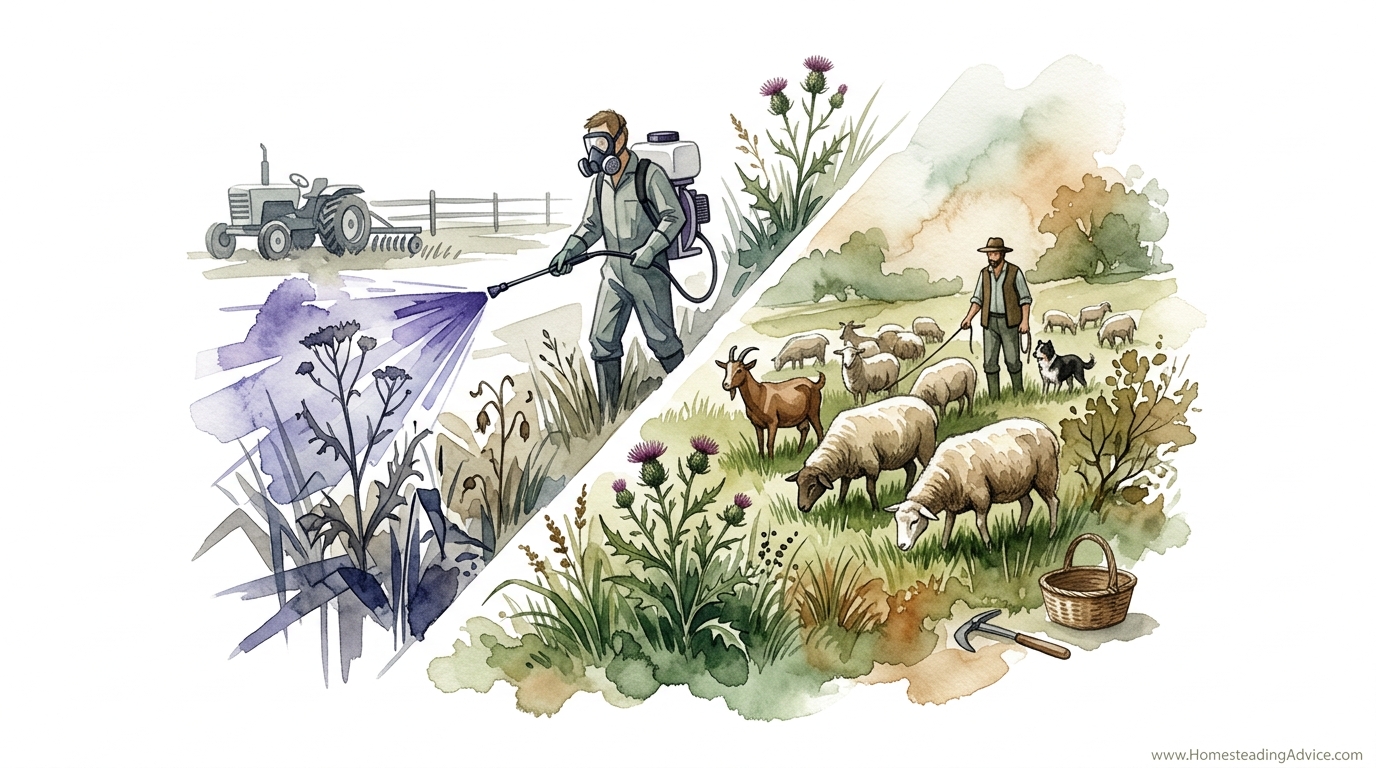
Why spend a fortune on chemicals to kill the very ‘weeds’ your livestock consider a gourmet, high-protein feast? Every time you spray herbicides, you aren’t just killing weeds – you’re killing the soil biology that feeds your grass. Natural grazing turns ‘nuisances’ into meat and milk for free, while building a resilient ecosystem that chemicals can’t touch.
Managing a pasture is often seen as a battle against nature, a constant struggle to keep the “bad” plants out so the “good” ones can thrive. However, when we shift our perspective from chemical warfare to biological management, those troublesome weeds reveal themselves as valuable indicators and high-quality forage. Organic pasture weed control isn’t about total eradication; it is about restoring balance to the land using the tools nature provided: hooves, teeth, and healthy soil biology.
Traditional chemical approaches often provide a temporary “clean” look, but they fail to address why the weeds appeared in the first place. By understanding the lifecycle of your pasture and the needs of your animals, you can transform a ragged field into a productive, self-sustaining ecosystem. This guide will walk you through the practical, hands-on strategies for managing pastures without synthetic inputs, focusing on self-reliance and the wisdom of integrated systems.
Organic Pasture Weed Control Strategies
Organic pasture weed control is the practice of managing undesirable plant growth through biological, mechanical, and cultural methods rather than synthetic herbicides. Instead of viewing weeds as an enemy to be destroyed, this strategy treats them as symptoms of underlying soil conditions or management gaps. In the real world, this looks like using sheep to eat the broadleaf plants cattle won’t touch, or adjusting grazing rotations to allow desirable grasses to outcompete invaders.
At its heart, this approach relies on the principle that nature abhors a vacuum. If there is a bare patch of soil or a mineral deficiency, a plant specifically adapted to those conditions will move in to fill the gap. Thistles often thrive in compacted soil because their deep taproots can break through layers that grass roots cannot. By identifying these patterns, you can use weeds as a free soil test, telling you exactly where your management needs to shift.
Think of your pasture as a complex community. In a diverse “herbal ley” or mixed pasture, what one species considers a weed, another considers a vital nutrient source. Organic control strategies leverage this diversity to maximize the total yield of the land. For example, while a cattle producer might curse the appearance of chicory or dandelions, a closer look reveals these plants are often higher in minerals like magnesium and zinc than the surrounding ryegrass.
The Indicator Method: Listening to the Land
Plants are the most honest storytellers on your farm. If you see an abundance of buttercups, your soil is likely too wet or acidic. If ragweed is taking over, it often points to low fertility and overgrazing. Understanding these signals allows you to address the root cause—such as applying lime to raise pH or improving drainage—rather than just cutting down the plant. This proactive approach saves time and money by solving the problem at its source.
How to Implement Biological and Mechanical Controls
Success in organic weed management requires a toolbox of techniques that work together. It is rarely a single “silver bullet” solution. Instead, it is a series of well-timed interventions that weaken the weeds while strengthening the forage you want to keep.
Multi-Species Grazing: The Competitive Edge
One of the most effective ways to manage weeds is to diversify the mouths eating them. Different livestock have different “palatability hierarchies.” Cattle are primarily grass-eaters and will often leave broadleaf weeds behind. However, sheep and goats are naturally inclined toward those very broadleaf plants and woody brush. By running multiple species together—or in a “leader-follower” system—you can ensure that almost every plant in the pasture is being utilized as forage.
Goats, for instance, are famous for their ability to handle thorny brush and weeds like multiflora rose or blackberry briers. Sheep will aggressively target thistles and leafy spurge if managed correctly. When these animals graze the weeds down, they prevent the plants from going to seed and force them to use up their root energy for regrowth. Over several seasons, this constant pressure can significantly reduce even the most stubborn infestations.
Mob Grazing and High-Density Impacts
Mob grazing involves putting a large number of animals on a small area for a very short period—sometimes just a few hours. This creates a high “stocking density.” In this environment, animals become less selective. They don’t have the luxury of picking only the tender clover; they eat what is in front of them, including many weeds they might otherwise ignore. Furthermore, the concentrated “hoof action” tramples remaining weeds into the ground, creating a mulch layer that prevents new weed seeds from germinating while feeding the soil biology.
Mechanical Timing: The Art of the Clip
Mowing or clipping is a vital mechanical tool, but timing is everything. To effectively kill or suppress a weed, you must clip it when its root reserves are at their lowest. For most biennial weeds like Musk Thistle, this is just as the plant begins to “bolt” or send up a flower stalk, but before it actually sets seed. If you mow too early, the plant simply regrows from the root. If you mow too late, you are just helping to spread the seeds across your field.
- Annual Weeds: Mow before they flower to prevent the seed bank from growing.
- Biennial Weeds: Mow in the second year during the early bloom stage.
- Perennial Weeds: Require repeated clippings over several years to starve the deep root systems.
Frost Seeding and Overseeding
To prevent weeds from moving in, you must keep the “grazing interface” occupied with desirable plants. Frost seeding is a traditional technique where you broadcast clover or grass seed over the frozen ground in late winter or early spring. The natural freeze-thaw cycle of the soil—expanding and contracting—works the seed into the earth without the need for heavy machinery. This fills in the bare spots where weeds would otherwise take hold, creating a thick, competitive sward.
Benefits of the Organic Approach
Choosing biological and mechanical controls over chemical ones offers measurable advantages for both the farmer’s bottom line and the health of the livestock.
Nutritional Superiority: Many common pasture weeds are actually “superfoods” for livestock. Dandelions, for instance, can have a digestibility rate of over 80% and are packed with vitamins. Chicory and plantain are deep-rooted “miners” that bring up minerals from deep in the subsoil, providing trace elements that shallow-rooted grasses cannot reach. By grazing these plants, you are providing your animals with a more balanced, mineral-rich diet for free.
Soil Health and Resilience: Synthetic herbicides can have a detrimental effect on mycorrhizal fungi and other soil microbes. These microbes are the “engine room” of your pasture, responsible for nutrient cycling and water retention. By avoiding chemicals, you foster a living soil that can better withstand droughts and floods. Healthy soil produces healthy plants, which in turn require fewer external inputs.
Economic Independence: The cost of chemical sprays, equipment maintenance, and fuel adds up quickly. Organic strategies rely on the labor of the animals themselves. When your cattle or sheep are “baling” the weeds and turning them into meat, they are working for you rather than you working for the chemical company. This builds a more resilient and profitable farm model that is less vulnerable to fluctuating input prices.
Challenges and Common Mistakes
The biggest hurdle in organic weed control is often the shift in mindset. It requires more observation and “thinking time” than a simple spray schedule. Here are the most common pitfalls to avoid:
Overgrazing: The Number One Enemy. When you let animals stay on a pasture too long, they eat the most desirable plants down to the roots. This weakens the “good” grass and leaves bare soil exposed. Weeds, which are often survivalists, quickly move into these gaps. Maintaining a minimum “residual” height—usually 3 to 6 inches (7.5 to 15 cm) depending on the species—is essential to keep the grass competitive.
Lack of Rest Periods. Pastures need time to recover. If you don’t allow for a proper rest period between grazing events, the root systems of your forage plants will shrink. A weakened root system cannot compete with the deep, aggressive roots of weeds like Canada Thistle. Depending on the season and moisture levels, rest periods might range from 20 to 60 days or more.
Ignoring Toxic Plants. While many weeds are nutritious, some are deadly. You must be able to identify plants like Poison Hemlock, Water Hemlock, or Nightshade. Livestock will generally avoid these if they have plenty of other food, but in a drought or overgrazed situation, they may eat them out of desperation. Organic management means knowing which plants must be physically removed from the field to protect your herd.
Limitations and Realistic Constraints
It is important to be realistic about what organic methods can achieve in a single season. Biological control is a long-term game of attrition, not a quick fix.
In cases of extreme infestation where a field is 80% weeds and 20% forage, “management” might not be enough. You may need to look at a total pasture renovation, which could involve multi-year cover cropping with competitive plants like sorghum-sudangrass to “smother” the weeds before re-seeding a permanent pasture. Environmental factors also play a huge role; in exceptionally wet years, certain weeds like buttercup or rushes may be impossible to control solely through grazing, as the soil is too fragile for heavy animal traffic.
Furthermore, biological controls such as releasing specific insects (like the weevil for Musk Thistle) can take several years to establish a population large enough to make a dent. This requires patience and a willingness to accept a few “messy” fields while the ecosystem stabilizes. If you require a perfectly manicured, golf-course look, the organic approach may not meet your aesthetic expectations, even if it is more productive for the animals.
Comparison: Biological Control vs. Chemical Spraying
| Feature | Biological/Organic Control | Chemical Spraying |
|---|---|---|
| Direct Cost | Low (Uses existing livestock/labor) | High (Herbicides, fuel, machinery) |
| Effect on Soil | Builds biology and organic matter | Can harm microbial life/fungi |
| Livestock Health | Diverse, mineral-rich diet | Risk of residue; monoculture diet |
| Speed of Results | Slow (2-5 years for full impact) | Fast (Visible kill in days) |
| Skill Level | High (Requires observation/ecology knowledge) | Moderate (Calibration/application) |
Practical Tips and Best Practices
Implementing these strategies requires a steady hand and a keen eye. Use these best practices to optimize your results:
- Invest in High-Quality Electric Fencing: The ability to move animals quickly and contain them at high densities is the foundation of biological weed control. Portable “polywire” allows you to create temporary paddocks to target specific weed patches.
- Know Your Weeds: Keep a pocket guide or use an app to identify weeds at every stage of growth—from seedling to seed-set. Knowing when a plant is most vulnerable is half the battle.
- Soil Test Regularly: Don’t guess, test. A simple pH imbalance can be the primary reason your clover is failing and your sorrel is thriving. Aim for a pH between 6.0 and 7.0 for most temperate pastures.
- Leave More Residual: The old rule of thumb is “graze half, leave half.” This leaves enough leaf area for the grass to continue photosynthesizing and keeps the ground shaded, which prevents many weed seeds from germinating.
- Use “Sacrifice Lots” in Muddy Weather: When the ground is saturated, keep animals off the main pasture. Their hooves will tear up the sod, creating the perfect nursery for weeds like dock and thistle.
Advanced Considerations: The Soil-Mineral Connection
For the serious practitioner, weed management eventually leads to the study of soil minerals. Some researchers suggest that specific weeds appear in response to mineral imbalances. For example, a heavy infestation of velvetleaf or pigweed might indicate an excess of potassium or a deficiency in calcium. By using the Albrecht method of soil balancing—focusing on the ratios of calcium, magnesium, and potassium—you can create a soil environment where desirable forages are so vigorous that weeds simply cannot find a place to grow.
Consider also the role of allelopathy. Some plants, like rye or certain clovers, release chemicals into the soil that inhibit the germination of other seeds. Integrating these “smother crops” into a rotation can provide a biological “cleanse” for a field, resetting the weed bank without the need for fire or chemicals.
Example: Reclaiming a Thistle-Infested Field
Imagine a 10-acre (4-hectare) pasture that has been continuously grazed by cattle for a decade. It is now dominated by Canada Thistle and Musk Thistle, with bare patches of ground and thin grass. A chemical approach would be to spray 2,4-D, which would kill the thistles but also eliminate any remaining clover, leaving the soil even more nitrogen-depleted.
Instead, an organic practitioner might follow this three-year plan:
Year 1: Bring in a flock of sheep or goats during the early spring to target the thistle rosettes. Clip the thistles with a mower in mid-summer just as the flower buds appear. Frost-seed 5 lbs per acre (5.6 kg/ha) of red and white clover in the late winter to begin fixing nitrogen.
Year 2: Implement a 30-day rotational grazing schedule. Increase the stocking density so the cattle are forced to trample the remaining thistle stalks. Continue to clip any plants that escape the animals before they can set seed. Apply lime if soil tests show acidity.
Year 3: The clover has now thickened the sward, providing natural nitrogen to the grass. The thistles, weakened by two years of root depletion and increased competition, are now only found in isolated patches. The field is now more productive, supporting more animal units than it did when the project began.
Final Thoughts
Organic pasture weed control is more than just an alternative to chemicals; it is a return to a more holistic, observant way of farming. It recognizes that every plant has a purpose and that the best way to manage the land is to work with the natural tendencies of our livestock and the hidden life within the soil. By turning “nuisances” into a free resource, we build farms that are more resilient, more profitable, and more in tune with the cycles of the seasons.
Success won’t happen overnight, but the results of a biological approach are long-lasting. As you develop your “grass eye” and learn to read the stories the weeds are telling you, you’ll find that you are no longer fighting nature, but partnering with it. This shift in perspective is the hallmark of a true steward of the land, ensuring that your pastures remain healthy and productive for generations to come.
Don’t be afraid to experiment. Start with one field, try a new grazing rotation, or borrow a few goats from a neighbor. The wisdom of the past, combined with modern ecological understanding, provides all the tools you need to build a thriving, chemical-free pasture. The path to self-reliance begins with the very first step into the field.