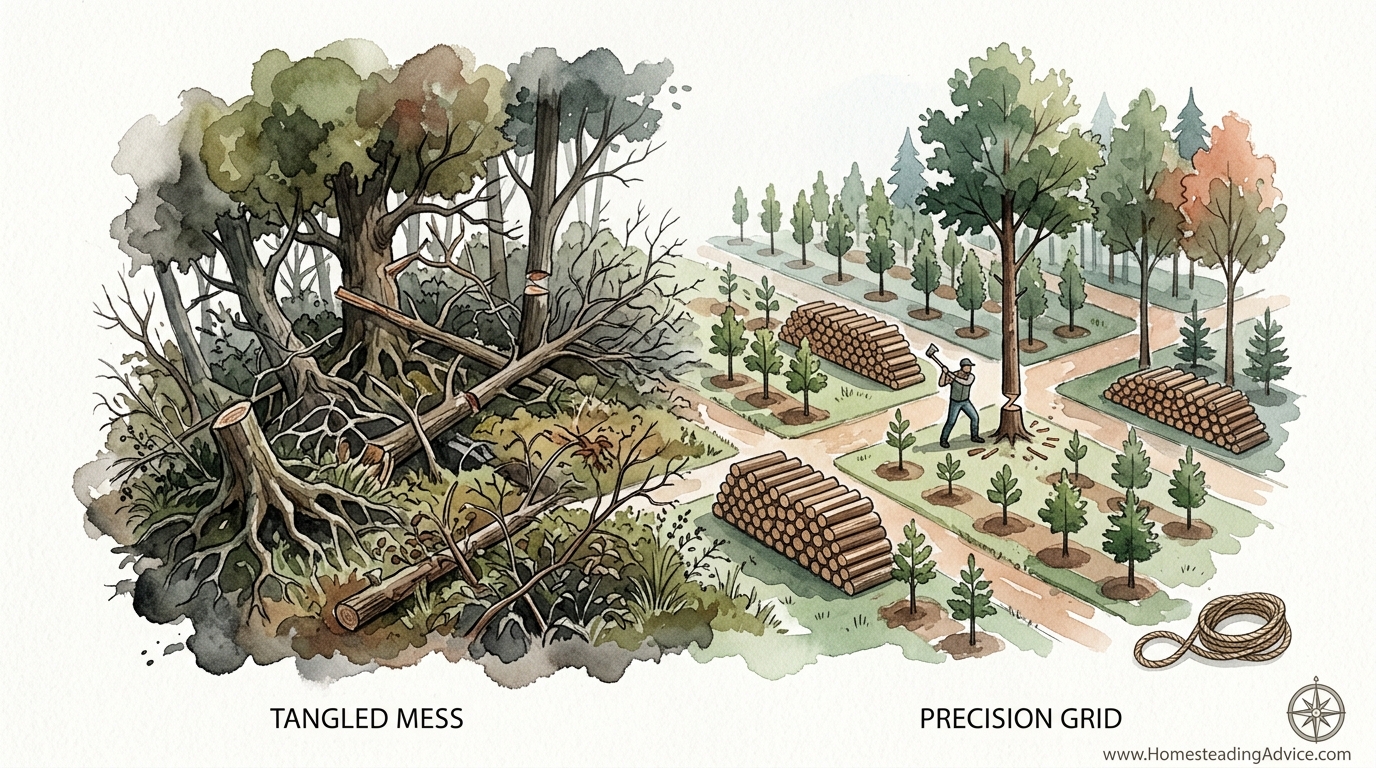
Stop wrestling with a tangled disaster and start working with a forest that opens its doors to your tractor. Random felling doesn’t just make your work harder; it destroys the next generation of trees. A little geometry today saves a thousand hours of struggle tomorrow.
Working in the woods is a dance between the needs of the land and the limits of your own muscle. When you approach a woodlot with a chainsaw and a plan, you are doing more than just cutting fuel or clearing space. You are shaping the future of that forest. A woodlot that is managed with precision feels different underfoot; it has a rhythm and a logic that makes every task, from skidding logs to thinning brush, safer and more efficient.
The difference between a “tangled mess” and a “precision grid” is often just a few degrees of felling angle. If you drop trees wherever they happen to lean, you create a jackstraw pile that is a nightmare to navigate. If you drop them with a plan, you create corridors of productivity. This guide will walk you through the practical steps of felling for long-term woodlot health, focusing on techniques that respect the timber and the person working it.
How To Fell Trees For Woodlot Management
Woodlot management felling is the practice of cutting trees in a specific pattern to improve the health of the remaining forest while making the removal of timber easier. Unlike clear-cutting, where everything goes, woodlot management focuses on “thinning from below” or “selective harvesting.” You are choosing which trees stay and which trees go based on their health, species, and how they impact their neighbors.
In a real-world scenario, imagine a five-acre (2-hectare) stand of mixed hardwoods. If left alone, these trees compete for sunlight and nutrients, leading to a crowded, stagnant forest. By felling specific trees, you release the “crop trees”—the healthy ones you want to keep—so they can grow faster. This process is used by homesteaders for firewood, by farmers for fence posts, and by small-scale loggers for high-value sawlogs.
The goal is to create a “precision grid” where trees are felled in a predictable direction, usually toward a pre-determined extraction trail. This keeps the forest floor organized. Instead of a chaotic landscape of crisscrossed trunks, you have a clean workspace where your equipment can move without damaging the bark of the standing “keeper” trees.
The Mechanics of Directional Felling
The heart of a managed woodlot is directional felling. This is the skill of making a tree land exactly where you want it, rather than where it wants to go. It requires an understanding of the tree’s natural lean, the weight of the canopy, and the physics of the hinge.
Start by assessing the “extraction path.” Before you even start your saw, look at where your tractor or winch is located. You want the butt of the tree to land near the trail, with the top pointing away. This “herringbone” pattern is a classic woodsman technique. It allows you to hook up a chain and pull the log straight out without the top getting hung up on standing timber.
The most reliable method for this is the “open-face notch.” You cut a wedge out of the front of the tree that is at least 70 to 90 degrees wide. This wide notch allows the tree to stay attached to the “hinge”—the thin strip of wood left between the notch and the back cut—all the way until it hits the ground. If the notch is too shallow, the hinge will snap early, and you lose control of the fall.
The Precision Grid vs. The Tangled Mess
In a “tangled mess” approach, a feller moves from tree to tree based on convenience. They cut what is closest and drop it wherever the lean is easiest. This leads to trees “hung up” in the branches of others, creating incredibly dangerous tension points. It also forces the operator to drive their equipment all over the forest floor, compacting the soil and damaging the roots of the trees they intended to save.
In a “precision grid,” the woodlot is treated like a warehouse. You establish primary skid trails—usually 10 to 12 feet (3 to 3.6 meters) wide—spaced about 60 to 100 feet (18 to 30 meters) apart. Every tree you fell is aimed at a 45-degree angle toward these trails. This creates a “fishbone” effect. When it comes time to haul the wood out, you stay on the trail, winch the logs to the tractor, and pull them out in one smooth motion.
This organized approach protects “regeneration.” In the gaps where sunlight hits the floor, new seedlings will sprout. If you have felled your trees in a grid, these seedlings won’t be crushed by logs being dragged haphazardly across the ground. You are effectively “farming” the forest for the next generation.
Benefits of Strategic Woodlot Felling
The most immediate benefit is safety. Most woods accidents happen when a tree does something unexpected or when a feller is working in a cramped, cluttered environment. By felling in a systematic way, you always have a clear “escape path”—a 45-degree route away from the falling tree—and a clean workspace.
Efficiency is the second major advantage. If you spend four hours felling and eight hours struggling to get the logs out of a mess, you have wasted a full day’s labor. In a managed grid, the extraction time is often cut in half. The logs are already oriented for the pull, and the trail is clear.
Long-term forest health is the third benefit. Removing “wolf trees”—large, low-quality trees with massive spreading crowns—allows sunlight to reach the “pole timber” below. This increases the growth rate of your best trees. A managed woodlot can often produce twice as much usable timber over a twenty-year period compared to an unmanaged one.
Common Mistakes and Pitfalls
The most common error is ignoring the “side lean.” A tree rarely leans perfectly in one direction. Most have a “heavy side” where the branches are thicker. If you don’t account for this by “steering” the hinge, the tree will pull to the side, missing your target and potentially hitting a high-value crop tree.
Another mistake is “over-cutting” the hinge. Beginners often cut the back-cut too far, severing the hinge entirely. Once the hinge is gone, the tree is a loose pillar of thousands of pounds of wood. It can slide off the stump (a “kickback”) or spin in mid-air. Always leave about 10% of the tree’s diameter as a solid, uniform hinge.
Many people also fail to clear the “felling zone.” This isn’t just about people; it’s about debris. Small saplings or heavy brush at the base of the tree can trip you as you try to move away. Always take five minutes with a brush hook or a small saw to clear a three-foot (1-meter) radius around the trunk and two clear paths leading away at an angle.
Limitations and Environmental Constraints
Precision felling is not always possible in extreme terrain. On very steep slopes, gravity takes over, and the risk of a log “sliding” or “rolling” outweighs the benefits of a grid pattern. In these cases, trees are often felled “across the slope” to catch them on the stumps of other trees, which is a specialized and dangerous technique.
Species also play a role. Brittle woods like Willow or some species of Pine can “shatter” or “snap” if they hit the ground too hard or if they are felled against their natural lean. In these instances, you may have to sacrifice your grid pattern to ensure the tree lands safely and remains in one piece.
Weather is a final constraint. High winds can turn a precision felling operation into a lottery. Even a light breeze can catch the “sail” of a leafy canopy and push a tree off its intended course. If the wind is gusting above 15 miles per hour (24 kilometers per hour), it is usually time to shut down the saw and head inside.
Comparing Felling Strategies
| Feature | Random Felling (Tangled Mess) | Precision Grid Felling |
|---|---|---|
| Setup Time | Minimal | Moderate (planning trails) |
| Extraction Effort | Very High (snags, turns) | Low (straight pulls) |
| Forest Impact | High (soil compaction, bark damage) | Low (concentrated traffic) |
| Safety Rating | Low | High |
| Skill Level | Beginner | Intermediate to Advanced |
Practical Tips for Success
Invest in a good set of felling wedges. These high-impact plastic wedges are driven into the back-cut with a forest axe. They do two things: they prevent the tree from sitting back and “pinching” your saw bar, and they allow you to physically “lift” the tree over its center of gravity. A two-dollar wedge can save a thousand-dollar chainsaw.
Use a “felling sight” on your saw. Most professional saws have a line etched or molded into the plastic housing. This line is perpendicular to the bar. When you are making your notch, point that line exactly where you want the tree to fall. If the line points at a rock, the tree will hit the rock. Trust the sight.
Always look up. This sounds simple, but many people focus only on the trunk. Look for “widowmakers”—dead branches hanging in the canopy. The vibration of the saw can shake them loose, sending a “spear” of wood straight down. If a tree has heavy deadwood, it may be better to leave it for a professional or pull it down with a winch from a safe distance.
Advanced Woodlot Considerations
For those looking to scale their operations, consider the “directional felling” of entire groups of trees to create “light gaps.” Instead of removing one tree here and there, you remove a small cluster. This mimics natural “windthrow” events and is excellent for encouraging species like Oak or Black Walnut that need significant sunlight to germinate.
Think about the “log length” before you cut. If you are milling your own lumber, know what lengths you need (e.g., 8, 10, or 12 feet / 2.4, 3, or 3.6 meters). When felling, try to land the tree in a spot where you have enough room to “buck” it (cut it into lengths) without the log being under “bind” or tension from the ground’s contour.
Soil moisture is an advanced timing factor. Felling and skidding during the “mud season” (late winter/early spring in many regions) can do permanent damage to the soil structure. The weight of a tractor or even a heavy log can create deep ruts that act as drainage ditches, washing away topsoil. Professional woodlot managers often wait for the ground to be “bone dry” or “iron frozen.”
Scenario: The Overcrowded Maple Grove
Consider a grove of Sugar Maples that hasn’t been touched in forty years. The trees are tall and “spindly,” with small crowns because they are too close together. To manage this for syrup or timber, you would first flag your skid trail through the center.
You identify “suppressed” trees—those with the smallest crowns—as your first targets. Using the precision grid method, you fell these trees away from the trail at 45-degree angles. By dropping them away from the “crop trees,” you ensure the branches of the keepers aren’t broken. Within two years, the remaining Maples will expand their crowns into the new space, increasing their sap production and diameter growth significantly.
Final Thoughts
Mastering the art of felling for woodlot management is a journey of observation. It requires you to slow down and look at the forest as a system rather than just a collection of wood. When you move from the “tangled mess” to a “precision grid,” you aren’t just making your life easier; you are acting as a steward of the land.
The skills of the notch, the hinge, and the extraction trail are the fundamentals of self-reliance in the woods. They allow a single person with a saw and a modest tractor to accomplish work that would otherwise require heavy industrial machinery. It is a quiet, disciplined way of working that pays dividends in safety and forest health.
As you gain experience, you will find that the woods start to “tell” you where the trees want to go. You will see the gaps before they exist and the trails before they are cut. Take your time, keep your chain sharp, and always respect the weight of the timber. The forest has a long memory; cut it well, and it will provide for you for a lifetime.