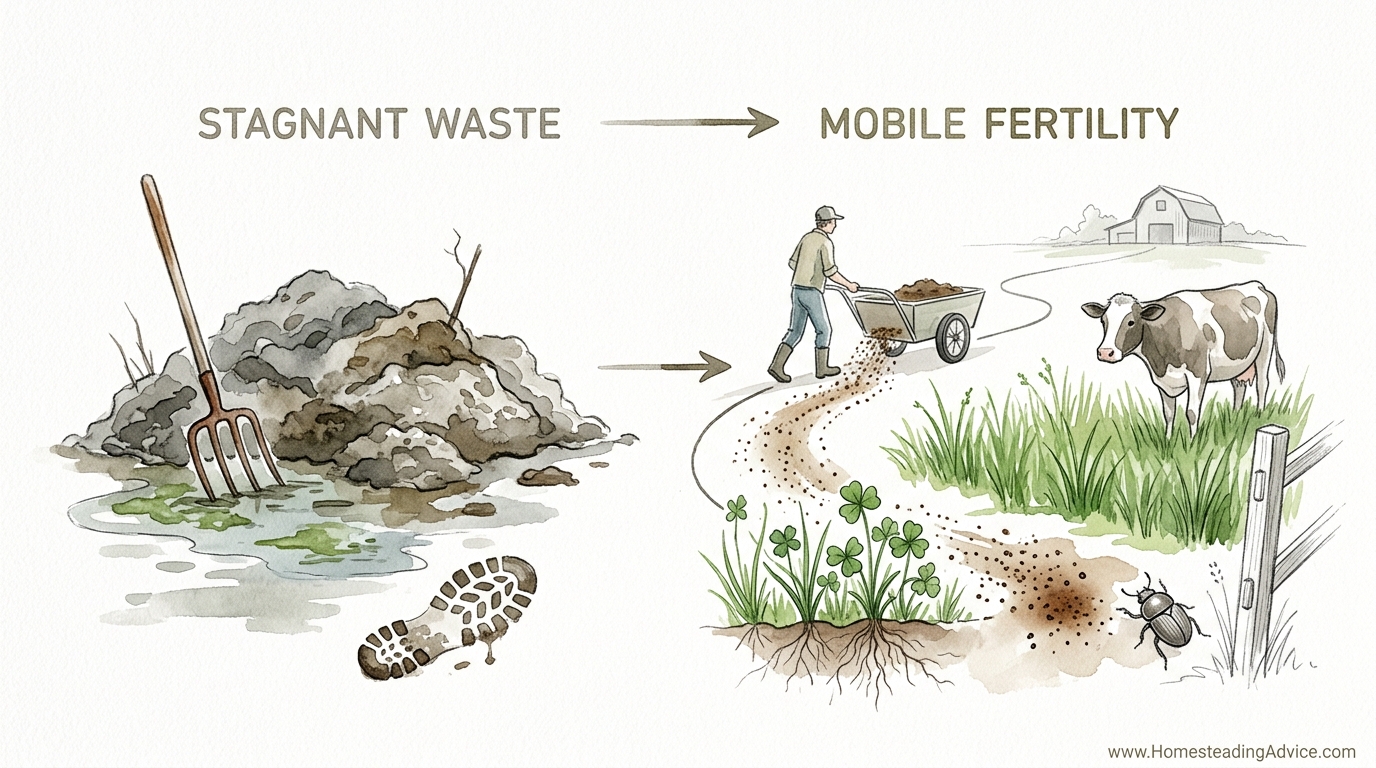
Manure is either a toxic liability in a pile or a gold-mine for your soil when managed as a system. Stop pushing your profits into a corner to rot. By integrating chickens into your cattle rotation, you automate your sanitation. The chickens spread the manure for free, kill the parasites, and turn that ‘waste’ into high-nitrogen soil food and fresh eggs.
Every successful farm is an ecosystem that mimics the wild. Long ago, massive herds of herbivores moved across the plains, followed closely by thousands of birds. These birds acted as the original sanitation crew, cleaning up the mess left behind and ensuring the grass grew back thicker and greener than before. Modern agriculture often forgets this partnership, choosing instead to separate animals into sterile, isolated boxes. This separation creates a “manure problem” that costs time and money to fix.
Regenerative farming turns this problem on its head. Instead of hauling waste or spraying chemicals to kill flies, you let biology do the heavy lifting. Moving chickens behind cattle transforms a smelly byproduct into a potent fertilizer that feeds the grass. This approach builds a self-sustaining cycle where every animal has a job, and every input serves multiple purposes.
Understanding the relationship between the cow and the chicken is the first step toward true self-reliance. This guide explains how to set up a multi-species grazing system that heals the land and puts money back in your pocket. You will learn the science behind the cycle and the practical steps to make it work on your own acreage.
Regenerative Manure Management For Cattle
Regenerative manure management for cattle is a holistic practice that treats livestock waste as a biological asset rather than a waste product. Conventional systems often concentrate manure in feedlots or lagoons, leading to runoff, methane emissions, and lost nutrients. In a regenerative system, manure remains on the pasture where it was dropped, but it is managed to prevent the buildup of pathogens and pests.
The primary goal is to ensure that manure is broken down and incorporated into the soil as quickly as possible. Left alone, a cow “pat” or “pie” can sit on the surface for weeks, killing the grass beneath it and providing a breeding ground for harmful flies and internal parasites. High-density rotational grazing moves the cattle frequently, but the manure still needs to be distributed. This is where the secondary “sanitation” species—typically chickens—comes into play.
This method exists to restore the natural carbon and nitrogen cycles. In the real world, this looks like a “leader-follower” system. The cattle are the leaders, grazing the top portion of the grass and dropping high-carbon waste. The chickens are the followers, scratching through that waste to find larvae and adding their own high-nitrogen manure to the mix. It is used on small-scale homesteads and massive commercial ranches alike to improve soil organic matter and animal health.
Imagine the pasture as a living digestive system. The cattle act as the teeth, breaking down the tall forage. The manure they leave behind is like a meal for the soil, but it needs “chewing” to be absorbed. The chickens act as the second stage of digestion, breaking open the manure piles and mixing them with the earth. Without this interaction, the soil becomes “constipated” with stagnant waste that never reaches the roots of the plants.
The Symbiotic Rotation: How It Works
Success depends entirely on timing. You cannot simply throw chickens and cows into the same field and expect a miracle. The system relies on a specific sequence that respects the life cycles of flies and parasites. Most producers use a three-day lag time between when the cattle leave a paddock and when the chickens arrive.
Timing the arrival of the birds is critical because of fly biology. Flies like the horn fly and stable fly lay their eggs in fresh cattle manure almost immediately. These eggs hatch into larvae, or maggots, within 24 to 48 hours. In warm weather (25-30°C / 77-86°F), these maggots are at their most succulent and visible about three to four days after the manure is dropped. If the chickens arrive too early, the maggots aren’t developed enough to provide a substantial meal; if they arrive too late, the flies have already pupated and flown away.
Rotational grazing provides the framework for this timing. The cattle move into a fresh “paddock” or fenced section every 12 to 24 hours. They eat the best grass and leave behind their waste. Three days later, you move the portable chicken coop, often called an “Egg Mobile” or “Chicken Tractor,” into that same spot. The hens spend the day scratching every manure pile to pieces, effectively “sanitizing” the ground before the fly cycle can complete.
Manure spreading is a side effect of the chicken’s natural scratching behavior. A single cow can produce 30 to 40 kilograms (65 to 90 pounds) of manure per day. If that manure stays in a pile, it creates a “dead zone” in the grass. Chickens can spread a single pile across a 2-square-meter (20-square-foot) area in minutes. This action increases the surface area of the manure, allowing soil microbes and dung beetles to process the nutrients faster and preventing the “smothering” of the forage.
Benefits of Integrated Sanitation
The most immediate advantage is the dramatic reduction in fly populations. Flies are more than just a nuisance; they cause “fly worry” in cattle, which leads to weight loss and reduced milk production. A heavy infestation of horn flies can suck a significant amount of blood from a cow daily. Chickens act as a mobile pest control unit, eating thousands of larvae before they ever become adult flies, which reduces the need for chemical ear tags or “pour-on” pesticides.
Internal parasite control is another major health benefit. Many bovine parasites, such as stomach worms, have a life cycle that involves larvae crawling out of manure and onto blades of grass to be eaten again by the cow. Scratching through the manure exposes these larvae to the sun and air, which kills many of them through desiccation. The chickens also eat the larvae directly, breaking the reinfection cycle and allowing you to reduce your reliance on chemical dewormers (anthelmintics).
Soil fertility receives a massive boost from the “double-dosing” of manure. Cattle manure is high in carbon and organic matter, but chicken manure is a nitrogen powerhouse. Typical chicken manure contains about 1.1% nitrogen, which is much higher than the 0.6% found in cattle manure. By combining these two, you create a balanced, slow-release fertilizer that stimulates rapid grass regrowth. Many farmers report that pastures managed this way stay green longer during droughts because the increased organic matter holds more water.
Economic diversification is the hidden gem of this system. Instead of spending money on fertilizer and fly spray, you are producing high-quality, pasture-raised eggs or meat. These products often fetch a premium price at local markets because of their superior flavor and nutrient profile. Pasture-raised eggs have been shown to contain up to seven times more beta-carotene and three times more Vitamin D than conventional store-bought eggs.
Challenges and Common Mistakes
Predation is the most common hurdle for anyone raising birds on open pasture. Foxes, coyotes, hawks, and even domestic dogs see a mobile chicken coop as a buffet on wheels. Farmers often make the mistake of using flimsy fencing or neglecting to lock the birds up at night. Effective systems require heavy-duty electric netting or a secure, predator-proof mobile coop that is closed every evening at dusk.
Water logistics can become a headache as the distance from the barn increases. Chickens require fresh, clean water at all times to maintain egg production, especially in the heat. Carrying buckets across 10 acres is not a sustainable plan. Successful managers often set up a “towed” water tank or a system of black HDPE pipes with quick-connect valves that follow the rotation of the birds.
Labor requirements are higher than in conventional systems. Moving a portable coop and several hundred feet of electric netting every few days takes time and physical effort. Some farmers attempt to move the birds too far at once, which can stress the hens and cause a temporary drop in egg laying. It is better to make small, frequent moves that keep the birds on fresh ground without overwhelming them.
Stocking density is another area where errors occur. Putting too many chickens in a small area for too long will lead to “over-scratching.” This destroys the root base of the grass and leaves the soil bare. Conversely, too few chickens will fail to adequately spread the manure and control the flies. A general rule of thumb is to start with 50 to 100 hens per acre of cattle pasture, adjusting based on how quickly they process the manure piles.
Limitations and Environmental Constraints
Climate plays a significant role in how well this system functions. In regions with harsh winters, the “follower” system usually pauses during the frozen months. Chickens cannot scratch through frozen manure, and their water lines will freeze. During these times, birds must be moved to a sheltered winter paddock or a deep-bedding greenhouse where their manure can be collected and composted for spring application.
Topography can limit the use of certain mobile coops. If your land is extremely steep or rocky, a heavy “Egg Mobile” built on an old bus or trailer frame might be impossible to move safely. In these cases, smaller, lighter “chicken tractors” that can be moved by hand or with an ATV are necessary. Terrain that is prone to flooding also poses a risk, as chickens are much more vulnerable to standing water and dampness than cattle.
Vegetation type matters more than people realize. Chickens do best in pastures with a mix of grasses, clovers, and broad-leafed plants. If the pasture is overgrown with tall, woody weeds or “rank” grass that the cattle refused to eat, the chickens will struggle to move through it and won’t be able to reach the manure piles effectively. This system works best when the cattle graze the grass down to about 10 to 15 centimeters (4 to 6 inches) before the birds arrive.
Integrated Management vs. Conventional Separation
Comparing these two methods highlights the difference between a “input-based” and a “process-based” farm. Conventional separation requires the farmer to be the middleman, moving nutrients by hand or machine. Integrated management allows the animals to perform those tasks as part of their daily life.
| Factor | Conventional Separation | Integrated Management |
|---|---|---|
| Fly Control | Chemical sprays, ear tags, or “pour-ons.” | Biological control via chicken predation. |
| Fertilizer Cost | High (buying N-P-K bags). | Zero (produced on-site by animals). |
| Manure Handling | Mechanical scraping or piling. | Automated spreading via scratching. |
| Parasite Load | Requires frequent chemical deworming. | Lowered naturally through life-cycle breaks. |
| Labor Type | Operating machinery/heavy cleaning. | Moving coops and fencing. |
While the integrated approach requires more observation and daily movement, it eliminates the recurring costs of chemicals and diesel. The “complexity” of the system is biological, not mechanical, making it more resilient to supply chain disruptions or price hikes in the fertilizer market.
Practical Tips for Implementation
- Use Livestock Guardian Dogs (LGDs): If you have a large flock, a well-trained Great Pyrenees or Anatolian Shepherd can live with the birds and the cattle. This drastically reduces losses from ground predators like coyotes.
- Build a “Shade Mobile”: In hot climates, chickens need protection from the sun. If your mobile coop is small, consider a separate portable shade structure to prevent heat stress.
- Monitor Dung Beetle Activity: Observe your manure piles. If you see deep holes and active beetles, your soil is healthy. Be careful with chemical dewormers, as they can kill these beneficial insects.
- Vary the Lag Time: In cooler weather, fly larvae grow slower. You may need to wait 4 or 5 days instead of 3. In the peak of summer heat, you might need to move the birds in after only 48 hours.
- Fencing Setup: Use 50-meter (164-foot) rolls of electric poultry netting. It is easier to handle than longer rolls and allows for more flexible paddock shapes.
Advanced Considerations for Scaling
Serious practitioners often look beyond just “cows and chickens.” Adding a third species, like hair sheep or goats, can further improve the manure management system. Sheep and goats eat the “weeds” that cows leave behind, and they carry different parasites. Integrating them into the rotation further breaks the life cycles of species-specific worms.
Multi-flock management is another way to scale. Instead of one massive coop, some farmers use several smaller units spread across the landscape. This prevents the “over-concentration” of birds in one spot and allows for more precise manure spreading. High-volume egg producers often use an “Egg Mobile” built on a converted school bus or a large hay trailer, which can house up to 500 or 1,000 birds.
Genetic selection becomes important as you scale. Not all chicken breeds are suited for the “follower” lifestyle. You want active, curious birds with strong foraging instincts. Breeds like the Rhode Island Red, Plymouth Rock, or various “Australorp” crosses are much better at hunting larvae than high-production White Leghorns, which can be flighty and less interested in scratching through manure.
Carbon-to-nitrogen ratios are the final frontier of soil health. Cattle manure is carbon-heavy, while chicken manure is nitrogen-heavy. Monitoring the “regrowth” of your grass will tell you if the balance is right. If the grass comes back a dark, bluish-green, your nitrogen levels are high. If it stays pale or yellow, you may need to increase the number of chickens or decrease the speed of the rotation to allow more manure accumulation.
A Realistic Scenario: The 20-Acre Homestead
Consider a farm with 10 beef steers and 150 laying hens. The farmer divides the 20 acres (8 hectares) into 1-acre paddocks using temporary electric wire. Every two days, the steers are moved to a fresh paddock. They leave behind approximately 400 kilograms (880 pounds) of manure per acre during their stay.
Following three days behind the steers, the farmer moves the 150 hens into the used paddock. The hens are contained within a 50-by-50 foot (15-by-15 meter) area of electric netting that surrounds their mobile coop. In one day, these 150 birds will visit and scratch apart every single manure pile in that area. They consume roughly 5 to 10 grams of larvae and insects per bird, reducing their need for purchased grain by 10-15%.
After a full season (6 months of grazing), the farmer notices that the “poverty grass” and weeds are being replaced by lush white clover and orchardgrass. The steers have gained weight at a rate of 0.8 kilograms (1.8 pounds) per day without any supplemental feed. The hens have produced an average of 120 eggs per day, which the farmer sells to neighbors. Most importantly, the fly population around the steers is negligible, and a fecal egg count shows that the internal parasite load in the cattle is well below the threshold for chemical treatment.
Final Thoughts
Regenerative manure management is more than just a farming technique; it is a shift in perspective. It requires you to stop seeing waste as a burden and start seeing it as the fuel for your land’s fertility. By simply reintroducing the bird to the herbivore, you solve the problems of sanitation, pest control, and fertilization in one fell swoop.
Success does not require expensive machinery or a degree in agronomy. It requires a keen eye for the cycles of nature and a willingness to move a fence and a coop every few days. The sweat equity you put into moving those birds is repaid ten times over in the health of your soil, the vigor of your livestock, and the quality of the food you produce.
Start small, observe your land, and let the animals teach you. Every manure pile that is scratched into the soil is a deposit into your farm’s long-term wealth. Once you see the grass explode with growth behind the chickens, you will never want to go back to the old way of pushing your profits into a rot pile again.