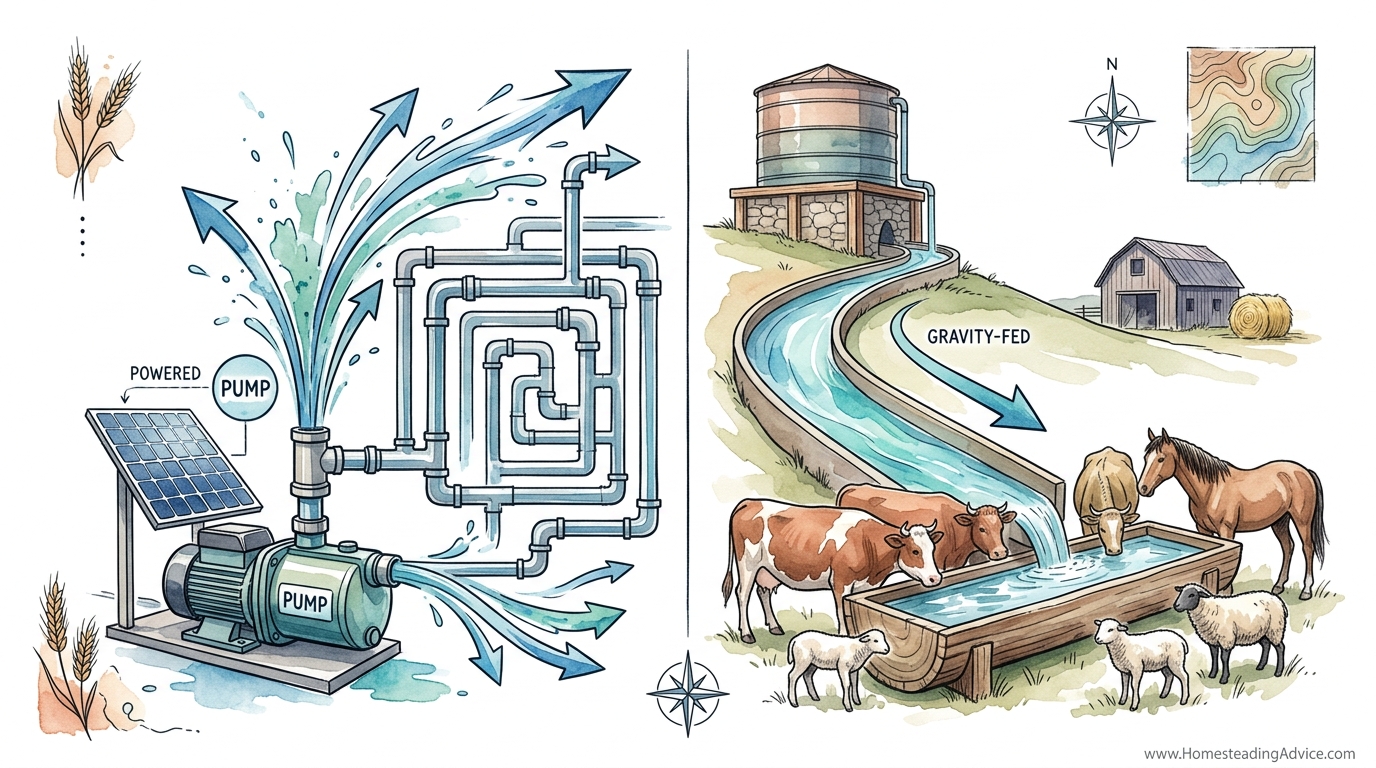
Stop paying for fuel and electricity to move your water when gravity is willing to work for you 24/7 for free. Every time you pull that starter cord on a water pump, you’re burning your farm’s profit. Passive keyline design doesn’t just save money; it transforms your entire landscape into a giant, self-filling sponge.
Moving water across a farm is often the most expensive and exhausting chore a producer faces. Most folks rely on noisy generators, temperamental solar pumps, or expensive grid-tied motors to keep their troughs full. While these tools have their place, they are fragile links in your farm’s infrastructure. If the fuel runs out or the sun stays behind the clouds for a week, your livestock are in trouble.
Working with the natural contours of your land allows you to build a system that never sleeps and never sends you a bill. This approach is about more than just pipes and tanks. It is a fundamental shift in how you view your acreage. You stop seeing hills as obstacles and start seeing them as high-capacity batteries for potential energy.
Gravity Fed Irrigation For Livestock
Gravity fed irrigation for livestock is the practice of capturing water at a high elevation and allowing the weight of the water itself to push it through pipes to lower-lying troughs or pastures. It is a system built on the simple physics of “head pressure.” For every foot (0.3 meters) of vertical drop from your source to your outlet, the water gains a predictable amount of weight and pressure.
In a real-world setting, this usually involves a pond, a spring box, or a large header tank perched on the highest ridge of the property. From there, a network of underground pipes carries the water down-slope. This method is the backbone of traditional hill farming and has been perfected by innovators like P.A. Yeomans through his Keyline Plan.
Imagine a spring flowing at the top of a hill. Naturally, that water would cut a narrow path straight down to the valley floor, likely causing erosion and leaving the surrounding ridges bone-dry. A gravity system captures that flow at the source. Instead of letting it escape, you direct it into a pipe and “steer” it to exactly where your cattle or sheep are grazing.
This system exists because it is the most reliable way to hydrate animals in remote areas. On large ranches or rugged homesteads, running electrical lines for miles is financially impossible. By using the landscape’s natural geometry, you can deliver thousands of liters (or gallons) of water per day without a single moving part other than a simple float valve in a trough.
The Physics of Flow: How Gravity Water Systems Work
Understanding how to move water without a pump requires a basic grasp of head pressure. Water has mass, and gravity pulls that mass toward the earth. When water is confined in a pipe, that downward pull translates into pressure that can be measured at the bottom.
To calculate your potential, you must measure the vertical drop, not the length of the pipe. One foot of vertical drop produces approximately 0.433 pounds per square inch (PSI) of static pressure. If you have a tank 100 feet (30.5 meters) higher than your trough, you will have roughly 43 PSI at the bottom, which is similar to standard household water pressure.
Static pressure is what you have when the water is not moving. The moment you open a valve and water begins to flow, you encounter “friction loss.” As water rubs against the inside of the pipe, it loses energy. This is called dynamic pressure. If your pipe is too small or your run is too long, the friction can eat up all your pressure, resulting in a weak trickle at the trough.
Selecting the right pipe diameter is the most important decision in the design phase. A 1-inch (25mm) pipe has significantly more friction than a 2-inch (50mm) pipe. For most gravity systems, using a pipe that is slightly larger than you think you need is a wise investment. Larger pipes move more volume with less resistance, ensuring that even if your vertical drop is minimal, the water reaches the destination with enough force to trigger the float valve.
Implementing Keyline Principles for Passive Flow
Keyline design is a landscape management system developed by P.A. Yeomans in Australia during the 1950s. It focuses on the “Scale of Permanence,” which ranks farm elements from the most difficult to change to the easiest. Topography and water are at the very top of that list.
The “keypoint” of a valley is the specific spot where the slope changes from convex to concave. This is where water naturally begins to concentrate and where erosion often starts. By placing a pond or a catchment at this keypoint, you are catching the water at the highest possible point where significant volume is available.
From this keypoint pond, you can run a “keyline” which is a line that falls away from the contour at a very slight grade, perhaps 1 in 200 or 1 in 500. This grade is just enough to keep the water moving via gravity without gaining enough speed to cause erosion. These lines allow you to “comb” water out of the wet valleys and move it toward the dry ridges.
Ripping the soil with a subsoiler along these keylines further enhances the gravity system. The small furrows act as tiny underground canals, slowing down runoff and forcing it to soak into the ground. This creates a “soil reservoir” that stays hydrated long after the rain stops, effectively watering your livestock’s forage from below using the same gravitational principles.
Benefits of Choosing Passive Flow Over Active Pumping
Reliability is the primary advantage of a gravity-fed system. Mechanical pumps are prone to failure; seals leak, impellers clog, and electrical components fry during lightning storms. A gravity system, once installed correctly and protected from freezing or physical damage, can operate for decades with almost zero maintenance.
Cost savings represent the most immediate impact on your farm’s bottom line. The initial investment in pipe and tanks might be higher than a cheap gas pump, but the operational cost is zero. You are effectively locking in your water delivery costs at today’s prices for the next thirty to fifty years.
Environmental health is another major factor. Passive systems do not produce noise pollution that can stress livestock or wildlife. They also eliminate the risk of fuel spills near your water source. Furthermore, by distributing water to high ridges, you encourage your animals to graze uphill, which helps spread manure and nutrients more evenly across your pastures.
Water quality often improves in these systems as well. When water is stored in a high header tank or a clean hilltop pond, it is less likely to be contaminated by runoff from lower-lying agricultural areas. Providing clean, cool water at the trough has been shown to increase livestock weight gain and overall herd health.
Challenges and Common Pitfalls to Avoid
Air locks are the most common enemy of the gravity-flow pioneer. If your pipe goes over a hump that is higher than the water source, air will get trapped at the peak. This air bubble acts like a physical plug, stopping the flow of water entirely. Always try to maintain a consistent downward grade, or install air release valves at every high point in the line.
Pipe sizing errors can cripple a system before it starts. Many beginners try to save money by using small-diameter garden hoses or 1/2-inch (13mm) poly pipe over long distances. Over a 1,000-foot (300-meter) run, the friction loss in a small pipe can be so high that even a 50-foot (15-meter) drop won’t produce a usable flow.
Sediment accumulation can eventually clog your lines if you pull water directly from a pond or a spring. Using a “header tank” or a “settling box” allows sand and silt to drop to the bottom before the water enters your main delivery pipe. Adding a fine-mesh screen at the intake, wrapped in a protective cage, prevents tadpoles, leaves, and debris from entering the system.
Livestock damage is a constant threat to any farm infrastructure. Cattle are heavy and like to rub against anything they can find. If your pipes are sitting on the surface, they will eventually be crushed or disconnected. Burying your main lines at least 12 to 18 inches (30 to 45 centimeters) deep is essential for long-term success.
Limitations: When Gravity Might Not Be Enough
Topography is the ultimate gatekeeper. If your water source is lower than your troughs, gravity simply cannot help you. Siphon systems can occasionally pull water over small rises, but they are notoriously difficult to prime and maintain. In flat landscapes, you may still need to use a pump to lift water to a high central tank before letting gravity take over the distribution.
Flow rate requirements can also limit the effectiveness of passive systems. If you have a large herd of several hundred thirsty cattle arriving at a trough at once, a slow gravity feed might not be able to keep up. In these cases, you need a larger “storage buffer” at the delivery point—meaning a very large trough or a secondary tank—to ensure there is enough water on hand for peak demand.
Environmental extremes, such as deep permafrost or severe drought, require specialized designs. In cold climates, pipes must be buried below the frost line, which can be several feet deep. In extremely arid regions, the evaporation from a header pond might be greater than the inflow, making an enclosed tank a better choice for gravity storage.
Comparison: Passive Gravity Flow vs. Active Pumping
| Feature | Passive Gravity Flow | Active Pumping (Gas/Solar) |
|---|---|---|
| Energy Cost | Zero | High (Fuel) or Low (Solar) |
| Reliability | Extremely High (No moving parts) | Moderate (Mechanical wear) |
| Initial Setup Cost | Moderate (Requires pipe & earthwork) | Low to Moderate |
| Maintenance | Minimal (Cleaning filters) | Regular (Oil, filters, repairs) |
| Dependence | Landscape Topography | Weather or Fuel Supply |
Practical Tips and Best Practices
Always install a high-quality float valve that matches your pressure. If you have very low pressure (less than 5 PSI), a standard high-pressure valve may never fully open or close. Look for “low-flow” or “full-port” float valves that allow the maximum amount of water through with minimal resistance.
Using High-Density Polyethylene (HDPE) pipe is generally better than using PVC for farm water lines. HDPE is more flexible, handles freezing better without cracking, and comes in long rolls which minimizes the number of joints. Joints are almost always the point where a system will fail, so reducing their number is a priority.
Install shut-off valves at both ends of your main line and at every trough. If a leak develops in one section of the farm, you want to be able to isolate that area without draining your entire water supply. Marking these valves with a permanent stake or a GPS point will save you hours of digging later.
Protect your troughs from “trough-tipping” by anchoring them to the ground. A half-empty trough is light enough for a playful calf or a thirsty bull to push around. Setting your troughs on a pad of crushed stone or concrete also prevents the area from turning into a muddy bog, which helps control parasites and foot rot.
Advanced Considerations: Siphons and Buffering
For those looking to push the limits of gravity design, a siphon system can pull water from a pond and over a dam wall without cutting a trench through the embankment. This requires the outlet to be lower than the intake, and the pipe must be perfectly airtight. Once primed, the weight of the water falling down the back of the dam pulls more water up and over the top.
Buffering is a technique used when your source flow is very slow, such as a “seep” spring that only produces 2 liters (0.5 gallons) per minute. Instead of piping that trickle directly to a trough, you pipe it into a massive “header tank” on a hill. Over 24 hours, that slow seep will collect 2,880 liters (about 760 gallons). When the livestock drink, they draw from this large reservoir at a high flow rate, and the tank refills slowly throughout the night.
Scaling your system can be done by linking multiple ponds at different elevations. Using the “Cascade” method, an upper pond overflows into a swale that leads to a lower pond, which then feeds the gravity lines. This creates multiple layers of redundancy and increases your total water storage capacity across the entire landscape.
Scenario: Watering 50 Beef Cattle on a 40-Acre Slope
Imagine you have 50 beef cattle that require approximately 2,000 liters (530 gallons) of water per day. Your water source is a spring located at an elevation of 350 meters (1,148 feet). Your primary grazing paddock is located at 330 meters (1,082 feet), exactly 300 meters (984 feet) away.
A 20-meter (65-foot) vertical drop gives you roughly 28 PSI of static pressure. If you use a 1.25-inch (32mm) HDPE pipe, your friction loss over 300 meters at a flow rate of 40 liters per minute is negligible. This ensures your trough will refill almost as fast as the cattle can drink.
By installing a 5,000-liter (1,320-gallon) header tank at the spring site, you create a two-day reserve. If the spring slows down during a mid-summer heatwave, your cattle won’t even notice. The float valve in the trough keeps the water level constant, and the cattle stay on the ridge, grazing the high ground and leaving their nutrients where the grass needs them most.
Final Thoughts
Building a gravity-fed irrigation system for your livestock is one of the most rewarding investments you can make in your farm’s resilience. It is a quiet, permanent solution that respects the laws of nature while protecting your profit margins. Once the trenches are backfilled and the water is flowing, you gain a peace of mind that no mechanical pump can provide.
Every gallon of water moved by gravity is a gallon you didn’t have to pay for or worry about. This approach connects you more deeply to your land, forcing you to observe its slopes, its hidden springs, and its natural rhythms. It is the way our ancestors watered their herds, and it remains the gold standard for sustainable agriculture today.
Start small by testing a single line from a high tank to a nearby trough. Observe the flow, learn how to clear air locks, and see how your animals react. Once you master the basics of head pressure and friction, the entire landscape becomes a tool for your success. Applying these principles ensures that your farm will remain productive and hydrated for generations to come.