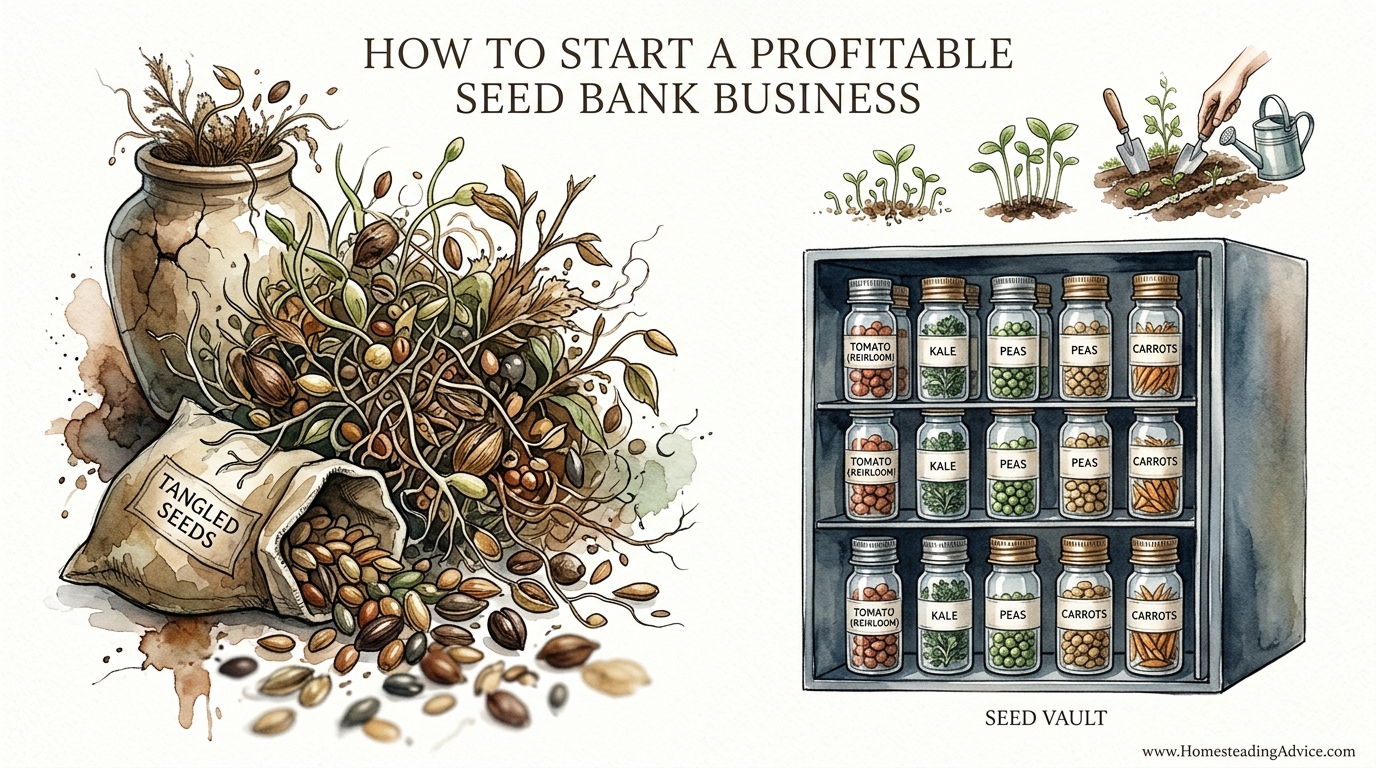
Is your garden’s future a tangled mess of mystery packets or a curated library of genetic wealth? Rare seeds are the ‘currency’ of the homestead world. If your seeds are in a messy box, you’re losing value. Organize your way to a high-demand heirloom seed business.
For generations, the true wealth of a farm was not found in the bank, but in the burlap sacks and glass jars tucked away in a cool cellar. These seeds represented a lineage of resilience—plants that had survived the lean years, the droughts, and the early frosts. Today, as global supply chains waver, the demand for these “genetic antiques” is skyrocketing.
Starting a seed bank is more than a hobby; it is an act of stewardship and a viable business. By transitioning from a casual gardener to a professional seed saver, you are providing a service that high-end chefs, market gardeners, and dedicated homesteaders are desperate to find. You are moving from TANGLED SEEDS—a box of unknown vitality—to a SEED VAULT that functions as a high-precision business inventory.
How To Start A Profitable Seed Bank Business
A seed bank business involves the cultivation, harvest, cleaning, and sale of open-pollinated (OP) seeds. Unlike hybrid seeds, which are the result of a specific cross that does not “breed true” in the next generation, heirloom and open-pollinated seeds produce offspring nearly identical to their parents. This allows the grower to save seeds year after year, making them a sustainable and highly valued asset.
In the real world, a seed business operates much like a high-end rare book dealer. You aren’t just selling a commodity; you are selling history, flavor, and a localized adaptation that commercial seeds simply cannot match. For instance, a “Mortgage Lifter” tomato seed isn’t just a tomato; it’s a 1930s Appalachian story of economic survival packaged in a 4-gram (0.14 oz) envelope.
This business exists because biodiversity is shrinking. Modern industrial agriculture focuses on about a dozen varieties of major crops. A profitable seed bank thrives in the margins, preserving the thousands of rare varieties that offer superior nutrition, pest resistance, and unique aesthetic appeal. It is used by local farmers wanting crops adapted to their specific microclimate and by home gardeners seeking the “best-tasting” varieties their grandparents once grew.
How to Establish a High-Standard Seed Operation
Success in this field is built on three pillars: genetic purity, high germination rates, and meticulous record-keeping. If you fail at any of these, your business is just a hobby with a paper trail. To move from garden-scale to commercial-scale, you must master the mechanics of the plant’s life cycle.
1. Mastering Isolation Distances
To keep a variety “true-to-type,” you must prevent it from cross-pollinating with different varieties of the same species. Wind and insects don’t care about your business plan; they will carry pollen between your *Cherokee Purple* and your *Red Brandywine* if they are too close. For commercial seed quality, follow these standard isolation distances:
- Beans and Peas: Primarily self-pollinating. Provide at least 6–15 meters (20–50 feet) of separation between varieties.
- Tomatoes: Mostly self-pollinating, but “currant” types or potato-leafed varieties cross easily. Isolate by 15 meters (50 feet).
- Peppers: High rate of cross-pollination by bees. Isolate by 150 meters (500 feet) or use blossom bags.
- Corn: Wind-pollinated. Requires a massive isolation distance of 1.6–3.2 kilometers (1–2 miles) to prevent contamination from field corn or other sweet corn.
- Squash and Melons: Insect-pollinated and highly promiscuous. Isolate by 800 meters (0.5 miles) or practice hand-pollination and taping of blossoms.
2. Preventing the Genetic Bottleneck
You cannot save seed from just one “perfect” plant. To maintain the genetic health of the variety, you need a diverse population. Saving seed from too few plants leads to inbreeding depression, where the variety loses its vigor over several years. For a commercial seed bank, aim for a minimum of 20–50 plants for self-pollinators like tomatoes, and at least 100–200 plants for cross-pollinators like corn or onions.
3. The Cleaning and Processing Phase
Clean seeds aren’t just for aesthetics; they prevent disease and ensure proper storage. There are two primary methods of processing: dry and wet.
Dry Processing: Used for beans, peas, lettuce, and grains. Allow the pods or seed heads to dry completely on the plant until they are brittle. Use screens or a winnowing fan to separate the “chaff” (plant debris) from the heavy seeds. Commercial growers often use a series of specialized screens with different mesh sizes to ensure only the plumpest, most viable seeds remain.
Wet Processing: Used for tomatoes, cucumbers, and squash. For tomatoes, the seeds are encased in a gel-like sac that inhibits germination. You must ferment the seeds in water for 2–4 days at room temperature (21°C / 70°F). This breaks down the sac and kills many seed-borne pathogens. Once the healthy seeds sink to the bottom, rinse them thoroughly and dry them quickly on a non-stick surface like a screen or glass plate.
Practical Tips: The Science of Storage
Once your seeds are cleaned, the clock starts ticking on their viability. Professional seed bankers use the James Rule (also known as the Harrington Rule) to maintain their inventory. The rule is simple: The storage temperature (in degrees Fahrenheit) plus the relative humidity (%) should be less than 100.
- Temperature Control: For every 5.5°C (10°F) drop in temperature, seed longevity doubles. Most active seed banks store their inventory at 4°C (40°F) in a dedicated refrigerator.
- Moisture Control: For every 1% reduction in seed moisture, longevity also doubles. Aim for a seed moisture content between 5% and 8%. Use indicating silica gel packs in airtight glass jars or Mylar bags to reach these levels.
- The Dark Factor: Light is a trigger for metabolic activity. Store your seeds in opaque containers or in a dark room to keep the embryos “sleeping” for as long as possible.
Benefits of a Seed Bank Business
The primary advantage of this business is the high profit margin per square foot. A single 15-meter (50-foot) row of high-demand heirloom peppers can produce thousands of seeds. While a farmer selling the peppers as food might make $200, a seed saver selling the same harvest as 100 packets of 25 seeds each at $4.00 per packet can make $400 from the same space.
Localized seeds are also more valuable. If you breed a tomato that thrives in the short, damp summers of the Pacific Northwest or the high heat of the Arizona desert, you have a product that big-box retailers cannot compete with. Your customers are buying success in their specific environment, not just a packet of seeds.
Furthermore, this business model fosters resilience and independence. You are the curator of your own production chain. You do not rely on a distributor to send you seeds in the spring; you are the source. In a world where seed patents and genetic modification are common, providing clean, open-pollinated stock is an act of high-demand heritage preservation.
Challenges and Common Mistakes
One of the most frequent errors is incorrect labeling. If you sell a packet labeled “Habanero” and the gardener grows out a mild pepper because of cross-pollination in your garden, you have lost a customer for life. Trust is the only currency that matters in the seed world. You must be ruthless about culling “off-types”—plants that don’t look like the variety is supposed to look.
Another pitfall is moisture entrapment. If you seal seeds in a jar before they are fully dry, you aren’t creating a vault; you’re creating a mold incubator. Seeds should be dry enough to snap, not bend. A “hammer test” (hitting a seed to see if it shatters rather than squishing) is a common old-world check for dryness in large seeds like corn and beans.
Many beginners also ignore germination testing. Before selling a lot, you must test its viability. This involves placing a sample of 20–100 seeds in a damp paper towel in a warm spot and counting how many sprout after a set period (usually 7–14 days). If your germination rate is below 85% for most vegetables, you cannot sell them at premium prices.
Limitations and Regulatory Constraints
While a seed bank is profitable, it has environmental boundaries. You cannot easily grow tropical seeds in temperate zones without significant infrastructure. Furthermore, some crops are biennial, meaning they only produce seed in their second year. Crops like carrots, onions, and beets require you to overwinter the roots and replant them the following spring, which doubles the time and labor required for a single harvest.
Legally, seed sales are regulated to protect the agricultural food supply. In the United States, the Federal Seed Act sets standards for labeling and purity. Most states require a low-cost seed dealer’s license and have specific requirements for what must appear on your label (the variety name, lot number, germination percentage, and test date). In the European Union, the rules are even stricter, requiring varieties to be listed on the Common Catalogue to be marketed commercially, though “conservation varieties” often have exemptions.
| Crop Type | Lifespan (Years) | Critical Storage Factor |
|---|---|---|
| Onions, Parsnips | 1–2 | Extreme sensitivity to humidity |
| Corn, Beans, Peas | 3–5 | Must be protected from weevils |
| Tomatoes, Peppers | 4–10 | Highly stable if kept cool |
| Cucumber, Squash | 5–10 | Excellent long-term viability |
Advanced Considerations for Scaling
As your business grows, you will transition from manual winnowing to mechanical aids. Investing in a set of graduated seed cleaning screens allows you to process 5 kilograms (11 lbs) of seed in the time it once took to do 500 grams (1 lb). Scaling also requires a more robust inventory system. Each batch of seed should have a Lot Number that tracks the year grown, the specific field location, and the date of the last germination test.
Consider the “Landrace” approach for a premium product line. Unlike standard heirlooms, landrace seeds are a diverse mix of a single species that has been allowed to cross-pollinate within a specific environment. This creates a “population” that is incredibly hardy. Selling “High-Desert Landrace Melons” targets a niche of practitioners who value survival and adaptability over rigid uniformity.
Scenario: The Fish Pepper Case Study
Imagine you decide to specialize in the *Fish Pepper*, a rare 19th-century heirloom used in the oyster houses of the Mid-Atlantic. You start with 100 plants in an isolated high-tunnel to ensure no cross-pollination with your bell peppers. Each plant produces roughly 30–50 peppers. One gram (0.035 oz) of pepper seed contains roughly 140 seeds. From 100 plants, you could easily harvest 500 grams (1.1 lbs) of clean seed.
If you package these into 1,000 packets of 40 seeds each, and sell them for $4.50 per packet, your gross revenue is $4,500. Your primary costs are the initial organic potting soil, the high-tunnel plastic, and your time. The “genetic wealth” of that single 1.1 lbs of seed is immense compared to the labor required to grow the peppers for fresh sale.
Final Thoughts
Building a profitable seed bank is a journey from the “tangled mess” of the amateur to the “library” of the professional. It requires the grit to cull weak plants and the patience to wait for the biennial harvest. However, the rewards are both financial and foundational. You aren’t just selling seeds; you are selling the ability for others to feed themselves and their families with crops that have stood the test of time.
Start small with two or three varieties that you know well. Master the isolation distances and the drying process. As your confidence grows, so will your vault. In the world of the homestead, those who hold the seeds hold the future. By following these professional standards, you ensure that your garden’s legacy remains pure, profitable, and permanent.
Explore the history of your chosen varieties and tell that story to your customers. The connection between the soil, the seed, and the table is a powerful one, and your role as a seed librarian is the most important link in that chain. Get your jars ready—the harvest is coming.