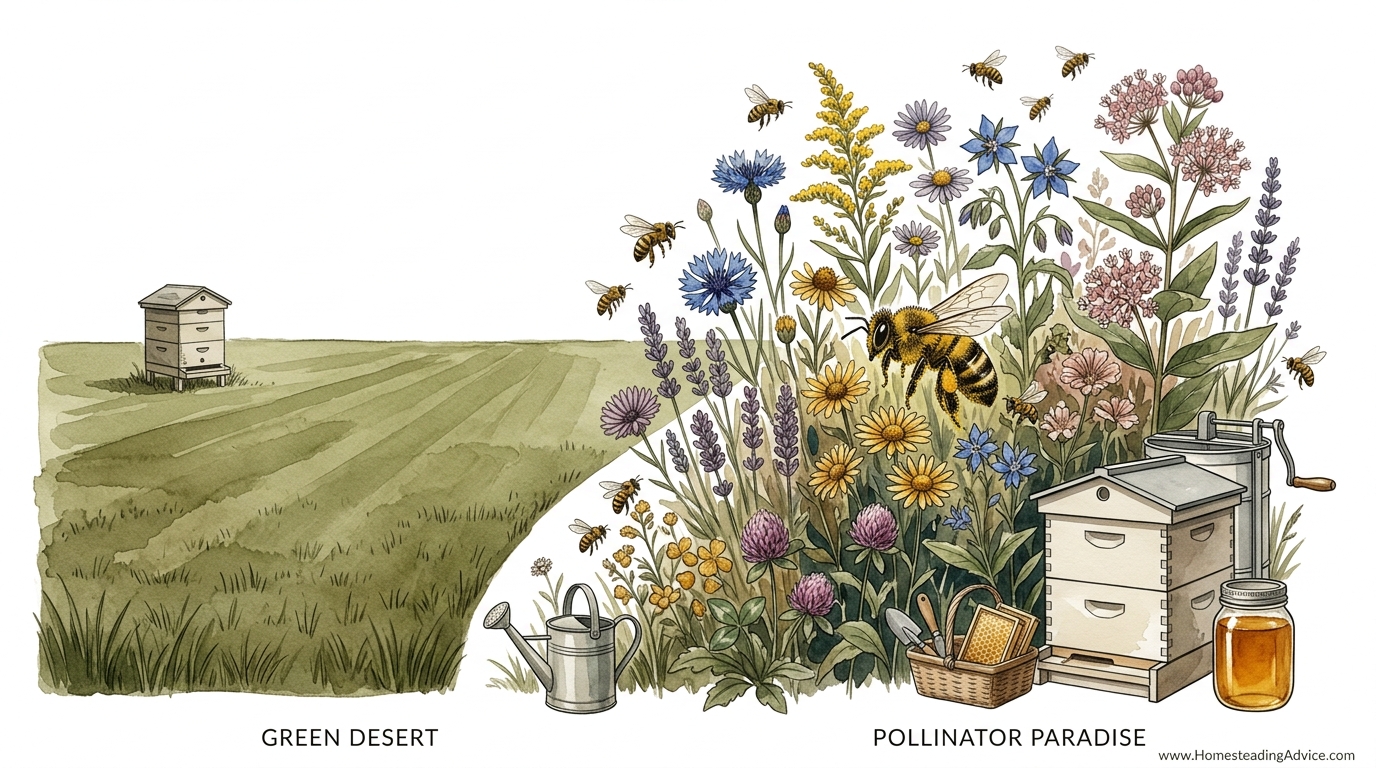
Your ‘perfect’ lawn is actually a food desert that is starving your beehive to death. We were taught that a clean, green lawn was the gold standard of homeownership. But for a honeybee, that pristine grass is a wasteland. By letting just 20% of your yard go ‘wild’ with native blooms, you aren’t just being lazy – you’re building a high-octane refueling station that can triple your honey production.
Modern landscaping has prioritized aesthetics over ecology for decades. While a manicured lawn might look tidy to a neighbor, it offers zero nutritional value to a honeybee colony. These “green deserts” force bees to fly miles in search of sustanance, burning precious energy that could otherwise be used to build wax or cure honey.
Returning to a more traditional, wilder approach to land management is not just about helping the environment; it is about maximizing the output of your apiary. Ancestral wisdom suggests that a hive thrives best when the forage is at its doorstep. When you replace a fraction of that lawn with high-nectar wildflowers, you reduce the “commute” for your foragers and see the results in your supers.
How To Increase Honey Yield With Wildflowers
Increasing honey yield with wildflowers is the practice of strategically planting or encouraging diverse, nectar-rich native plants within the immediate foraging range of a beehive. It exists because honeybees are “optimal foragers,” meaning they seek the highest caloric reward for the lowest energetic cost. Research shows that even small-scale land development can nearly double the flight distance and energy expenditure of bees, whereas proximity to high-quality forage significantly boosts hive weight and survival.
Think of a honeybee like a cargo plane. If the refueling station is five miles (8 km) away, the plane must burn a significant portion of its fuel just to reach the destination and return. If the fuel is right next to the runway, the plane can carry more cargo and make more frequent trips. In beekeeping, that “cargo” is nectar, and the “fuel” is the sugar the bee consumes to stay airborne. Reducing that flight distance is the most effective way to turn a struggling colony into a honey-producing powerhouse.
This method is used by backyard beekeepers, commercial apiarists, and sustainable farmers who recognize that 1 acre (0.4 hectares) of high-quality wildflower forage can support multiple hives far more effectively than a 10-acre (4-hectare) monoculture of grass. It turns a yard into a productive ecosystem rather than a maintenance-heavy vanity project.
The Mechanics of Nectar Flow and Forage Density
Understanding how wildflowers translate into honey requires a look at the “nectar flow.” Flowers produce nectar to attract pollinators, but the quantity and sugar concentration vary by species and environmental conditions. A diverse wildflower patch ensures that something is always blooming, preventing “nectar dearths” where bees might otherwise starve during dry spells or between major crop blooms.
High-quality wildflower meadows can produce significant quantities of honey per acre. For example, some estimates suggest that well-managed clover or wildflower blocks can yield anywhere from 30 to 150 pounds (13 to 68 kg) of honey per hive depending on the variety and weather conditions. Diversity is the key here; while a single crop like sunflowers might provide a massive burst of nectar, it only lasts for a few weeks. A wildflower mix provides a continuous supply from early spring through late autumn.
Forage density also impacts the health of the bee’s immune system. Much like humans, honeybees thrive on a varied diet. The diverse compounds found in wildflower nectar, such as flavonoids and phenolic acids, help boost a colony’s resistance to diseases and parasites. This leads to a larger, healthier workforce capable of collecting even more honey.
How to Convert Your Lawn to a Pollinator Paradise
Starting a wildflower conversion does not require tilling your entire property. The “20% Rule” is a practical starting point for most homeowners. Dedicating just one-fifth of your outdoor space to native blooms creates a sufficient “refueling station” for your hives without sacrificing all your recreational space.
- Identify the Site: Choose a sun-drenched area that receives at least 6 to 8 hours of direct sunlight. Most high-nectar wildflowers require heat and light to maximize sugar production in their nectar.
- Site Preparation: Clear the existing grass. You can do this through solarization (covering the area with clear plastic for 6 weeks) or by simply scalping the grass and roughly raking the soil. Avoid heavy tilling, as this often brings dormant weed seeds to the surface.
- Seed Selection: Use a mix that is native to your specific region. Native plants have co-evolved with local pollinators and are more resilient to your local climate and soil conditions.
- Sowing: Scatter seeds in the fall or early spring, depending on your climate. Many native seeds require a period of cold “stratification” (winter chill) to germinate.
- Establishment: Water the area lightly during the first few weeks if the weather is dry. Once established, native wildflowers are typically drought-tolerant and require far less water than a traditional lawn.
Patience is a virtue in this process. Many perennial wildflowers spend their first year growing deep root systems and may not bloom fully until the second season. Mixing in some annuals like Zinnias or Cosmos can provide immediate nectar rewards while the perennials mature.
Benefits of a Wildflower-Rich Landscape
Choosing a wildflower meadow over a manicured lawn provides measurable advantages for both the beekeeper and the land. The shift from a “Green Desert” to a “Pollinator Paradise” creates a ripple effect of benefits.
Increased Honey Production: The most direct benefit is the increase in honey yield. Because bees spend less time and energy flying, they can bring back more nectar per trip. Studies have shown that hives located near diverse floral resources gain weight faster and produce more surplus honey for the beekeeper to harvest.
Reduced Maintenance Costs: Lawns are expensive to maintain. They require constant mowing, fertilization, and watering. A wildflower meadow, once established, requires mowing only once or twice a year—typically in late autumn after the seeds have dropped. This saves money on fuel, equipment, and water bills.
Improved Soil Health: Native wildflowers often have deep “taproots” that can reach 5 to 15 feet (1.5 to 4.5 meters) into the ground. These roots break up compacted soil, improve water infiltration, and sequester carbon far more effectively than the shallow roots of turfgrass.
Challenges and Common Mistakes
Transitioning to a wilder landscape is not without its hurdles. Many beginners make the mistake of assuming “wild” means “unmanaged,” which can lead to problems with neighbors or invasive species.
The “Weed” Misconception: Neighbors may view your burgeoning meadow as a neglected yard. To avoid this, “frame” your wildflower area with a mowed border or a split-rail fence. This signal of “intentionality” shows that the wild look is a deliberate choice rather than laziness.
Invasive Species Overrun: If you do not properly clear the ground before planting, aggressive non-native weeds may outcompete your wildflowers. Regular “spot-weeding” during the first year is essential to ensure your native plants get the foothold they need.
Using Treated Seeds: Never buy wildflower seeds that have been treated with neonicotinoids or other systemic pesticides. These chemicals are designed to kill insects and can be expressed in the nectar and pollen, which is toxic to the very bees you are trying to save.
Limitations and Practical Constraints
While wildflowers are a boon for bees, they are not a magic bullet for every situation. Environmental and legal constraints must be considered before you start digging.
Urban and suburban areas often have strict Homeowners Association (HOA) rules or city ordinances regarding “weed height.” In these cases, a full meadow might be prohibited. You can work around this by planting “bee-friendly” flower beds or using lower-growing species like White Clover (Trifolium repens) or Self-heal (Prunella vulgaris), which can tolerate some mowing while still providing nectar.
Soil type also dictates what will grow. If you have heavy clay or pure sand, you must select species specifically adapted to those conditions. Planting a “prairie mix” in a swampy area will result in failure. Always test your soil pH and drainage before ordering expensive seed mixes.
Practical Tips for Maximum Nectar Flow
To truly maximize your honey yield, you should aim for a “succession of bloom.” This means having different species that flower at different times throughout the year.
- Early Spring: Dandelions and fruit trees are vital. Do not spray or mow dandelions in the spring; they are often the first high-energy food source available to a colony coming out of winter.
- Mid-Summer: This is usually when the “Main Flow” occurs. Plants like Bee Balm (Monarda), Echinacea, and Milkweed (Asclepias) provide the bulk of the nectar for your honey harvest.
- Late Autumn: Goldenrod and Asters are essential for winter survival. Bees use this late-season nectar to build up the stores they need to stay warm through the winter months.
- Water Access: Bees need water to cool the hive and dilute honey. Providing a shallow water source with landing stones near your wildflower patch will keep them from drowning while they drink.
Comparison: Lawn vs. Wildflower Meadow
| Feature | Manicured Lawn | Wildflower Meadow |
|---|---|---|
| Honey Production | Negligible to Zero | High (can triple yield) |
| Maintenance | Weekly mowing / fertilization | Annual mowing / no fertilizer |
| Water Needs | High (1 inch / 2.5 cm per week) | Low (drought tolerant) |
| Biodiversity | Very Low (Monoculture) | Very High (50+ bee species) |
| Cost of Upkeep | Expensive ($$$) | Economical ($) |
Advanced Considerations for Serious Practitioners
Experienced beekeepers can take this a step further by tailoring their wildflower patches to specific honey flavors or medicinal properties. For example, planting large stands of Lavender or Thyme can subtly influence the aroma and flavor profile of the honey, creating a premium “monofloral” product.
Consider the “micro-climate” of your yard. Cold air settles in low spots, which can delay blooming in the spring. South-facing slopes warm up faster and can provide an “early start” for your foragers. Strategically placing your hives at the top of a slope allows bees to fly downhill when they are heavy with nectar, saving them even more energy on the return trip.
Scaling up to larger acreage requires different equipment. While a backyard gardener can hand-broadcast seeds, a serious practitioner with several acres (hectares) may need a “no-till drill” to ensure good seed-to-soil contact without disturbing the existing ecosystem. This method preserves the fungal networks in the soil which help native plants thrive.
Real-World Example: The One-Acre Transformation
Imagine a beekeeper with two hives and a one-acre (0.4-hectare) grass paddock. In the first year, they mowed the grass weekly and harvested only 20 pounds (9 kg) of honey per hive, as the bees had to fly to a distant clover field.
In the second year, the beekeeper converted the center half-acre (0.2 hectares) into a native wildflower meadow. They planted a mix of Purple Coneflower, Wild Bergamot, and Partridge Pea. By reducing the flight distance from miles to yards, the bees were able to make more frequent foraging trips. The colony population grew rapidly due to the consistent pollen supply.
The result? That autumn, the beekeeper harvested 65 pounds (29 kg) of honey per hive—more than triple the previous year’s yield. Furthermore, the hives entered winter with full deep boxes of honey, requiring no supplemental sugar feeding. The time spent on lawn maintenance dropped from 40 hours a year to just 4 hours of spot-weeding and a single autumn mow.
Final Thoughts
Reclaiming your land from the “green desert” is an act of stewardship that pays dividends in every jar of honey you harvest. It is a return to an older, more honest way of living with the land—one where we provide for the creatures that provide for us. By letting go of the need for a perfect, sterile lawn, you open the door to a vibrant, buzzing ecosystem that supports both your hobby and the health of the planet.
Start small, perhaps with just that 20% wild zone. Watch as the first blossoms appear and the bees descend upon them with a frantic, joyful energy. You will soon realize that the most beautiful thing about your yard isn’t the uniform height of the grass, but the richness of the life it supports. Applying these principles will not only increase your honey yield but will deepen your connection to the natural cycles of the seasons.
Experiment with different native species and observe which ones your bees prefer. Over time, you will develop a “pioneer’s eye” for the land, knowing exactly what it needs to flourish. The reward for this work is sweet, golden, and entirely earned through a partnership with the wild.