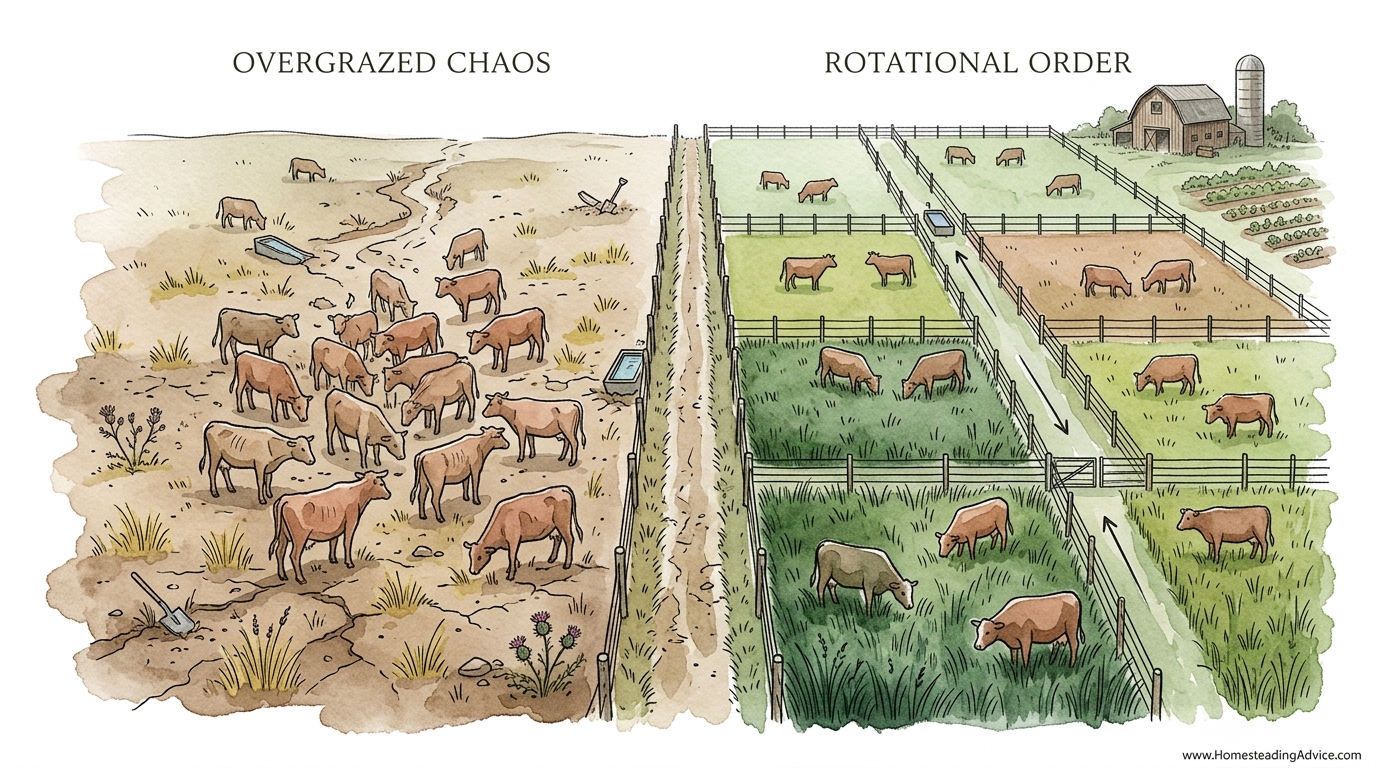
A single fence is just a boundary, but a series of fences is a precision tool for building topsoil overnight. Continuous grazing is a recipe for a desert. Introducing order through rotational cells allows the grass to recover, the soil to breathe, and your livestock to thrive on the highest quality forage possible.
Moving a herd from one patch of dirt to another is about more than just fresh grass. It is a commitment to stewardship and a return to the wisdom of the old ways, where animals moved across the landscape in tight groups, never lingering long enough to sour the ground. This process mimics the natural migration of wild herds and represents the most effective way to manage a homestead or a commercial ranch.
Whether you are running three head of cattle on five acres or three hundred on five hundred, the design of your pastures determines your success. A poorly planned layout leads to wasted labor, mud-caked water troughs, and unevenly grazed fields. A well-designed system makes moving animals a five-minute chore that you actually look forward to.
Best Rotational Grazing Layouts
Choosing the right configuration for your land is the first step in moving from chaos to order. The goal of any layout is to maximize the rest period for your grass while minimizing the labor required to move animals and provide water. In real-world situations, these designs are used to heal tired land, increase the carrying capacity of a farm, and break the life cycles of internal parasites.
A wagon wheel layout, often called the hub-and-spoke system, is perhaps the most iconic design. It features a central area containing the water source and handling facilities, with paddocks radiating outward like the spokes of a wheel. This design is common on properties where installing multiple water points is too expensive or technically difficult.
Grid or block layouts are the standard for intensive management. These involve dividing a large rectangular field into several smaller, square-shaped paddocks. Because square paddocks encourage more even grazing, they are often preferred by those looking to maximize forage utilization. In this system, livestock are moved through the squares in a logical sequence, often using a central lane to reach a water point or the next cell.
Strip grazing is a more fluid approach, often used within larger permanent pastures. A front fence is moved forward daily, and a back fence is moved up to prevent animals from grazing the regrowth of the grass they just ate. This is particularly effective for high-value forage like alfalfa or for “stockpiling” grass for winter use.
Principles of Recovery and Impact
The success of any layout rests on the principle of the “Three Rs”: Rotation, Recovery, and Residual. Rotation is the movement itself. Recovery is the time the plants need to rebuild their root systems and leaf area. Residual is the amount of grass left behind after the animals move.
Livestock should generally be moved into a paddock when the forage is 8 to 10 inches (20 to 25 centimeters) tall and moved out when it is grazed down to 3 to 4 inches (7 to 10 centimeters). Leaving this residual height is critical because it protects the soil from the sun, keeps the ground cool, and ensures the plant has enough leaf surface left to jumpstart photosynthesis for the next growth cycle.
Overgrazing happens when an animal is allowed to bite a plant, stay in the paddock, and then bite that same plant again as it tries to regrow three days later. A proper layout prevents this by ensuring the animals are long gone before the first “regrowth” leaves appear.
How to Design Your Grazing System
Designing a layout starts with a map of your property and a clear understanding of your water resources. Water is the most expensive and difficult piece of the puzzle, so it usually dictates where the fences go. Most cattle will not travel more than 800 to 1,000 feet (240 to 300 meters) for water before they start creating “cow paths” that lead to erosion and uneven manure distribution.
Begin by identifying your perimeter. This fence must be permanent and stout—high-tensile wire or woven wire is standard. Once the perimeter is secure, you can look at interior divisions. Using temporary polywire for interior fences allows you to experiment with different paddock sizes before committing to permanent posts.
Lanes are the arteries of your farm. A lane system connects all your paddocks to a central point, usually a corral or a permanent water tank. Lanes should be wide enough for your equipment and your herd to pass through comfortably, typically at least 12 to 16 feet (3.5 to 5 meters) wide. If a lane is too narrow, it will quickly turn into a mud pit.
Mapping out your paddocks should follow the contours of the land. Avoid running long, narrow paddocks up and down a steep hill. Animals will naturally graze the bottom of the slope near the water and ignore the top. Instead, orient your paddocks along the contour so that the slope is uniform across the grazing area.
Benefits of Managed Rotational Systems
The primary benefit of a well-executed rotation is the exponential increase in soil health. When animals are concentrated in a small area for a short time, they deposit manure and urine evenly across the field. This natural fertilizer is the key to building topsoil. Instead of nutrients piling up under a single shade tree, they are spread across the entire pasture.
Healthy soil leads to healthy forage. Because the plants are given ample time to rest—often 30 to 60 days depending on the climate and season—their roots go deeper into the earth. These deep roots allow the pasture to stay green longer during a drought and soak up more water during heavy rains, reducing runoff.
Internal parasite management is another practical advantage, especially for sheep and goat producers. Most parasite larvae hatch and climb to the top of a blade of grass over a period of 3 to 5 days. Moving your animals every 2 to 3 days means they leave the paddock before the parasites can infect them. Resting that paddock for at least 40 days allows the larvae to die off before the herd returns.
Challenges and Common Mistakes
The most frequent error is sticking to a calendar instead of watching the grass. Grass grows at different speeds depending on the temperature and rainfall. In the spring, when the “green up” is fast, you might need to move animals every day. In the dormant season or during a summer slump, you may need to slow the rotation down or provide supplemental hay in a “sacrifice area” to prevent overgrazing.
Underestimating water requirements is another pitfall. A lactating beef cow can drink up to 20 gallons (75 liters) of water a day in hot weather. If your pipe size is too small or your tank capacity is insufficient, the herd will become stressed, and your rotation will fail. Use at least a 3/4-inch or 1-inch (20mm or 25mm) HDPE pipe to ensure adequate flow to distant paddocks.
Failing to plan for a “sacrifice area” often leads to damaged pastures during wet weather. A sacrifice area is a small lot or barnyard where you can hold the animals and feed hay when the ground is too soft to support their weight. Taking the herd off the grass for 48 hours during a heavy rain can save months of recovery time for your soil.
Limitations of Rotational Layouts
Terrain is a significant constraint. On very steep, rocky, or heavily timbered land, the labor required to set up and move fences may outweigh the benefits. In these environments, a “deferred” grazing system—where animals are given large tracts of land but moved only a few times a year—might be more realistic.
Labor and time are also real boundaries. Intensive rotational grazing requires someone to be on the land, moving fences and checking water daily. If you work a full-time job away from the farm, a daily move might not be sustainable. In that case, a three-day or four-day rotation is a better balance between management and lifestyle.
Environmental conditions like extreme winter or prolonged drought can also halt a rotation. In many regions, the grass simply stops growing for several months. During these times, the “rotational” part of the system focuses on moving the herd to prevent soil compaction rather than managing forage growth.
Layout Comparison: Wagon Wheel vs. Grid
Choosing between the two most common layouts depends on your budget and your land’s topography.
| Factor | Wagon Wheel (Hub) | Grid (Square) System |
|---|---|---|
| Water Cost | Low (One central source) | Higher (Pipe & multiple taps) |
| Fencing Efficiency | High (Pie-shaped wedges) | Medium (Requires more wire) |
| Grazing Evenness | Lower (Heavy use at center) | Very High (Uniform shapes) |
| Labor Requirement | Low (Easy animal moves) | Higher (More gates/lane work) |
Practical Tips for Success
Start small. Do not try to divide your entire farm into thirty paddocks on day one. Start by splitting your largest pasture in half. Once you are comfortable moving the animals and watching the grass regrow, split those halves into quarters.
Invest in a high-quality fence energizer. A “hot” fence is a psychological barrier, not a physical one. If the animals do not respect the wire, the system collapses. Look for an energizer with at least 2 to 3 joules of output for every 10 acres (4 hectares) of managed land.
Keep your water system flexible. Above-ground HDPE pipe is a great way to test water locations before you bury them. You can use quick-connect couplers to move a single trough between different paddocks as the herd rotates. This prevents the “sacrifice zone” that typically forms around permanent, stationary tanks.
Advanced Considerations for the Serious Grazier
Once the basics are mastered, consider multi-species grazing. Cattle prefer taller grasses, while sheep and goats will graze closer to the ground and eat weeds or brush that cattle ignore. Running sheep behind cattle—a system known as leader-follower—can increase the total meat production per acre by 15% to 20% while naturally cleaning the pasture of “problem” plants.
Stockpiling is another advanced strategy. By closing off a portion of your rotation in late summer and allowing the grass to grow until the first frost, you can create a bank of “standing hay” for winter. In many climates, this allows you to graze well into December or January, drastically reducing your winter feed costs.
Monitor your stocking density versus your stocking rate. Stocking rate is the number of animals on the whole farm for the whole year. Stocking density is the number of animals on a single acre for a single day. Increasing your density for very short periods (mob grazing) can help trample weeds and old “rank” grass into the soil, feeding the microbes and accelerating topsoil production.
Example: 20-Acre Homestead Layout
Imagine a 20-acre (8-hectare) parcel divided into eight paddocks of 2.5 acres each. A herd of 10 steers is rotated through these cells.
In the spring, when the grass is growing fast, the steers stay in each paddock for 3 days. The total rotation takes 24 days. By the time they return to the first paddock, the grass has had 21 days to recover, which is sufficient during the peak growing season.
In the mid-summer heat, growth slows down. The grazier decides to supplement with hay in a dry lot for 10 days to allow the paddocks to reach a 40-day rest period. This ensures that the grass is not overgrazed during its most vulnerable time. By managing the rest period rather than the grazing period, the grazier maintains a healthy stand of forage through the entire year.
Final Thoughts
Mastering the art of rotational grazing is a journey of observation. It requires you to look at the ground as much as you look at the livestock. When you move the herd, you are not just providing food; you are managing a complex biological system that connects the sun, the grass, the animals, and the soil.
A well-designed layout is the foundation of self-reliance on the land. It reduces your dependence on expensive machinery, chemical fertilizers, and store-bought feed. Most importantly, it leaves the land in better condition than you found it, building a legacy of fertile soil for those who come after you.
Take the time to walk your fences and watch how the water flows. Experiment with different paddock shapes and don’t be afraid to change your plan as the seasons shift. The grit required to move a fence in the rain is rewarded by the sight of a thriving, deep-green pasture that stays productive long after your neighbors’ fields have turned brown.