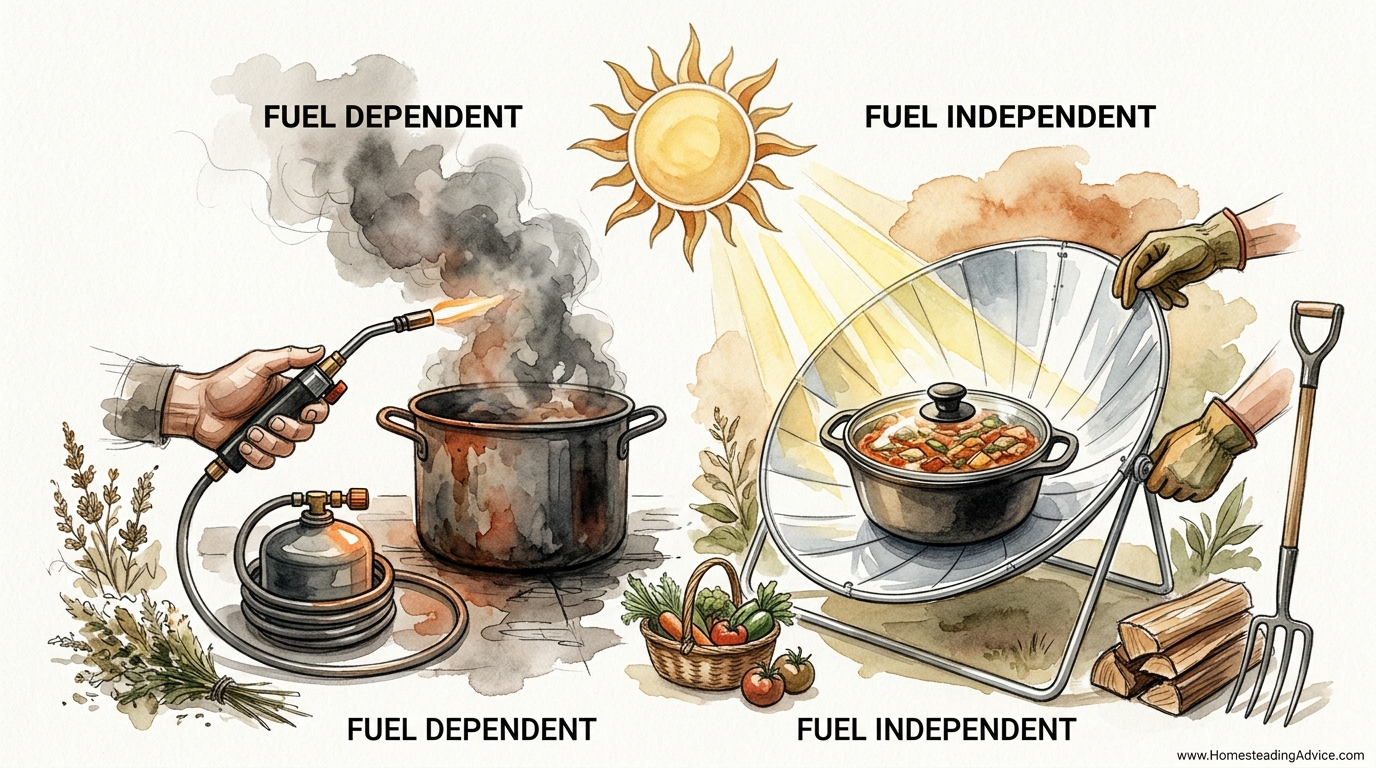
What if you could cook a gourmet meal every day without ever chopping a single log or breathing in wood smoke? We’ve relied on fire for millennia, but modern solar technology offers a cleaner, ‘invisible’ flame. Discover how to transition from the labor-intensive wood pile to the effortless abundance of solar thermal cooking.
Modern self-reliance often focuses on complex batteries and expensive panels. While those have their place, the most direct way to harness the sun is through thermal energy. This isn’t about converting light into electricity to run a coil; it is about catching the heat itself and putting it directly into your dinner.
Cooking with the sun feels like a quiet revolution. There is no roar of a gas burner or crackle of tinder. Instead, you use the same star that grows your garden to roast your meat and bake your bread. It is a shift from being fuel dependent to being fuel independent, relying on a source that arrives at your doorstep every morning for free.
How To Cook With Solar Energy For Free
Solar thermal cooking is the practice of using sunlight to heat, cook, or pasteurize food and drink. It works by capturing the sun’s radiation and concentrating it into a small area, where it is absorbed and converted into heat. This method has been used for centuries, with the first academic descriptions dating back to the late 1700s.
In the real world, solar cooking is a lifeline for millions. In regions where wood is scarce or air pollution from indoor fires causes respiratory illness, solar ovens provide a healthy, soot-free alternative. For the modern home-steader, it is a way to keep the kitchen cool during the summer and slash utility bills without sacrificing the quality of the meal.
Think of a car parked in the sun with the windows rolled up. The interior gets much hotter than the outside air because the glass lets light in but traps the heat. Solar cookers use this “greenhouse effect” alongside reflective surfaces to reach temperatures that can easily boil water or roast a chicken.
The Three Principles of Solar Cooking
To master the sun, you must understand three basic principles: concentration, absorption, and retention. These three factors dictate how hot your cooker gets and how long it takes to finish a meal.
Concentration involves using reflective surfaces, such as mirrors or polished aluminum, to redirect sunlight toward a central point. The more light you can aim at your pot, the more energy you have to work with. Simple panel cookers might use four reflectors, while high-performance parabolic cookers use a deep, curved dish to focus light with surgical precision.
Absorption happens when that concentrated light hits your cooking vessel. This is why dark-colored pots—specifically matte black—are essential. Dark surfaces absorb the majority of the light spectrum and convert it into thermal energy. If you use a shiny or white pot, the light will simply bounce off, and your food will stay cold.
Retention is the final piece of the puzzle. Once the light becomes heat, you must keep it from escaping. This is usually done with a clear lid or an insulated box. High-quality cookers use double-walled glass or thick layers of insulation to ensure that the 150°C (300°F) air inside stays there, even if there is a cool breeze outside.
The Four Main Types of Solar Cookers
Not every solar cooker is built the same way. Depending on whether you want to slow-cook a stew or fry an egg, you will need a specific design.
1. Solar Box Cookers
Box cookers are essentially insulated containers with a transparent lid. They are the most common type because they are easy to use and very forgiving. They act like a slow cooker or a standard oven, reaching temperatures between 120°C and 160°C (250°F to 320°F). These are perfect for baking bread, roasting meats, or cooking grains where you want steady, even heat over several hours.
2. Panel Cookers
These are the simplest and most portable designs. They consist of several flat, reflective panels that direct sunlight onto a pot placed inside a heat-resistant plastic bag. While they don’t reach the high temperatures of a box oven, they are incredibly cheap to build or buy. They typically hit 100°C to 140°C (212°F to 284°F), making them ideal for simmering beans or pasteurizing water.
3. Parabolic Cookers
A parabolic cooker is the “stove-top” of the solar world. The curved dish focuses light into a single, intense hot spot. Temperatures can exceed 250°C (480°F), allowing you to fry, sauté, or boil water almost as fast as a conventional gas burner. However, they require frequent adjustment—sometimes every 15 to 20 minutes—to keep the focal point aligned with the sun.
4. Evacuated Tube Cookers
These are the newest players in the field. They use a double-walled glass tube with a vacuum between the layers. The vacuum acts as near-perfect insulation, allowing the inner chamber to get extremely hot even in freezing weather. These cookers are highly efficient and can reach temperatures up to 290°C (550°F), making them great for fast roasting and even browning.
Benefits of the Solar Approach
The primary advantage is cost. Once you own or build the cooker, the fuel is 100% free. Over a lifetime of use, this can save thousands of dollars in gas, electricity, or charcoal. Beyond the wallet, there is the benefit of taste. Solar cooking is a gentle process that prevents food from drying out, often resulting in more tender meats and more vibrant vegetables.
There is also a massive environmental and health win. Traditional wood-fire cooking releases carbon and soot, which can lead to lung disease. Solar thermal cooking produces zero emissions. It keeps your house cool in the summer because you aren’t running an indoor oven, which in turn reduces your air conditioning load.
Finally, there is the peace of mind that comes with fuel independence. If the grid goes down or a supply chain is interrupted, your ability to feed your family remains unchanged. As long as the sun rises, your kitchen is open for business.
Challenges and Common Mistakes
The biggest hurdle for most beginners is timing. You cannot start dinner at 5:00 PM and expect it to be ready by 6:00 PM. Solar cooking requires you to work with the rhythm of the day. Most meals should be started by 10:00 AM or 11:00 AM to take advantage of the peak sun hours.
A common mistake is using the wrong cookware. Many people try to use their high-end stainless steel or copper pots. These reflect too much light. You need thin, dark, matte-finished pots for the best results. Cast iron can work because it is black, but its high thermal mass means it takes a long time to preheat. Thin enameled steel is often the “goldilocks” choice for solar thermal.
Neglecting the wind is another frequent error. Even on a hot day, a strong wind can strip the heat away from a poorly insulated cooker. Always place your cooker in a sheltered spot or use a “heat trap” like a roasting bag to keep the warmth where it belongs.
Limitations to Consider
Solar cooking is not a 365-day solution for everyone. It depends entirely on “direct beam radiation.” If it is heavily overcast or raining, the cooker won’t work. While some advanced tube cookers can work under thin clouds, most designs require a clear blue sky to reach meaningful temperatures.
Seasonal changes also play a role. In the winter, the sun is lower in the sky and the days are shorter. While you can still cook in the winter—especially with an evacuated tube—the “cooking window” is much narrower. You might only have three or four hours of usable light instead of the eight or ten hours available in the summer.
Lastly, you cannot cook at night without advanced modifications. Unlike a gas stove that you can flick on at midnight, a standard solar cooker is a daytime-only tool. For many, this means solar becomes a primary tool for lunches and prep-cooking dinner, which is then reheated later.
Comparing the Heat Sources
| Feature | Solar Thermal | Wood Fire | Propane/Gas |
|---|---|---|---|
| Fuel Cost | $0 (Free) | Variable (Labor or $) | High |
| Effort Level | Low (Set and forget) | High (Chopping, Tending) | Low (Instant) |
| Emissions | None | High Smoke/Soot | Moderate CO2 |
| Reliability | Weather Dependent | Anytime | Dependent on Supply |
Practical Tips for Success
To get the most out of your solar oven, start by preheating. Just like a conventional oven, you want the air inside to be hot before the food goes in. Place your empty cooker in the sun 30 minutes before you plan to start. This jumpstarts the process and ensures your food begins cooking the moment it hits the tray.
Orientation is key. The sun moves about 15 degrees every hour. For a box cooker, you can often get away with moving it once every 90 minutes. For a parabolic, you need to be much more diligent. Using a “shadow indicator”—a small stick or bolt standing vertically—can help you align the cooker perfectly. When the shadow disappears, you are aimed directly at the sun.
Cut your food into smaller pieces to speed up the process. A whole potato might take three hours to bake, but diced potatoes could be done in one. If you are cooking meat, aim for thin cuts or stews. Remember that you don’t need to add as much water as you would on a stove; since the cooker is sealed, very little moisture evaporates.
Advanced Considerations: Storing the Heat
Serious practitioners often look for ways to extend their cooking time into the evening. This is achieved through thermal mass. By placing heavy, black-painted bricks or stones inside the cooking chamber, you can store “sensible heat.” These stones soak up energy all day and slowly release it after the sun goes down, keeping your food warm for hours.
Some advanced systems use “latent heat” storage with phase-change materials (PCMs). These are substances like specific waxes or salts that melt at high temperatures. As they melt, they store a massive amount of energy. When they eventually solidify, they release that heat. This technology allows for “solar cooking at night,” though it is currently more common in industrial or experimental setups than in backyard boxes.
Another modern twist is the hybrid solar-electric cooker. These devices use a small heating element that can be powered by a battery or a direct DC solar panel (DDS). If a cloud passes over, the electric element kicks in to maintain the temperature. This eliminates the uncertainty of weather while still keeping the process fuel independent.
Real-World Scenario: The Sunday Roast
Imagine a clear Saturday morning. You prep a 2kg (4.4lb) beef roast with carrots and onions in a black enameled pot. At 10:30 AM, you place the pot inside your solar box cooker. You align the reflectors and see the internal thermometer start to climb. By 11:00 AM, the oven has reached 135°C (275°F).
You go about your day, perhaps working in the garden or reading on the porch. Every hour, you give the box a slight nudge to track the sun. Around 2:30 PM, the aroma of roasted beef begins to waft through the yard. You check the internal temperature of the meat; it’s a perfect 63°C (145°F).
Dinner is ready before the sun even starts to dip. You can leave the pot in the insulated box until you are ready to eat, as the oven will stay hot for a long time even after you move it into the shade. You’ve prepared a centerpiece meal using nothing but the light from the sky.
Final Thoughts
Transitioning to solar thermal cooking is more than just a way to save money on your power bill. It is a return to a more rhythmic, intentional way of living. It forces you to look at the sky, to understand the seasons, and to work with the natural energy that our planet receives every day.
While it has its limitations—mainly the need for clear skies and a bit of patience—the trade-off is a kitchen that is cooler, safer, and completely independent of the fluctuating prices of the fuel market. Whether you are a weekend camper or a dedicated off-gridder, the “invisible flame” of the sun is a tool that belongs in your arsenal.
Start small. Try a simple panel cooker or even build a DIY box oven from cardboard and foil to see the principle in action. Once you experience the quiet thrill of boiling water with nothing but mirrors and light, you’ll never look at a sunny day the same way again. The abundance is already there; you just have to catch it.