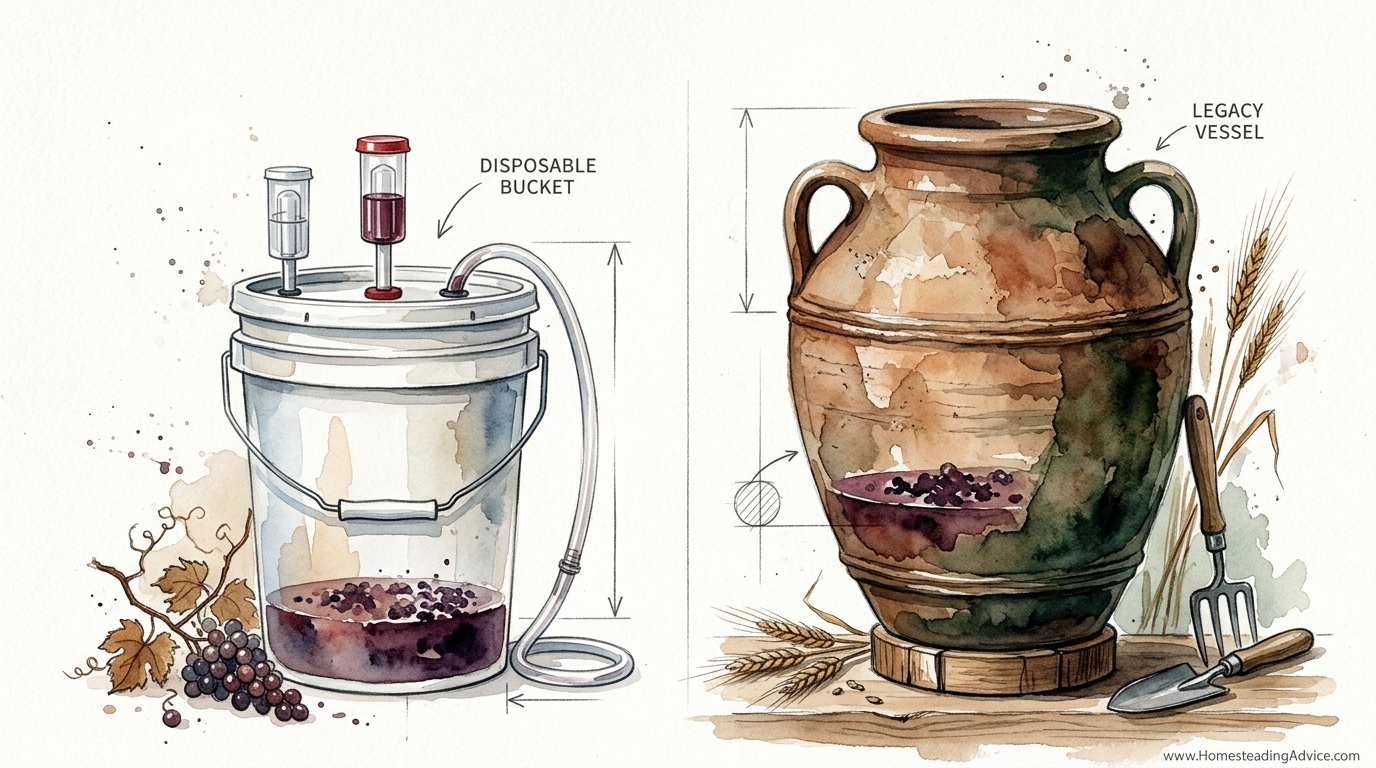
Are you fermenting in a bucket that belongs in a landfill, or a vessel that improves with every century of use? Plastic fermenters scratch easily, harboring bacteria that ruin batches, and they offer zero thermal mass. A clay amphora or heavy oak barrel provides a breathable, stable environment that actually interacts with your wine, creating a legacy product that tastes better every year.
Choosing the right container for your vintage is a decision that ripples through time. Most beginners reach for a 20-liter (5-gallon) food-grade plastic bucket because it is cheap and accessible. However, as your craft deepens, you realize that winemaking is not just about the grapes; it is about the womb in which they transform. A legacy vessel, like a Georgian qvevri or a French oak barrique, is more than a container—it is a partner in the fermentation process.
This guide explores the transition from disposable shortcuts to time-tested legacy vessels. We will look at how materials like clay, oak, and concrete handle temperature and oxygen, and why the “best” vessel is often the one our ancestors were using thousands of years ago.
Best Wine Fermentation Vessels
The best wine fermentation vessels are those that manage three critical variables: temperature, oxygen, and flavor. In the modern era, “best” is often split between two camps: the high-tech precision of stainless steel and the ancestral wisdom of porous, natural materials. While a disposable plastic bucket serves a purpose for a quick primary fermentation, it lacks the thermal mass and micro-oxygenation capabilities of legacy options.
A legacy vessel is a tool designed for a lifetime—or several lifetimes—of use. Examples include clay amphorae (used for over 8,000 years in regions like Georgia), oak barrels (favored for the last two millennia), and concrete eggs (a modern refinement of ancient stone vats). These vessels exist to provide a stable, “living” environment for yeast and bacteria to do their work without the sharp temperature spikes that can lead to off-flavors.
In real-world commercial winemaking, these vessels are chosen based on the desired style. A crisp Sauvignon Blanc might stay in stainless steel to preserve its citrus notes. A bold Cabernet Sauvignon, however, almost requires the slow oxygen exchange of an oak barrel to soften its harsh tannins into something velvety and complex.
How Materials and Shapes Influence Your Wine
Understanding how a vessel works requires looking at the interplay of physics and biology. Every material has a different relationship with heat and air.
The Role of Thermal Mass
Thermal mass refers to a material’s ability to absorb and store heat energy. Clay and concrete have high thermal mass. When a 500-liter (132-gallon) concrete egg reaches its fermentation temperature, usually between 18°C and 28°C (64°F to 82°F) for red wines, it holds that temperature steady. Unlike plastic or thin-walled stainless steel, these heavy vessels do not cool down instantly when the cellar temperature drops at night. This consistency keeps the yeast “happy,” preventing the stress that causes sulfurous odors or “stuck” fermentations.
Micro-Oxygenation and Porosity
Legacy vessels like oak and unlined clay are porous. They allow microscopic amounts of oxygen to migrate through the walls and into the wine. This is not the same as leaving a lid off; it is a controlled, slow-motion breath. This Oxygen Transmission Rate (OTR) is vital for stabilizing the color in red wines and for the polymerization of tannins, which makes the wine taste “smooth” rather than “astringent.”
Shape and Convection Currents
The shape of the vessel also matters. Traditional Georgian qvevri and modern concrete eggs are ovoid. This shape encourages natural convection currents. As heat is generated during fermentation, the wine rises in the center and falls along the cooler walls, creating a constant, gentle circulation. This keeps the “lees” (spent yeast cells) in suspension. Lees contact adds a creamy mouthfeel and protects the wine from premature oxidation.
Legacy Vessels vs. Disposable Buckets
When deciding between a legacy vessel and a disposable one, you are weighing long-term quality against short-term convenience.
- Plastic Buckets (Disposable): These are made of high-density polyethylene (HDPE). They are light, cheap, and easy to stack. However, plastic is easily scratched. A scratch even 0.1 mm deep can house a colony of Acetobacter or Brettanomyces that survives even the strongest sanitizers. They are meant to be replaced every few years.
- Oak Barrels (Legacy): A standard 225-liter (59-gallon) barrique is a masterpiece of cooperage. While the “new oak” flavor fades after 3–5 years, the barrel remains a perfect micro-oxygenation chamber for decades if maintained.
- Clay Amphorae (Legacy): These can literally last for centuries. Ancient qvevri found in archaeological sites are often still structurally sound. They impart a distinct minerality and earthiness that no other material can replicate.
| Feature | Disposable (Plastic) | Legacy (Clay/Oak/Concrete) |
|---|---|---|
| Lifespan | 1–3 years | 20–100+ years |
| Thermal Stability | Poor (low mass) | Excellent (high mass) |
| Oxygen Exchange | None (airtight) | Controlled Micro-O2 |
| Cost | $20–$50 | $500–$5,000+ |
Benefits of Legacy Vessels
The practical benefits of investing in a legacy vessel go beyond the romanticism of using ancestral tools.
Enhanced Texture and Complexity
Wines fermented in clay or concrete often have a “weight” on the palate that stainless steel wines lack. This is due to the natural lees stirring and the mineral exchange from the vessel walls. In oak, the benefit includes the addition of vanillins and tannins from the wood itself, which build structure.
Self-Regulating Environments
Because of the high thermal mass, a legacy vessel is more forgiving if your cellar temperature fluctuates. If your heating fails for a few hours in the winter, a heavy clay vessel will only drop a fraction of a degree, whereas a plastic bucket might drop 5°C (9°F), shocking the yeast and producing “off” esters.
Sustainability and Resilience
A plastic bucket is a petroleum product destined for a landfill. An oak barrel can be repurposed as a planter or furniture after its winemaking life is over. A clay amphora, once buried, is a permanent part of the farm’s infrastructure. This self-reliance is a hallmark of serious practitioners who want to disconnect from the “buy-and-toss” economy.
Challenges and Common Mistakes
Working with legacy vessels requires a higher level of skill and diligence. The most common mistakes involve sanitation and moisture management.
Failure to Hydrate Oak: A common error with new or stored barrels is not allowing the wood to swell before filling. If you pour 200 liters of wine into a dry barrel, it will leak through the staves, wasting your hard work. You must fill it with clean, chlorine-free water for 24–48 hours first.
Improper Clay Sealing: New clay vessels are often too porous, leading to excessive evaporation or “seeping.” Traditionally, qvevri are coated with hot beeswax. If the wax is applied too thick, you lose the micro-oxygenation benefit; if it is too thin, you lose the wine.
Neglecting Sanitation: Because these materials are porous, you cannot simply spray them with a sanitizer and walk away. They require deep cleaning with steam or specialized solutions like potassium metabisulfite and citric acid to ensure no “wild” yeasts or bacteria have moved into the pores.
Limitations of Legacy Vessels
Legacy vessels are not ideal for every situation. Their weight is a significant logistical hurdle. A 500-liter concrete egg can weigh over 1,000 kg (2,200 lbs) empty. Once installed, it is rarely moved. If you are a hobbyist in a small apartment, a legacy vessel might be physically impossible to manage.
Furthermore, they are specialized. An oak barrel used for a heavy red wine cannot easily be used for a delicate white wine the following year, as the flavors and colors will bleed into the new batch. Stainless steel, by contrast, is a “blank slate” that can be scrubbed clean and used for anything.
Practical Tips for Maintaining Legacy Vessels
If you decide to invest in a legacy vessel, follow these best practices to ensure it lasts for decades:
- For Oak: Never store a barrel empty and dry. If it is not holding wine, it should be filled with a storage solution (water, citric acid, and sulfur) or “sulfur-burned” with a sulfur wick to prevent mold growth.
- For Clay: When not in use, keep clay vessels scrubbed clean and bone-dry. If they are buried, ensure the surrounding soil has good drainage to prevent groundwater from seeping through the porous clay.
- For Concrete: Use a food-grade tartaric acid wash on new concrete to neutralize the surface alkalinity. This prevents the concrete from “stealing” the acidity from your first batch of wine.
Advanced Considerations: Surface Area to Volume Ratio
Serious practitioners pay close attention to the ratio of the vessel’s surface area to the volume of liquid it holds. This ratio determines how quickly the wine ages.
A 225-liter (59-gallon) barrique has a much higher surface-to-volume ratio than a 2,000-liter (528-gallon) foudre. Consequently, the wine in the smaller barrel will take on oak flavors and oxygen much faster. If you are aging a delicate wine for a long period (more than 18 months), a larger legacy vessel is often superior because the “breath” is slower and more controlled.
Practical Example: The Qvevri Transition
Consider a winemaker who has been using five-gallon (19-liter) plastic carboys for years. They decide to bury a 100-liter (26-gallon) clay qvevri in their cellar.
In the plastic carboy, the fermentation of their Syrah was fast and hit temperatures of 32°C (90°F) because the thin plastic could not dissipate heat. The resulting wine was high in “hot” alcohol aromas and felt thin.
In the qvevri, buried in 15°C (59°F) earth, the fermentation took twice as long. The clay’s thermal mass and the surrounding soil acted as a natural heat sink, keeping the wine at a steady 24°C (75°F). The micro-oxygenation through the beeswax-lined walls allowed the tannins to soften in place. After six months, the qvevri wine was stable, clear (due to the pointed bottom collecting lees), and ready for bottling without the need for heavy filtration.
Final Thoughts
The choice between a disposable bucket and a legacy vessel is a choice between a commodity and a craft. While plastic is a useful entry point for the curious, it will never provide the stable, interactive environment that natural materials offer. Legacy vessels like oak, clay, and concrete are investments in the quality of your wine and the sustainability of your practice.
They require more care, more muscle, and a deeper understanding of the winemaking process, but the rewards are measurable. A wine that has “breathed” through the staves of an oak barrel or the walls of a clay amphora possesses a depth and life that static, airtight containers simply cannot match.
If you are serious about your legacy as a winemaker, look beyond the landfill-bound plastic. Find a vessel that has a history—and start building your own. Experiment with different materials, respect the maintenance cycles, and you will find that the vessel is just as important as the grape.