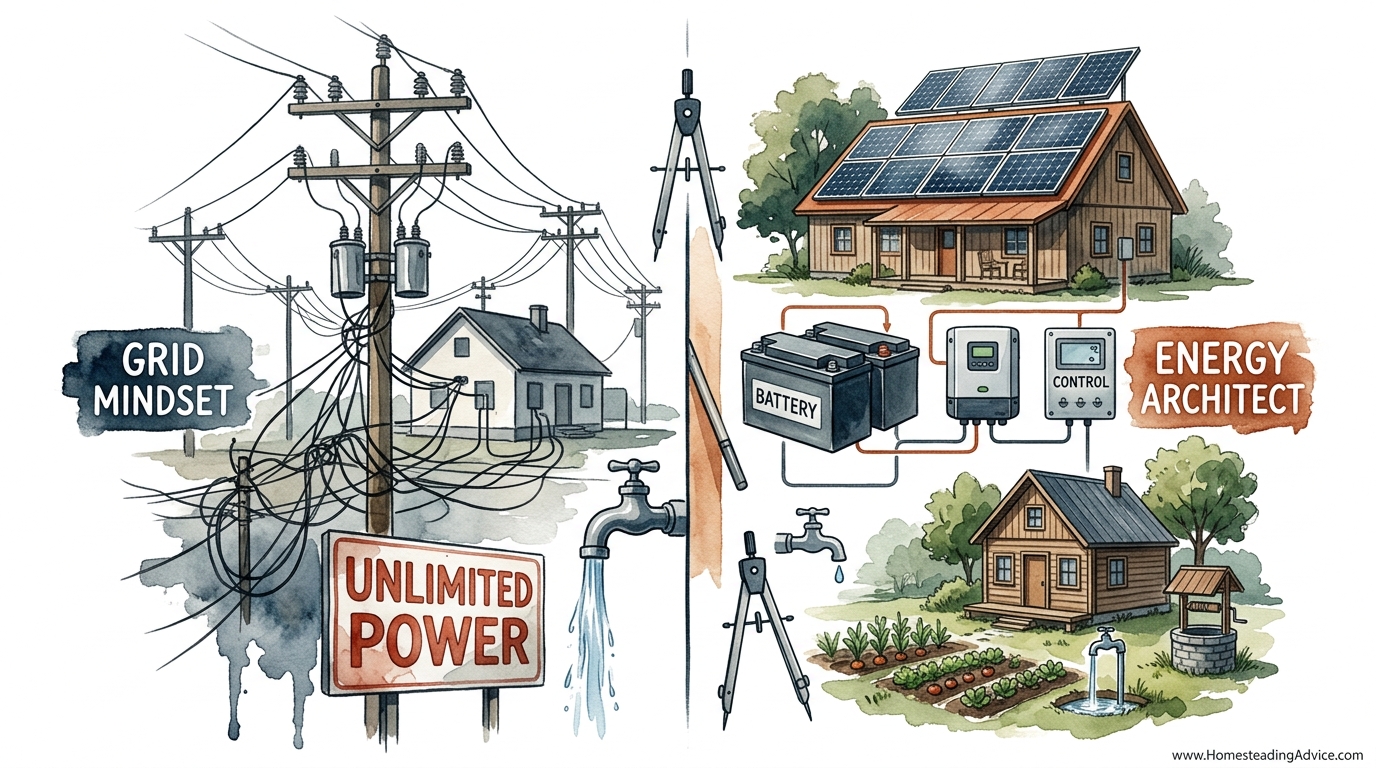
Your batteries are for surviving the night, not for powering your laundry list. Off-grid living isn’t just about changing your lightbulbs; it’s about changing your mind. A consumer waits for the battery to provide; a producer aligns their life with the sun’s peak rhythm to keep their batteries untouched and healthy for decades.
Living beyond the reach of the utility poles requires a shift from the passive role of a customer to the active role of an Energy Architect. In the city, you flip a switch and expect the ghost in the wire to respond without question. Out here, every electron has a cost, and that cost is measured in the lifespan of your equipment and the depth of your self-reliance.
Managing energy isn’t about deprivation or sitting in the dark. It is about understanding the flow of power from the sky to the silicon, and then to the tasks that sustain your life. When you master your loads, you stop being a slave to your battery monitor and start living in harmony with the natural cycles of the day.
How To Manage Off Grid Solar Loads
Managing off-grid solar loads is the practice of intentional energy consumption. It is the process of deciding which appliances run, when they run, and for how long, based on the current state of your solar production and battery reserves. In a grid-tied home, you can run the welder, the dryer, and the air conditioner simultaneously because the grid is an infinite bucket. Off-grid, your bucket has a specific size, and your faucet has a limited flow rate.
This management exists because your inverter has a maximum output (measured in Watts) and your batteries have a finite storage capacity (measured in Amp-hours or Kilowatt-hours). If you pull too much at once, the inverter trips. If you pull too much over time, the batteries die prematurely. Effective load management keeps the lights on while protecting the most expensive parts of your system.
Real-world load management often looks like waiting for the sun to hit its peak before starting a load of laundry. It means using a manual pump for a glass of water at 2:00 AM instead of letting a 1.5-horsepower well pump kick on and surge the system. It is the difference between a system that lasts five years and one that lasts twenty.
Understanding the Math of Your Energy Audit
Before you can manage your loads, you must know what they are. This is called a load audit. Every appliance in your home has a “label” that tells you how much energy it requires. To be an Energy Architect, you must translate these labels into a daily energy budget.
Start by listing every device you intend to use. You need to record the Voltage (V), the Amperage (A), and the Wattage (W). The relationship is simple: Volts x Amps = Watts. For example, a small coffee maker might draw 8 Amps at 120 Volts, which equals 960 Watts.
To find the daily consumption, multiply the Watts by the hours of use. If that coffee maker runs for 15 minutes (0.25 hours), it consumes 240 Watt-hours (Wh) per day. Do this for every light, charger, and pump. Remember to account for “phantom loads”—those small LEDs on your microwave or TV that draw 5 to 10 Watts every hour of every day, potentially wasting 240 Wh daily just by existing.
Measuring Surge vs. Continuous Watts
Most appliances have two power ratings: running (continuous) and surge (starting). Heating elements, like a toaster or a space heater, have almost no surge; they draw the same power from start to finish. However, anything with a motor—refrigerators, well pumps, or power tools—requires a massive burst of energy to get the internal mass moving.
A refrigerator might only draw 150 Watts while running, but it could require 1,200 Watts for a fraction of a second to start the compressor. If your inverter is rated for 2,000 Watts and three such motors try to start at the same moment, your system will shut down to protect itself. Managing loads means staggering these starts.
Staggering and Scheduling: The Solar Noon Strategy
The most important tool in off-grid load management is the clock. Your solar panels reach their maximum efficiency during “Solar Noon,” which is the period when the sun is highest in the sky. Depending on your latitude and the time of year, this window typically lasts 4 to 6 hours.
During these peak sun hours, your panels are likely producing more power than your batteries can even accept. This is “free” energy. If you wait until 8:00 PM to run a heavy load, you are pulling that energy out of your batteries, causing chemical wear and tear. If you run that same load at 1:00 PM, the energy flows directly from the panels to the appliance, leaving the batteries untouched.
Prioritize heavy tasks for the middle of the day. This includes:
- Running the washing machine or dishwasher.
- Using power tools in the workshop.
- Pumping water into a large storage tank.
- Vacuuming the floors.
- Charging high-capacity portable power stations or tool batteries.
By the time the sun begins to set, your heavy work should be done, and your batteries should be at 100% capacity (State of Charge). The evening and night should be reserved for low-draw “survival” loads: LED lighting, a small fan, and perhaps a laptop or phone charger.
Prioritizing Loads: Critical vs. Luxury
Every device in an off-grid home falls into a hierarchy of importance. When a week of heavy clouds or a winter storm arrives, the Energy Architect knows exactly which circuits to flip off.
Critical Loads (The Non-Negotiables)
These are the systems required for safety, communication, and food preservation.
- Refrigeration: Keeping food from spoiling is the highest priority.
- Water Pressure: The ability to flush a toilet or have drinking water.
- Basic Lighting: One or two high-efficiency LED bulbs (5W–10W) for navigation.
- Communications: A modem or radio to stay in touch with the world.
Secondary Loads (Comfort)
These make life easier but can be sacrificed if the battery voltage drops too low.
- Small Kitchen Appliances: Blenders, mixers, or coffee grinders.
- Entertainment: Televisions or gaming consoles.
- Climate Control: Ceiling fans or small circulation pumps for wood stoves.
Luxury Loads (Heavy Draw)
These should only be used when the sun is shining or the battery bank is oversized.
- Electric Heating: Space heaters, electric blankets, or hair dryers.
- High-Volume Pumping: Filling a swimming pool or large-scale irrigation.
- Induction Cooktops: While efficient, they draw thousands of watts instantly.
Managing High-Surge Loads: Well Pumps and Motors
The well pump is often the “inverter killer” in a remote homestead. A 1-horsepower pump submerged 200 feet (60 meters) in the ground requires a significant kick to move a column of water. A standard 1 HP pump may draw 1,000–1,500 Watts while running, but its surge can exceed 4,000–5,000 Watts.
To manage this, consider installing a **Soft Start** device. These electronic modules slowly ramp up the voltage to the motor, reducing the inrush current by up to 70%. This prevents the “lights dimming” effect and allows you to use a smaller, more efficient inverter.
Another strategy is the use of a large pressure tank. A standard 20-gallon (75-liter) tank only holds about 5 to 7 gallons (19 to 26 liters) of actual water before the pump must kick on. By upgrading to an 80-gallon (300-liter) tank, the pump runs less frequently, allowing you to “bulk pump” during the day and use the stored water pressure throughout the night without the pump ever turning on.
Benefits of Active Load Management
The primary benefit of managing your solar loads is the radical extension of your battery life. Batteries, whether Lead Acid or Lithium (LiFePO4), are rated for a certain number of “cycles.” A cycle is one discharge and one recharge. If you deeply discharge your batteries every night, you might get 500 to 2,000 cycles. If you manage your loads so that the batteries only ever drop to 80% or 90% capacity, you can double or triple that lifespan.
System reliability is the second major advantage. When you know your limits, you eliminate the risk of “blackout” events. There is a profound peace of mind that comes from glancing at the sky, seeing a cloud bank, and knowing exactly how to adjust your habits to maintain power until the sun returns.
Furthermore, active management allows you to build a smaller, more affordable system. Rather than spending $50,000 to build a system that can handle any possible whim, you can spend $15,000 on a system that rewards your intelligence and discipline.
Common Mistakes to Avoid
Many beginners suffer from “Grid Mindset.” They assume that because they have “3,000 Watts of Solar,” they can run 3,000 Watts of appliances at any time. This ignores the reality of weather, seasonal changes, and system efficiency losses.
Mistake 1: Relying on the Battery Monitor % Only
Battery monitors that show a percentage (%) can be notoriously inaccurate, especially with Lead Acid batteries. They often drift over time. It is better to learn the resting voltage of your battery bank. For a 12V system, 12.7V is full, and 12.1V is about 50% discharged. If you wait until the monitor says 0%, you have likely already damaged your cells.
Mistake 2: Ignoring Seasonal Sun Hours
In the summer, you might get 6 hours of “peak sun.” In the winter, you might only get 2 hours. If you maintain the same energy habits in December that you had in July, your system will fail. You must adjust your “luxury” consumption as the days shorten.
Mistake 3: Underestimating Phantom Loads
Leaving a satellite receiver or a “smart” coffee maker plugged in can consume more energy over 24 hours than a microwave does in 5 minutes. Use physical power strips to completely cut power to these devices when not in use.
Limitations and Environmental Boundaries
Load management has its limits. No amount of scheduling can overcome a poorly designed or undersized system. If you live in a region with frequent “socked-in” fog or month-long winter rains, you must have a secondary charging source, such as a backup generator or a wind turbine.
Environmental temperature also plays a massive role. In extreme cold (below 0°C / 32°F), lithium batteries cannot be charged without an internal heating element, and lead-acid batteries lose significant effective capacity. If your battery bank is in an uninsulated shed, your “manageable load” will shrink during the winter months regardless of how much sun is hitting the panels.
Physical space is another boundary. If your roof or ground mount only allows for six panels, your daily energy budget is hard-capped. You cannot “manage” your way into more power than the physics of your array allows.
Manual vs. Automated Load Management
There are two primary ways to handle the “Energy Architect” duties: through habit or through hardware.
| Feature | Manual Management | Automated (Smart) Management |
|---|---|---|
| Cost | Free (Relies on discipline) | Higher (Requires smart relays/controllers) |
| Complexity | Low (Flip switches as needed) | High (Needs programming and setup) |
| Reliability | High (Mechanical switches don’t glitch) | Variable (Depends on software/Wi-Fi) |
| Flexibility | Infinite (You decide in the moment) | Rigid (Follows programmed logic) |
Manual management is the way of the pioneer. You look at the sky, check the meter, and decide not to do the laundry today. Automated management uses devices like the **Sol-Ark SmartLoad** or **Victron Venus OS** to automatically turn off “luxury” circuits when the battery voltage drops below a certain point. While automation is convenient, it is no substitute for the wisdom of the inhabitant.
Practical Tips for Immediate Improvement
If you want to start managing your loads more effectively today, follow these best practices:
- The One-Heavy-Load Rule: Never run two heating or motor-based appliances at the same time. If the dryer is on, the toaster stays off.
- Pre-Heat or Pre-Cool: Use excess afternoon sun to “charge” the thermal mass of your home. Run the AC or the heater while the sun is out so the house stays comfortable through the evening without using the batteries.
- Nighttime Digital Fast: Turn off your Wi-Fi router and cell boosters before bed. These can save 200–400 Wh over a 10-hour night.
- Water Harvesting: If you use a well, pump water only during the day. Fill a gravity-fed tank or a large pressure tank at 1:00 PM.
- Check Terminal Connections: Loose wires create resistance, which creates heat and wastes energy. A simple turn of a wrench can improve your system’s efficiency by a measurable margin.
Advanced Consideration: Diversion Loads
For those with large solar arrays, there comes a point where the batteries are full at 11:00 AM, and the charge controller begins to “clip” or waste the incoming power. This is where a **Diversion Load** (also called a Dump Load) becomes invaluable.
A diversion load is a secondary appliance—usually a DC water heating element or a space heater—that only turns on once the batteries reach a specific voltage (typically around 14.2V for a 12V system). Instead of the energy simply not being harvested, it is “diverted” into a well-insulated water tank. This allows you to have a full tank of hot water for showers or dishes by evening, essentially using your water heater as a “thermal battery.”
This requires a charge controller with a programmable “AUX” output. It is the pinnacle of the Energy Architect’s craft: ensuring that not a single photon from the sun is wasted.
Scenario: A Winter Storm Management Plan
Imagine a three-day blizzard is approaching. A Grid Mindset person continues to watch TV and leave the lights on until the inverter screams and the house goes dark. An Energy Architect acts differently.
On Day 1, as the clouds roll in, you turn off the freezer and the refrigerator’s “ice maker” function. You fill every available water jug using the well pump while the sun is still peeking through. You charge every power tool, phone, and laptop to 100%.
On Day 2, with the snow falling, you move into “Survival Mode.” You unplug the TV and the microwave. You use a headlamp instead of overhead lights. You keep the refrigerator door closed at all costs; a modern Energy Star fridge can stay cold for 24–48 hours if left shut.
On Day 3, the sun returns. You don’t immediately turn everything back on. You wait for the panels to clear their snow and for the battery voltage to climb back into the “Safe Zone” (above 13.0V for LiFePO4 or 12.6V for Lead Acid) before resuming normal life. This discipline is what keeps your system alive for decades.
Final Thoughts
Managing off-grid solar loads is a dance between the needs of the human and the limits of the hardware. It is a return to a more intentional way of living, where the rising and setting of the sun dictates the rhythm of the household. By moving away from the Grid Mindset and embracing the role of the Energy Architect, you transform your solar system from a fragile luxury into a robust foundation for independence.
Start small by auditing your devices and learning the “Solar Noon” strategy. As your understanding grows, you can integrate more advanced techniques like soft starts, thermal storage, and diversion loads. The goal is not to live in the past, but to use modern technology with ancestral wisdom.
Apply these principles, watch your meters, and trust your instincts. The sun provides a bounty of energy every day; your job is simply to be a good steward of that gift. Experiment with your schedule, find the limits of your system, and enjoy the silence of a home that powers itself.