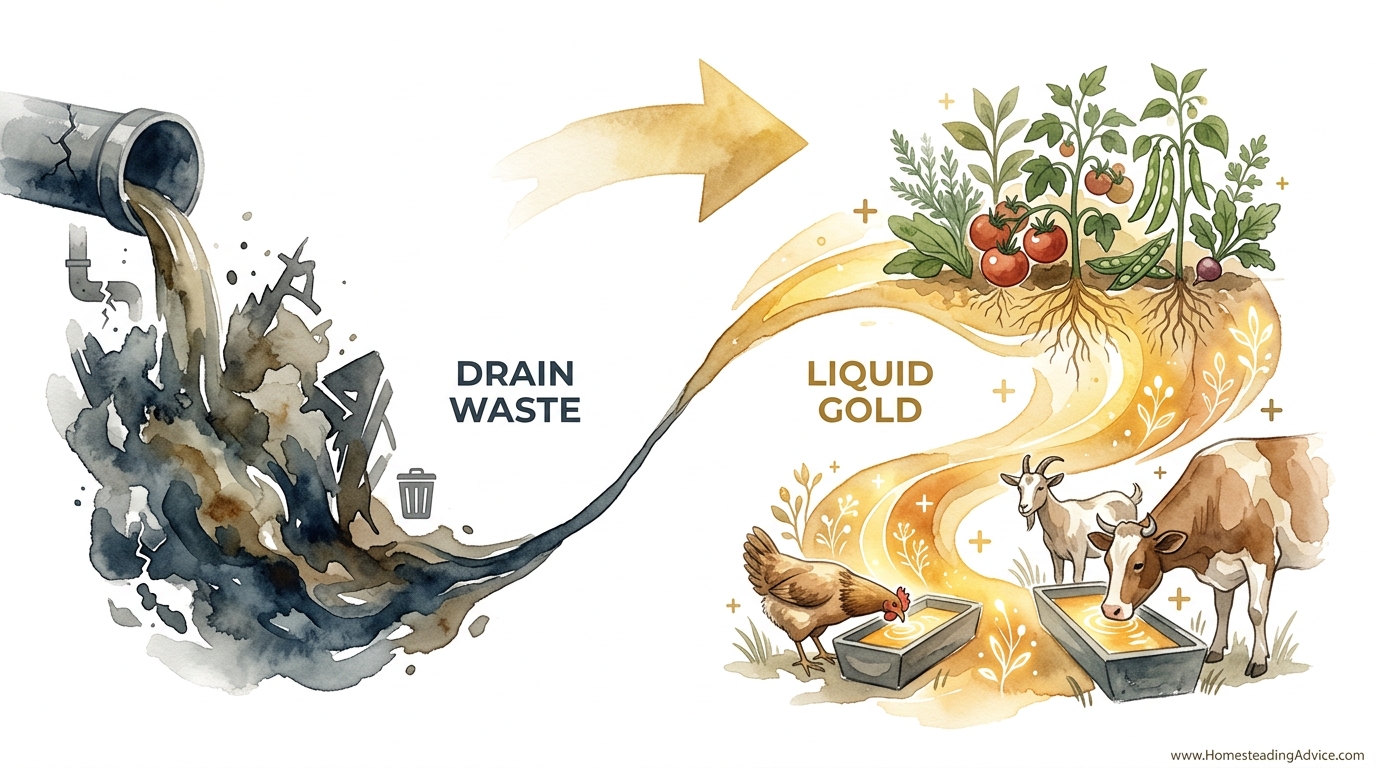
The most nutritious part of your milk is likely heading straight for the sewer system. Most home cheesemakers treat whey as an annoying byproduct to be discarded. In a circular system, whey isn’t waste – it’s a high-protein livestock supplement and a mineral-rich soil amendment. From crafting secondary ‘whey cheeses’ like Ricotta to boosting the growth of your nightshade plants, discover how to stop the drain on your resources and start fueling your homestead.
When you stand over a steaming pot of curds and whey, you are looking at two-thirds of the nutrients from the original milk. While the curds provide the fats and caseins for cheese, the translucent liquid left behind carries the water-soluble proteins, minerals, and vitamins. For the self-reliant homesteader, pouring this liquid down the sink is more than a missed opportunity; it is a break in the cycle of life that supports your land and your animals.
Ancestral wisdom taught us that nothing on the farm should have a single use. The dairy, the garden, and the pigpen were once inextricably linked by a golden thread of liquid whey. In the modern age, we have forgotten that this ‘waste’ is actually a concentrated package of energy. By understanding the chemistry and biology of this byproduct, you can turn a disposal problem into a cornerstone of your homestead’s productivity.
How To Reuse Cheese Whey For Garden And Livestock
Cheese whey is the liquid remaining after milk has been curdled and strained. It exists in two primary forms: sweet whey and acid whey. Sweet whey is produced when you use rennet to coagulate milk for hard cheeses like Cheddar or Swiss. Acid whey, on the other hand, comes from making soft cheeses like Chèvre, Greek yogurt, or Paneer, where acid or heat-acid precipitation is used to form the curd.
In a real-world homesteading context, whey functions as a biological bridge. It contains significant amounts of lactose (milk sugar), high-quality proteins like lactalbumin, and essential minerals such as calcium, phosphorus, and potassium. Because it is highly digestible, it serves as a powerful caloric boost for livestock. In the soil, those same sugars and minerals feed the microbial life that makes nutrients available to your crops.
Think of whey as a biological battery. When you pour it into a pig’s trough, you are transferring the sun’s energy—originally captured by grass and processed by a cow or goat—directly into the growth of your meat animals. When you spray it on your garden, you are deploying a natural antifungal agent and a slow-release fertilizer that stimulates the very ground you walk on.
Understanding the Difference: Sweet vs. Acid Whey
Before you begin applying whey to your land or animals, you must identify which type you have. Sweet whey typically has a pH between 5.6 and 6.7. It is rich in proteins and is the preferred choice for livestock because it is more palatable and less likely to cause digestive upset in high quantities. It is also the source of Ricotta cheese, which is made by heating the whey to nearly boiling to reclaim the remaining albumin proteins.
Acid whey is significantly more tart, with a pH ranging from 3.6 to 5.1. This acidity makes it a more specialized tool. While pigs and chickens can still consume it, it should be introduced slowly to prevent scouring. In the garden, acid whey is a potent tool for adjusting soil pH or feeding acid-loving plants like blueberries and azaleas. However, its high acidity means it requires more careful dilution to avoid harming sensitive root systems.
The nutritional profile also varies slightly between the two. Sweet whey generally retains more of the milk’s original protein, while acid whey is often higher in calcium and minerals that were released from the casein micelles during the acidification process. Knowing which you have determines whether you are reaching for a growth stimulant or a soil conditioner.
How to Use Whey as a Livestock Supplement
Pigs are the undisputed champions of whey consumption. Historically, the finest hams in Europe, such as the famous Prosciutto di Parma, were produced by finishing pigs on the whey from local Parmesan cheese production. Whey provides high-quality amino acids that balance the protein profile of grain-based feeds, leading to leaner, more flavorful meat and a healthy, glossy coat.
When feeding whey to pigs, start with small amounts to allow their digestive systems to adapt to the lactose. For growing pigs, whey can replace a significant portion of their daily water and protein needs. A general rule of thumb for adult hogs is to limit whey to about 20% to 30% of their total dry matter intake. Ensure they always have access to fresh, clean water, as the minerals in whey can lead to salt toxicity if the animals cannot hydrate properly.
Chickens and other poultry also benefit from whey, though their smaller digestive tracts require more moderation. Whey can be fed liquid in a separate bowl or used to soak grain and mash. Soaking grain in whey for 12 to 24 hours initiates a light fermentation process that breaks down phytates, making the minerals in the grain more bioavailable to the birds. This often results in stronger eggshells and improved feather quality during the molt.
Recommended Livestock Rations
| Livestock Type | Application Method | Recommended Amount |
|---|---|---|
| Pigs (Growers) | Free choice liquid | Up to 3-5 gallons (11-19 liters) per day |
| Laying Hens | Fermented grain soak | 1 part whey to 2 parts grain |
| Cattle (Calves) | Milk replacer booster | Replace 10-15% of water with sweet whey |
| Meat Rabbits | Mixed with pellets | Moisten feed slightly to prevent dust |
How to Use Whey in the Garden
Your garden sees whey as a multi-vitamin and a defensive shield. As a fertilizer, whey provides an N-P-K (Nitrogen-Phosphorus-Potassium) ratio of approximately 0.15-0.05-0.17. While these numbers look small compared to synthetic bags, the nutrients are in a highly mobile, organic form that plants can absorb quickly. It is particularly effective for heavy feeders like tomatoes, peppers, and cucumbers.
For soil application, never use undiluted whey. The high sugar content can attract pests like ants or flies, and the acidity can burn tender roots. A standard dilution of 1 part whey to 10 parts water (1:10) is safe for most garden plants. Apply this mixture directly to the soil at the base of the plants. This drenching method also introduces beneficial Lactobacillus bacteria into the soil, which can help suppress soil-borne pathogens.
Whey is also a legendary organic solution for powdery mildew. The proteins in the whey, when exposed to sunlight, create a chemical reaction that is toxic to many fungal spores. To make a foliar spray, mix 1 part sweet whey with 2 parts water. Spray this on the leaves of squash, roses, or grapes during the brightest part of the day. The “sunlight-activated” nature of this treatment makes it more effective than many commercial organic fungicides.
Benefits of Reusing Whey
Reclaiming whey offers immediate economic benefits. By substituting a portion of your livestock’s protein needs with whey, you can significantly reduce your dependence on expensive commercial feeds. For a small-scale homestead producing 5 gallons (19 liters) of milk a week, the resulting whey can save hundreds of dollars in feed costs over a single season.
Environmental stewardship is another critical advantage. Whey is a biological pollutant if it enters local waterways; its high biological oxygen demand (BOD) can strip oxygen from the water, harming aquatic life. By cycling it through your pigs or your soil, you turn a potential hazard into a resource. This closes the “nutrient loop” of your farm, ensuring that the minerals you took from the pasture in the form of milk are returned to the land.
The health of your soil microbiology will also see a measurable lift. Research has shown that whey applications stimulate the growth of Gram-positive and Gram-negative bacteria, as well as actinomycetes. These microorganisms are the workers that decompose organic matter and unlock phosphorus for your plants. A homestead that utilizes its whey often sees darker, more friable soil and a more robust ecosystem of earthworms and beneficial nematodes.
Challenges and Common Mistakes
One of the most frequent errors is over-feeding whey to animals that are already receiving a high-salt diet. If you add salt to your curds before they are fully drained, that salt ends up in the whey. Feeding large amounts of salty whey to pigs without providing unlimited fresh water can lead to fatal salt poisoning. Always taste your whey; if it tastes salty to you, it is too salty to be a primary water source for your animals.
In the garden, the biggest mistake is failing to rotate application sites. While whey is a fantastic fertilizer, repeated heavy applications in the same spot can lead to a buildup of mineral salts or cause the soil to become overly acidic. It can also cause a temporary odor problem if the liquid pools and begins to sour in the open air. Always ensure the soil is well-draining and apply whey just before a rain or follow it with a light watering to wash it into the root zone.
Storage is another hurdle for the homestead. Raw whey is a living product that will continue to ferment. If left in a warm bucket for more than a day or two, it can develop unpleasant odors and attract flies. It is best to use whey within 24 to 48 hours of cheese making. If you must store it longer, keep it in a cool, dark place or a dedicated refrigerator to slow down the bacterial activity.
Limitations and Constraints
Whey is not a “magic bullet” for all agricultural problems. Its effectiveness as a fertilizer is limited by its high water content, meaning you must handle large volumes to provide significant nutrient loads. For large-scale farms, the logistics of moving thousands of gallons of liquid can be prohibitive. It is a resource best suited for the smallholder or the backyard cheesemaker where the distance from the kitchen to the barn is short.
Similarly, acid whey should be used with extreme caution on plants that prefer alkaline or neutral soil, such as lavender or asparagus. While a single diluted application won’t kill them, a season-long regimen can shift the soil pH enough to stunt their growth. Always test your soil pH annually if you are using whey as a primary amendment to ensure you aren’t inadvertently creating an environment that is too acidic for your crops.
Practical Tips for Success
- Strain meticulously: Use a fine butter muslin or cheesecloth to remove all small bits of curd. Curd fragments left in the whey will rot and attract pests both in the animal trough and the garden.
- Temperature matters: Never apply hot whey (from Ricotta making) directly to plants or animals. Allow it to cool to ambient temperature before use.
- The 1:10 Rule: When in doubt, a 10% whey to 90% water dilution is the safest starting point for any garden application.
- Morning feeding: Feed whey to livestock in the morning so they have the rest of the day to stay active and drink water to process the proteins and sugars.
- Compost activator: If you have an excess of whey that you cannot use elsewhere, pour it onto your compost pile. It acts as a powerful nitrogen “green” that accelerates the decomposition of “brown” materials like straw or wood chips.
Advanced Considerations: Fermented Feeds
Serious practitioners can take whey reuse a step further by using it as a starter culture for fermented silage or “slop” for hogs. By mixing whey with ground grains and allowing it to sit for 48 hours in a sealed container, you create a probiotic-rich feed. This fermentation predigests the grains, making the protein more available and populating the animal’s gut with beneficial Lactobacillus.
In the garden, some advanced growers use whey to create specialized “microbial teas.” By bubbling air through a mixture of whey, molasses, and water, you can bloom a massive population of beneficial bacteria in a matter of hours. This concentrated tea can be used as a soil drench after a disease outbreak to help restore the biological balance of the rhizosphere.
Example Scenario: The One-Cow Homestead
Imagine a homestead with one Jersey cow producing 4 gallons (15 liters) of milk per day. After setting aside milk for the family, the homesteader makes a weekly batch of Cheddar cheese from 10 gallons (38 liters) of milk. This process yields approximately 9 gallons (34 liters) of sweet whey every Saturday.
On Sunday, the homesteader uses 1 gallon of that whey to make a fresh batch of Ricotta for the family. The remaining 8 gallons are split: 5 gallons go to the two fattening pigs, providing them with a high-protein treat that supplements their pasture and grain. The last 3 gallons are diluted at a 1:10 ratio with 30 gallons of water and used to fertilize the 100-foot row of tomatoes and peppers.
This simple weekly cycle ensures that the minerals from 10 gallons of milk are either consumed by the family, built into the muscle of the pigs, or returned to the soil to grow next year’s crop. No nutrients are lost to the drain, and the homestead operates as a truly circular system.
Final Thoughts
The journey from the milk pail to the garden bed is a reminder that in nature, there is no such thing as trash. Whey is a gift of energy and biology, a liquid concentrate of the very best parts of the earth. When we choose to reuse this byproduct, we are practicing a form of homesteading that is both ancient and essential.
Whether you are looking to shave a few dollars off your feed bill, save your pumpkins from powdery mildew, or simply live a more integrated life, whey is a resource you cannot afford to ignore. Start small, observe how your animals and plants respond, and soon you will find yourself guarding every drop of this liquid gold.
As you continue to refine your homesteading skills, remember that the smallest loops are often the most powerful. By reconnecting your dairy work with your garden and livestock, you are building a resilient, self-sustaining world right in your own backyard. Experiment with these methods, keep your buckets clean, and watch as your land thrives on what others would throw away.