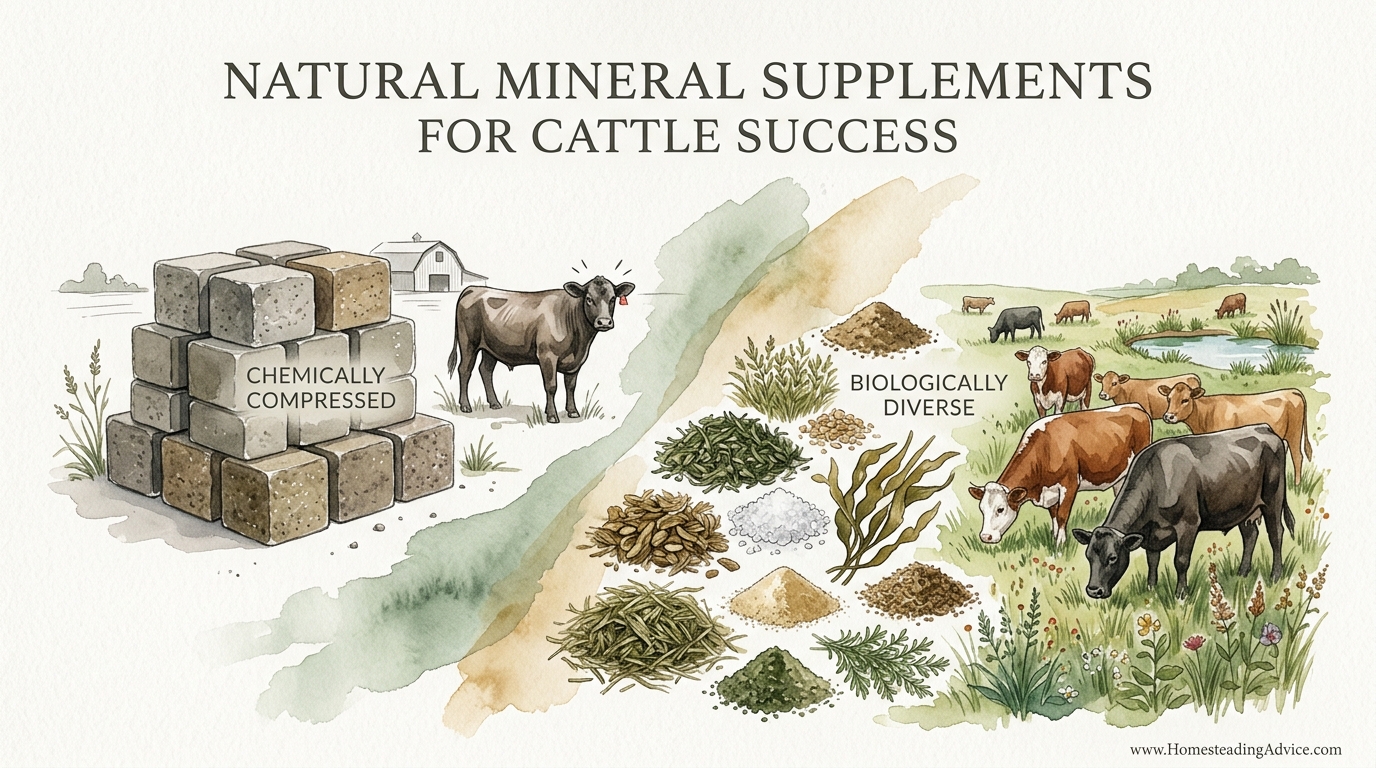
Is your herd’s health limited by a factory-made block or fueled by the ocean’s minerals? Most cattle owners think a $10 mineral block from the feed store is ‘enough.’ But a factory-pressed block often lacks the bio-available trace minerals cows actually crave. Choosing a natural kelp and sea salt blend means you aren’t just feeding them; you’re building their immune system from the soil up.
Mineral nutrition is the quiet foundation of a profitable cattle operation. While many focus on protein and hay quality, the trace elements found in the deep ocean and ancient sea beds often hold the key to performance that a standard block simply cannot unlock. Taking a cues from ancestral wisdom and modern biological science allows us to see that the minerals in sea salt and kelp are far more than just “supplements”—they are the fuel for cellular repair, reproductive success, and immune resilience.
Modern industrial agriculture has moved toward convenience, favoring the chemically compressed block over biologically diverse loose minerals. This shift often leaves cattle with a “salt fix” but a “mineral hunger.” Understanding the difference between these two approaches is the first step toward a healthier, more self-reliant herd that requires fewer veterinary interventions and produces stronger calves.
Natural Mineral Supplements For Cattle Success
Natural mineral supplements for cattle typically consist of two primary pillars: unprocessed sea salt and dried seaweed meal, specifically Ascophyllum nodosum (kelp). Unlike refined white salt which is stripped of its character, natural sea salt contains dozens of trace minerals in their original, balanced ratios. When paired with kelp, which concentrates minerals and vitamins from the ocean, you create a powerhouse of nutrition that mimics the diversity of a wild diet.
These supplements exist because modern soils are often depleted of critical elements like iodine, selenium, and copper. Heavy rainfall, intensive grazing, and historical farming practices have leeched these minerals out of the dirt, meaning the grass your cows eat may look lush but is nutritionally “empty.” Providing these minerals in a loose, free-choice form allows the animal to self-regulate based on its biological needs.
Visualize the difference between a synthetic vitamin pill and a bowl of fresh, organic vegetables. The pill provides the basics, but the vegetables provide a complex web of enzymes, co-factors, and minerals that work together. Sea salt and kelp function like those vegetables, offering “crystalloid” minerals that are instantly recognized and absorbed by the cow’s digestive system.
How It Works: The Science of Bioavailability
Bioavailability refers to how much of a nutrient the animal can actually absorb and use. Most standard mineral blocks use “oxide” forms of minerals (like copper oxide), which are essentially ground-up rocks with very low absorption rates. In contrast, minerals in kelp are naturally chelated—meaning they are already bonded to organic molecules, making them easy for the rumen to process.
Unrefined sea salt provides minerals in a crystalloid state. This is a unique form where the minerals are dissolved in a way that they can diffuse directly through cell membranes. Research has shown that the mineral profile of sea water is remarkably similar to the mineral profile of bovine blood. Introducing these sea minerals into the diet supports the electrical balance of the cells and improves the efficiency of the rumen microbes.
Step-by-step mineral absorption in a cow involves several stages:
- Ingestion: The cow licks the loose kelp/salt mixture based on her internal “salt-craving” drive.
- Rumen Fermentation: Trace minerals like cobalt fuel the bacteria that produce Vitamin B12, which is essential for energy.
- Ion Exchange: The negatively charged particles in seaweed meal help neutralize positively charged toxins in the gut.
- Metabolic Distribution: Minerals like iodine move to the thyroid to regulate the entire body’s metabolism.
Benefits of Natural Mineral Feeding
Switching to a natural mineral program offers practical, measurable benefits that show up in the pasture and the bank account. One of the most immediate changes is often seen in the hair coat. Cattle with access to sea salt and kelp frequently develop a deep, shiny sheen and shed their winter coats much faster. This isn’t just about looks; a healthy coat is a sign of a high-functioning liver and a robust immune system.
Reproductive success is another major advantage. Iodine and selenium are critical for hormone production. Operations using kelp report fewer cases of retained placentas and shorter “days open” between calving. When a cow’s thyroid is fully supported, her reproductive cycle becomes more predictable and her calves are born with stronger “vigor,” often getting to their feet and nursing within minutes of birth.
Resistance to common ailments like pinkeye and foot rot is significantly bolstered. High levels of bioavailable zinc and iodine in the system act as natural defenses against environmental pathogens. Organic dairy farmers have long used kelp to lower somatic cell counts (SCC) in their milk, proving that these minerals help the body fight inflammation from the inside out.
Challenges and Common Mistakes
One common mistake is relying on the “convenience” of a block without monitoring intake. Cattle have limited “nutritional wisdom” when it comes to hard-pressed blocks; they often lick them out of boredom or stop once their tongue is sore, even if they are still mineral-deficient. Loose minerals solve this, but they require a dry, weather-protected feeder to prevent clumping and waste.
Palatability can sometimes be a hurdle. While most cattle love the taste of kelp, some may over-consume it initially if they are severely deficient. This is known as “luxury consumption.” To prevent this, some producers mix the kelp with salt in a 50/50 ratio to act as a natural limiter. Salt is a powerful regulator; if they eat too much, the salt drives them to the water tank and stops the feeding behavior.
Mistaking “white salt” for “mineral salt” is another pitfall. Refined white salt is 99% sodium chloride and provides nothing else. If you provide a plain salt block alongside your expensive kelp mix, the cows may fill up on the plain salt and ignore the mineral-rich kelp. Always remove plain salt sources when introducing a high-quality sea salt and kelp program.
Limitations and Environmental Constraints
While sea minerals are powerful, they are not a “magic bullet” for every situation. In regions with extreme, site-specific deficiencies—such as the “Goiter Belt” in the northern United States or areas with toxic levels of molybdenum—kelp alone may not provide enough of a specific element to overcome the imbalance. In these cases, a targeted mineral supplement formulated by a nutritionist may be required alongside the natural base.
Environmental moisture is a practical boundary. Kelp meal is hygroscopic, meaning it pulls moisture from the air. In high-humidity coastal regions, loose kelp can turn into a sticky mess if left in open troughs. Producers must invest in “weathervane” style feeders or covered mineral stations to ensure the product remains appetizing and effective.
Cost is a factor that requires a long-term view. A 50-pound (22.6 kg) bag of Icelandic kelp meal costs significantly more than a standard bag of trace mineral salt. If your operation is focused solely on the lowest possible input cost per day, the price tag of premium kelp might seem prohibitive. However, this is a trade-off; higher upfront mineral costs are almost always offset by lower veterinary bills and higher weaning weights.
Comparison: Factory Blocks vs. Natural Loose Minerals
| Factor | Factory-Pressed Blocks | Natural Kelp & Sea Salt |
|---|---|---|
| Bioavailability | Low (Oxide forms) | High (Organic/Chelated) |
| Mineral Diversity | Limited (6-12 elements) | Broad (60+ elements) |
| Intake Control | Poor (Hard to lick) | Excellent (Self-regulating) |
| Daily Cost | Very Low | Moderate |
| Digestive Impact | Neutral | Positive (Microbe food) |
Practical Tips and Best Practices
Establishing a successful mineral station starts with placement. Cattle are creatures of habit; they will use a mineral feeder more consistently if it is located near a water source or a shaded loafing area where they spend their mid-day hours. Providing one feeding station for every 30 to 40 head of cattle ensures that even the timid animals have access without being bullied by the dominant cows.
Monitor your consumption rates weekly. A standard target for loose mineral is approximately 2 to 4 ounces (56 to 113 grams) per head per day. If they are consuming much more than this over a two-week period, increase the salt ratio to 2 parts salt and 1 part kelp. If they aren’t touching it, move the feeder to a higher-traffic area or try a different brand of sea salt that has a more attractive “mineral smell.”
Using a “buffet style” feeder can yield even more insight. Some practitioners offer the sea salt and the kelp in separate compartments. This allows you to see exactly what the herd is lacking. If they hammer the kelp but leave the salt, they are likely searching for the vitamins and trace elements; if they eat only the salt, they may just be sodium-starved from high-potassium spring pastures.
Advanced Considerations: The Soil-Herd Connection
Serious practitioners understand that what goes into the cow eventually goes into the soil. Cattle only absorb a fraction of the minerals they consume; the rest is excreted in manure and urine. When you feed premium sea salt and kelp, you are essentially using your cattle as “mobile mineral spreaders” for your pastures. The trace elements in their manure help fuel the soil microbiome, which in turn grows more nutrient-dense grass the following season.
Iodine deserves special attention in the northern latitudes. Cows with iodine deficiency often suffer from “silent heats,” making it difficult to get them bred on time. Since kelp is one of the richest natural sources of iodine, it acts as a thyroid regulator. Maintaining consistent iodine levels is far more effective than trying to “shock” the system with high-dose injections once a problem is already evident.
Consider the seasonal shifts in mineral needs. During the heat of summer, cattle lose significant amounts of sodium and potassium through sweat and respiration. Increasing the sea salt ratio during these months can help manage heat stress and maintain hydration. Conversely, in the late winter (the “hungry gap”), increasing the kelp ratio provides the extra vitamins needed to support the developing fetus during the final trimester of pregnancy.
Example Scenario: The Spring Turn-Out
Imagine a herd of 50 beef cows being turned out onto lush, green spring pasture. While the grass looks incredible, it is often very high in water and potassium, which can flush magnesium and other minerals out of the cow’s system before they can be absorbed. This is the prime time for “grass tetany” or other metabolic crashes.
Implementing a 50/50 mix of Icelandic kelp and Redmond sea salt two weeks before turn-out prepares the rumen. As the cows move onto the lush grass, they continue to visit the mineral feeder. The high-quality salt provides the sodium needed to balance the high potassium in the grass, while the kelp provides the magnesium and trace minerals that the fast-growing forage lacks. The result is a herd that stays “settled” on the new grass without the characteristic scouring or weight loss often seen in the spring.
Measuring the results by fall, this producer notices that the calves are an average of 15 pounds (6.8 kg) heavier than the previous year when they were on a standard block. The cows are already bred back, and the cost of the kelp was roughly $12 per head for the season—a small price to pay for the increased weaning weight and reproductive certainty.
Final Thoughts
Feeding your herd is an act of stewardship that extends far beyond just filling bellies. Moving away from factory-pressed blocks toward natural, sea-based minerals is a return to a more biological, self-reliant way of ranching. It acknowledges that the ocean holds the complexity that our modern soils have lost, and that the animal’s own instincts are often the best guide for its health.
The transition may take time, and it certainly requires more observation than simply dropping a block in the dirt. However, the rewards—shiny coats, healthy calves, and a resilient herd—are the hallmarks of a successful operation. By investing in the mineral foundation of your herd, you are securing the future of your land and your livestock for generations to come.
Start small if you must. Replace one mineral station with a loose kelp and sea salt blend and watch the cattle. Their behavior will tell you everything you need to know about what they’ve been missing. Once you see the difference in their health and vitality, the old $10 block will never look the same again.