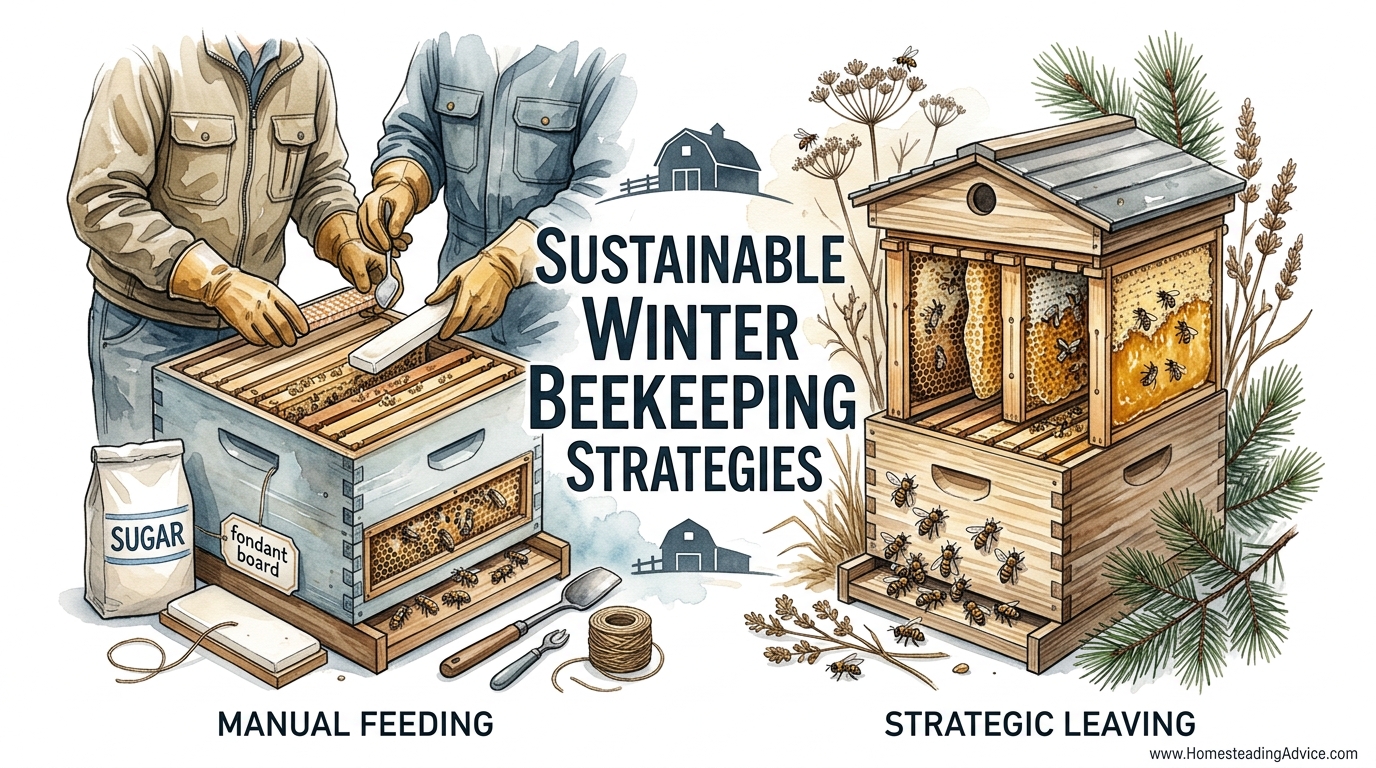
Stop working a second job just to buy white sugar for your bees when they already made the world’s best food for themselves. If you take every drop of honey and replace it with sugar water, you’re working harder and your bees are getting weaker. Strategic beekeeping means leaving the ‘tithe’ the bees need to survive, saving you hundreds in labor and feed costs.
There is a deep, quiet satisfaction in watching a heavy hive settle in for the winter. It is the weight of self-reliance. For centuries, beekeepers didn’t carry fifty-pound bags of refined sugar into their apiaries. They understood a simple, ancestral truth: the bees know how to feed themselves better than we ever could. This isn’t about laziness; it is about working with the grain of nature instead of against it.
When you shift from manual feeding to strategic leaving, you stop treating your bees like livestock on life support and start treating them like the resilient partners they are. Every frame of honey left behind is more than just calories. It is a biological insurance policy, packed with the enzymes, minerals, and complex acids that build a bee’s immune system. In the pages that follow, we will explore how to reclaim this older, more sustainable way of keeping bees.
Sustainable Winter Beekeeping Strategies
Sustainable winter beekeeping is the practice of managing a honeybee colony so it can survive the coldest months primarily on its own stored resources. Instead of a “harvest everything and feed back” mentality, this strategy focuses on calculating the exact needs of the colony based on local climate and ensures those needs are met with real honey before any surplus is taken. It exists to reduce the chemical and nutritional stress on the hive, promoting a more robust generation of “winter bees” that are physiologically different from their summer counterparts.
Think of the hive like a bank account. Manual feeding is like taking out a high-interest loan to pay your bills every month. Strategic leaving is like keeping a healthy balance in your savings. In the real world, this looks like weighing hives in the late summer and making the hard choice to leave a full super of honey rather than extracting it and spending your weekends mixing 2:1 sugar syrup. It is used by natural beekeepers, homesteaders, and increasingly by commercial apiarists who find that the cost of labor and winter losses often outweighs the profit of that last few gallons of honey.
An analogy often used in older beekeeping circles is that honey is “pre-digested sunshine.” While sugar water provides raw energy, it lacks the biological “fingerprint” of the local flora. Sustainable strategies prioritize this fingerprint, ensuring that when the cluster expands and contracts during a mid-winter thaw, the bees are consuming a diet that naturally regulates their gut pH and supports their microbiome.
How to Implement Strategic Leaving
Moving toward a self-sustaining hive requires a shift in your seasonal calendar. You cannot wait until the first frost to decide if the bees have enough. The process begins during the “main flow” when you decide how many supers to add and, more importantly, when to stop taking them away.
Step 1: Know Your Regional Target Weight
The first step is determining how much honey a colony actually needs to survive in your specific microclimate. A colony in the southern United States or Mediterranean climates may only need 40 to 50 lbs (18 to 23 kg) of stored honey because the winters are short and foraging begins early. In contrast, beekeepers in the northern United States, Canada, or Scandinavia must often leave 80 to 100 lbs (36 to 45 kg) to account for five or six months of confinement.
Step 2: The Late-Summer Weight Check
Around mid-August to early September (in the Northern Hemisphere), you should perform a “heft test” or use a hive scale. If you are using standard Langstroth equipment, a single deep frame fully capped with honey weighs approximately 6 to 7 lbs (2.7 to 3.2 kg). By counting the number of full frames in the brood nest and the first super, you can estimate the total stores. If the hive is light, this is the window where you decide to leave the next box of honey rather than pulling it for the extractor.
Step 3: Consolidating the Brood Nest
Bees are most efficient when their food is directly above or to the immediate sides of the winter cluster. As the queen slows her laying, the bees will naturally begin “backfilling” the brood cells with nectar. Strategic beekeepers encourage this by removing empty, unused supers that would otherwise act as a “chimney,” allowing heat to escape. You want the hive to be dense and heavy, with the food positioned where the heat of the cluster will keep it warm enough to consume.
The Biology of Honey vs. White Sugar
To understand why leaving honey is superior, we have to look at what is actually inside the comb. Honey is not just sugar; it is a complex biological fluid. It contains small amounts of pollen, which provides the protein and lipids necessary for the bees to develop their “fat bodies”—an organ that stores vitellogenin. This protein is the literal fountain of youth for winter bees, allowing them to live for six months instead of six weeks.
White sugar (sucrose) is a pure carbohydrate. While bees are remarkably good at converting it into energy, research shows that a diet of pure sucrose can alter the relative abundance of gut microbiota. Specifically, honey has a lower pH (more acidic) than sugar syrup, which creates an environment that is less hospitable to pathogens like Nosema ceranae. When bees eat honey, they are also consuming p-coumaric acid, a compound found in pollen and honey that helps them detoxify pesticides and strengthens their immune response.
Furthermore, honey contains enzymes like glucose oxidase and invertase. These enzymes continue to work within the stored food, providing a level of protection against spoilage and aiding in the digestion process. When we replace this with sugar water, we are essentially asking the bees to do the work of processing that “raw” sugar during a time when their metabolic resources should be focused entirely on thermoregulation.
Benefits of Strategic Leaving
The advantages of this approach stretch from the health of the bee to the thickness of the beekeeper’s wallet. By leaving the “tithe” the bees earned, you are participating in a system that rewards long-term stability over short-term gain.
- Reduced Labor: Mixing, hauling, and cleaning feeders is one of the most time-consuming tasks in the apiary. Leaving honey eliminates this entire workflow.
- Stronger Spring Build-up: Colonies wintered on honey often explode in population faster in the spring. They have the micronutrients necessary to start rearing brood even before the first pollen arrives.
- Lower Mortality Rates: Statistics frequently show that hives with ample natural stores have a higher survival rate during “long” winters or late-spring cold snaps compared to those relying on emergency sugar feeding.
- Improved Honey Quality: By not feeding sugar syrup in the autumn, you eliminate the risk of “adulterated” honey—syrup that gets moved up into your spring supers and ends up in your harvest.
Challenges and Common Mistakes
The most frequent error in strategic leaving is “wishful thinking.” A beekeeper might see a few frames of honey and assume it’s enough, only to have a warm February cause the bees to consume their stores twice as fast as expected. Warm winter days are actually more dangerous than cold ones because they encourage the bees to fly and burn energy without any nectar available to replenish it.
Another challenge is the “Late-Season Dearth.” If you pull your honey in July and then a drought hits in August, the bees may starve before they even get to winter. Strategic beekeepers always keep a “reserve” of capped honey frames in the shed. If a colony looks light in October, you can simply swap an empty frame for a full one of their own honey. This is far more effective than trying to get them to take down gallons of syrup when the temperatures are dropping below 50°F (10°C).
Robbing is also a significant risk. If you have one hive that is a “super-producer” and another that is weak, the stronger hive may rob the winter stores of the weaker one. This can leave you with one hive that is over-provisioned and another that is guaranteed to die. Monitoring hive weight right up until the bees cluster is essential to catch these imbalances.
Limitations: When This May Not Work
There are certain environmental conditions where leaving honey can actually be a disadvantage. One example is “Honeydew Honey” or honey made from certain high-ash sources like aster or heather in some regions. These types of honey can have a high mineral content that leads to “dysentery” in bees if they are confined for too long without a cleansing flight. In these specific cases, a supplemental feeding of clean white sugar can actually help by providing a “low-residue” food source for the coldest weeks.
Similarly, if you are dealing with a “package” of bees started late in the season, they simply may not have had the time to forage enough to survive. In this scenario, you cannot “leave” what isn’t there. Forcing a first-year hive to survive on zero stores is a recipe for failure, and manual feeding becomes a necessary bridge to get them to their second year.
Comparison: Manual Feeding vs. Strategic Leaving
| Feature | Manual Feeding (Sugar) | Strategic Leaving (Honey) |
|---|---|---|
| Initial Cost | Low (cost of sugar) | High (opportunity cost of honey) |
| Labor Level | High (mixing, filling, cleaning) | Very Low (hefting/monitoring) |
| Bee Health | Sufficient (Carbs only) | Optimal (Enzymes/Minerals) |
| Spring Build-up | Moderate (Needs pollen patties) | Fast (Natural nutrition) |
| Risk Level | Depends on weather for feeding | Lower (Food is already stored) |
Practical Tips for Success
If you want to transition to a more hands-off, sustainable wintering method, start with these actionable steps. These techniques ensure you aren’t just leaving things to chance, but are actively managing for resilience.
- The 13°C (55°F) Rule: Remember that bees cannot effectively take down liquid syrup once the daytime highs drop below this temperature. If your hives are light after this point, you must use “dry” feeding methods or, ideally, frames of capped honey.
- Use a Feeding Shim: If you are worried about stores, place a 2-inch (5 cm) “shim” or spacer on top of the hive. This allows you to place emergency fondant or sugar bricks directly above the cluster without breaking the propolis seal of the inner cover.
- Reduce the Entrance: A small entrance (1-2 inches or 3-5 cm) prevents cold drafts from blowing directly onto the cluster, which helps the bees conserve the energy they get from their honey.
- Insulate the Lid: Heat rises. Placing a piece of 1-inch (2.5 cm) rigid foam insulation inside the outer cover helps prevent condensation from dripping onto the bees, which is a major cause of winter death.
- Keep a Log: Note which hives survived on their own honey and which ones needed help. Over time, you can breed from the “thrifty” queens that manage their winter stores most efficiently.
Advanced Considerations: The Thrifty Bee
For the serious practitioner, strategic leaving is part of a larger genetic selection process. Not all bees are created equal when it comes to winter consumption. Some “industrial” lines of bees are bred to maximize brood production at all costs. These colonies will often continue rearing brood late into the fall, burning through 80 lbs (36 kg) of honey before January even arrives.
In contrast, many “pioneer” or local survivor stocks have a “thriftiness” gene. These bees sense the declining day length and drastically reduce their brood rearing early. They enter the winter with a smaller cluster and a lower metabolic rate. By choosing to leave honey instead of feeding sugar, you are naturally selecting for these thrifty genetics. The hives that can’t manage their stores will die out, and the ones that thrive will provide the grafted queens for your next season. This is how you build an apiary that is truly adapted to your local landscape.
Additionally, consider the “condensing hive” theory. Traditional straw skeps or thick-walled log hives didn’t have top vents. They allowed moisture to condense on the walls, which the bees could then drink. In a thin-walled modern hive, we often use top vents to prevent “rain” on the bees, but this also vents out the heat. Strategic beekeeping often involves experimenting with insulation and moisture management to create a “micro-environment” where the bees need to eat less honey just to stay warm.
Example Scenario: The Northern Homestead
Imagine a beekeeper in Vermont with four hives. In late July, she notices the goldenrod is starting to bloom. Instead of taking all the honey from the second deep box, she decides to “tithe” one full super per hive. She weighs the hives in September and finds they average 110 lbs (50 kg) total weight.
Throughout the winter, she doesn’t open the hives. She simply “hefts” the back of the hive once a month. In February, a warm spell hits. She notices one hive feels light. Because she saved two frames of honey from a hive that died the previous year (and checked it for disease), she quickly opens the lid, slides the frames in next to the cluster, and closes it. By April, all four hives are flying vigorously, while her neighbor—who took all the honey and fed sugar syrup—has lost two hives to “starvation” despite the feeders being half-full of frozen syrup.
Final Thoughts
Strategic beekeeping is about more than just saving money on sugar. It is a fundamental shift in our relationship with the honeybee. It requires us to trust their instincts and respect the work they do to prepare for the dark months. When we leave the bees their own honey, we are providing them with the tools they need to stay healthy, resilient, and productive without our constant intervention.
This path requires patience and a bit of “pioneer grit.” You have to be willing to take a smaller harvest today so that you can have a stronger apiary tomorrow. Start by leaving just one extra box of honey on half of your hives this year. Compare the results in the spring. You will likely find that the bees who ate the food they made themselves are the ones leading the charge when the first dandelions bloom.
As you move forward, keep observing, keep weighing, and keep learning from the bees. They have been surviving winters for millions of years without a single bag of white sugar. Perhaps it’s time we let them show us how it’s done.