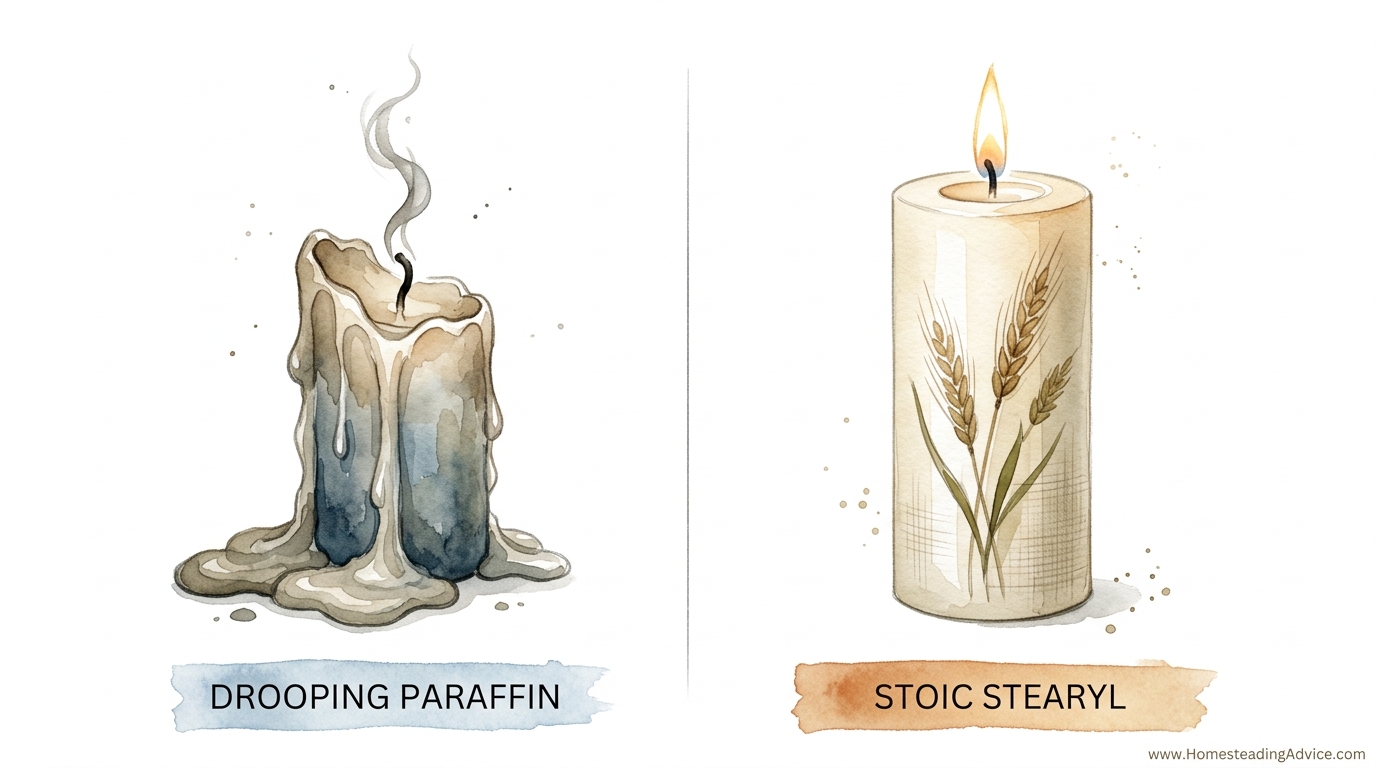
Most candles wilt under their own weight, but a simple natural additive makes them practically bulletproof. There is nothing more frustrating than a beautiful pillar candle that turns into a floppy mess the moment the temperature rises. Most beginners rely on soft paraffin, but the pros know that resilience is built through the right blend of stearin and beeswax. It is the difference between a candle that wilts and one that stands as a legacy for months.
Candle making is an old craft that demands both patience and a bit of grit. In the days of our ancestors, a candle was a tool for survival, not just a decoration. If a taper bent in the summer heat or a pillar burned through in a single evening, it was a waste of hard-earned resources. To achieve the kind of stoic stability seen in professional-grade candles, you must look beyond the basic block of wax and understand the structural additives that provide strength.
This guide explores the practical methods for fortifying your wax. We will look at traditional hardeners like stearic acid and beeswax, alongside modern enhancements like Vybar. Whether you are battling a humid climate or simply want a pillar that maintains its sharp edges through a fifty-hour burn, these techniques will elevate your craft from hobbyist to master chandler.
How To Make Candles Harder And Longer Lasting
Making a candle harder and longer-lasting involves increasing the wax’s melting point and reinforcing its molecular structure. In the world of candle making, “hardness” refers to the physical resistance of the wax to pressure and heat. A harder wax is essential for pillars, tapers, and any free-standing candle that must support its own weight without the help of a glass jar.
Long-lasting performance is directly tied to this hardness. When wax is more dense and has a higher melting point, the flame must work harder to liquefy it. This creates a slower, more controlled burn rate. While a standard soft paraffin might melt away at a rate of an inch per hour, a fortified blend can often double that lifespan, providing a steady, reliable light for many more evenings.
In real-world terms, imagine a house. Soft wax is like a frame built of pine; it works, but it might flex under heavy snow. Adding stearin or beeswax is like switching to oak or steel reinforcement. It provides the “pioneer-grit” necessary for the candle to survive a hot afternoon on a windowsill or a long winter night on the dining table. Professional makers use these techniques to ensure their products don’t slump or “mottle” unless that effect is specifically desired.
The Mechanics of Wax Hardening: Stearin and Vybar
To understand how to harden wax, you have to look at how it cools. As liquid wax becomes solid, it forms a crystal lattice. Soft waxes have large, irregular crystals that don’t pack together tightly. Hardeners work by filling the gaps between these crystals or by forcing them into a tighter, more uniform structure.
Stearic Acid (Stearin)
Stearic acid, often simply called stearin, is the most traditional hardener used in the craft. Historically isolated from animal tallow in the early 1820s, it transformed candle making from a smelly, smoky chore into a refined industry. Today, it is available in both animal-derived and vegetable-based forms, usually appearing as small white flakes or beads.
Stearin increases the melting point of the wax and makes it significantly more opaque. It also helps the candle shrink slightly as it cools. This “shrinkage” is a godsend for anyone using metal or plastic molds, as it allows the candle to pop out easily without sticking. Without stearin, a pillar candle often becomes a permanent resident of its mold.
Vybar: The Modern Polymer
Vybar is a synthetic polymer designed to replace stearic acid in specific applications. It is incredibly potent, requiring much smaller amounts to achieve a similar hardening effect. While stearin is often used at a 10% ratio, Vybar is typically used at only 0.5% to 1%.
The primary advantage of Vybar is its ability to lock in fragrance oils. If you want a candle that smells incredibly strong but remains hard and stable, Vybar is often the better choice. It prevents the “bleeding” or “sweating” of oils that can occur when you try to push the fragrance load of a candle too high.
Using Beeswax for Natural Resilience
Beeswax is nature’s ultimate candle hardener. With a natural melting point between 144°F and 147°F (62°C – 64°C), it is significantly tougher than standard paraffin or soy. It has been the gold standard of the craft for centuries, prized for its clean burn and honey-sweet aroma.
When added to softer waxes, beeswax imparts a certain “tenacity.” It makes the wax less brittle and more pliable, while still raising the overall melting point. A common practice for serious makers is the “80/20 blend”—80% paraffin or soy and 20% beeswax. This ratio creates a candle that is exceptionally hard but has a smooth, creamy finish that resists cracking.
One thing to remember is that beeswax has its own character. It is a dense material that requires a larger wick than pure paraffin because the flame needs more heat to draw the thick, hardened wax up the wick. If you find your beeswax-blended candle is “tunneling” (burning down the center while leaving walls of wax), you likely need to move up to a thicker, sturdier wick.
Benefits of Hardening Your Candles
Choosing to harden your candles isn’t just about preventing them from drooping; it offers a suite of practical advantages that improve the user experience and the longevity of the product.
- Extended Burn Time: Harder wax resists the heat of the flame more effectively, leading to a slower consumption of fuel and a much longer-lasting candle.
- Sharp Aesthetics: For molded candles, hardness ensures that fine details—like the ridges on a pillar or the delicate petals of a floral mold—stay crisp and defined even in warmer room temperatures.
- Improved Scent Throw: Additives like Vybar allow the wax to hold a higher concentration of fragrance oil (up to 10-12%) without compromising the candle’s structural integrity.
- Ease of De-molding: Hardeners like stearin cause the wax to contract slightly upon cooling, making it much easier to remove the finished candle from a mold.
- Clean Burning: Properly hardened candles, especially those using stearin or beeswax, tend to produce less soot and a more stable, flicker-free flame.
Challenges and Common Mistakes
Even with the best materials, mistakes happen. Hardening wax is a balance of chemistry and environment, and overdoing it can lead to its own set of problems.
A common pitfall is adding too much stearin. While stearin makes a candle hard, it also makes it brittle. If you exceed a 15-20% ratio in paraffin, you might find your candle cracking as it cools, or worse, shattering if it is dropped. It is a fine line between “sturdy” and “fragile.”
Another frequent error is the “mottle trap.” Some makers love the snowflake-like mottling effect on candles. However, adding too much hardener—especially Vybar—will completely eliminate this effect, turning the candle into a solid, opaque block. If you want a mottled look but still need a hard candle, you have to use specialized “mottling wax” and keep your additives to an absolute minimum.
Temperature control is also a major hurdle. If you pour your hardened wax too hot (above 180°F / 82°C), you risk creating large sinkholes in the center of the candle as the dense wax contracts. Conversely, pouring too cool (below 145°F / 63°C) can result in “jump lines” or visible rings on the side of the candle where the wax started to set before the pour was finished.
Limitations and When Not to Use Hardeners
Hardeners are not a universal fix, and there are times when they may actually hinder your results. For instance, in container candles—those poured into glass jars—extreme hardness is often a disadvantage.
Container wax is designed to be soft and “sticky” so that it adheres to the glass. If you add too much hardener to a jar candle, the wax will pull away from the sides as it cools, creating unsightly air gaps known as “wet spots.” These don’t affect the burn, but they ruin the professional look of the glass.
Environmental factors also play a role. If you are making candles in a very cold climate, a highly hardened candle may become so brittle that it cracks just from the ambient temperature drop. In these cases, it is often better to use a slightly softer blend or pre-heat your molds to slow down the cooling process.
Comparison: Stearin vs. Vybar vs. Beeswax
Choosing the right additive depends on your specific goals. This table compares the three most common hardeners based on their primary characteristics and typical usage.
| Additive | Typical Ratio | Key Benefit | Best For |
|---|---|---|---|
| Stearin | 5% – 10% | Opacity & Mold Release | Classic Pillars & Tapers |
| Vybar 103 | 0.5% – 1% | Scent Retention & Hardness | Scented Molded Candles |
| Beeswax | 10% – 30% | Long Burn & Natural Texture | High-end Luxury Blends |
Practical Tips for Best Results
To get the most out of your additives, follow these practical steps during your next pour. Precision is the mark of a serious practitioner.
- Use a Scale: Do not measure your additives by volume (teaspoons). Use a digital scale to measure by weight. A 10% stearin load means 100g of stearin for every 1000g of wax.
- Heat the Additive First: When using stearin, it is often helpful to melt the stearin flakes first and then add your wax chunks to the liquid. This ensures a perfectly homogeneous blend.
- Watch the Pour Temp: For hardened pillars, aim for a pour temperature between 165°F and 175°F (74°C – 79°C). This is hot enough to prevent lines but cool enough to minimize shrinking.
- Pre-heat Your Molds: If you are working in a cool room, use a heat gun to warm your metal molds to about 100°F (38°C) before pouring. This prevents the “thermal shock” that causes surface cracking.
- Double Pour: Hardened waxes shrink. Always save about 10% of your wax blend to perform a “top-off” pour after the candle has formed a skin and a center cavity has developed.
Advanced Considerations: Custom Blending
Once you master the basics, you can begin “tuning” your wax for specific environments. A candle intended for an outdoor summer wedding in a southern climate requires a much higher melting point than one intended for a climate-controlled indoor shop.
Advanced makers often use a combination of additives. For example, a blend of 5% stearin and 0.5% Vybar can provide the best of both worlds: the excellent mold release and opacity of stearin with the incredible scent-carrying power of Vybar. This is often referred to as “the professional’s secret” for high-end retail pillars.
You should also consider the “shore hardness” of your wax. If you want to create intricate carved candles (like the colorful dip-and-carve styles), you actually need a wax that is hard enough to hold its shape but soft enough to be sliced with a knife without shattering. This is achieved by carefully balancing microcrystalline wax with your paraffin base, rather than using traditional hardeners like stearin.
Example Scenario: The Heirloom Pillar
Consider a scenario where you want to create a large 4×9 inch (10×23 cm) pillar candle that will be used as a centerpiece for a series of holiday dinners.
If you use pure paraffin, the candle might begin to sag after three hours of burning, and the large melt pool might eventually breach the walls of the candle, causing a “blowout” and a mess on the table.
Instead, you create a blend: 800g of high-melt-point paraffin (145°F / 63°C), 150g of stearin, and 50g of yellow beeswax. You add your fragrance at 180°F (82°C) to ensure it binds, then cool the mixture to 170°F (77°C) for the pour. The resulting candle is rock-solid. It burns with a deep, contained melt pool that never breaks the sturdy outer walls, and it lasts for the entire holiday season. This is the power of a deliberate, hardened blend.
Final Thoughts
Creating a candle that stands tall and burns long is a testament to a maker’s skill and respect for the materials. By understanding the roles of stearin, Vybar, and beeswax, you move away from guesswork and toward a predictable, professional result. These additives are the backbone of a resilient candle, providing the structural integrity needed to withstand heat and time.
Never be afraid to experiment with your ratios. Every workspace is different, and the “perfect” blend often depends on your local humidity and temperature. Keep a detailed log of your pours, noting the percentages of additives and the temperatures used. Over time, this record will become your most valuable tool, a personal map to creating candles that are truly “bulletproof.”
As you continue your journey in the craft, remember that the goal is self-reliance and quality. A candle is more than just light; it is a piece of functional art. By fortifying your wax, you ensure that your work remains a lasting presence in whatever home it finds itself, standing as a stoic reminder of the care and grit you poured into it.