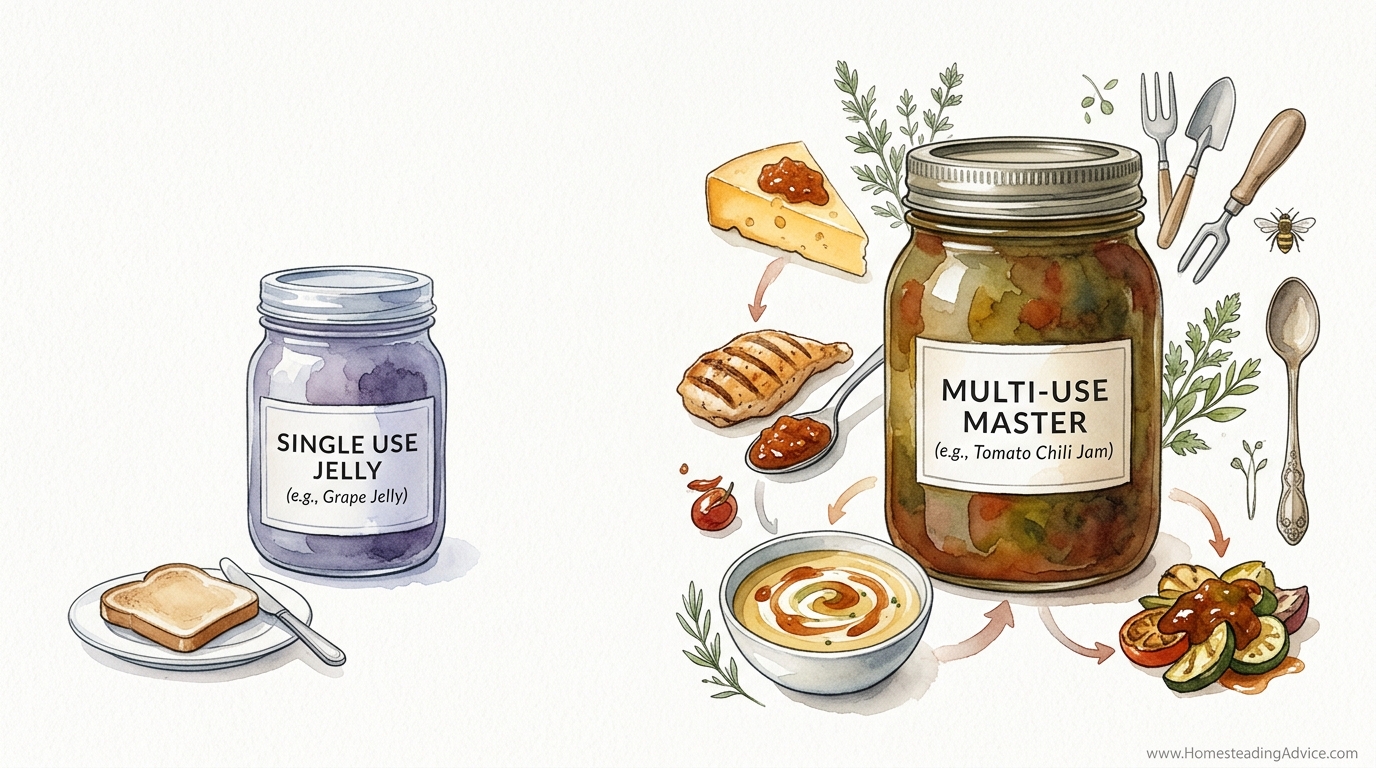
Why waste shelf space on a jar that only does one thing when you can can a pantry Swiss Army Knife? A pantry full of strawberry jam is fine, but a pantry full of savory concentrates is a culinary revolution. One jar of savory onion jam can turn a boring Tuesday night dinner into a five-star meal in seconds. You are not just preserving food; you are bottling potential.
For generations, the kitchen was the heart of the home, and the pantry was its lifeblood. Our ancestors didn’t have the luxury of “single-use” items. Every jar on that cedar shelf had to pull its weight. If you spent the time and wood-fire to process a batch of preserves, it had to be more than a simple breakfast spread. Today, we are rediscovering that wisdom. Savory onion jam is the modern “multi-use master,” a concentrated burst of flavor that works as a glaze, a dip, a sandwich topper, or a base for a complex pan sauce.
Taking control of your food supply means knowing exactly what goes into your jars. When you make your own savory preserves, you bypass the corn syrup and artificial thickeners found in store-bought condiments. You replace them with the slow-cooked depth of caramelized onions, the tang of high-quality vinegars, and the natural sweetness of maple or honey. This guide will walk you through the process of creating these versatile staples safely and effectively.
How To Make Versatile Savory Preserves
Savory preserves are concentrated condiments made by cooking vegetables—most commonly onions—with acids, sweeteners, and spices until they reach a jam-like consistency. While most people think of jam as a fruity accompaniment to morning toast, savory preserves are designed to complement meats, cheeses, and grains. They occupy a unique space between a relish and a sauce, offering the thick texture of a spread with the complex flavor profile of a slow-braised dish.
Onions are the backbone of this craft. When you cook a raw onion, it undergoes a chemical transformation. The pungent sulfur compounds mellow out, and the natural sugars begin to caramelize, turning a sharp, crunchy vegetable into a soft, mahogany-hued delicacy. In the world of preservation, we take this a step further. We add acidity (like balsamic or apple cider vinegar) to make the mixture safe for shelf-stable storage and sugar to help the pectin set into a spreadable gel.
These preserves exist because they solve the “boring meal” problem. In a real-world scenario, you might come home late with nothing but a couple of frozen burgers or a block of cheddar. A spoonful of savory onion jam instantly elevates those basic ingredients. It provides the “umami”—that deep, savory fifth taste—that usually takes hours of simmering to achieve. Whether you are hosting a high-end charcuterie evening or just trying to get a quick meal on the table, these jars are your secret weapon.
The Process of Crafting Savory Onion Jam
Creating a shelf-stable savory preserve requires a balance of culinary art and food science. Because onions are naturally low-acid vegetables, they cannot simply be tossed in a jar and water-bathed like peaches or berries. You must follow a tested recipe that introduces enough acid to lower the pH to a safe level (below 4.6).
Step 1: Preparation and Caramelization
Start with approximately 2 lbs (about 900g) of onions. Sweet varieties like Vidalia or Walla Walla are excellent choices because they have a higher natural sugar content, which aids the caramelization process. Slice them thin or dice them finely, depending on the texture you want in your final jam.
In a heavy-bottomed pot, heat a small amount of oil and add your onions. The goal is a slow, steady caramelization. Do not rush this step. If you use high heat, you will scorch the onions, leaving a bitter aftertaste that no amount of sugar can fix. Stir occasionally for 30 to 45 minutes until the onions are soft and deep golden brown.
Step 2: Adding the Flavor and Acid
Once the onions are ready, it is time to add the preserving agents. For a classic Balsamic Onion Jam, you would typically add:
- 1/2 cup (120ml) of balsamic vinegar
- 2 cups (475ml) of unsweetened apple juice
- 1/2 cup (120ml) of maple syrup or honey
- 1.5 teaspoons (9g) of salt
- Spices like white pepper, thyme, or a single bay leaf
These ingredients don’t just provide flavor; the vinegar provides the acidity required for safe water-bath canning, and the apple juice provides additional liquid and natural pectin.
Step 3: The Gelling Phase
To get that perfect “jam” consistency, you will often use a low-sugar or no-sugar-needed pectin. Combine the pectin with a small amount of granulated sugar (about 1/2 cup or 100g) and stir it into the boiling onion mixture. Bring the pot to a full rolling boil—one that cannot be stirred down—and let it boil hard for exactly one minute. This activates the pectin bonds, ensuring your jam isn’t a runny syrup.
Step 4: Canning and Processing
Ladle the hot jam into sterilized half-pint (250ml) jars, leaving 1/4 inch (0.6cm) of headspace. Remove air bubbles with a plastic tool, wipe the rims clean, and apply your lids and bands to fingertip tightness. Process the jars in a boiling water bath canner. Most recipes require 10 minutes of processing at sea level. If you live at a higher elevation, you must adjust the time:
- 1,001 – 3,000 feet: Add 5 minutes
- 3,001 – 6,000 feet: Add 10 minutes
- 6,001 – 8,000 feet: Add 15 minutes
Let the jars cool undisturbed for 12 to 24 hours before checking the seals.
The Benefits of Savory Preserves
Choosing to stock your pantry with savory onion jam offers practical and measurable advantages over standard sweet jellies. These benefits extend from the kitchen table to your long-term food security.
Unmatched Versatility
The primary advantage is the “Swiss Army Knife” utility. A jar of strawberry jam is largely limited to breakfast or dessert. In contrast, onion jam can be used as a pizza base, a sandwich spread, a glaze for roasted pork or chicken, or a stir-in for hearty stews. It bridges the gap between different meal categories, making it a more valuable use of shelf space.
Cost-Efficiency and Waste Reduction
Onions are often one of the most affordable vegetables at the market, especially when bought in bulk during the harvest season. If you grow your own, a bumper crop of onions can be difficult to store if you don’t have a perfect root cellar environment. Turning them into jam preserves that harvest for up to 18 months, ensuring none of your hard work goes to waste.
Health and Transparency
Commercial condiments are frequently loaded with high-fructose corn syrup, excessive sodium, and chemical preservatives like potassium sorbate. By making your own savory preserves, you control every milligram of salt and every drop of sweetener. You can use organic ingredients and avoid the “natural flavors” that are often anything but natural.
Challenges and Common Mistakes
Even experienced canners can run into trouble when moving from fruit jams to savory preserves. The chemistry is different, and the stakes—due to the low-acid nature of vegetables—are higher.
The pH Trap
The most dangerous mistake is treating a savory jam like a fruit jam without adding enough acid. Onions are low-acid (pH 5.3–5.8). Without the correct ratio of vinegar or lemon juice, the environment inside the jar can support the growth of Clostridium botulinum. Never “wing it” with the amount of vinegar in a canning recipe. If the recipe calls for 1/2 cup of 5% acidity vinegar, do not use less.
Improper Caramelization
Rushing the onions is a common culinary error. If you don’t cook them long enough, they will remain “crunchy” even after processing. This ruins the jam-like texture. Conversely, burning the onions creates a bitter flavor that intensifies over time in the jar. Patience is the only ingredient that cannot be substituted.
Headspace and Siphoning
Leaving too much or too little headspace can prevent a proper seal. For savory jams, 1/4 inch is the standard. If you overfill, the jam may bubble out during processing, getting under the lid and preventing the seal from forming. If you leave too much space, the air may not be fully exhausted, leading to oxidation and discoloration.
Limitations: When This Method May Not Be Ideal
While savory onion jam is a powerhouse in the pantry, it is not a universal solution for every situation. Understanding these constraints is part of being a serious practitioner.
Low-Sugar Restrictions
If you are strictly avoiding all sugars (including natural ones like maple syrup), making a traditional jam is difficult. Pectin requires sugar or a sugar-substitute like calcium-activated pectin to set. While you can make a savory “spread” without sugar, it often lacks the glossy, thick consistency that makes it so versatile.
Texture Sensitivity
Processed onion jam is soft and jammy. If a recipe calls for the distinct, firm texture of freshly sautéed onions, the preserve may not be a perfect substitute. It is a concentrate of flavor, not a structural replacement for raw or lightly cooked vegetables.
Time Investment
This is not a “quick” project. Between peeling 5 lbs of onions, the 45-minute caramelization, and the canning process, you are looking at a half-day commitment. For someone who only uses onion jam once a year, the effort might not outweigh the convenience of buying a single jar. However, for a self-reliant household, the trade-off is almost always worth it.
Comparing the Multi-Use Master vs. Single-Use Jelly
To understand why savory preserves are gaining popularity, it helps to look at them side-by-side with the traditional pantry staples.
| Feature | Savory Onion Jam (Multi-Use) | Strawberry Jelly (Single-Use) |
|---|---|---|
| Primary Use | Burgers, Roasts, Cheeses, Sauces | Toast, PB&J, Thumbprint Cookies |
| Complexity | High (Umami, Sweet, Acidic) | Medium (Sweet, Tart) |
| Meal Adaptability | Breakfast, Lunch, Dinner, Appetizers | Primarily Breakfast & Dessert |
| Prep Effort | High (Slow Caramelization) | Low to Medium |
| Canning Method | Water Bath (with added acid) | Water Bath |
Practical Tips for Success
Applying these techniques will help you move from a beginner to a proficient preserver of savory goods.
- Mix Your Onions: Don’t feel restricted to just one type. Combining red onions for color, yellow onions for depth, and shallots for sweetness creates a more complex final product.
- The Deglazing Secret: When caramelizing onions, bits of brown sugar (fond) will stick to the bottom of the pan. Use a splash of your vinegar early in the process to scrape those bits up; they contain the most intense flavor.
- Chop Consistency: For a more elegant “jam,” finely dice your onions. For a rustic “relish” style, use thin slices. If the pieces are too large, the jam will be difficult to spread on small crackers or crostini.
- Check Your Vinegar: Ensure your vinegar has at least 5% acidity. Some “gourmet” or homemade vinegars have lower acidity levels, which could make your preserves unsafe for water-bath canning.
- Label Your Batches: Savory jams often look similar to fruit jams once processed. Always label your jars with the date and the specific flavor profile (e.g., “Balsamic Onion w/ Thyme, June 2024”).
Advanced Considerations for the Serious Practitioner
For those who have mastered the basic onion jam, there are ways to push the boundaries of savory preservation.
Advanced Acidification
While balsamic is a favorite, experimenting with sherry vinegar, champagne vinegar, or even fermented fruit vinegars can change the entire character of the jam. As long as you maintain the 5% acidity threshold, the type of vinegar can be swapped to match the cuisine you cook most often.
Savory Confit vs. Water-Bath Canning
Serious practitioners often distinguish between “shelf-stable” and “storage-stable.” Garlic confit (garlic cooked in oil) is a legendary savory preserve but is never safe for room-temperature canning. It must be stored in the freezer or refrigerator. Understanding the difference between a high-acid jam (safe for the pantry) and a low-acid confit (safe only for the cold) is vital for household safety.
Natural Pectin Sources
If you want to avoid boxed pectin, you can utilize the natural pectin found in tart apples or citrus peels. Adding a finely grated Granny Smith apple to your onion mixture provides the structural integrity needed for a set without the need for commercial additives. This aligns with a more ancestral approach to food preservation.
Practical Scenarios: The Onion Jam in Action
How does this theory translate into a Monday night dinner? Here is a realistic scenario.
Imagine you have some leftover roasted chicken that is a bit dry. Normally, this would be a mediocre meal. By taking two tablespoons of your home-canned savory onion jam and whisking it with a splash of chicken broth and a teaspoon of mustard in a hot skillet, you create a rich, glossy pan sauce in three minutes. Pour that over the chicken, and you have a dish that tastes like it came from a bistro.
In another scenario, you are hosting an impromptu gathering. A block of goat cheese topped with a dollop of balsamic onion jam and served with simple crackers becomes the highlight of the evening. The jam provides the sweetness, the acidity, and the savory depth all in one go. You didn’t have to cook for hours; you just had to open a jar.
Final Thoughts
Building a pantry that works for you is a journey back to self-reliance. When you prioritize multi-use masters like savory onion jam, you are doing more than just filling jars; you are creating a foundation for effortless, high-quality cooking. These preserves represent a shift from the “sweet-only” mentality of the modern grocery store to the balanced, savory wisdom of the historical kitchen.
Take the time to master the caramelization, respect the science of acidification, and experiment with the flavor profiles that your family loves most. Once you see how a single jar of onion jam can transform your cooking, you will never look at a plain jar of jelly the same way again.
Encourage yourself to start with a small batch. See how it performs in your kitchen, and then, as the harvest seasons roll in, fill those shelves with the most versatile tools you can create. Your future self, standing in front of the pantry on a busy Tuesday night, will thank you.