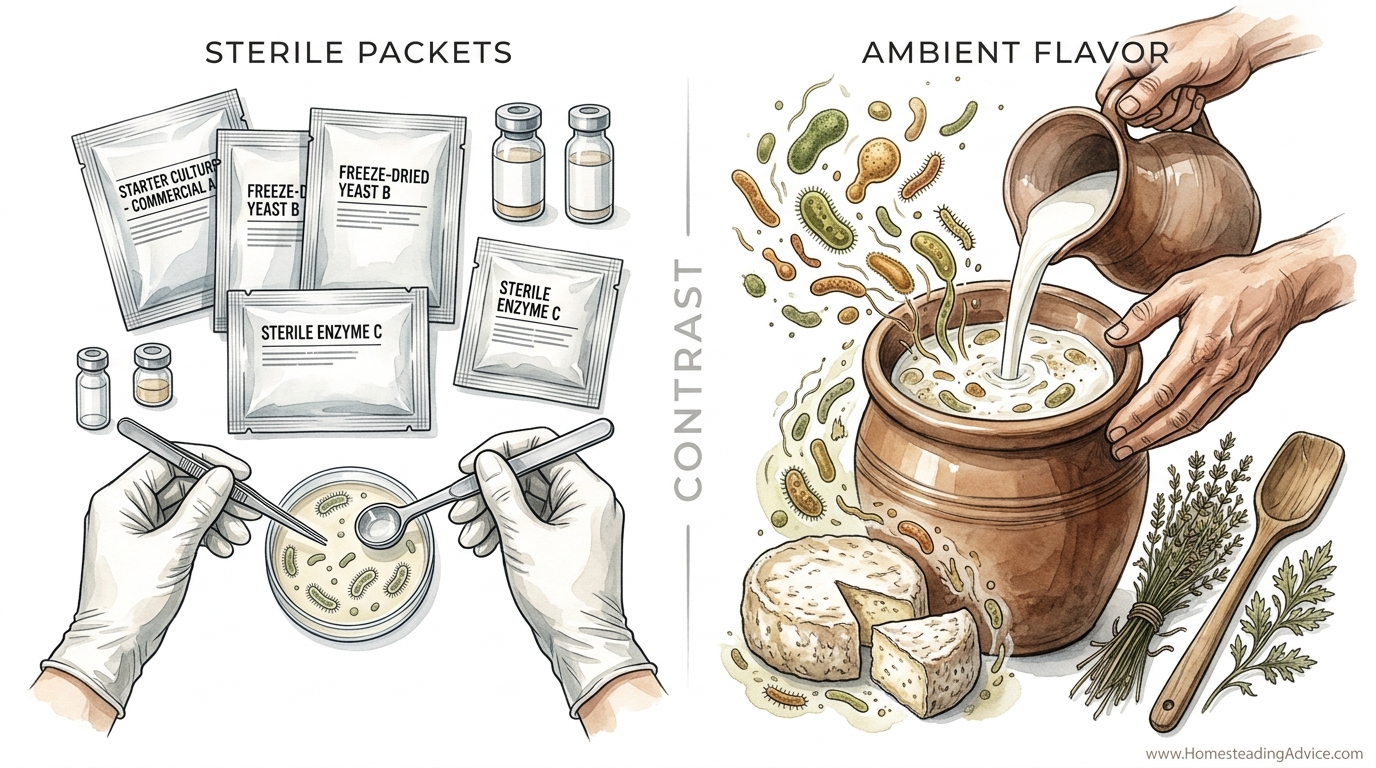
Your kitchen air is teeming with the secret ingredients to the world’s most complex cheeses, yet you keep buying them in plastic packets. The world’s most famous cheeses weren’t created in a lab; they were born from the unique ‘terroir’ of the air around the farmhouse. While modern cheesemakers rely on sterile, factory-produced starter packets that taste the same everywhere, the master artisan knows how to invite the wild microflora of their own land into the vat. Learn how to transition from a consumer of industrial cultures to a curator of wild flavor.
For millennia, cheesemaking was a dance with the invisible. A cheesemaker did not “add” a culture; they cultivated an environment where the milk’s own life could flourish. This process relies on a deep understanding of the relationship between the soil, the animal, and the atmosphere. When you move away from the predictability of commercial powders, you reclaim a piece of ancestral wisdom that prioritizes nuance over uniformity.
This guide serves as your map back to that older way of doing things. We will explore how to capture the microflora in your own home and turn it into a powerhouse of fermentation. By the end, you will see raw milk not just as an ingredient, but as a living ecosystem ready to be transformed into something extraordinary.
Natural Wild Fermentation Cheese Making Guide
Natural wild fermentation in cheesemaking is the practice of using indigenous lactic acid bacteria (LAB), yeasts, and molds to acidify and ripen milk. Unlike modern methods that use “DVI” (Direct Vat Inoculation) cultures—which are essentially freeze-dried, standardized bacteria—wild fermentation relies on what is already present in the raw milk or the immediate environment. It is the dairy equivalent of baking with a sourdough starter rather than a packet of commercial yeast.
In the real world, this method is the backbone of traditional European “PDO” (Protected Designation of Origin) cheeses. Think of the intense, biting character of a true Roquefort or the complex, nutty depths of a traditional Comté. These cheeses are “born” from the land. The bacteria on the grass the cow eats ends up on the cow’s udder, then in the milk, and finally in the cheese. This is the definition of terroir: a taste that belongs to a specific place and nowhere else.
Harnessing these wild microbes matters because it preserves genetic diversity. When a handful of global biotech companies produce nearly all the cheese cultures used today, we lose the “microbial sovereignty” that once made every village’s cheese unique. By practicing natural fermentation, you aren’t just making food; you are becoming a seed-saver of the microbial world, keeping alive the strains that industrialization has largely forgotten.
The Science of the Micro-Herd: How It Works
Before you dive into the vat, you must understand the “micro-herd.” When you work with raw milk, you are managing a population of billions of organisms. These bacteria have a single job: to eat the lactose (milk sugar) and turn it into lactic acid. This acidification is what protects the cheese from spoilage and allows the rennet to work effectively. In a wild system, this happens through several distinct methods.
The Role of Raw Milk
Raw milk is the essential foundation for true wild fermentation. It is naturally populated with a diverse array of bacteria that are destroyed during pasteurization. When milk is heated to 161°F (72°C) in industrial settings, it becomes a “blank slate.” This allows companies to control the flavor perfectly, but it also removes the biological complexity that prevents “off” flavors naturally. Raw milk from healthy, grass-fed animals acts as its own seed bank, containing the exact microbes needed to preserve it.
The Clabber Method: The Mother Culture
The most common way to start a wild ferment is through “clabbering.” This is the process of allowing raw milk to sour and thicken naturally at room temperature. A clabber culture is the “sourdough starter” of the dairy world. By taking a small amount of today’s clabber and adding it to tomorrow’s fresh milk, you “train” the bacteria to become a strong, reliable acidifier. Over several generations, this mother culture becomes more stable and effective at turning milk into cheese.
Backslopping with Whey
Another ancient technique is “backslopping.” After a batch of cheese is finished, the leftover whey is highly acidic and teeming with the specific bacteria that just successfully fermented the milk. By saving a portion of this “sweet whey” and letting it sit overnight to sour, you create a “whey starter.” Adding this to the next day’s batch ensures that the successful microbes are passed down, creating a lineage of flavor that can last for years.
Step-by-Step Guide to Creating a Wild Starter
Starting your journey into wild fermentation requires more patience than equipment. You are essentially “hunting” for the right bacteria in your own kitchen. Follow these steps to establish your first reliable clabber culture.
1. Sourcing and Preparation
- Sourcing: Find the freshest raw milk possible. Ideally, this milk should be less than 24 hours old and come from a source where the animals are pasture-raised. If raw milk is not legal in your area, look into “herd share” programs or high-quality non-homogenized, low-temp pasteurized milk (though the latter may require the addition of a small amount of kefir to “re-wild” it).
- Vessels: Use clean glass jars. Avoid plastic, as it can harbor unwanted bacteria in microscopic scratches. Sterilize your jars with boiling water before use.
- Temperature: Most wild dairy microbes thrive at room temperature, roughly 68°F to 75°F (20°C to 24°C). If your kitchen is too cold, the milk may spoil before it ferments.
2. The Initial Ferment
Pour 1 pint (500ml) of fresh raw milk into a glass jar. Cover it with a breathable cloth or a loose lid to allow gasses to escape while keeping dust out. Place it in a quiet corner of your kitchen, away from direct sunlight. Let it sit undisturbed for 24 to 48 hours. You are waiting for the milk to thicken into a yogurt-like consistency. This is your “wild clabber.”
3. Refining the Culture
Once the milk has thickened, it may smell slightly “yeasty” or sharp. To turn this into a stable cheesemaking starter, you must “feed” it. Discard all but 2 tablespoons (30ml) of the clabber. Add 1 cup (250ml) of fresh milk to the jar and stir. Repeat this every 24 hours for 3 to 5 days. By the end of this period, the culture should thicken reliably within 24 hours and have a clean, lemony, and pleasant aroma. It is now ready to inoculate a full vat of milk.
4. Scaling for a Batch
When you are ready to make a wheel of cheese, use your mother culture at a rate of roughly 1% to 2% of your total milk volume. For a 2-gallon (7.5-liter) batch of cheese, you would add about 1/2 cup to 3/4 cup (125ml to 180ml) of your active clabber. Stir it into the milk at the beginning of your recipe, usually before heating to your target temperature (typically 86°F to 90°F / 30°C to 32°C for most farmstead styles).
Benefits of Natural Wild Fermentation
Choosing the wild path over the industrial one offers rewards that cannot be measured in a laboratory. It is a commitment to quality that transforms the act of eating into an experience of connection.
Superior Flavor Depth: Industrial cultures are designed for speed and consistency. They often provide one or two “notes” of flavor. Wild ferments, however, contain a “poly-culture” of dozens of different strains. As the cheese ages, these different bacteria break down proteins and fats at different rates, leading to a complex “symphony” of taste—from sweet cream and hay to earthy mushrooms and sharp pepper.
Increased Probiotic Diversity: Natural cheeses are living foods. Because they haven’t been standardized, they contain a wider variety of beneficial bacteria that can support gut health. Traditional clabber and kefir-based starters are some of the most probiotic-rich substances on the planet, providing a broader spectrum of health benefits than a single-strain supplement.
Resilience and Sovereignty: Relying on your own cultures means you are never at the mercy of a supply chain. If the stores are closed or the shipping lines fail, you still have the means to preserve your milk. This self-reliance is a core tenet of the “pioneer” mindset—the ability to provide for oneself using only what the land offers.
Challenges and Common Mistakes
Transitioning to wild fermentation is not without its hurdles. Because you are working with nature, things don’t always go according to plan. Understanding these pitfalls will help you navigate the learning curve.
The “Funky” Phase: Beginners often mistake the natural smell of wild fermentation for spoilage. A healthy clabber should smell tart, like lemons or sourdough. If it smells like rotten eggs, old gym socks, or putrid meat, something has gone wrong. This usually happens if the milk was contaminated during collection or if the room was too cold, allowing “bad” bacteria to win the race against the “good” ones.
Weak Curd Formation: Wild starters often work more slowly than industrial packets. If you add your rennet too soon—before the bacteria have produced enough acid—your curds may be soft and fragile. This results in a low yield and a “mushy” cheese. To avoid this, always test the “flocculation” (the point when the milk starts to jell) and give the milk ample time to ripen before adding the coagulant.
Over-Acidification: Conversely, if your starter is too powerful or you let it ripen for too long, the milk can become too acidic. This leads to a cheese that is crumbly, dry, and “shirly” (excessively sour). Monitoring the pH or simply tasting the milk for a slight “tingle” on the tongue can help you time the process perfectly.
Limitations: When This May Not Be Ideal
While wild fermentation is a beautiful art, it is not always the right choice for every situation. There are practical and environmental boundaries to consider.
Regulatory Constraints: In many parts of the world, selling raw milk cheese aged for less than 60 days is illegal due to safety concerns. If you are looking to start a commercial creamery, you may find that the regulatory hurdles for natural, unstandardized cultures are significant. For the home practitioner, this is less of an issue, but it is a reality of the modern food system.
Consistency for Market: If your goal is to produce a cheese that tastes exactly the same every single Tuesday of the year, wild fermentation will frustrate you. The flavors will shift with the seasons—richer in the spring when the grass is lush, and more subdued in the winter when the animals are on hay. For some, this is a feature; for a commercial brand, it can be a marketing challenge.
Milk Quality Dependency: You cannot make good wild fermented cheese with poor-quality milk. If your milk source is not pristine, or if the animals are stressed and unhealthy, the wild microflora will reflect that. This method requires a high level of “upstream” quality control that begins at the barn door.
Comparison: Industrial vs. Natural Cultures
To better understand the trade-offs, let’s look at how the two approaches compare across several key factors.
| Factor | Industrial (DVI) Packets | Natural Wild Fermentation |
|---|---|---|
| Cost | Ongoing ($1-$5 per batch) | Free (Self-sustaining) |
| Complexity | Low (Open packet and pour) | Medium (Requires maintenance) |
| Flavor Profile | One-dimensional, consistent | Multi-layered, seasonal |
| Required Skill | Beginner | Intermediate to Advanced |
| Self-Reliance | Zero (Dependent on shipping) | High (Total sovereignty) |
Practical Tips for the Wild Cheesemaker
Applying these concepts in a modern kitchen requires a blend of science and intuition. Here are some best practices to ensure your success.
- Keep a “Culture Log”: Note the date, the temperature of your kitchen, and the aroma of your starter each day. Over time, you will begin to see patterns and predict how your cheese will behave based on the “mood” of your clabber.
- Use the “Back of the Spoon” Test: When checking your clabber, dip a clean spoon into it. The culture should coat the spoon smoothly and break cleanly away when you lift it. If it is stringy or “ropy,” it may have been contaminated with certain yeasts or bacteria that thrive in high-sugar environments.
- Warm Gently: When heating your milk to add the culture, never use high heat. A slow, gentle rise in temperature (about 1 degree per minute) prevents shocking the wild microbes and ensures they are active when you add the rennet.
- The Power of Salt: In wild fermentation, salt is your primary “volume knob” for bacterial activity. Salt slows down the bacteria. If your cheese is acidifying too quickly, a slightly higher salt concentration in the brine or dry-rub can help stabilize the aging process.
Advanced Considerations: Affining and Natural Rinds
For the serious practitioner, the fermentation doesn’t end once the cheese is pressed. The “aging” (or affinage) is where the wild microflora truly shine. This is where you transition from managing the inside of the cheese to managing the outside.
Natural Rind Development: Instead of waxing your cheese or vacuum-sealing it in plastic, consider a “natural rind.” By brushing the cheese with a light brine or simply allowing the wild molds in your aging space to land on the surface, you create a protective barrier. This rind breathes, allowing the cheese to develop flavors that are impossible to achieve in a sealed bag.
The “Cheese Cave” Environment: You don’t need an actual cave to age natural cheese. A dedicated small refrigerator kept at 50°F to 55°F (10°C to 13°C) with a container of water for humidity (aim for 85% relative humidity) works perfectly. The key is consistent airflow and a lack of chemical smells, which the cheese will absorb readily.
Biofilms and Wood: Traditional cheesemakers often use wooden aging boards. Over years of use, these boards develop a “biofilm”—a community of beneficial bacteria that actually helps protect the cheese from harmful molds. This is a level of advanced microbial management that turns your aging space into a living part of the cheesemaking process.
Example Scenario: A Batch of Wild Farmstead Tomme
To see how this works in practice, let’s walk through a typical scenario. Imagine it is early summer. You have collected 4 gallons (15 liters) of fresh, warm morning milk from a local dairy.
You take 1 cup (250ml) of your 5th-generation clabber culture, which has a beautiful scent of fresh apples and cream. You stir this into the 90°F (32°C) milk and let it ripen for 45 minutes. During this time, the “wild” bacteria are waking up and beginning to consume the lactose.
Next, you add your rennet. Within 30 minutes, you have a firm curd that “breaks” cleanly over your finger. You cut the curds into 1/2-inch (1.25cm) cubes and stir them gently for another 30 minutes, allowing the whey to escape. After pressing the curds into a mold for 12 hours, you have a solid wheel of cheese.
Because you used wild cultures, this cheese will now go into your aging space for three months. By the time you cut into it, the wild yeasts have created tiny, almost invisible “eyes” in the paste, and the flavor is a complex mix of the summer grass and the unique “soul” of your kitchen’s air. This is a cheese that no factory could ever replicate.
Final Thoughts
Embracing natural wild fermentation is a journey toward the heart of what food is meant to be. It requires us to slow down, to observe, and to trust in the biological systems that have sustained humanity for thousands of years. By moving away from sterile packets and back toward ambient flavor, you aren’t just making a better sandwich; you are participating in a grand tradition of craftsmanship.
The transition may be challenging at first, and you will likely have a few “failed” batches that end up as chicken feed. But those failures are the tuition you pay for a deeper education in the nature of life itself. Once you taste the difference between a standardized block of store-bought cheddar and a wheel of your own wild-fermented cheese, there is no going back.
Start small, find a good source of milk, and begin your first clabber today. The air in your kitchen is waiting to help you create something legendary. Experiment, be patient, and let the wild things lead the way.