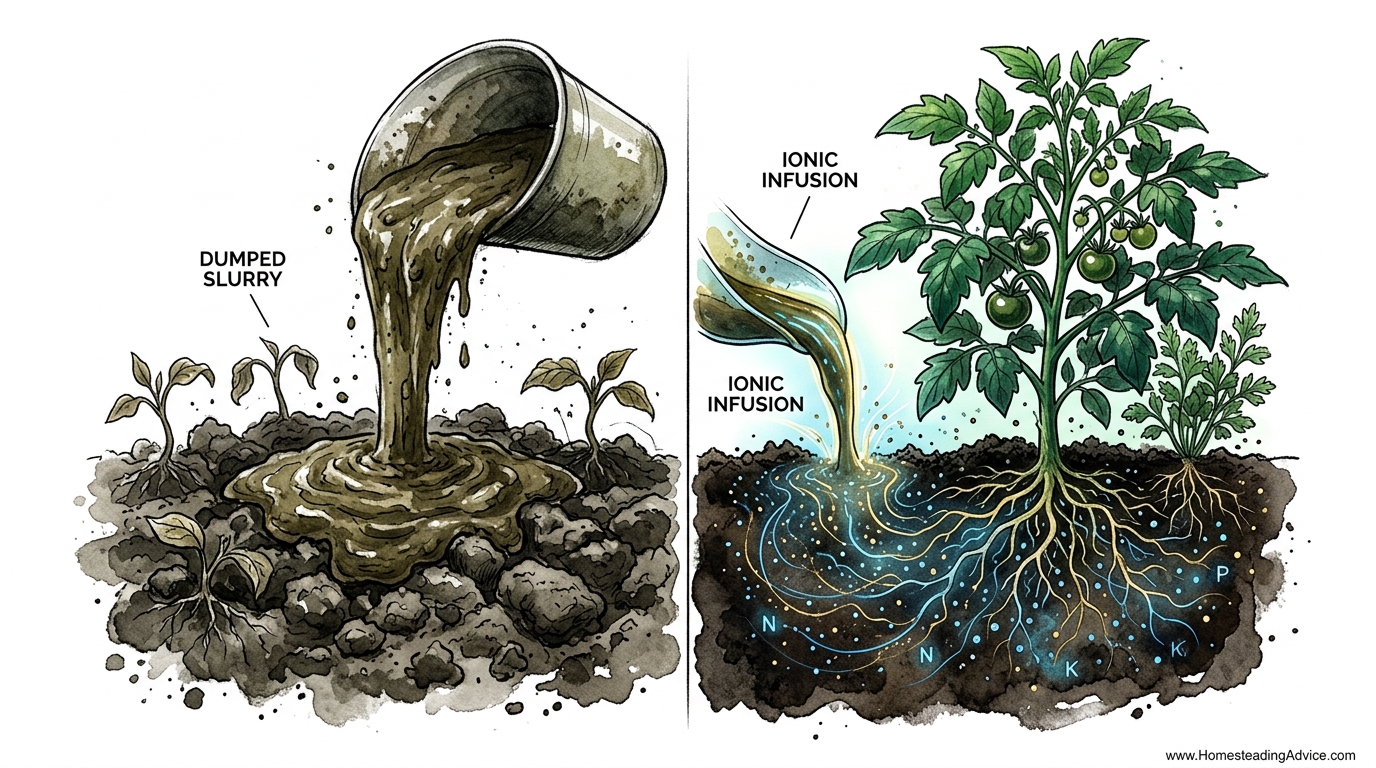
Raw digestate is a mess, but a precision-diluted ‘bio-tea’ is the most powerful growth hormone on earth. Stop dumping your digester waste and start crafting a precision liquid fertilizer. Your plants don’t want a flood of sludge; they want a targeted, diluted nutrient injection that absorbs in seconds.
The old ways of farming often relied on what we could see—the heavy pile of manure, the thick layer of compost, or the dark, heavy smell of the barnyard. But the secret to true garden vitality isn’t in the weight of the waste; it’s in the refinement of the nutrients. When you take the byproduct of an anaerobic digester and treat it with the respect it deserves, you aren’t just getting rid of waste. You are creating a biological infusion that feeds the soil at a cellular level.
This transition from seeing “slurry” as a problem to seeing “bio-tea” as a solution is the hallmark of a resilient, self-reliant grower. It requires a shift in mindset from the blunt force of DUMPED SLURRY to the refined accuracy of IONIC INFUSION. By understanding the chemistry behind the bubbles, you can unlock a level of growth that makes synthetic fertilizers look like a pale imitation of the real thing.
Maximizing Garden Yields With Biogas Slurry
Biogas slurry, or anaerobic digestate, is the liquid remains left behind after bacteria have finished breaking down organic matter in an oxygen-free environment. While most folks focus on the methane gas produced for cooking or heating, the real treasure of a biogas system is the slurry. It is a concentrated, liquid gold that contains almost all the nutrients originally found in the feedstock, but in a form that plants can actually use.
In the natural world, nutrients are often locked up in complex organic molecules. A plant cannot simply “eat” a piece of straw or a hunk of manure. These materials must be broken down by soil microbes over months or even years. The biogas digester acts like a mechanical stomach, performing this breakdown in a matter of weeks. The resulting slurry is a suspension of minerals, organic acids, and beneficial microbes that are ready for immediate uptake.
Real-world applications of this “liquid gold” range from massive industrial corn fields in Europe to small-scale kitchen gardens in Southeast Asia. Whether you are managing a 100-acre (40-hectare) farm or a 10-foot (3-meter) garden bed, the principles remain the same. The slurry is a biological catalyst. It doesn’t just provide Nitrogen, Phosphorus, and Potassium (NPK); it delivers them alongside phytohormones like gibberellins and auxins, which tell the plant to grow faster, taller, and stronger.
How the Bio-Tea Transformation Works
To understand why a precision-diluted tea outperforms raw sludge, you have to look at the chemistry of the digester. Inside the tank, a process called anaerobic digestion converts organic nitrogen into ammoniacal nitrogen ($NH_4-N$). This form of nitrogen is highly soluble in water and is the “fast food” of the plant world.
When you apply raw, undiluted slurry, the concentration of ammonia is often too high. It can overwhelm the delicate root hairs of a plant, causing what we call “ammonia burn.” Furthermore, raw slurry is thick. It sits on top of the soil, sealing off the pore spaces and preventing the earth from “breathing.” This leads to anaerobic pockets in your garden beds, which can invite root rot and pathogens.
The “Bio-Tea” method involves a precise dilution—typically ranging from 1 part slurry to 3 parts water (1:3) for heavy feeders, up to 1 part slurry to 10 parts water (1:10) for delicate seedlings. This dilution does three critical things:
- Reduces Phytotoxicity: It lowers the ammonia concentration to a level that stimulates roots rather than searing them.
- Increases Penetration: The thinner liquid travels deeper into the soil profile, reaching the entire root zone instead of just the surface.
- Oxygenates the Soil: By carrying the nutrients in a water-based solution, you ensure that the soil remains porous and aerobic, which is essential for the healthy soil microbes that support your plants.
The Filtration Step
For those looking to use a sprayer, filtration is mandatory. Raw slurry contains “fibrous” material—tiny bits of undigested lignin and cellulose. While great for soil structure, these fibers will clog a nozzle in seconds. Sieve your slurry through a fine mesh or a burlap sack before dilution. What remains in the bag is a high-quality solid compost; what passes through is the base for your precision infusion.
Benefits of the Bio-Tea Approach
The primary advantage of using a diluted biogas tea over raw manure or synthetic alternatives is the speed of response. Because the nutrients are already in an ionic state, they don’t need to wait for soil bacteria to process them. Within hours of a root drench or a foliar spray, the plant begins to move those minerals into its vascular system.
Measurable benefits often include:
- Increased Yield: Studies have shown that crops like rice can see a 30% increase in yield, while maize (corn) often sees a 25% boost compared to traditional manuring.
- Enhanced Protein and Sugar: The presence of trace minerals like Zinc (Zn) and Iron (Fe) in the slurry can nearly double the protein content in certain forage crops and increase the “Brix” (sugar content) in fruits and vegetables.
- Soil Structure Improvement: Unlike synthetic fertilizers, which can degrade soil over time, the organic matter in the slurry promotes the formation of “water-stable aggregates.” This means your soil holds onto water better during droughts and drains better during floods.
- Disease Resistance: The beneficial bacteria found in well-managed digestate, such as Bacillus species, act as a natural defense against soil-borne pathogens.
Common Challenges and Pitfalls
The most common mistake a grower makes is “loving their plants to death” with too much of a good thing. Because biogas slurry is so potent, applying it at full strength is like giving a child a gallon of espresso. It will result in dark, lush leaves that are actually structurally weak and highly attractive to pests like aphids and mites.
Another pitfall is the **Odors and Volatilization**. If you spread slurry on a hot, windy afternoon, you can lose up to 50% of your valuable nitrogen to the atmosphere in the form of ammonia gas. Not only is this a waste of fertilizer, but it also creates a nuisance for neighbors. Always apply your tea in the early morning or late evening when the air is still and the sun is low. This ensures the liquid soaks into the ground before it can evaporate.
The “Salinity Trap” is a third concern. Biogas slurry can be high in soluble salts. If you live in an arid region and apply the tea repeatedly without sufficient irrigation or rainfall to flush the soil, these salts can build up. This increases the Electrical Conductivity (EC) of your soil, making it harder for plants to drink water, even if the soil looks wet.
Limitations: When the Tea Isn’t the Answer
While powerful, biogas slurry is not a “magic bullet” for every situation. There are realistic constraints that every practitioner must acknowledge.
Environmental Boundaries: If your soil is already saturated or “waterlogged,” adding more liquid fertilizer is a recipe for disaster. The nutrients will simply run off into local waterways, causing algae blooms and polluting the groundwater. Never apply the tea right before a heavy rainstorm.
Nutrient Imbalance: Biogas slurry is typically very high in Nitrogen but can be relatively low in Phosphorus (P). Over time, relying solely on slurry can lead to a Phosphorus deficiency. This is often seen in crops that fail to set fruit or have stunted, purple-tinted leaves. To balance this, some growers “spike” their tea with bone meal or rock phosphate.
The Pathogen Factor: While mesophilic digestion (standard in most home systems) kills many pathogens, it is not 100% effective against everything. If you are using human waste or diseased animal carcasses as feedstock, you must exercise extreme caution. Never use the tea as a foliar spray on “ready-to-eat” crops like lettuce or strawberries within 60 days of harvest.
Comparison: Raw Slurry vs. Precision Bio-Tea
To help visualize why the extra step of dilution and timing matters, consider the following comparison based on efficiency and plant health.
| Feature | Dumped Raw Slurry | Precision Bio-Tea |
|---|---|---|
| Absorption Speed | Slow (days to weeks) | Rapid (hours to days) |
| Risk of Root Burn | High (Ammonia toxicity) | Minimal to None |
| Nitrogen Efficiency | Poor (High losses to air) | Excellent (Direct injection) |
| Application Method | Surface spreading only | Drench, Foliar, Fertigation |
| Labor Requirement | Low (Bulk dumping) | Moderate (Mixing/Filtering) |
Practical Tips and Best Practices
If you want to start using bio-tea today, follow these simple, field-tested rules of thumb:
- The 1:5 Rule: For general garden use, a 1:5 dilution (one gallon of slurry to five gallons of water) is the safest starting point. It provides enough punch to see a difference without the risk of over-fertilization.
- Test Your Water: If your well water is very alkaline (high pH), it can cause the ammonia in the slurry to “volatilize” even faster. Adding a tablespoon of apple cider vinegar per 5 gallons (19 liters) of tea can help stabilize the nitrogen.
- Use a “Settling Tank”: Instead of taking slurry directly from the digester outlet, let it sit in a secondary tank for 24–48 hours. This allows the heavy solids to sink and the “clear liquor” to rise to the top. This clear liquor is much easier to filter and use for foliar spraying.
- Temperature Matters: Soil microbes are most active when the ground is above 60°F (15°C). Applying your bio-tea to frozen or near-freezing ground is a waste of time, as the plants are dormant and the soil cannot absorb the liquid.
- The “Morning Dew” Strategy: For foliar feeding, spray just as the dew is drying on the leaves. The leaf stomata (pores) are wide open, allowing for maximum absorption of the micronutrients.
Advanced Considerations for the Serious Practitioner
For those who have mastered the basics and want to push their yields to the limit, there are ways to “supercharge” your bio-tea.
Microbial Inoculation: While the slurry contains many bacteria, the anaerobic environment of the digester is very different from the aerobic environment of the soil. Some advanced growers aerate their diluted tea with a simple fish-tank bubbler for 12 hours before application. This “activates” the biology, encouraging the growth of aerobic microbes that thrive in the root zone.
Chelation with Humic Acids: Adding a small amount of humic or fulvic acid to your bio-tea can help “chelate” the minerals. Chelation is a fancy word for wrapping a mineral in an organic molecule, making it even easier for the plant to absorb. This is especially useful in clay soils where minerals like phosphorus and potassium tend to get “locked up” and become unavailable to the plant.
The Biochar Synergy: One of the most exciting frontiers in regenerative agriculture is the combination of biogas slurry and biochar. Biochar is essentially a highly porous “biological sponge.” When you soak biochar in your bio-tea, the char absorbs the nutrients and microbes. When buried in the garden, this “charged” biochar acts as a slow-release fertilizer battery that can last for decades.
Example Scenario: The Tomato Transformation
Imagine two gardeners, Silas and Elias. Both have a small biogas digester and a row of heirloom tomatoes.
Silas takes the raw slurry and pours a thick bucketful around the base of his plants once a week. Within two weeks, his soil develops a grey crust. The leaves of his tomatoes turn dark green and curl downward—a classic sign of nitrogen toxicity. When a heatwave hits, his plants wilt faster than any others because the high salt content in the slurry has damaged the root hairs, making them unable to draw in enough water.
Elias, however, uses the bio-tea method. He filters his slurry through a screen and mixes it at a 1:8 ratio. Every Wednesday morning, he uses a watering can to apply the tea as a root drench. Once a month, he uses a fine-mist sprayer to give the leaves a “foliar snack.” His plants grow at a steady, sustainable pace. The stems are thick and sturdy, and the fruit set is heavy. By the end of the season, Elias harvests 40% more tomatoes than Silas, and his soil remains soft and full of earthworms.
This isn’t magic; it’s the difference between dumping waste and managing nutrients.
Final Thoughts
The transition from a “waste-disposal” mindset to a “nutrient-management” mindset is the most important step any gardener can take. Raw biogas digestate is undoubtedly a mess—it’s smelly, heavy, and difficult to handle. But within that mess lies the raw potential of the universe, waiting to be refined into the world’s most powerful growth hormone.
By committing to the art of the precision-diluted bio-tea, you are doing more than just feeding your plants. You are participating in a cycle of ancestral wisdom that recognizes the value in what others throw away. You are building soil that will be more fertile next year than it is today, and you are doing it without the need for expensive, store-bought chemicals.
Take the time to experiment. Start with a 1:10 dilution and watch your plants. Listen to what they tell you. If the leaves stay pale, tighten the ratio to 1:5. If they turn a deep, unnatural blue-green, back off and add more water. This is the “pioneer-grit” approach to modern gardening: using your hands, your eyes, and your common sense to turn a “mess” into a masterpiece. Your garden will thank you with the most abundant harvest you’ve ever seen.