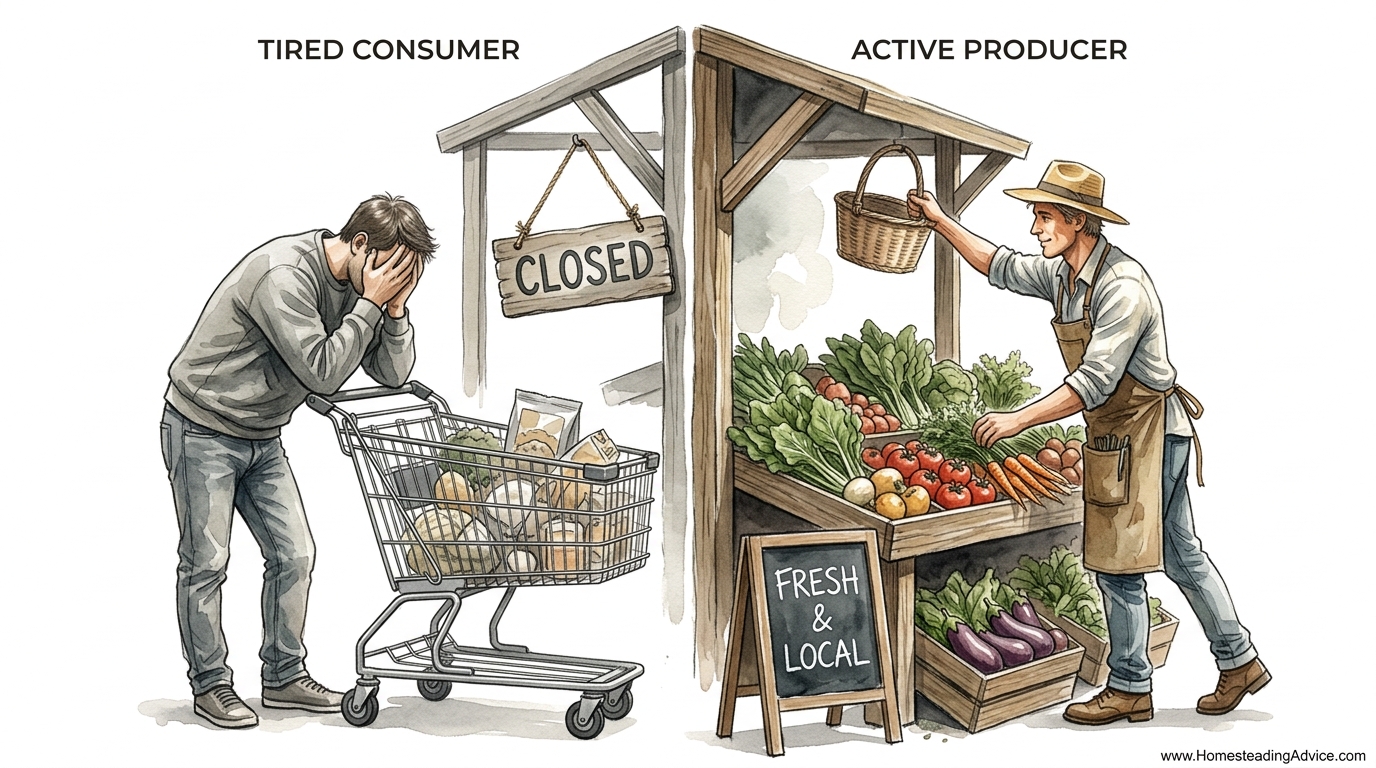
The most powerful shift you can make is moving from the checkout line to the farm stand. Stop paying for mediocrity and start selling excellence. The transition from consumer to producer is the moment your homestead stops being a hobby and starts being a business. Your neighbors want what you can grow.
Many people spend years perfecting their soil and refining their harvest, only to let the surplus go to waste or give it away for free. While generosity has its place, building a sustainable homestead requires a return on your labor. Moving from a tired consumer—one who relies entirely on fragile supply chains—to an active producer allows you to take control of your local food economy.
Establishing a roadside presence is more than just putting a table by the driveway. It is an act of self-reliance that connects you to the ancestral wisdom of trade and community support. This guide will walk you through the practicalities of turning your garden gate into a gateway for local commerce.
Starting A Roadside Farm Stand
A roadside farm stand is a small-scale retail operation located on or near the land where the food is produced. It serves as a direct bridge between the grower and the customer, eliminating the middlemen that usually stand between a seed and a dinner plate. These stands range from simple “honor system” wagons to permanent, weather-proof structures equipped with refrigeration.
In the real world, these stands act as vital community hubs. They exist because they solve a problem for both the producer and the buyer. The producer gets to keep 100% of the profit instead of the 15-20% typically offered by wholesale distributors. The buyer receives produce that was often harvested just hours before purchase, retaining a level of nutrient density and flavor that grocery store items cannot match.
Visualize a simple wooden structure at the end of a gravel driveway. Inside, there are baskets of heirloom tomatoes, bundles of fresh herbs, and perhaps a dozen multi-colored eggs. A small chalkboard lists the day’s harvest, and a heavy metal box is bolted to the post for payments. This is the simplest form of the producer’s economy. It requires no marketing department and no complex logistics—just good food and a visible location.
The Legal Foundation: Zoning and Cottage Food Laws
Before you hammer the first nail into a display shelf, you must understand the rules of the land. Zoning and food safety regulations are the two primary hurdles for any new stand. These laws vary significantly between regions, but the underlying principles remain similar across the globe.
Zoning laws dictate how you can use your property. In many rural or agricultural zones, farm stands are allowed “by right,” meaning you do not need a special permit to operate. However, if you live in a residential or suburban area, there may be restrictions on commercial activity, the size of your structure, or how close it can be to the road. Always call your local county planning office to check your specific parcel’s classification.
Food safety is governed by what are often called Cottage Food Laws. In the United States, most states have specific exemptions for “non-potentially hazardous” foods. This usually includes:
- Whole, uncut fruits and vegetables.
- Dried herbs and teas.
- Honey and pure maple syrup.
- Traditional high-acid jams and jellies.
- Baked goods that do not require refrigeration (breads, cookies, pies).
Items like meat, dairy, and “cut” produce (like sliced melon) are typically more regulated and require licensed commercial kitchens. For example, in California, “Field Retail Stands” are limited to whole produce and shell eggs, while more formal “Farm Stands” can sell a limited amount of pre-packaged goods produced nearby. Understanding these distinctions early prevents costly fines or forced closures.
Choosing the Right Location
The success of your stand depends heavily on visibility and accessibility. Even the best organic berries will rot if no one can see where to buy them. You need to think like a customer driving at 45 miles per hour (72 kilometers per hour).
Visibility is your primary marketing tool. A stand tucked behind a hedge or a sharp curve is a missed opportunity. You want a straight stretch of road where drivers have enough time to see your signs, process the information, and slow down safely. If your property is on a high-speed road, ensure there is a wide shoulder or “lay-by” where cars can pull off without obstructing traffic.
Accessibility means more than just being near the road. You must provide a clear, flat area for parking. Two or three parking spots are usually sufficient for a small stand. If a customer has to struggle to turn around or worries about getting stuck in the mud, they will likely keep driving. Consider the direction of traffic; a stand on the right side of the road for people heading home from work is often more profitable than one on the “morning side” of the commute.
Designing and Building the Stand
Your stand’s design should reflect the quality of your goods. It does not need to be fancy, but it must be functional and clean. A rugged, well-built wooden structure conveys a sense of “pioneer-grit” and reliability.
The Structure
A basic stand can be built from reclaimed pallets, cedar, or pressure-treated lumber. The footprint should be large enough to hold your peak harvest but small enough to remain manageable. A 4-foot by 8-foot (1.2 meters by 2.4 meters) structure is a common starting size. Ensure the roof has a generous overhang—at least 12 inches (30 centimeters)—to protect your produce and your customers from sun and rain.
The Layout
Organize your shelves with the “heavy to light” rule. Heavier items like pumpkins, watermelons, or bags of potatoes should be on lower, sturdier shelves. Delicate items like berries, leafy greens, and cut flowers should be at eye level. Use angled shelving to make the produce more visible from the road. Customers should be able to see the variety and abundance of your harvest at a single glance.
Refrigeration and Temperature Control
Heat is the enemy of fresh produce. If you are selling eggs, leafy greens, or berries, you will need a way to keep them cool. A simple high-quality cooler with ice packs can work for an honor-system stand. If you have electricity at the site, a small glass-front refrigerator is a game-changer. It keeps the food safe and allows customers to see the freshness of the items inside without opening the door.
What to Sell: Inventory Selection
An active producer focuses on what the community needs, not just what they happen to have too much of. To be profitable, you need a mix of “traffic drivers” and “margin builders.”
High-Demand Traffic Drivers
These are the items that bring people to the stand. They are often seasonal favorites that people associate with local farming.
- Sweet Corn: A classic summer draw. People will drive miles for corn picked that morning.
- Tomatoes: Heirlooms with deep colors and rich flavors that the grocery store cannot replicate.
- Fresh Eggs: A year-round staple with a loyal customer base.
- Strawberries and Blueberries: High-value crops that move quickly during their short seasons.
Margin Builders and Value-Added Products
While produce brings them in, value-added products often provide the best profit margins. These items utilize surplus or “seconds” (produce with minor cosmetic flaws) to create something new. Turning 5 pounds (2.2 kilograms) of bruised berries into 10 jars of jam can triple your profit on that fruit. Dried herbs, bouquets of flowers, and handmade soaps are other excellent additions that take up little space but add significant value to the average transaction.
Pricing and Payment Systems
Pricing your goods is a balance between fair market value and recognizing the superior quality of homestead-fresh food. Do not undervalue your labor. People shopping at a farm stand are usually willing to pay a premium for transparency and flavor.
The Honor System vs. Manned Stands
Most small roadside stands operate on the honor system. This allows you to keep working in the garden while the stand sells for you. The risk of theft is real, but many producers find that the savings in labor costs far outweigh the occasional loss. A manned stand is only necessary if your volume is high enough to justify a full-time employee or if you are in an area where security is a major concern.
Modern Payment Methods
While the traditional cash box is a staple, we live in a digital world. Modern consumers often do not carry physical currency. Integrating digital options can increase your sales by 20% to 40%.
- The Cash Box: Use a heavy-duty, locked metal box bolted to the structure. Provide a small slot for bills and coins.
- QR Codes: Post clear signs with QR codes for Venmo, PayPal, or Cash App. This allows customers to pay instantly with their phones.
- Round Numbers: Price your items in round increments (e.g., $4.00 or $5.00) to make it easier for customers to pay with exact change and for you to track digital payments.
Effective Marketing and Signage
Your signs are your silent salespeople. They need to be bold, simple, and legible from a distance. Use the “10-foot rule” (3-meter rule): if a person cannot read the sign from 10 feet away while walking, they certainly cannot read it while driving.
Start with a “lead-in” sign at least 500 feet (150 meters) before your stand. This gives drivers time to react. The sign should simply say “FARM STAND AHEAD” with an arrow. Your main sign at the stand should list the primary items currently in stock, such as “FRESH EGGS & TOMATOES.” Use high-contrast colors like black on yellow or white on dark green.
Don’t ignore the digital community. Join local Facebook groups and post photos of your morning harvest. Mentioning that the “peaches are perfectly ripe today” can trigger a surge of afternoon traffic. People love to see the face behind the food, so sharing a bit of your homesteading journey builds a loyal following that feels more like a community than a customer base.
Benefits of the Roadside Model
Choosing a roadside stand over a traditional farmer’s market or wholesale route offers several distinct advantages. The most significant is the reduction in logistics and waste. You are selling where you grow. There is no need to load a truck, drive 30 miles (48 kilometers), spend 6 hours at a market, and drive back with unsold wilted produce.
Another benefit is the higher profit margin. Because there is no booth fee and no middleman taking a cut, you retain the full retail value of every item. Furthermore, the roadside stand allows for flexible timing. You can open and close the stand based on your harvest cycle and your own schedule. If the tomatoes aren’t ready until Wednesday, you don’t have to open on Tuesday.
Challenges and Common Mistakes
The path of the producer is not without its hurdles. One of the most common mistakes is poor inventory management. Leaving wilted lettuce or soft cucumbers on the shelf for “one more day” destroys customer trust. Your reputation is built on being better than the grocery store; if your quality dips, your customers will return to the supermarket.
Theft and security are also valid concerns. While most people are honest, you should take steps to protect your earnings. Use a “security cameras in use” sign, even if you don’t have a sophisticated system. Empty the cash box several times a day so that a potential thief never finds a significant haul.
Finally, beware of burnout. A farm stand requires daily attention—cleaning the shelves, restocking items, and checking the payment box. If you treat it like a hobby, the results will be inconsistent. If you treat it like a business, it requires a disciplined routine.
Limitations and Considerations
A roadside stand may not be ideal for every homestead. If you live on a dead-end road with very low traffic, your customer base will be limited to your immediate neighbors. In this case, you might be better off with a subscription-based CSA (Community Supported Agriculture) model or a pre-order system for pick-up.
Environmental factors also play a role. If your stand is exposed to extreme wind, dust, or direct afternoon sun, your produce will degrade rapidly. You must be willing to invest in a structure that mitigates these factors. Additionally, check your local liability insurance. Most standard homeowner’s policies do not cover commercial activity on the property. A small “commercial general liability” policy is often necessary to protect yourself in case a customer trips or claims food-borne illness.
Comparison: Honor System vs. Manned Stands
| Feature | Honor System Stand | Manned Farm Stand |
|---|---|---|
| Labor Requirement | Low (restocking only) | High (constant staffing) |
| Security Risk | Moderate to High | Very Low |
| Customer Interaction | Minimal (signage based) | High (builds relationships) |
| Operating Costs | Very Low | Moderate (wages/time) |
| Sales Potential | Steady/Passive | High (upselling possible) |
Practical Tips for Daily Operations
Running a successful stand is about the details. Harvest in the early morning when plants are most hydrated; this ensures the longest possible shelf life for your greens and berries. A quick “hydro-cooling” dunk in cold water (10-15°C / 50-60°F) for items like lettuce or kale can keep them crisp for hours even in the heat.
Maintain a cleaning routine. Wipe down the shelves every morning to remove dust, cobwebs, and organic debris. A clean stand signals to the customer that you take food safety seriously. If the stand looks neglected, people will assume the food is old.
Keep a notebook in the stand. This serves two purposes. First, it allows you to track what sells and at what time of day. Second, it gives customers a place to leave feedback or requests. Many honor-system producers find that a “Guest Book” fosters a sense of community trust, making people less likely to steal and more likely to leave a kind note.
Advanced Considerations: Scaling Your Business
Once your roadside stand is established and profitable, you may want to look toward the future. Scaling up often involves diversifying your season. Can you offer greenhouse-grown greens in the winter or dried wreaths and pumpkins in the autumn? Extending your selling season keeps your brand “top of mind” for locals throughout the year.
Consider collaborating with other producers. If you grow great vegetables but don’t have chickens, you might partner with a neighbor who has surplus eggs. You can sell their eggs on commission (taking perhaps 10-15% for the “shelf space”) or buy them wholesale. This turns your stand into a mini-hub for the local food economy, offering customers a “one-stop-shop” experience.
Lastly, explore agritourism. A simple farm stand can be a gateway to “U-Pick” days or farm tours. Inviting people to see the soil where their food grows creates an emotional connection that transcends a simple transaction. This is the ultimate expression of the active producer—not just selling a product, but sharing a lifestyle and a set of values.
Example Scenario: The Summer Peak
Consider a homesteading family in mid-July. They have 20 tomato plants in full production, a surplus of zucchini, and 15 laying hens. At the start of the week, the producer harvests 40 pounds (18 kilograms) of tomatoes and 2 dozen zucchini.
They price the tomatoes at $4.00 per pound and the zucchini at $1.00 each. They also have 10 dozen eggs priced at $6.00 per dozen.
- Total Potential Revenue: $160 (Tomatoes) + $24 (Zucchini) + $60 (Eggs) = $244.
- Daily Labor: 30 minutes for harvesting, 15 minutes for cleaning/stocking.
By Friday, 90% of the inventory is gone. Total revenue for the week is $220. After subtracting $20 for egg feed and packaging, the net profit is $200 for approximately 5 hours of total work across the week. This income covers the cost of the entire garden’s seeds, fertilizer, and water, effectively making the family’s own food supply free while providing extra cash for homestead improvements.
Final Thoughts
Building a roadside farm stand is a tangible step toward a more resilient and self-sufficient life. It transforms the surplus of your land into a resource for your community, fostering trust and providing a superior alternative to industrial food systems. The transition from a tired consumer to an active producer is a journey of reclaiming your role in the local economy.
Success in this venture comes from a combination of quality, consistency, and clear communication. Whether you start with a simple basket of garden extras or a purpose-built structure, the key is to begin. Listen to your soil, watch what your neighbors buy, and adjust your plans as you grow.
The ancestral wisdom of the village market is still relevant today. By standing at the edge of your property and offering the fruits of your labor, you are doing more than selling food. You are strengthening the bonds of your community and ensuring that the tradition of the independent producer continues for generations to come. Experiment with your crops, refine your displays, and take pride in every item that leaves your stand.