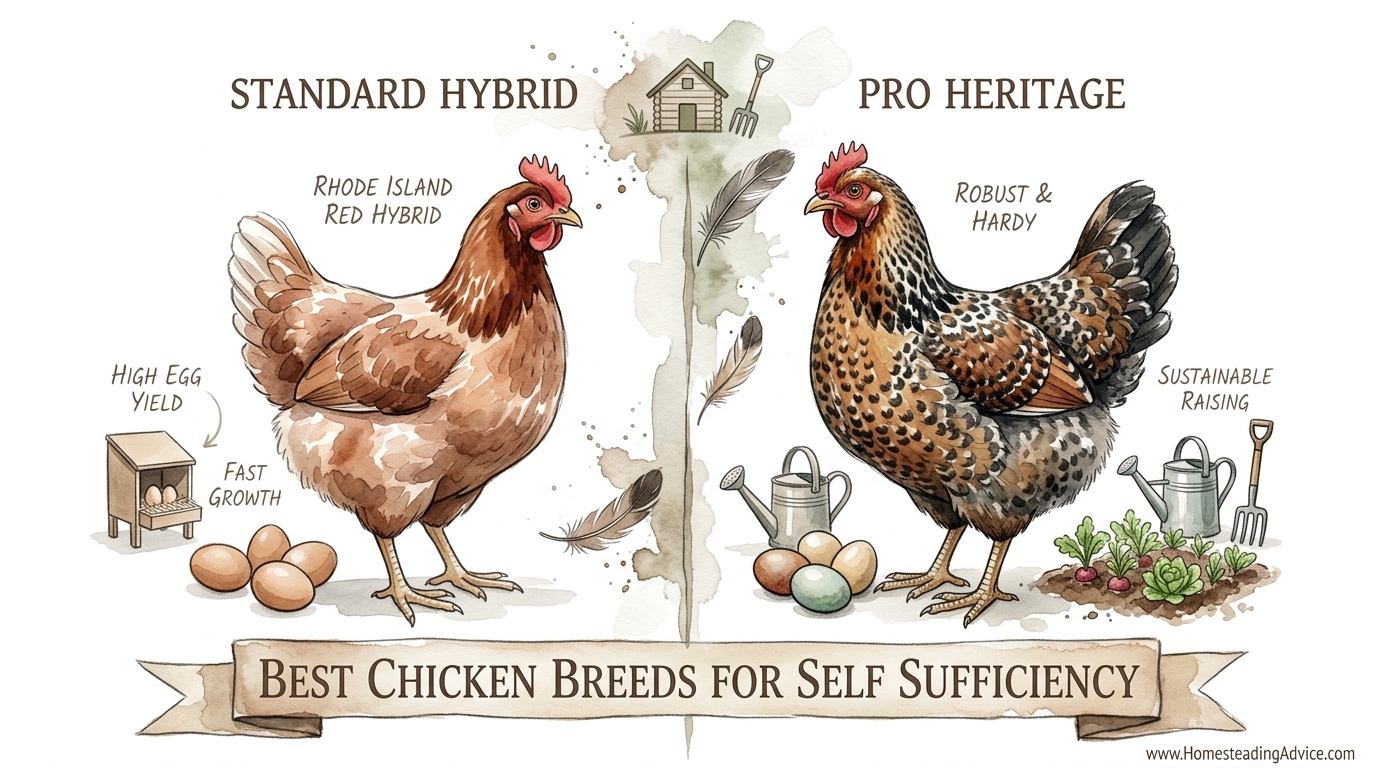
Do you want an egg-machine that burns out in a year, or a partner that feeds you for a decade? Commercial hatcheries sell you the ‘Formula 1’ of chickens -they go fast, but they break down almost immediately. Professional homesteaders choose heritage breeds. These ‘Pro’ birds are built for longevity, predator resistance, and the ability to find their own food. Stop buying replacements and start building a legacy flock.
Choosing a chicken breed is the most foundational decision you will make on your path to self-reliance. It is the difference between a farm that functions as a grocery store and a farm that functions as an ecosystem. If you are looking for a bird that can survive a hard winter, outrun a hawk, and raise its own replacements, you are looking for a heritage breed.
In this guide, we will strip away the marketing fluff of the big hatcheries. We will look at the birds that have the mettle to handle the real world. These are the breeds that built our ancestors’ farms and are still the best tools for the modern practitioner of self-sufficiency.
Best Chicken Breeds For Self Sufficiency
Self-sufficiency in poultry means moving away from the “disposable bird” model. A self-sufficient breed is a bird that can reproduce naturally, forage for a significant portion of its diet, and live a long, productive life. While industrial hybrids are designed for 18 months of intense production before they are “spent,” a heritage bird is a marathon runner.
These breeds exist because they were refined over centuries for multi-purpose utility. They provided eggs for the morning, meat for the evening, and manure for the garden. They were the original “closed-loop” system, requiring minimal external inputs to thrive. On a self-sufficient homestead, a bird that cannot find its own grubs or protect its chicks is a liability, not an asset.
When we talk about the best breeds, we are looking for “dual-purpose” giants and “landrace” survivors. These birds have the genetic diversity to handle environmental shifts. They are not delicate; they are the backbone of a sustainable food supply.
The Buckeye: The Only American Breed Developed by a Woman
Nettie Metcalf of Ohio developed the Buckeye in the late 1800s because she was dissatisfied with the lean, flighty birds of her time. She wanted a bird that could handle the brutal Midwestern winters and provide a heavy carcass for the table. The result is a mahogany-colored bird that is arguably the most predator-resistant and cold-hardy breed on the American continent.
Buckeyes are unique because they have a pea comb, which is a small, low-profile comb that is almost immune to frostbite. They are also known for being “mousers,” actively hunting small rodents and insects with the tenacity of a barn cat. A mature hen will weigh around 6.5 lbs (2.9 kg), while a rooster can reach 9 lbs (4.1 kg), making them a formidable presence in the yard.
The Delaware: The Rapid-Growth Heritage Choice
If you want a bird that grows faster than a standard heritage breed but still maintains its health, the Delaware is your best bet. Developed in the 1940s, this breed was briefly the king of the American broiler industry before being replaced by the modern Cornish Cross. It is a striking white bird with black barring on the neck and tail feathers.
The Delaware is an exceptional dual-purpose bird, producing around 200 large brown eggs per year while growing a meaty frame. They are calm, curious, and tend to be higher in the pecking order without being aggressive. For a homesteader, the Delaware offers the best of both worlds: a bird that reaches processing weight quickly and a hen that provides steady food for years.
The Black Australorp: The World Record Layer
Coming out of Australia, the Black Australorp is a heritage powerhouse. It famously holds the world record for egg production, with one hen laying 364 eggs in 365 days. While you should not expect that level of output in a backyard setting, a well-bred Australorp will consistently give you 250 to 300 eggs per year.
What makes the Australorp a “Pro” bird is its longevity. Unlike high-production hybrids that often develop reproductive issues by age two, an Australorp can remain productive for five years or more. Their beetle-green iridescent feathers provide excellent camouflage in the shadows, helping them evade aerial predators like hawks.
The Brahma: The King of All Poultry
For those in climates where the mercury stays below freezing for months, the Brahma is the gold standard. Often called the “King of All Poultry,” these birds are massive, with roosters reaching 12 lbs (5.4 kg). They have feathered legs and feet, providing extra insulation against the cold ground.
Brahmas are gentle giants and make excellent mothers. While they don’t lay as many eggs as an Australorp—averaging about 150 per year—they lay throughout the winter when other birds have shut down. Their large size makes them less prone to being carried off by smaller birds of prey, and their meat is noted for its rich flavor and high-quality broth.
How to Manage a Self-Perpetuating Flock
Building a legacy flock requires more than just buying the right chicks; it requires a shift in management. You must stop thinking of yourself as a consumer and start thinking as a breeder. This involves selecting for traits that favor survival and production in your specific environment.
The first step is to foster broodiness. Broodiness is the instinct of a hen to sit on her eggs and hatch them. Many modern breeds have had this trait bred out of them because it stops egg production for several months. On a self-sufficient farm, a broody hen is your most valuable asset—she is a free incubator and a professional chick raiser.
To manage this, you need to provide safe, quiet nesting areas. When a hen “goes broody,” she will stay on the nest and puff up her feathers when approached. Instead of “breaking” her of this habit, give her a clutch of 8 to 12 fertile eggs. She will handle the temperature, humidity, and protection of the chicks, saving you the cost and labor of artificial brooding.
Feeding a self-sufficient flock also looks different. Instead of relying 100% on store-bought crumbles, you should encourage foraging. Rotational grazing using a mobile coop (a “chicken tractor”) or electric netting allows birds to find up to 30% of their protein in the form of bugs, worms, and greens. This improves the nutrient density of the eggs and slashes your feed bill.
Benefits of Choosing Heritage Breeds
Choosing heritage breeds over standard hybrids offers several measurable advantages for the serious practitioner. These benefits go beyond nostalgia and enter the realm of practical farm economics.
- Reproductive Independence: Heritage breeds breed “true to type,” meaning their offspring will look and perform like the parents. You never have to buy chicks again once you have a breeding pair.
- Reduced Replacement Costs: While a hybrid ISA Brown might die after two years, a heritage Plymouth Rock or Rhode Island Red can live 8 to 10 years, with 5 to 7 of those being productive years.
- Lower Feed Inputs: Heritage birds are active foragers. They have the instinct to seek out food, whereas industrial birds often wait by the feeder for their next meal.
- Predator Intelligence: These birds are more alert. They maintain a higher degree of situational awareness and have the “flight” capabilities needed to reach a high roost when a fox appears.
- Dual-Purpose Utility: You get a respectable amount of meat and eggs from the same bird. This simplifies your farm systems and ensures nothing goes to waste.
Challenges and Common Mistakes
The biggest challenge for many is the “slow” nature of heritage birds. If you are used to the immediate gratification of a hybrid that starts laying at 17 weeks, the 24 to 28 weeks required for a heritage bird can feel like an eternity. This is the “Formula 1” trap—expecting speed without considering the long-term maintenance.
A common mistake is treating heritage birds like industrial birds. If you keep a Buckeye or a Jersey Giant in a cramped, 4-square-foot (0.37 sq m) run with no access to grass, they will underperform. These birds need space to work. Their health and productivity are tied to their ability to move and forage.
Another error is ignoring genetic diversity. If you start with a very small group of birds and never introduce new blood or manage your breeding lines, you can run into inbreeding depression. This leads to smaller eggs, weaker chicks, and higher mortality rates. Successful practitioners often trade roosters with neighbors or keep multiple “families” within their flock to maintain vigor.
Limitations: When This Approach May Not Work
Heritage breeds are not for everyone. If you live in an urban environment with a 20-foot (6-meter) backyard and strict noise ordinances, a large, active heritage flock is likely a bad idea. These birds are vocal and they need room to roam.
If your primary goal is the absolute highest possible egg count for a commercial business, heritage breeds will not beat the industrial hybrids in the short term. The “egg per day” metric is owned by the hybrids. If you cannot afford to wait six months for your first egg, you might need a transitional flock of hybrids while you build up your heritage lines.
Environmental constraints also play a role. A heavily feathered Brahma or Cochin will struggle in a tropical climate where temperatures regularly exceed 95°F (35°C). Conversely, a Mediterranean breed like a Minorca, with its large comb and light body, will struggle in a Canadian winter where temperatures drop to -20°F (-29°C). You must match the bird to the land.
Standard Hybrid vs. Pro Heritage
| Feature | Standard Hybrid (ISA Brown, Red Star) | Pro Heritage (Buckeye, Australorp) |
|---|---|---|
| Productive Lifespan | 1.5 – 2 Years | 5 – 7 Years |
| Reproduction | Does not breed true; offspring are inferior | Breeds true; self-sustaining flock |
| Foraging Ability | Low; dependent on processed feed | High; actively hunts and grazes |
| Meat Quality | Poor; lean and tough | Excellent; flavorful and dual-purpose |
| Cold Hardiness | Moderate; prone to comb frostbite | High; adapted to regional climates |
Practical Tips for Success
Building a self-sufficient flock is an exercise in observation. You should spend time watching your birds to see which ones are the first out of the coop in the morning and the last to go in at night. These are the birds with the highest “grit” and foraging drive.
- Ferment Your Feed: Soaking your grain in water for 24-48 hours creates a probiotic-rich “mash.” This increases nutrient absorption and reduces waste, stretching your feed dollars by up to 20%.
- Cull for Vitality: Do not be afraid to remove birds from the breeding pool that are prone to illness or are lazy foragers. In a self-sufficient system, you only want to pass on the strongest genetics.
- Provide a “Cock-of-the-Walk”: A good heritage rooster is not just for making chicks. He is a security guard. A quality rooster will find food for the hens and alert them to predators. Choose one that is protective but not aggressive toward you.
- Plant for Your Poultry: If you have the space, plant “chicken forage” like mulberry trees, comfrey, or clover. These provide free, high-quality nutrition that falls right into their reach.
Advanced Considerations: Breeding Systems
Once you move beyond basic chicken keeping, you will need a breeding system to maintain your flock without buying new birds. One of the most effective methods for small-scale practitioners is the “spiral breeding” or “line breeding” system. This involves keeping three separate groups of birds and rotating the roosters between them each year to maximize genetic diversity while keeping the bloodlines pure.
You should also learn the “Standard of Perfection” for your chosen breed. This is the blueprint for what the bird should look like and how it should weigh. Breeding toward the standard is not just for show; the standard was designed around health and productivity. A bird that meets the weight standards will have the carcass quality needed for the table, and a bird with the correct body shape will have the room in its cavity to lay large eggs consistently.
Example Scenario: The Five-Year Legacy Plan
Imagine starting with 12 Buckeye chicks (10 hens, 2 roosters) in Year One. By Year Two, you allow your three best hens to go broody. They hatch 25 chicks, roughly half of which are roosters. You process the 10 extra roosters for the freezer and keep the 5 best pullets to expand your egg production.
By Year Three, your original hens are still laying well, and your Year Two pullets are in their prime. You trade your original roosters for two unrelated Buckeye roosters from another breeder to ensure fresh genetics. By Year Five, you have a rotating flock of 40 birds, a freezer full of heritage meat, and a surplus of eggs that pays for the little supplemental grain you buy. You have successfully built a “living pantry” that requires almost no input from the outside world.
Final Thoughts
Building a self-sufficient flock is a long-term investment in your family’s food security. It requires a move away from the high-speed, high-stress models of commercial agriculture and a return to the slower, steadier rhythms of heritage animal husbandry. These birds are not just “livestock”; they are active participants in the management of your land.
Whether you choose the cold-hardy Buckeye, the productive Australorp, or the rapid-growing Delaware, the goal is the same: to create a system that feeds you even if the store shelves are empty. Start with the best genetics you can find, provide them with the space they need to work, and let mother nature do the rest.
If you are ready to take the next step, look for local breeders who prioritize health and foraging ability over “show” traits. Your future self—and your future flock—will thank you for the grit you put in today. Applying these principles will transform your backyard from a hobby into a legacy.