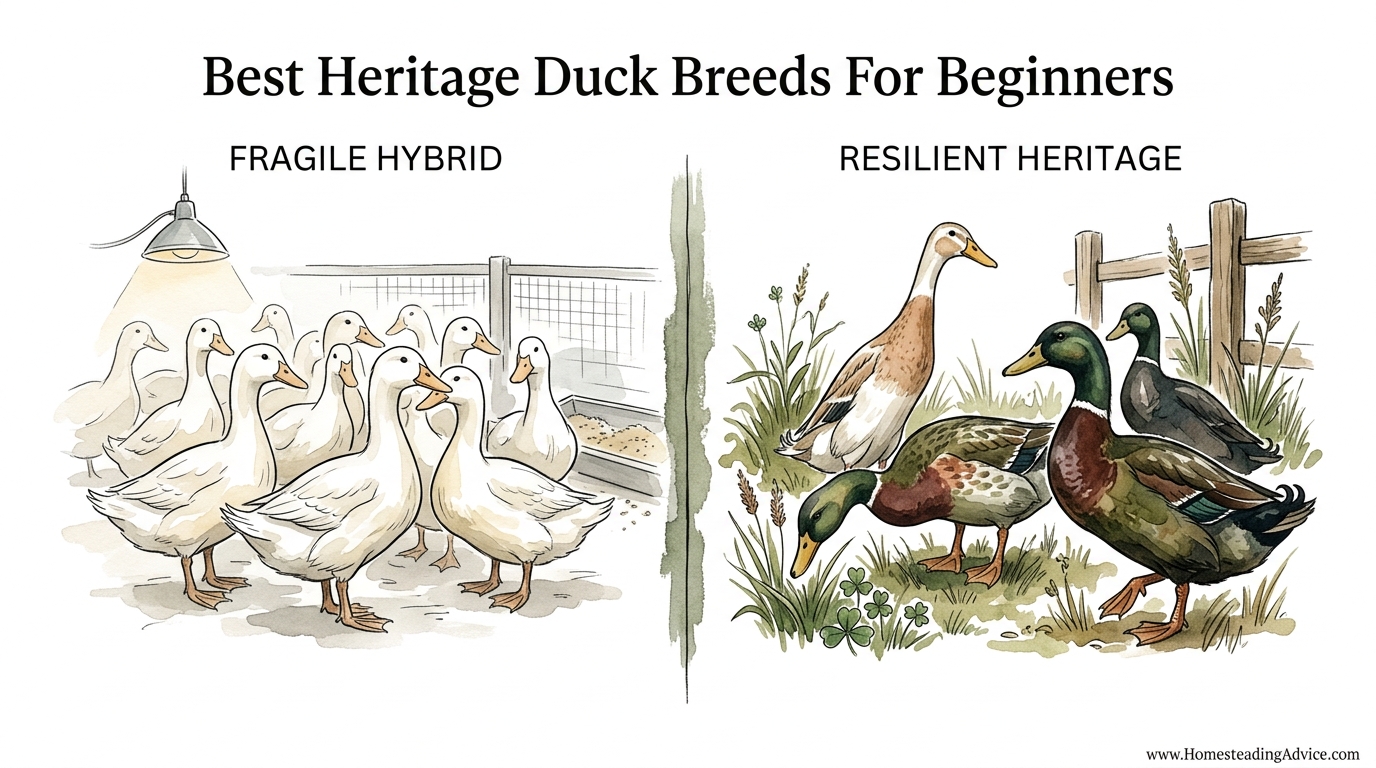
One is an egg-laying machine that breaks down in two years; the other is a 10-year partner built for survival. Commercial hybrid ducks are bred for a single purpose: maximum eggs until they burn out. Heritage breeds like the Magpie or Cayuga are built for the long haul, resisting disease and foraging their own way through the winter.
If you are looking to add waterfowl to your land, the choice between a factory-bred hybrid and a resilient heritage breed is more than just a matter of aesthetics. It is a choice about the type of relationship you want with your animals. Are you looking for a short-term production unit, or are you looking for a self-sustaining partner that can weather the storms of a changing climate and the rigors of a natural environment?
This guide walks you through the world of heritage ducks, focusing on the breeds that offer the best balance of productivity, hardiness, and temperament for those just starting out. You will learn how these birds work, how to house them, and why their ancient genetics are the secret to a successful, low-input homestead.
Best Heritage Duck Breeds For Beginners
Heritage duck breeds represent the genetic history of domestic waterfowl before the age of industrial farming. These breeds were developed over centuries by farmers who needed birds that could survive on pasture, protect themselves from predators, and provide a steady supply of meat and eggs without expensive store-bought feed.
A heritage duck must meet specific criteria. It must be a breed recognized by the American Poultry Association (APA), it must be able to mate naturally, and it must have a long, productive lifespan. These birds are not just survivors; they are thriving remnants of a time when livestock had to be as tough as the people who raised them.
For a beginner, the best heritage breeds are those that forgive minor mistakes in management while providing clear benefits to the garden or small farm. These breeds are often described as dual-purpose, meaning they are excellent for both egg production and as a source of high-quality meat.
The Ancona Duck
The Ancona is often considered the gold standard for a beginner’s homestead duck. Developed in Great Britain, these birds are famous for their “broken” plumage, which looks like a pinto horse or a Holstein cow. They are incredibly hardy and can withstand both extreme cold and humid heat.
Anconas are exceptional foragers. They will spend their days hunting down slugs, snails, and various insects, significantly reducing the pest load in your garden. They typically lay between 210 and 280 large eggs per year, which can range in color from white to cream, blue, or even seafoam green.
The Welsh Harlequin
If you want a bird that is as beautiful as it is productive, the Welsh Harlequin is a premier choice. This breed was developed from two “sport” mutations of Khaki Campbells in the 1940s. Unlike the flighty Campbell, the Welsh Harlequin is known for its calm, inquisitive, and docile temperament.
They are prolific layers, often producing 240 to 330 white eggs annually. Because they have a light-colored under-plumage, they are also easier to pluck than darker breeds, making them a practical choice for those interested in home-raised meat. They are active foragers and will happily clear an orchard of windfall fruit and pests.
The Cayuga Duck
The Cayuga is a uniquely American breed, originating from the Finger Lakes region of New York. They are easily recognized by their beetle-green, iridescent black feathers that shimmer in the sunlight. Historically, they were the primary meat duck of the United States before the Pekin took over the commercial market.
Cayugas are quiet, making them ideal for those with neighbors nearby. They lay 100 to 150 eggs per year, which start the season as a striking charcoal or black color before fading to light gray or white. While they produce fewer eggs than the Ancona, their meat is renowned for its rich, beef-like flavor.
The Magpie Duck
Magpie ducks are light, active, and highly efficient. Named for their black-and-white markings that mimic the Magpie bird, these ducks were bred to be fast-moving foragers. They are excellent for larger properties where the ducks need to travel significant distances to find food.
They are surprisingly productive for a light breed, often laying 220 to 290 eggs per year. Magpies are generally healthy and disease-resistant, though they can be a bit more “high-strung” than the docile Ancona. They are a great fit for the practitioner who wants a bird that requires very little supplemental feeding during the summer months.
How to House and Care for Heritage Ducks
Success with heritage ducks starts with understanding that they are not land-fowl like chickens. They have specific physiological needs related to their feathers, their oil glands, and their unique way of processing food through water.
Providing Adequate Space
Heritage ducks are larger and more active than their hybrid counterparts. Overcrowding leads to stress, which in turn leads to disease. You should provide at least 4 to 6 square feet (0.37 to 0.55 square meters) of floor space per duck inside the coop. This allows them to groom themselves and move around without trampling each other.
For the outdoor run or pasture, the requirements are even higher. Each duck needs a minimum of 15 to 20 square feet (1.4 to 1.8 square meters) of space to forage effectively. If you can provide more, do so. A heritage duck that has room to roam will find more of its own food and stay healthier than one confined to a small, muddy pen.
Water: The Essential Element
Ducks do not strictly need a pond to survive, but they do need deep water every single day. A duck must be able to submerge its entire head in water to clear its blowholes and keep its eyes moist. Without this, they are prone to respiratory infections and “crusty eye.”
For a beginner, a heavy-duty plastic kiddie pool or a galvanized stock tank is an excellent starting point. These should be emptied and scrubbed regularly. In the winter, you must ensure that the water does not freeze solid. Ducks will happily play in water even when temperatures are below freezing (0°C / 32°F), as their circulatory system in their legs prevents them from losing too much body heat.
Feeding for Long-Term Health
While heritage ducks are excellent foragers, they still require a balanced diet, especially during the peak laying season. A high-quality poultry pellet is the easiest way to ensure they get the niacin and protein they need.
Ducks require more niacin (Vitamin B3) than chickens to support their heavy bone structure and leg health. If you are using a standard chicken feed, you may need to supplement with brewer’s yeast. This is particularly important for ducklings, whose rapid growth can lead to bowed legs if niacin levels are too low.
Benefits of Choosing Heritage Breeds
Choosing a heritage breed is an investment in the future of your flock. These birds offer practical, measurable advantages that become clear over years of ownership.
Resilience and Longevity
The most significant benefit is the lifespan of the bird. While a commercial hybrid may suffer from reproductive blowouts or leg failure by age three, a heritage duck like a Cayuga or Ancona can live and remain productive for 8 to 12 years. This longevity means you do not have to constantly replace your flock, saving you money and emotional stress in the long run.
Superior Foraging Skills
Heritage breeds have retained the “wild” instincts that allow them to identify food sources in the environment. They are opportunistic eaters that will hunt for frogs, small snakes, and even mice, alongside their primary diet of greens and insects. This reduces your feed bill and turns your ducks into a functional tool for land management.
True Breeding
If you have a drake (male) and several ducks (females), heritage breeds will “breed true.” This means the offspring will look and act like the parents. You can hatch your own eggs and sustain your flock indefinitely without ever needing to buy more ducklings from a hatchery. This is the ultimate form of self-reliance.
Challenges and Common Mistakes
Raising ducks is rewarding, but it is not without its hurdles. Many beginners treat ducks like “wet chickens,” which leads to several common problems.
The Wet Coop Syndrome
Ducks are incredibly messy. They will bring water into the coop, splash it everywhere, and turn straw into a soggy, fermented mess within hours if the ventilation is poor. You must use the “deep litter method” or clean the coop much more frequently than you would for chickens.
Ensure your coop has plenty of hardware-cloth-covered openings near the roofline to allow moisture to escape. Damp air in a coop leads to frostbite in the winter and mold issues in the summer.
Incorrect Male-to-Female Ratios
One of the most frequent errors is keeping too many drakes. Drakes can be very aggressive during the breeding season. A single drake needs at least 4 to 6 ducks to keep him occupied. If the ratio is lower, the ducks can suffer from physical injuries, feather loss, and extreme stress. If you only want two or three ducks, it is best to keep only females.
Predator Vulnerability
Ducks are “sitting ducks” for a reason. They do not have the sharp beaks or spurs of a rooster, and their heavy bodies make them easy targets for foxes, raccoons, and hawks. Your coop must be built like a fortress. Use 1/2 inch (1.27 cm) hardware cloth instead of chicken wire, as raccoons can reach through chicken wire and kill your birds.
Limitations of Heritage Ducks
Every choice involves a trade-off. While heritage ducks are resilient, they may not be the perfect fit for every situation.
Noise and Neighborhoods
Ducks can be loud. Female ducks, in particular, have a booming quack that can carry for several hundred yards. If you live in a dense suburban area with strict noise ordinances, even the “quiet” Cayuga might cause friction with neighbors. Drakes are much quieter, producing a raspy whisper, but they do not provide eggs.
The Mess Factor
Ducks will turn any puddle into a mud hole. If you have a beautifully manicured lawn that you want to keep pristine, ducks are not the right animal for you. They will drill holes into the soft mud with their bills (a behavior called “drilling”) in search of worms. This is excellent for the soil but hard on the aesthetics of a yard.
Heritage vs. Hybrid: A Comparison
The following table highlights the core differences between the two philosophies of duck keeping.
| Feature | Resilient Heritage | Fragile Hybrid |
|---|---|---|
| Lifespan | 8–12 Years | 2–4 Years |
| Annual Egg Production | 150–280 (High Quality) | 300+ (Extreme Volume) |
| Foraging Ability | Excellent / Self-Sufficient | Moderate / Pelleted Feed Dependent |
| Health Resilience | High (Built for survival) | Low (Prone to reproductive issues) |
| Breeding Status | Breeds True (Sustainable) | Does Not Breed True (Terminal cross) |
Practical Tips for Success
To get the most out of your heritage flock, consider these field-tested strategies:
- Select for Temperament: When buying ducklings, look for breeders who select for docility. A calm flock is much easier to manage than a flighty one.
- Use Sand in the Run: If your duck run becomes a mud pit, layer it with 3 to 4 inches (7.5 to 10 cm) of coarse construction sand. It drains well and is easy to hose off.
- Ferment Your Feed: Soaking your duck pellets in water for 24 hours before feeding can increase nutrient absorption and reduce waste. It also helps keep the ducks hydrated.
- Garden Integration: Let your ducks into the garden at the end of the season to “clean up.” They will eat weed seeds and leftover pests while fertilizing the soil for next year.
Advanced Considerations: Breeding True
Once you have mastered the basics of heritage duck care, you may want to explore the world of selective breeding. Because heritage ducks breed true, you have the opportunity to improve your flock over generations.
Serious practitioners often select for “vigorous foraging” or “winter laying.” If you notice a specific duck that continues to lay eggs even when temperatures drop to -10°C (14°F), that is a bird whose genetics you want to keep. By hatching eggs from your most resilient individuals, you create a localized strain of ducks that is perfectly adapted to your specific climate and land.
This process requires keeping meticulous records and potentially separating your breeding pens during the spring. It is a step toward true agricultural independence and a way to participate in the conservation of these rare and important breeds.
Example Scenario: The Orchard Protector
Imagine a small homestead with a half-acre orchard of apple and pear trees. In a typical year, the farmer struggles with codling moths and fallen fruit that rots and attracts wasps.
By introducing a small flock of five Welsh Harlequin ducks, the dynamic changes. The ducks spend their mornings patrolling the orchard, eating every windfall fruit before it can rot. They probe the soil around the base of the trees, consuming moth larvae before they can climb the trunks.
The farmer provides a simple A-frame shelter and a single stock tank for water. Because the ducks are heritage birds, they require 30% less commercial feed than a production-bred flock would in the same environment. By the end of the season, the farmer has a harvest of chemical-free fruit, 1,200 large, rich eggs, and a healthier orchard floor.
Final Thoughts
Embracing heritage duck breeds is a commitment to a slower, more resilient way of farming. These birds do not offer the instant, explosive gratification of a commercial hybrid, but they offer something much more valuable: stability. They are the 10-year partners that will be there morning after morning, providing for you as long as you provide for them.
Whether you choose the iridescent beauty of the Cayuga or the workhorse efficiency of the Ancona, you are stepping into a lineage of animal husbandry that stretches back centuries. These birds are a living connection to a time when self-reliance was the only way of life.
Start small, focus on the fundamentals of water and space, and listen to what your birds are telling you. In time, you will find that a heritage flock is not just a source of food, but a vital part of a thriving, resilient ecosystem.