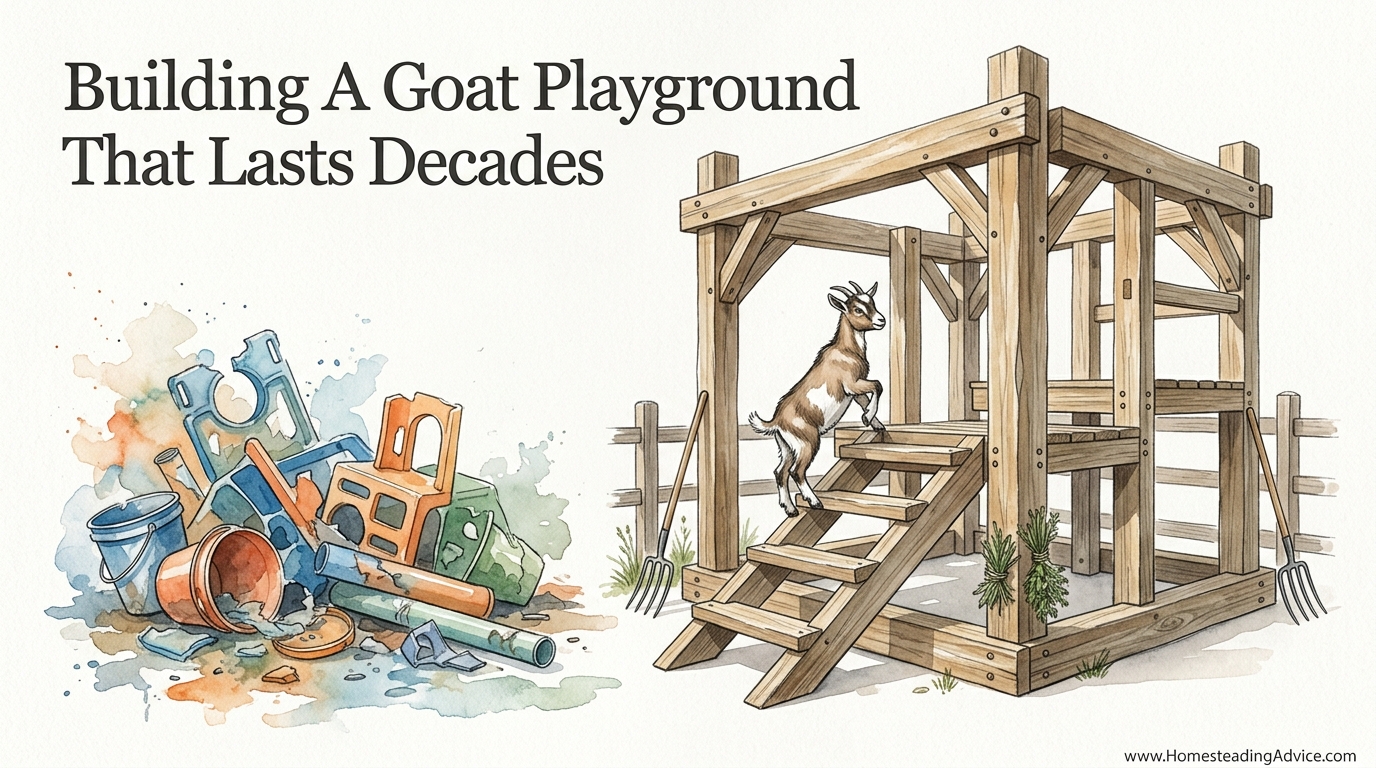
Will your goat enrichment end up in a landfill next year, or will it become a permanent landmark on your land? Goats are destructive by nature. Cheap plastic ‘toys’ aren’t just an eyesore; they’re a safety hazard when they shatter. A heavy timber and stone climbing structure mimics their ancestral mountain habitat and provides a legacy feature that outlasts the herd itself.
When you bring goats onto your property, you aren’t just managing livestock; you are stewardship a piece of living history. These animals carry the genetic memory of the Bezoar ibex, scaling the sheer cliffs of the Taurus and Zagros mountains. To keep them healthy, satisfied, and away from your garden fences, you must offer them a challenge that respects that heritage.
Building with natural materials like massive logs and native stone isn’t just about aesthetics. It is about durability and the physical well-being of the animal. A goat that spends its day navigating a rugged timber playground develops better muscle tone, stronger hooves, and a more stable social hierarchy.
Building A Goat Playground That Lasts Decades
A legacy goat playground is a permanent installation designed to withstand the brutal physical pressure of head-butting, climbing, and the corrosive nature of the elements. Unlike temporary pallet structures or plastic slides that degrade under UV light, a timber and stone playscape is built with the same philosophy as a well-crafted barn or a stone fence.
These structures exist to solve two primary problems: boredom and infrastructure damage. Goats are notoriously intelligent and easily bored. When a goat lacks a vertical outlet for its energy, it directs that curiosity toward your barn doors, your fence lines, and your vehicle’s hood. By providing a “mountain” in the pasture, you center their activity in a safe, designated zone.
In real-world situations, these structures serve as the hub of the herd’s social life. You will see the dominant buck or doe claiming the highest point, while the kids practice their balance on the lower “scree” slopes of stone. This verticality increases your usable pasture square footage without expanding your fence line, allowing animals to occupy the same footprint at different elevations.
How to Construct a Timber and Stone Legacy Structure
Building a structure that lasts requires attention to the foundation and the quality of the joinery. You are not just stacking wood; you are engineering a terrain feature.
The Foundation
Start by clearing a level area of at least 15 by 15 feet (4.5 by 4.5 meters). Dig down 6 inches (15 cm) and backfill with crushed stone or gravel. This provides drainage and prevents your heavy timbers from rotting at the ground-contact point. A solid base is critical because a finished timber and stone structure can easily weigh several thousand pounds.
Selecting the Timber
Choose rot-resistant species like Eastern Red Cedar, Black Locust, White Oak, or Osage Orange. If you must use pine, ensure it is heavy-duty pressure-treated lumber rated for “ground contact.” For a legacy build, use logs with a minimum diameter of 8 to 12 inches (20 to 30 cm). These provide the mass necessary to resist the pushing force of a 200-pound (90 kg) Boer buck.
The Stone Element
Integrate large, flat-topped boulders or dry-stone masonry. Use stones that are too heavy for a goat to move. Stack them in a pyramid fashion, ensuring each stone has at least three points of contact for stability. The rough texture of the stone acts as a natural nail file, wearing down goat hooves and reducing the frequency of manual trimmings.
Step-by-Step Assembly
1. Place your largest “anchor” boulders at the corners of your gravel pad.
2. Set vertical “king posts” (heavy logs) into the center, either buried 3 feet (90 cm) deep or secured to a concrete pier.
3. Notch the horizontal logs using a chainsaw or chisel to create “saddle” joints where they meet the vertical posts.
4. Secure joints with heavy-duty timber bolts or galvanized lag screws at least 10 inches (25 cm) long.
5. Infill the base and interior of the timber frame with smaller stones and clean fill to create “rooms” or “caves” underneath the main platforms.
Benefits of Natural Material Enrichment
Choosing timber and stone over synthetic alternatives offers measurable advantages for both the owner and the herd.
Hoof Health and Maintenance
The primary physical benefit is the abrasive quality of the materials. In the wild, goats travel over rock and gravel, which naturally maintains the length and shape of the hoof wall. On soft pasture, hooves grow unchecked. A stone climbing structure forces the goat to use its hooves to grip and pivot, significantly reducing “hoof rot” risks by keeping the feet dry and worn.
Psychological and Herd Stability
Goats use height to establish rank. By providing multiple tiers, you allow lower-ranking members of the herd to find their own space without being trapped by a dominant individual. This “escape” potential reduces bullying and stress-related illnesses. The complexity of a timber build also provides mental stimulation, as goats must calculate jumps and balance points, mimicking their natural foraging behaviors.
Environmental Longevity
A timber structure eventually returns to the earth as organic matter, while a stone structure remains as a permanent feature of the landscape. There is no microplastic shedding or chemical leaching into your soil. When the time comes to rotate pastures or retire a herd, the “goat mountain” remains a beautiful, rustic feature rather than a pile of broken plastic scrap.
Challenges and Common Mistakes to Avoid
Even the sturdiest materials can fail if the design is flawed. Stability is the most frequent point of failure in DIY builds.
The “Trap” Hazard
A common mistake is leaving “V” shaped gaps between logs or stones. A goat’s leg or head can easily slide into a narrowing gap and become wedged. As the animal panics and pulls, it can break a limb or suffocate. Always ensure that gaps are either too small for a hoof to enter (less than 2 inches / 5 cm) or wide enough for a head to easily pull back out (more than 10 inches / 25 cm).
Slick Surfaces
Freshly peeled logs can be incredibly slippery when wet. If you are using debarked timber, use a chainsaw to score shallow “tread” marks into the top surface of the logs or attach “cleats” made of smaller branches. This provides the traction necessary for goats to jump safely during rain or snow.
Unsecured Counter-Leverage
Never assume the weight of a log is enough to keep it in place. Goats jump with significant horizontal force. A log that is simply resting on another log will eventually roll, potentially crushing a kid underneath. Every structural element must be mechanically fastened or deeply notched.
Limitations and Environmental Constraints
While a timber and stone structure is superior in many ways, it is not ideal for every homestead.
Terrain and Mobility
If your pasture is prone to extreme flooding or sits in a swampy lowland, a heavy timber structure will rot prematurely, even with high-quality wood. Furthermore, these structures are not portable. If you practice intensive rotational grazing where you move your goats every few days, a fixed “legacy” structure may only be accessible to them a few times a year.
Cost and Labor
Building with stone and heavy logs requires either significant physical strength or the use of machinery like a tractor with a front-end loader. The initial investment in time and high-quality timber bolts is higher than buying a few plastic barrels. For a homesteader with limited physical mobility or no access to heavy equipment, this type of build may be prohibitive.
Comparing Enrichment Approaches
The choice between temporary and permanent enrichment often comes down to your long-term goals for the property.
| Feature | Plastic/Repurposed | Timber & Stone Legacy |
|---|---|---|
| Initial Cost | Low (often free) | Moderate to High |
| Lifespan | 1–3 Years | 15–30 Years |
| Hoof Wear | Minimal | Exceptional |
| Maintenance | Frequent Replacement | Annual Inspection |
| Visual Impact | Cluttered/Industrial | Rustic/Natural |
Practical Tips and Best Practices
To get the most out of your build, consider these optimization techniques used by experienced herdsmen.
- Orientation: Place the tallest part of the structure so it catches the morning sun. Goats love to “sun” themselves on high platforms to warm up their rumen after a cold night.
- Sanding and Splinters: While you want a rough surface for hooves, check the “rubbing posts” for large splinters. Goats will rub their sides against the timber to shed their winter coats; ensure these vertical posts are relatively smooth to avoid skin tears.
- Drainage: Dril small “weep holes” in any flat wooden platforms to prevent water from pooling. Standing water accelerates rot and creates a slip hazard.
- Vegetation: Plant non-toxic, hardy vines like grapes (if you don’t mind them being eaten) near the base. The shade provided by the structure’s “caves” will be the goats’ favorite spot during the heat of summer.
Advanced Considerations for Large Herds
For those managing more than ten goats, the dynamics of the playground change. You must account for “bottlenecks.”
If you build a bridge connecting two platforms, ensure it is wide enough (at least 3 feet / 90 cm) for two goats to pass each other. A narrow bridge becomes a “confrontation point” where a dominant doe might head-butt a lower-ranking goat off the side. In a large herd, this can lead to frequent injuries.
Consider scaling your structure horizontally rather than just vertically. A series of interconnected “islands” of stone and timber allows multiple sub-groups within the herd to have their own space. This mimics the scattered rock outcroppings of a mountain range and prevents the “king of the hill” dynamic from becoming too aggressive.
Example Scenario: The Small-Scale Homestead
Imagine a homestead with four Nigerian Dwarf goats. A legacy build for this herd might consist of three large Eastern Red Cedar stumps of varying heights (2ft, 3ft, and 4ft). These are connected by 8-foot (2.4 m) long “balance beams” made of 6×6 timbers.
The base is surrounded by a ring of flat limestone rocks sourced from a local quarry. The total footprint is 12×12 feet. Because Nigerian Dwarfs are smaller, the height is kept under 5 feet (1.5 m) to prevent injury from falls. The owner spends one weekend on the build, using a simple impact driver and galvanized timber screws. Ten years later, the goats have changed, but the “cedar grove” remains a central, beautiful part of the pasture.
Final Thoughts
Building a goat playground from timber and stone is an act of respect for the animals you raise. It acknowledges their intelligence, their physical needs, and their history as mountain dwellers. While it requires more sweat and better materials than a temporary fix, the result is a functional piece of farm infrastructure that enhances the health of your herd and the beauty of your land.
As you plan your build, look to the landscape. Use the stone that comes from your own soil and the wood from your own woodlot if possible. When you build with the intention of longevity, you create a space where your goats can truly thrive, expressing their natural instincts in a way that plastic and pallets can never provide.
Experiment with different heights and textures. Observe how your goats interact with the first log you set down. They will tell you through their play what they need. Trust your hands, choose your materials wisely, and build something that will still be standing long after the current kids have grown.