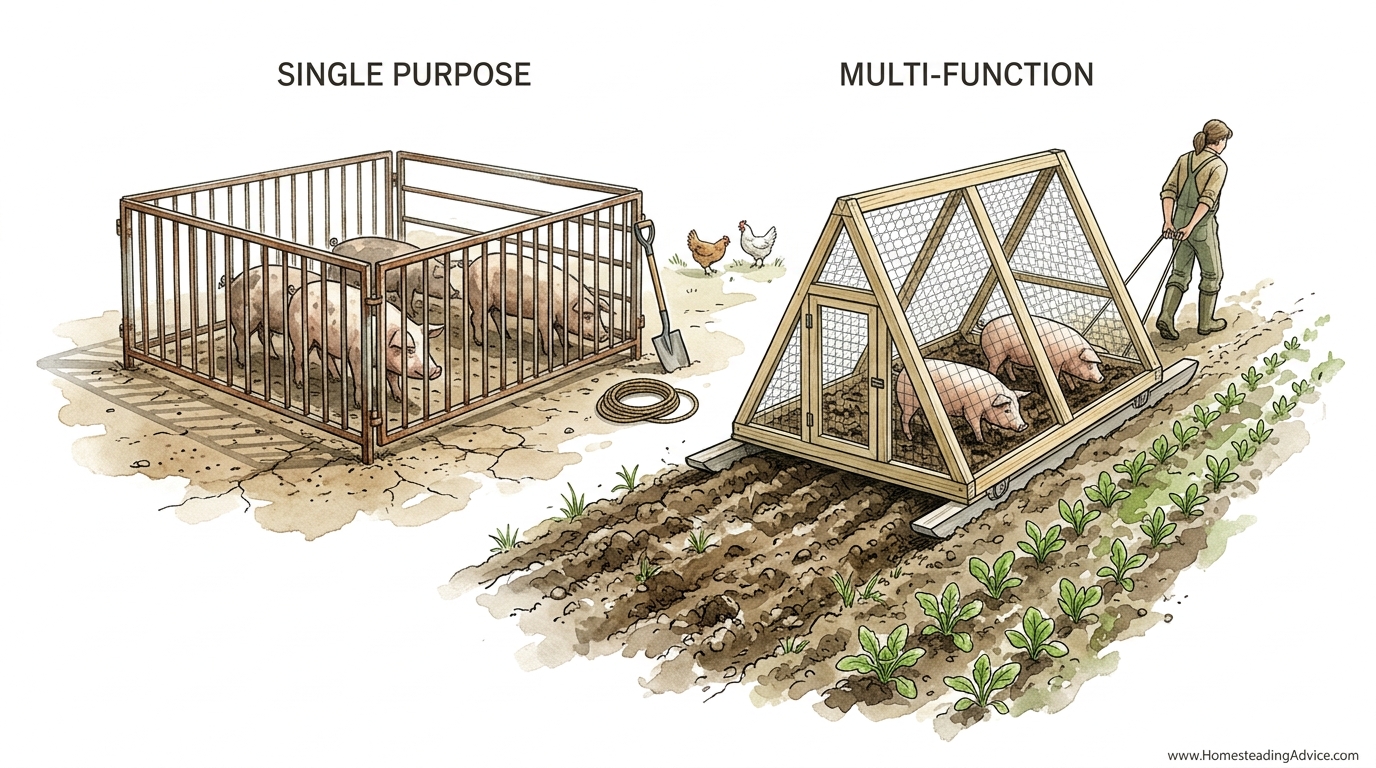
Why buy a gas-powered rototiller when your pigs are looking for a job? A pig in a permanent pen is a liability; a pig in a mobile tractor is a high-performance garden tool. Our multi-functional tractor design provides shelter, tilling, and fertilization all in one move. Move the pen once a day and watch your soil transform from dead clay to black gold.
Pigs possess an ancient, biological drive to turn the earth. This instinct, often viewed as a nuisance in a fixed barnyard, becomes a superpower when harnessed correctly. A mobile pig tractor is not just a cage; it is a management system that aligns the needs of the animal with the needs of the land.
Practical self-reliance means looking at every input on the farm and asking if it can do two or three jobs at once. When you use a pig to prep your garden, you eliminate the need for expensive fossil fuels and heavy machinery that compacts the very soil you are trying to loosen. You also provide the pig with a fresh, sanitary environment every single day, which drastically reduces the risk of parasites and disease.
How To Build A Mobile Pig Tractor
A mobile pig tractor is a floorless, portable enclosure designed to house swine while allowing them direct access to the ground. These structures act as a hybrid between a traditional pig ark and a mobile grazing system. In the real world, they are used by market gardeners, permaculture practitioners, and small-scale homesteaders to clear brush, terminate cover crops, or prepare new garden beds without the use of herbicides or mechanical plows.
Think of it as a bottomless crate that provides enough security to keep a pig in, but enough flexibility to be moved by a human or a small farm vehicle. While chicken tractors are common, a pig tractor must be built with significantly more structural integrity. A growing 150-pound (68 kg) hog has the strength to lift standard fencing and the weight to crush flimsy frames.
The most effective designs typically utilize heavy-duty materials such as cattle panels, angle iron, or pressure-treated lumber. A common footprint for a starter tractor is 8 feet by 12 feet (2.4 m by 3.6 m), which provides 96 square feet (8.9 sq m) of working space. This size is manageable for two or three feeder pigs and remains light enough to move across uneven terrain.
Building a tractor usually involves creating a rigid base frame that can withstand the stress of being dragged. Many successful designs use skids made of 4×4 timbers (10 cm x 10 cm) with the leading edges beveled at a 45-degree angle to prevent them from digging into the turf. Steel skids or “sleds” made from notched angle iron are even more durable for long-term use.
Materials and Step-by-Step Construction
Strength is the priority when selecting your materials. Standard poultry wire or lightweight garden fencing will not hold a pig. You need 4-gauge cattle panels or dedicated hog panels that can withstand rooting and leaning.
The Base Frame and Skids
Construction begins with the foundation. Use two 12-foot (3.6 m) pressure-treated 4×4 posts as your primary skids. Use two 8-foot (2.4 m) 2×4 boards to bridge the ends, creating a rectangular footprint. Secure these with heavy-duty lag bolts or carriage bolts.
Avoid using simple nails or exterior screws for the primary structural joints. The vibration and torque of moving the tractor over bumps will eventually pull those fasteners loose. Drill pilot holes and use 1/2-inch (13 mm) bolts with wide washers to distribute the pressure.
Wall Assembly and Reinforcement
Mount 2×4 vertical studs at each corner and at 4-foot (1.2 m) intervals along the sides. These studs should stand approximately 3 to 4 feet (0.9 to 1.2 m) tall. Height is less about keeping the pig from jumping—since most domestic breeds are not high jumpers—and more about providing enough clearance for you to enter and for the pigs to move comfortably.
Fasten cattle panels to the interior of the wooden frame. Mounting them on the inside ensures that when a pig pushes or leans against the wall, the pressure is exerted against the wooden studs rather than just the staples or clips. Use heavy-duty fencing staples every 6 inches (15 cm) to secure the wire.
The Shelter and Roof
Pigs are highly susceptible to sun and extreme temperatures because they do not have sweat glands. Dedicate the back 4 feet (1.2 m) of the tractor to a fully enclosed shelter. Use 3/4-inch (19 mm) exterior-grade plywood for the walls of this “bedroom” area and a sheet of corrugated metal or heavy-duty UV-resistant tarp for the roof.
Pitch the roof slightly to ensure rainwater sheds away from the sleeping area. A wet pig is a cold pig, and a cold pig burns more calories keeping warm than putting on weight or tilling your soil. Ensure the shelter is oriented toward the back of the tractor so that when you drag the unit forward, the pigs naturally move into the fresh tilled area rather than getting trapped in the shelter.
How It Works: The Physics of Porcine Tillage
Success with a pig tractor relies on understanding the natural biology of the pig’s snout. A pig’s snout is a highly specialized tool equipped with a prenasal bone that allows it to exert incredible upward and downward force. When a pig senses a root, a grubs, or a mineral pocket in the soil, it uses its snout to wedge under the surface and lever the earth upward.
Tillage Depth and Nutrient Mixing
Unlike a rototiller that merely chops the top 4 to 6 inches (10 to 15 cm) of soil into a fine dust, pigs engage in deep-core aeration. They will often dig 8 to 12 inches (20 to 30 cm) deep to find the roots of invasive weeds like Canada Thistle or Quackgrass. As they dig, they naturally incorporate their manure and urine into the subsoil.
This process creates a biological “nutrient sponge.” Instead of fertilizer sitting on the surface where nitrogen can volatilize into the atmosphere, the pigs bury the nutrients where plant roots can actually reach them. The act of walking also helps press organic matter—like old straw bedding or crop residues—into the soil, where it can be broken down by earthworms and microbes.
The Rotation Schedule
Moving the tractor once a day is the standard practice for garden preparation. If you leave the pigs in one spot for too long, they will eventually create a “wallow” or a deep pit. While this might be fun for the pig, it causes soil compaction and creates an anaerobic environment that is detrimental to garden health.
Observe the soil surface. Once the majority of the green vegetation is gone and the soil has been turned over to a depth of roughly 4 inches (10 cm), it is time to move. On a 96-square-foot (8.9 sq m) plot with two pigs, this transition usually takes 24 to 48 hours depending on the soil type and the age of the pigs.
Practical Benefits of the Mobile System
Shifting from a static pen to a mobile tractor offers measurable improvements in animal health and soil productivity. These advantages are not just theoretical; they show up in your feed bill and your harvest yields.
Disease and Parasite Management
Internal parasites often rely on a life cycle that involves the animal re-ingesting eggs found in their own manure. In a permanent dirt lot, the parasite load in the soil builds up over months and years. In a mobile tractor, you are constantly moving the pigs away from their waste. By the time you rotate back to the same spot—ideally 12 to 24 months later—the parasite eggs have perished and the land has been “sanitized” by time and sunlight.
Fertilizer Savings
Pig manure is one of the most nutrient-dense organic fertilizers available. Standard pig slurry typically contains significant amounts of Nitrogen (N), Phosphorus (P), and Potassium (K). A 1,000-gallon (3,785-liter) equivalent of pig manure can be comparable to a bag of 19-7-20 commercial fertilizer. By allowing the pigs to apply this directly to your garden beds, you bypass the labor of shoveling, hauling, and spreading manure from a barn.
Reduced Feed Costs
While pigs cannot thrive on grass alone, they are excellent foragers. A pig on fresh pasture or a garden bed full of cover crops will meet a portion of its caloric and mineral needs from the environment. They will consume clover, dandelions, grubs, and fallen fruit. This supplemental nutrition can reduce your total grain consumption by 10% to 20%, depending on the quality of the forage.
Common Challenges and How to Solve Them
Building and operating a pig tractor is not without its frustrations. Pigs are intelligent, strong, and occasionally stubborn. Understanding their behavior helps you avoid common pitfalls.
The “Lift and Escape” Problem
Pigs are notorious for finding the weakest point in a structure. If there is a gap between the bottom of the fence and the ground, a pig will put its snout under it and lift the entire tractor. This is why heavy 4×4 skids are essential. If your pigs are particularly aggressive lifters, you can attach a single strand of electric wire to the inside of the tractor frame, about 6 inches (15 cm) off the ground. One or two encounters with the “hot” wire will teach the pigs to stay away from the edges.
Weight and Mobility Issues
A tractor built for strength is inevitably heavy. Moving a 500-pound (227 kg) wooden structure across a muddy field is a recipe for a back injury. To solve this, many practitioners install detachable pneumatic wheels. These wheels can be pinned into place to lift the skids off the ground for the move, then removed once the tractor is in its new position. Alternatively, use a small tractor or an ATV with a tow strap to make the daily move a 30-second job.
Water Delivery Systems
Standard water troughs are a disaster in a mobile tractor. Pigs will flip them over, stand in them, or fill them with mud within minutes. The only reliable solution is a nipple-watering system. Mount a 55-gallon (208-liter) plastic barrel on the top of the tractor and plumb it with stainless steel hog nipples. This provides clean, gravity-fed water that cannot be contaminated by the pigs’ rooting activities.
Limitations and Environmental Constraints
A mobile pig tractor is a specialized tool, and like any tool, it has situations where it may not be the best choice. Recognizing these boundaries ensures you don’t damage your land or stress your animals.
Steep Terrain and Erosion
Moving a heavy tractor on a significant slope is dangerous. Not only is there a risk of the unit sliding and pinning an animal (or the operator), but the pigs’ digging can trigger erosion on steep grades. If your land has a slope greater than 15 degrees, consider using permanent terraced paddocks rather than a mobile tractor.
Wet Seasons and Mud
Pigs love mud, but “pugging”—the deep compaction caused by animal hooves in wet soil—can ruin soil structure. During periods of heavy, prolonged rain, a mobile tractor can turn a garden bed into a swamp in hours. In these conditions, it is best to move the pigs to a “sacrifice area” or a well-bedded permanent barn until the soil dries enough to support their weight without collapsing the air pores in the earth.
Temperature Extremes
In climates where temperatures exceed 95°F (35°C), a simple plywood shelter may not provide enough cooling. Pigs need a way to regulate their temperature. If you are tractoring during a heatwave, you must provide a misting system or manually spray down the pigs several times a day. Conversely, in sub-freezing winters, the lack of a thick bedding pack (which is hard to maintain in a mobile unit) can lead to frostbite or pneumonia.
Breed Selection for the Mobile System
Different breeds have different digging habits and temperaments. Choosing the right pig for your specific goals is a critical first step.
| Breed Type | Example Breeds | Best Use Case | Foraging Intensity |
|---|---|---|---|
| Lard / Heritage | American Guinea Hog, Mangalitsa | Clearing dense brush and tough roots | Very High | Bacon / Modern | Yorkshire, Landrace, Hampshire | Fast growth and light surface tilling | Moderate |
| Dual-Purpose | Berkshire, Tamworth, Hereford | Garden prep and high-quality meat | High |
Heritage breeds like the Berkshire or Tamworth are generally preferred for tractoring because they have retained more of their ancestral foraging instincts. The American Guinea Hog is particularly popular for smaller homesteads because of its manageable size and docile nature, though it grows much slower than modern commercial crosses.
Advanced Considerations: Multi-Species Sequences
Experienced practitioners often view the pig tractor as just one piece of a larger rotational puzzle. To maximize soil fertility and health, you can follow the pigs with other animals.
The “Pig-Chicken-Garden” Sequence
After the pigs have tilled a section of land, they leave behind turned earth and fresh manure. This is the perfect environment for a mobile chicken tractor. Move the chickens onto the “pig-tractored” ground 24 hours later. The chickens will scratch through the pig manure, spreading it out and eating any fly larvae or parasites. This “sanitizes” the ground even further and adds a different set of nutrients (high in calcium and phosphorus) to the soil.
Managing Seed Banks
Pigs are excellent at terminating “seed banks.” If you have a field full of weeds that have dropped their seeds for years, the pigs will actually eat those seeds as they root. By the time the pigs and chickens have finished their rotation, the soil is as close to a blank slate as nature allows. This is the ideal time to sow a diverse cover crop mix or transplant your garden starts.
Practical Tips for Daily Management
Success is often found in the small details of daily care. These adjustments can make the difference between a thriving garden and a frustrated farmer.
- Lure with Feed: Never try to push a pig during a move. Instead, place their daily grain ration at the far end of the tractor. They will naturally walk toward the food as you pull the tractor forward, ensuring no legs get caught under the skids.
- Check for Gaps: Even a 2-inch (5 cm) gap under the skid can be an invitation for an escape. Carry a few “fill rocks” or pieces of wood to block any low spots in the terrain where a pig might try to squeeze under.
- Monitor Manure Distribution: If you notice the pigs are only “using the bathroom” in one corner, they are likely reacting to a draft or an uncomfortable sleeping spot. Adjust the orientation of the tractor to ensure they feel secure enough to utilize the entire space.
- Keep it Level: Ensure the tractor is resting as level as possible. If it is tilted significantly, the gravity-fed water system may not work correctly, or the pigs may pile up in one corner during the night.
Examples and Realistic Scenarios
To visualize how this works, consider a homesteader in the Pacific Northwest dealing with a 2,000-square-foot (186 sq m) patch of Himalayan Blackberry. Using a 8×12 tractor with two Berkshire feeder pigs, the homesteader moves the unit 8 feet forward every 24 hours.
In approximately 21 days, the pigs have completely traversed the patch. They have eaten the leaves, crushed the canes, and—most importantly—dug up the root crowns that usually lead to re-growth. The total cost to the homesteader was the initial build of the tractor (approx. $300 – $500 depending on materials) and about 100 pounds (45 kg) of supplemental grain. In return, they received a tilled, fertilized garden bed and two pigs that have gained significant weight.
Contrast this with the alternative: renting a brush mower, buying glyphosate herbicide, and then manually rototilling the area three times to remove the root debris. The pig tractor is slower, but it leaves the soil in a state of biological life rather than chemical sterility.
Final Thoughts
The mobile pig tractor is more than a piece of equipment; it is a philosophy of cooperation with nature. It acknowledges that a pig’s desire to dig is not a problem to be solved with concrete floors, but a resource to be utilized for the health of the earth. When you provide an animal with the opportunity to perform its natural function, the entire ecosystem benefits.
As you implement this system, expect a learning curve. You will likely tweak your wheel design, experiment with different nipple waterers, and learn which weeds your local pigs prefer. These adjustments are part of the process of becoming a more resilient, observant land manager.
Watching a patch of hard, grey clay turn into crumbly, dark soil under the work of a few happy pigs is one of the most satisfying sights in agriculture. Start small, build your tractor for strength, and let your pigs show you what they can do. You may find that you never want to hear the roar of a gas-powered tiller again.