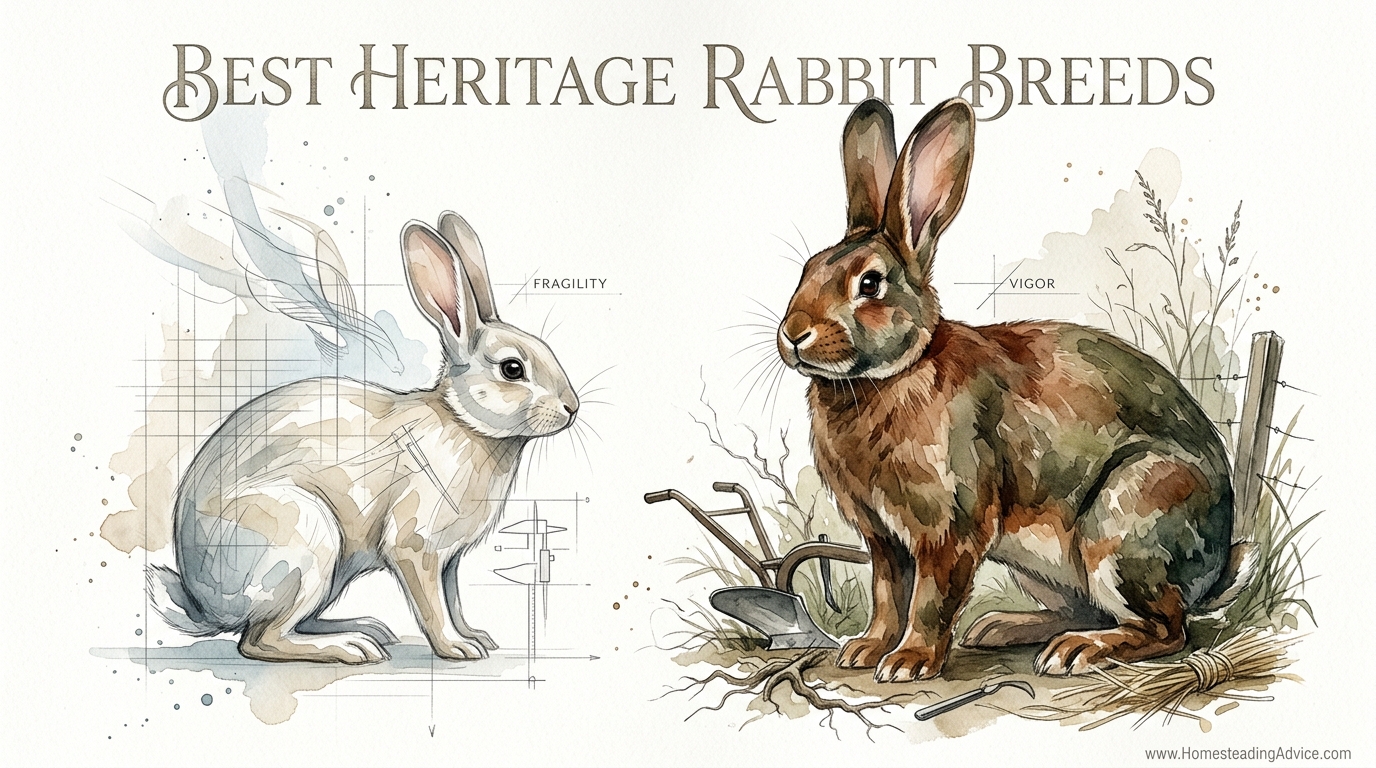
We bred the survival out of rabbits for the sake of aesthetics; it’s time to go back. If your rabbits need climate-controlled barns and ‘special’ vet-prescribed diets just to survive, you’re keeping the wrong rabbits. Heritage breeds were developed to thrive on pasture, survive the winter, and raise their own young without human interference. Choose vigor over fluff.
Modern commercial rabbits are often bred for a single metric: speed. They grow fast in a cage, but they often lack the “mothering” instincts or the gut health to handle a diverse, natural diet. On the other hand, heritage breeds carry the genetic memory of the farmyard. These animals were the backbone of rural life for centuries because they produced high-quality meat and fur with minimal human coddling.
When you choose a heritage breed, you are investing in a partner for your homestead rather than a fragile product. You want an animal that can handle a temperature swing and won’t abandon its litter the moment a dog barks. This guide explores the most resilient breeds that still carry the ancestral vigor needed for a self-sufficient life.
Best Heritage Rabbit Breeds
Heritage rabbit breeds are defined by their historical utility and their ability to thrive in traditional farming systems. Unlike modern industrial hybrids, these rabbits were selected for multi-purpose value, including premium meat, durable fur, and exceptional reproductive health. The Livestock Conservancy tracks many of these breeds, noting that their “threatened” or “recovering” status is often due to the shift toward industrial factory farming.
The Silver Fox
The Silver Fox is perhaps the quintessential American heritage breed. Developed by Walter B. Garland in Ohio during the 1920s, it was the second breed ever created in the United States. It was bred specifically for a “dual-purpose” role: to provide a heavy meat carcass and a pelt that mimicked the expensive silver fox of the fur trade.
Adult bucks typically weigh between 9 and 11 lbs (4.1–5.0 kg), while senior does range from 10 to 12 lbs (4.5–5.4 kg). Their most striking feature is their fur, which is unique among all rabbit breeds. If you stroke the fur from tail to head, it stands straight up until you stroke it back down. This density makes them incredibly cold-hardy, allowing them to thrive in northern climates where other rabbits might struggle.
From a vigor standpoint, Silver Fox does are legendary. They are known for being calm, “milky” mothers who rarely lose a litter. They have a high dressing percentage of about 65%, meaning you get more meat and less waste than with many show-focused breeds.
Champagne d’Argent
One of the oldest known heritage breeds, the Champagne d’Argent traces its history back to 17th-century France. The name translates to “Silver [rabbit] of Champagne,” and they were originally raised by monks who valued them for their incredibly fine-textured meat.
These rabbits are born jet black and gradually turn a shimmering silver-gray as they mature, a process that completes around 6 or 7 months of age. They reach a senior weight of 9 to 12 lbs (4.1–5.4 kg). Because they have been a staple of French meat production for hundreds of years, their carcass quality is exceptional.
They are docile and adapt well to different housing styles. Their “vigor” shows in their gut health; they tend to be less prone to the digestive upsets that plague modern “industrial” whites when introduced to fresh forage or pasture.
American (Blue and White)
The American rabbit is a true “homestead” breed that nearly vanished during the late 20th century. Developed in 1917, it features a unique “mandolin” body shape—a long, arching back that allows for large, meaty haunches. The Blue variety is particularly prized for its deep, slate-colored fur, which was once the gold standard for the American garment industry.
American rabbits are built for the ground. Their hardy nature makes them excellent candidates for pasture tractors or colony settings. They weigh 9 to 12 lbs (4.1–5.4 kg) and are known for being “thrifty,” a term old-timers used to describe an animal that gains weight well even on lower-quality forage.
Standard and American Chinchilla
Not to be confused with the rodent of the same name, Chinchilla rabbits were bred to have fur that looks like their namesake. The Standard Chinchilla is a smaller, compact rabbit (5.5–7 lbs / 2.5–3.2 kg), while the American Chinchilla was scaled up to be a premier meat producer weighing 9 to 12 lbs (4.1–5.4 kg).
The American Chinchilla is currently on the “Watch” list for conservation, but it is one of the best heritage meat breeds available. They grow rapidly, reaching 4 to 5 lbs (1.8–2.3 kg) by 8 to 10 weeks of age. Their vigor is evident in their foraging ability; they are highly efficient at converting grass and weeds into high-protein meat.
Beveren
The Beveren originated in Belgium in the late 1800s and is another “mandolin” shaped breed. They are large, active, and curious rabbits. While many modern breeds are content to sit in a corner, the Beveren likes to move. This makes them perfect for those who want to raise rabbits in a more natural, expansive environment.
They are exceptionally cold-hardy and feature a thick, “rollback” coat that protects them from dampness and wind. Does are excellent mothers, often producing large litters of 8 to 12 kits and raising them with high success rates.
How the Heritage Management System Works
Raising heritage rabbits requires a shift in mindset from “managing a product” to “cultivating a population.” You cannot treat a Silver Fox like a factory-farmed Californian and expect to see the full benefit of its genetics. Heritage rabbits thrive when their natural instincts are utilized rather than suppressed.
Selection for Maternal Instincts
In commercial setups, humans often intervene by warming kits or even hand-feeding. In a heritage system, you cull for vigor. If a doe does not build a proper nest, or if she abandons her young, she does not stay in the breeding program. Ancestral vigor means the rabbit does the work so you don’t have to.
Pasture and Forage Integration
Heritage breeds were developed before the invention of the “complete pellet.” They were fed on “hay, oats, and garden waste.” To maximize their health, many practitioners use “rabbit tractors”—portable floorless cages that move daily. This gives the rabbits access to fresh clover, grass, and dandelions.
When moving rabbits to pasture, you must introduce greens slowly to build up their cecal health. Heritage breeds generally handle this transition better than modern lines because they haven’t had the “forage” genetics bred out of them. A 10% daily increase in fresh greens is a safe way to transition.
The Colony Approach
Some heritage keepers prefer a colony system—a large, predator-proofed indoor or outdoor area where multiple does live together. This allows for natural social behavior and exercise. While more complex to manage due to territorial disputes, breeds like the American Blue or the Beveren often thrive when they have room to dig and jump.
Benefits of Heritage Rabbits
Choosing a heritage breed offers practical advantages that go beyond the “save the breed” sentiment. These animals are built for a time when resources were scarce and every animal had to pay for its keep.
Superior Meat Quality: Commercial rabbits are often slaughtered very young to maximize profit, resulting in meat that can be bland. Heritage breeds often take an extra two to four weeks to reach “fryer” weight, but this slower growth leads to a more developed flavor and a better texture.
Valuable Byproducts: The pelts of a Silver Fox or a Champagne d’Argent are worth significantly more than the thin, brittle skin of a commercial white rabbit. These hides can be tanned and used for clothing, blankets, or sold as premium crafts.
Resilience and Reduced Input: Because these breeds are hardier, you spend less on “support” infrastructure. You don’t need heated waterers in most climates if you choose cold-hardy breeds, and you don’t need expensive cooling systems if you provide shade and airflow for heat-tolerant lines.
Cold Hardiness: Many heritage breeds, particularly the Beveren and Silver Fox, possess a dense undercoat that allows them to remain comfortable in temperatures well below freezing, provided they are dry and out of the wind.
Challenges and Common Mistakes
The primary challenge with heritage rabbits is the “patience gap.” If you are used to the 8-week slaughter cycle of commercial hybrids, heritage growth rates may feel slow. However, most homesteaders find that the trade-off in health and mothering ability is worth the extra few weeks of feeding.
The “Show Line” Trap: A major pitfall is buying heritage rabbits from “show” breeders who only select for color and ear length. If a rabbit has won 50 ribbons but hasn’t raised a litter on its own in three generations, it has lost its heritage value. Always ask a breeder about their “mothering stats” and whether their rabbits have ever touched grass.
Inbreeding Depression: Because some heritage breeds are rare, the “breeding pool” can be small. It is essential to track pedigrees and bring in “outcross” lines from other breeders every few years to maintain genetic vigor.
Ignoring Heat Stress: While heritage rabbits are often cold-hardy, their large size and thick fur make them susceptible to heat. Temperatures over 85°F (29°C) can be fatal. Many beginners forget to provide frozen water bottles or ceramic tiles for cooling during summer peaks.
Limitations of Heritage Breeds
Heritage rabbits are not the right choice for everyone. If your goal is to produce the absolute maximum amount of protein in the shortest possible window of time using a strictly “indoor battery” system, you are better off with commercial New Zealand White hybrids.
Heritage breeds require more space. A mandolin-shaped American or a large Beveren will develop “sore hocks” or spinal issues if kept in a cage that is too small for them to stretch out. You must provide a minimum of 30 x 36 inches (76 x 91 cm) for senior does of these larger breeds.
Furthermore, finding quality stock can be difficult. You may have to travel several states away or pay for specialized animal transport to get a truly “vigorous” line of Silver Fox or American Chinchilla.
Heritage Breed Comparison Table
| Breed | Avg. Weight | Primary Strength | Litter Size | Status |
|---|---|---|---|---|
| Silver Fox | 10-12 lbs (4.5-5.4 kg) | Cold hardy / Unique fur | 6-8 | Recovering |
| Champagne d’Argent | 9-12 lbs (4.1-5.4 kg) | Meat flavor / Efficiency | 5-8 | Watch |
| American Blue | 9-12 lbs (4.1-5.4 kg) | Hardiness / Pasture use | 6-10 | Threatened |
| Beveren | 9-12 lbs (4.1-5.4 kg) | Large litters / Active | 8-12 | Watch |
| American Chinchilla | 9-12 lbs (4.1-5.4 kg) | Fast growth / Pelt value | 6-9 | Watch |
Practical Tips for Success
If you are ready to bring heritage rabbits onto your land, success starts with the setup. You aren’t just building a cage; you are building a habitat.
- Verify the Source: Buy from breeders who use the “Standard of Perfection” but also select for production. If the breeder doesn’t know their rabbits’ average 8-week weights, they aren’t a production breeder.
- Focus on Foot Health: Heritage rabbits are heavy. If you use wire-bottom cages, ensure the wire is 14-gauge or thicker and provide a “resting board” (a piece of wood or tile) so they can get off the wire.
- Feed for Vigor: supplement 16% or 18% protein pellets with high-quality timothy or orchard grass hay. Avoid alfalfa for senior rabbits as the high calcium can cause kidney stones.
- Cull Mercilessly: This is the hardest part for beginners. To maintain heritage vigor, you must remove rabbits from the breeding program that show aggression, poor mothering, or chronic health issues. A “pet” is a companion; a “breeding heritage rabbit” is a genetic legacy.
Advanced Considerations: Line Breeding for Vigor
Serious practitioners often use line breeding to “fix” desirable traits. This involves breeding related animals—such as grandfather to granddaughter—to ensure that the “mothering” or “hardiness” genes are dominant.
When line breeding, you must be prepared to cull any kits that show genetic defects. This process is how the original developers created these breeds in the first place. By concentrating the “best” genes, you create a strain of rabbits that is uniquely adapted to your specific farm’s climate and forage profile.
Another advanced technique is “winter breeding.” While many commercial keepers stop breeding in the winter, heritage keepers with hardy breeds like the Silver Fox may continue. This produces kits that are naturally selected for cold tolerance, ensuring the next generation is even tougher than the last.
Example: Transitioning to Heritage Rabbits
Imagine a homesteader named Elias who started with commercial New Zealand White hybrids. He found that in his humid, southern climate, his “industrial” rabbits frequently suffered from heat stroke and required constant fans. Their gut health was fragile; a handful of fresh clover often led to “bloat” and death.
Elias decided to transition to the American Blue. He started with two does and one buck from a breeder who raised them in outdoor colonies. Within a year, he noticed a dramatic shift. His American Blues had no trouble with the heat as long as they had shade and airflow. They grazed on the local “weeds” with no digestive issues.
Most importantly, Elias noticed the “mothering” difference. His New Zealand does often required him to check the nest boxes every two hours in the cold. His American Blue does built deep, fur-lined nests and successfully raised 9 kits per litter without any human intervention. By switching to a heritage breed, Elias reduced his daily labor by 40% while maintaining his meat production levels.
Final Thoughts
Heritage rabbit breeds represent more than just a nostalgic look at the past. They are a practical solution for the modern homesteader who values self-reliance and resilience over industrial speed. By choosing breeds like the Silver Fox, American, or Champagne d’Argent, you are preserving a genetic library that knows how to survive on its own terms.
True vigor is not something you can buy in a supplement bag. It is the result of centuries of careful selection by farmers who needed animals to be tough, productive, and independent. Choosing these breeds is a commitment to that wisdom.
As you begin your journey with heritage rabbits, focus on the fundamentals: good ventilation, high-quality forage, and strict selection for maternal health. Experiment with different housing styles, whether it is a traditional hutch or a pasture tractor, and watch how these animals respond to a more natural life. You may find that once you go back to heritage genetics, you can never go back to “fluff” again.