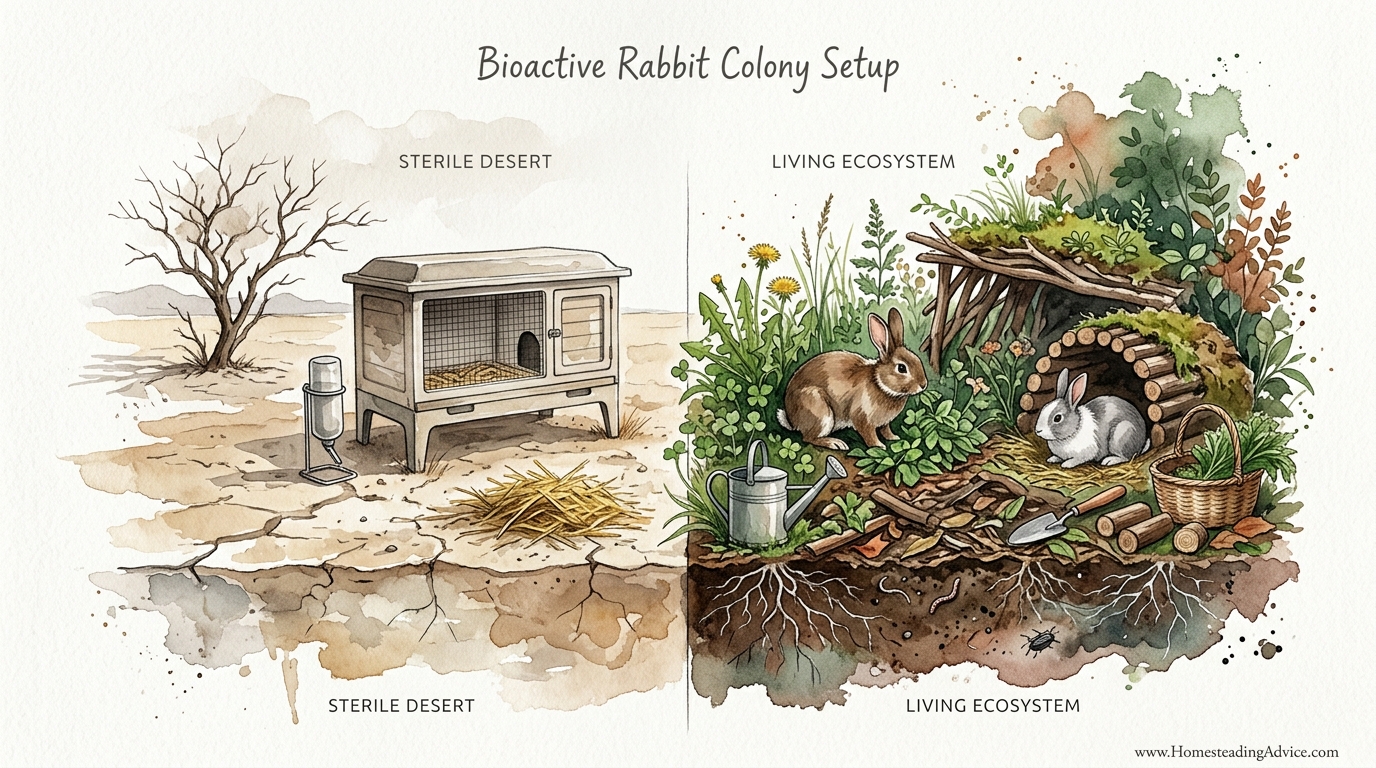
A sterile cage isn’t clean; it’s a biological desert waiting for a disease outbreak. We were told wire cages were ‘cleaner,’ but they actually destroy a rabbit’s immune system. A bioactive colony uses beneficial microbes and natural flooring to process waste and keep your rabbits resilient. It’s time to build a living habitat, not a prison.
When you transition from the standard wire-bottom cage to a living ecosystem, you are shifting from a philosophy of “managing waste” to a philosophy of “cultivating life.” In the old way, every dropping was a liability to be scrubbed. In a bioactive setup, every dropping is fuel for the microbial engine that keeps your herd healthy.
This guide will walk you through the grit and the glory of building a bioactive colony. We will cover the biology of the floor, the engineering of the enclosure, and the medicinal plants that keep the system running without a bottle of chemicals in sight.
Bioactive Rabbit Colony Setup
A bioactive rabbit colony is a self-sustaining indoor or outdoor enclosure that utilizes a living substrate to break down organic waste. Unlike a traditional hutch that relies on physical removal of manure, this system employs a “clean-up crew” of insects, fungi, and bacteria to cycle nutrients back into the soil.
In the real world, this looks like a large, floor-based pen or a fenced paddock where the ground is not just dirt, but a complex layer of organic matter. It exists to mimic the ancestral warrens where rabbits have thrived for thousands of years. You will find these setups on modern homesteads, in progressive rabbitries, and even in large-scale indoor “rabbit rooms.”
Think of the bioactive floor as a slow-cooker for compost. You are not just keeping rabbits; you are managing a massive, living bio-filter. When a rabbit urinates, the nitrogen is captured by carbon-rich bedding—like wood chips or straw—and then processed by microbes before it can turn into harmful ammonia.
This approach is used because it creates a “microbial shield” around the animals. In a sterile environment, the first bad bacteria to arrive wins because there is no competition. In a bioactive system, the beneficial microbes occupy every available niche, making it much harder for pathogens like Eimeria (coccidiosis) to take hold.
How the Biological Engine Works
The heart of this system is the Carbon-to-Nitrogen (C:N) ratio. Rabbit manure is a “cold” manure, but it is still high in nitrogen. Urine is even higher. To prevent the floor from becoming a stinking, anaerobic mess, you must provide enough carbon to balance the load.
Microbial competition is your primary defense against disease. When you have a thriving population of “good” bacteria and fungi in the substrate, they out-compete the “bad” ones for resources. This is why kits raised on a living floor often have much stronger gut health than those raised in a bleached cage.
Decomposition generates heat. During cold seasons, a deep bioactive floor can stay significantly warmer than the surrounding air. This thermal mass protects your rabbits from the ground up, reducing the energy they spend just trying to stay warm.
Natural behavior is the final component. Rabbits are designed to dig, forage, and socialize. A bioactive setup allows them to express these instincts, which reduces stress. Lower stress leads to a stronger immune system, creating a virtuous cycle of health.
The Infrastructure of a Living Enclosure
Building the physical structure requires a different mindset than building a hutch. You are containing an animal that can dig through the earth and chew through wood.
Predator proofing is the first priority. If your colony is outdoors or on a dirt floor, you must prevent tunnel-outs and break-ins. Using 19-gauge (1mm) or 16-gauge (1.6mm) galvanized hardware cloth is a common choice, but many long-term practitioners prefer 2″x4″ (5cm x 10cm) welded wire for the floor because it lasts longer in contact with acidic soil.
Burying your wire is essential if you want to allow natural burrowing. Digging a trench 2 feet (60cm) deep around the perimeter and lining it with wire or roofing tin prevents the rabbits from tunneling under the fence. If you want a full “dig-proof” floor, lay the wire across the entire area and cover it with at least 12 to 18 inches (30cm to 45cm) of substrate.
Drainage determines whether your colony succeeds or fails. A bioactive floor must be moist enough to support life but never soggy. If you are building on concrete, you need a slope or a drainage layer of coarse gravel or “leca” balls under the soil to prevent “swamp-foot.”
The Substrate and Clean-Up Crew
The substrate is not just “dirt.” It is a recipe designed to hold moisture, provide aeration, and feed the microbes. A standard starting mix for a large-scale rabbit bioactive floor follows these proportions:
- 50% Organic Topsoil: Avoid anything with synthetic fertilizers or “moisture crystals.”
- 30% Coconut Coir or Peat Moss: This holds the moisture that the clean-up crew needs to breathe.
- 20% Coarse Sand: This prevents the soil from compacting into a brick, allowing for air to reach the lower layers.
Once the base is in, you add your carbon layer. This is where you use straw, kiln-dried wood chips, or shredded leaves. Aim for a depth of at least 6 inches (15cm) for the total substrate, though 12 inches (30cm) is better for stability.
Introducing the Clean-Up Crew (CUC)
The insects and worms you add are the “custodians” of the colony. They eat the manure and the wasted hay, turning it into rich vermicompost.
Red Wiggler Worms (Eisenia fetida): These are the workhorses. They love rabbit manure and will breed rapidly in the moist, lower layers of the substrate. They can survive cold winters by diving deep into the center of the thermal mass.
Isopods (Sowbugs or Roly-Polies): Common species like Armadillidium vulgare are excellent at breaking down tough cellulose, like hay stems and wood chips. They need hiding spots—stones, cork bark, or thick branches—to feel secure enough to breed.
Springtails: These tiny, white hexapods are the mold-police. They eat fungal outbreaks before they can spread. They thrive in any damp corner of the enclosure.
Benefits of the Bioactive Approach
The most immediate benefit is the reduction in labor. Daily chores shift from “scraping and bleaching” to “observing and feeding.” You spend more time watching your rabbits interact and less time fighting the smell of ammonia.
Gut health and immunity see the most significant improvement. Research into free-range and floor-rearing systems shows that rabbits exposed to a diverse microbial environment develop a more robust ileum microbiome. This “natural vaccination” helps them resist the digestive disorders that are the leading cause of death in weanling kits.
Waste becomes a resource. Instead of hauling bags of manure to the trash, you are creating high-grade compost. Every few months, you can “harvest” the bottom layer of the substrate to use in your garden. This material is already teeming with life and ready to feed your vegetables.
Thermal regulation is a hidden advantage. In the summer, the damp soil provides a cool place for rabbits to sprawl out and drop their body temperature. In the winter, the biological activity in the deep litter provides a gentle, rising heat.
Challenges and Common Mistakes
The “Soggy Substrate” is the most frequent killer of bioactive systems. If the floor stays wet for too long, it becomes anaerobic. This produces a “rotten egg” smell and allows pathogens to bloom. You avoid this by ensuring your C:N ratio stays balanced—add more dry straw if the floor feels mushy.
Ammonia spikes happen when there isn’t enough airflow or carbon. If you can smell ammonia, your rabbits’ lungs are already being damaged. Increase your ventilation and stir the top layer of bedding to help it dry out and process the nitrogen.
Overcrowding will crash the system. Every bioactive floor has a “carrying capacity.” If you have too many rabbits for the size of the floor, the waste will accumulate faster than the microbes can eat it. A general rule for a bioactive colony is at least 10 to 15 square feet (approx. 1 to 1.5 square meters) per adult rabbit to ensure the floor remains healthy.
Escapes through burrowing are a constant risk. Rabbits are master engineers. If you don’t reinforce the corners and the perimeter of your dig-barrier, they will eventually find a weak spot. Check your boundaries weekly.
Limitations: When This May Not Work
High-density commercial operations may find the space requirements of a colony prohibitive. Because you need more square footage per rabbit to maintain biological balance, you cannot stack them like you can with cages.
Extremely humid environments make moisture management difficult. If you live in a region where the air is constantly saturated, the substrate may never dry out enough to stay “sweet” (aerobic). In these cases, you might need a “hybrid” system with elevated sections and a very shallow, fast-cycling bioactive floor.
Certain predators, like rats or snakes, can be harder to manage in a colony. Rats are attracted to the warmth and the spilled grain. They can tunnel into the substrate if your floor wire isn’t a fine enough mesh (1/2 inch or 1.25cm is usually required to stop rats).
Comparing the Systems
| Factor | Sterile Cage System | Bioactive Colony |
|---|---|---|
| Immune Support | Low; relies on sanitizers. | High; microbial competition. |
| Daily Maintenance | High; tray cleaning/scraping. | Low; feeding and monitoring. |
| Start-up Cost | Moderate; cost of cages. | High; fencing and substrate. |
| Ammonia Risk | High if not cleaned daily. | Low if balanced properly. |
| Animal Welfare | Limited natural movement. | High expression of behavior. |
Practical Tips and Best Practices
Establish “moisture zones” within the enclosure. Keep the area around the waterer slightly damp to support the worms and springtails, but keep the sleeping and feeding areas bone-dry. This helps the rabbits regulate their own health.
Use “carbon-heavy” feeding. When you feed hay, some will always fall to the floor. Don’t see this as a waste; see it as free bedding. High-fiber timothy or orchard grass hay makes excellent carbon fodder for the bioactive floor once the rabbits are done nibbling the best parts.
Introduce tannin-rich forage. Plants like willow branches, blackberry leaves, and oak bark are high in tannins. These natural compounds have been shown to inhibit the life cycle of Eimeria (coccidia). Providing a steady supply of these “medicinal” sticks gives the rabbits the tools to self-medicate.
Monitor the “indicator species.” If you stop seeing isopods on the surface at night, or if the worms are all clustering at the very bottom, your substrate might be too dry or the pH might be off. A healthy CUC is a sign of a healthy rabbit environment.
Advanced Considerations: The Living Pharmacy
Serious practitioners don’t just rely on the floor; they use the perimeter of the colony to grow a “living pharmacy.” Plant oregano, mint, and dandelion around the enclosure. These plants are not only high in minerals but also possess antibacterial and anti-parasitic properties.
Oregano oil has been studied as a powerful natural coccidiostat. By feeding fresh oregano or adding a few drops of high-quality oregano oil to the water, you further reinforce the gut-health benefits of the bioactive system.
Managing the social hierarchy is the “advanced” part of colony raising. In a bioactive space, rabbits will establish a pecking order. Providing multiple levels—shelves, tunnels, and hollow logs—allows lower-ranking rabbits to escape the sightline of dominant ones, reducing stress-induced illnesses.
Rotation is another high-level strategy. If you have the space, dividing your colony into two paddocks and rotating the herd every 3–4 months allows the plants to regrow and the microbes to fully process the manure without new inputs. This mimics the natural movement of wild warrens.
Example Scenario: The Winter Resilience Setup
Imagine a homestead in a northern climate where winter temperatures drop to -20°F (-29°C). In a standard hutch, the rabbits are at risk of frostbite and frozen water.
In a bioactive colony, the owner has built a deep litter floor with 12 inches (30cm) of mixed topsoil, wood chips, and straw. Underneath the sleeping area, the decomposition of manure and carbon is generating a steady internal temperature of 50°F (10°C) at the substrate level.
The rabbits have dug a shallow burrow into this warm mass. They are fed tannin-rich willow branches harvested in the fall and dried oregano mixed with their hay. Despite the freezing air, the kits are born in a warm, microbially-diverse nest, and the mortality rate remains near zero because the environment supports their natural resilience.
Final Thoughts
Building a bioactive rabbit colony is a return to a more ancestral way of animal husbandry. It requires us to trade our bottles of bleach for a deeper understanding of soil biology and microbial life. It is not the “easy” way out—it requires a keen eye and a commitment to balancing an ecosystem—but the rewards are profound.
Rabbits raised in these living habitats are visibly different. They are more muscular, their coats are shinier, and their eyes carry the brightness of animals that are allowed to be what they were born to be. You are not just building a pen; you are cultivating a resilient lineage.
Start small if you must. Build a bioactive floor in a single pen and watch the transformation. You will find that when you stop fighting nature and start working with it, the “biological desert” of the wire cage becomes a distant, dusty memory.