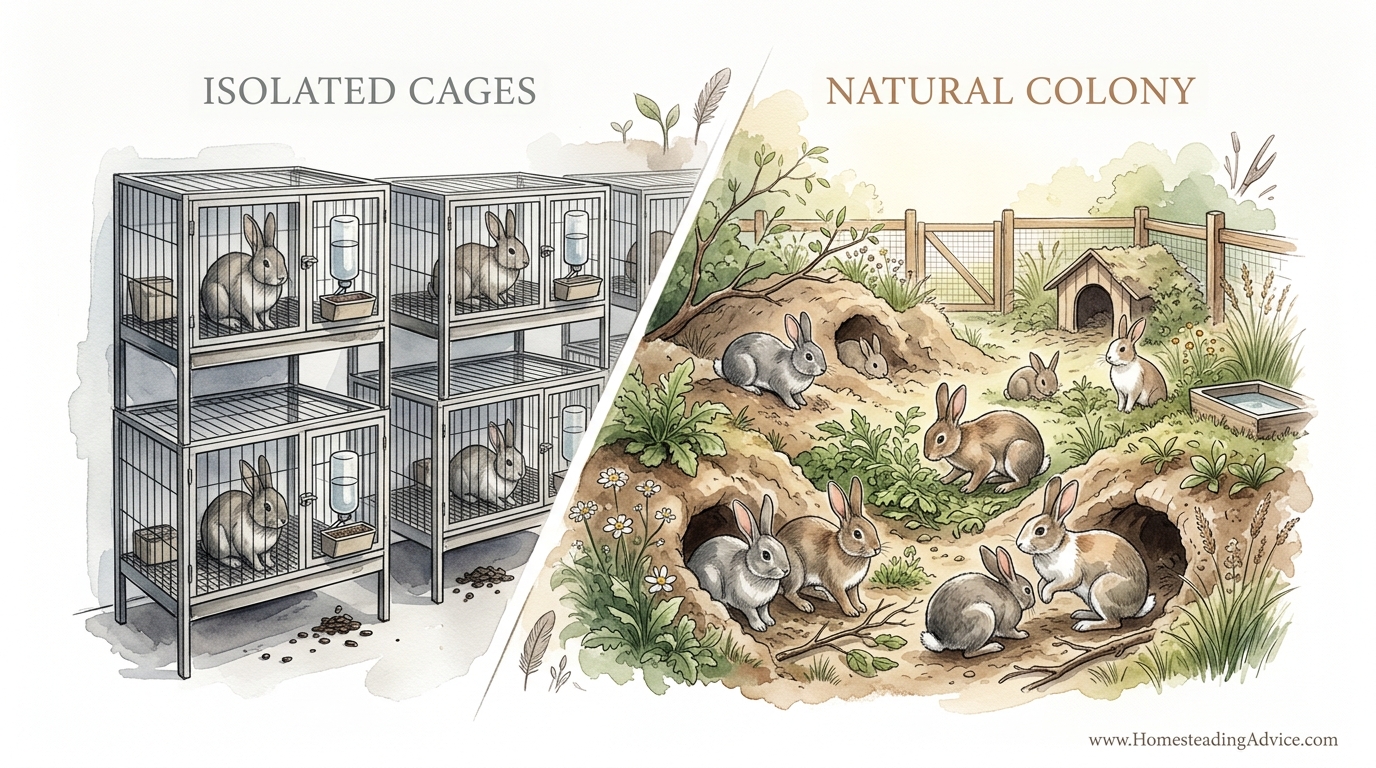
Is a ‘sterile’ cage actually making your rabbits more susceptible to disease? Modern rabbit keeping favors isolation, but nature favors community. Rabbits raised in colonies develop stronger immune systems, better maternal instincts, and significantly lower stress levels. It’s time to trade the fragile wire box for a resilient, natural ecosystem.
For generations, we have been told that the only way to keep a rabbit healthy is to isolate it in a wire-floored cage. We were taught that the ground is the enemy and that socialization is a recipe for fighting. However, if you look at the ancestors of our domestic breeds—the European rabbit—you will find a creature that is defined by its community. These animals were never meant to live in a vacuum. When we strip away their social structure, we strip away their natural resilience.
Choosing to raise rabbits in a colony is about more than just giving them space to hop. It is about restoring a biological balance that allows the animal to do the work of staying healthy. In a natural colony, rabbits exercise their muscles, forage for diverse nutrients, and learn the hard-won lessons of hierarchy and motherhood from their elders. This approach requires more observation and a deeper understanding of animal behavior, but the result is a hardier, more vibrant herd that can weather the challenges of homestead life.
How To Raise Rabbits In A Natural Colony
Raising rabbits in a natural colony means housing a group of rabbits together in a large, open environment rather than in individual cages. This setup mimics a wild warren, providing the animals with the freedom to move, socialized with one another, and often burrow into the earth or deep bedding. In the real world, this system is favored by homesteaders and small-scale farmers who prioritize animal welfare and want to reduce the labor of individual cage maintenance.
A colony is a living, breathing social unit. Unlike a cage system where you are the sole provider and manager of every minute detail, a colony allows the rabbits to manage their own social lives. They groom each other, huddle together for warmth in the winter, and help raise each other’s young. This is not a “set it and forget it” method; it is a system of management that relies on creating the right environment so the animals can thrive by their own instincts.
Visualizing a colony is easy if you think of a small-scale pasture or a dedicated shed floor. Instead of rows of wire boxes, you see a wide-open space with various levels, hiding spots, and communal feeding areas. The rabbits are free to zoom at dawn and dusk, stretching their legs in ways that a 24-by-30-inch (60-by-76-cm) cage simply does not allow. This movement builds bone density and lean muscle, creating an animal that is physically superior to its caged counterparts.
How the Colony System Works
Success in a colony begins with the floor. You must decide whether you will allow your rabbits to burrow into the earth or if you will keep them on a solid floor with deep bedding. Earth colonies are the most natural, but they require the most security. To prevent escapes, you must bury hardware cloth or heavy-duty cattle panels at least 2 to 3 feet (60 to 90 cm) underground around the entire perimeter. Some keepers choose to floor the entire area with wire and then cover it with 12 inches (30 cm) of soil, allowing for digging without the risk of a rabbit tunneling into the next county.
The social structure is the engine of the colony. A typical starter colony consists of one buck and two to four does. Introducing them all at once into a neutral territory is the best way to minimize initial fighting. There will be scuffling, ear-nipping, and chasing as they establish the “pecking order.” This is a natural part of their communication. You must provide enough “furniture”—hiding boxes, hollow logs, or PVC pipes—so that a submissive rabbit can escape the line of sight of a dominant one. Once the hierarchy is set, the colony usually settles into a peaceful routine of shared grooming and napping.
Feeding in a colony is done communally. Large hoppers for pellets and big hay racks reduce the time spent on daily chores. Instead of filling ten individual crocks, you fill one large station. Water is best provided through a gravity-fed system with multiple nipples or a large, heavy trough that cannot be tipped. Because the rabbits are in a group, they stimulate each other to eat, often leading to better growth rates in young kits who learn what is edible by watching the adults.
Designing the Space
The amount of space you provide determines the stress level of the herd. A good rule of thumb is at least 10 to 15 square feet (0.9 to 1.4 square meters) per adult rabbit. If the space is too cramped, the social hierarchy will turn from a functioning community into a constant battleground. High ceilings are less important than floor space, but providing “mezzanine” levels—like sturdy wooden shelves—can effectively double your usable square footage and give does a place to escape an over-eager buck.
Ventilation is the silent protector of rabbit health. In a colony, especially one indoors, ammonia can build up quickly if the airflow is stagnant. Ensure there are windows or vents at both the floor and ceiling levels to move air without creating a direct, chilling draft. In an outdoor colony, the rabbits need a weatherproof shelter where they can retreat from rain and wind. This shelter should be filled with dry straw or wood shavings to provide insulation during the colder months.
The Measurable Benefits of Community
The most immediate benefit of a colony is the reduction in stress. Rabbits are social creatures that experience high levels of cortisol when kept in solitary confinement. In a group, they benefit from “allo-grooming”—the act of grooming one another—which lowers heart rates and strengthens social bonds. A relaxed rabbit has a more efficient digestive system and a more responsive immune system, making them less likely to succumb to common ailments like GI stasis or snuffles.
Maternal instincts flourish in a colony setting. In cages, a first-time mother may get stressed and scatter her litter. In a colony, she has the benefit of observing other mothers. It is common to see “communal nesting,” where two does will share a large nest box or burrow and nurse each other’s kits. This “auntie” behavior ensures that if one mother is low on milk or becomes ill, the kits still have a chance at survival. The presence of the buck can also be beneficial; many colony keepers report that a good buck will guard the nest and even huddle with the kits to keep them warm when the mother is out feeding.
Muscle tone and meat quality are significantly improved in colony-raised meat rabbits. The ability to run and jump develops the hindquarters and loins, leading to meat that is firmer and more flavorful. While cage-raised rabbits can sometimes become “flabby,” colony rabbits are athletic and lean. For the homesteader, this means a more nutritious and substantial carcass at the time of harvest.
Challenges and Common Pitfalls
Fighting is the most common concern for new colony keepers. While does usually settle their differences, bucks can be territorial. Keeping two unneutered adult bucks in a small colony is often a recipe for disaster. One will eventually dominate the other, leading to serious injury. Most successful colonies use only one resident buck, or they use a large enough acreage that multiple bucks can establish separate territories. If you see a rabbit that is consistently being bullied to the point of losing weight or hiding constantly, that individual must be removed for the safety of the herd.
Sanitation requires a different mindset in a colony. You cannot simply pull a tray and hose it off. In a deep-bedding system, you are essentially managing a slow-compost pile. You must add fresh carbon—straw, wood chips, or dried leaves—regularly to soak up urine and cover manure. If the bedding becomes soggy or smells of ammonia, the risk of respiratory infection and coccidiosis skyrockets. A “muck out” should happen at least twice a year, taking the bedding down to the floor and starting fresh.
Record keeping is the greatest logistical hurdle. When does kindle in underground burrows, you may not know a litter exists until the kits emerge at three weeks old. This makes it difficult to track exact birth dates, litter sizes, or which buck sired which litter if you have multiple males. For those focused on strict pedigree breeding or show standards, the colony system can be frustrating. You have to accept a certain level of “natural mystery” in exchange for the health benefits of the system.
Limitations and Realistic Constraints
Space is the ultimate boundary. If you live on a small suburban lot, you may not have the room to build a secure, 200-square-foot (18.5-square-meter) outdoor run. A cramped colony is worse than a clean cage; it concentrates pathogens and intensifies aggression. If you cannot provide the necessary square footage, you are better off sticking to a traditional hutch or a rabbit tractor system that moves to fresh ground daily.
Climate plays a significant role in colony design. In extremely hot regions, an underground burrow is a lifesaver, as the earth stays a consistent 55 to 65 degrees Fahrenheit (13 to 18 degrees Celsius). However, in areas with high water tables or heavy spring flooding, burrows can become death traps. You must understand your local geography. If your ground doesn’t drain well, you should build your colony on a raised wooden or concrete floor with deep litter rather than allowing the rabbits to dig.
Biosecurity is harder to maintain in a group. In a cage bank, if one rabbit gets sick, you can often isolate it before the disease spreads. In a colony, the rabbits share everything—food, water, and air. If a highly contagious pathogen like RHDV (Rabbit Hemorrhagic Disease Virus) enters the colony, it can wipe out the entire herd in days. This means you must be extremely cautious about introducing new rabbits. Any new addition should be quarantined in a separate cage for at least 30 days before joining the colony.
Colony vs. Cage Raising: A Comparison
| Factor | Isolated Cages | Natural Colony |
|---|---|---|
| Social Stress | High (Isolation) | Low (Community) |
| Daily Labor | High (Multiple units) | Low (Batch feeding) |
| Disease Spread | Slower/Controllable | Faster/Harder to isolate |
| Record Keeping | Precise | Estimated/Difficult |
| Physical Fitness | Limited | Excellent |
Practical Tips for a Resilient Colony
Managing parasites on the ground requires a proactive approach. Coccidiosis is a protozoal infection that thrives in damp, manure-rich soil. To combat this, you should feed high-tannin plants like blackberry leaves, raspberry leaves, or willow branches. These natural “dewormers” help keep the intestinal load of parasites manageable. Additionally, keeping the feeding and watering stations on a raised platform or a concrete pad will prevent the rabbits from eating off soiled ground.
- Visual Barriers: Use large rocks, stumps, or plywood lean-tos. If a rabbit can’t see its rival, the urge to chase often disappears.
- Apple Cider Vinegar: Add a tablespoon per gallon (roughly 4 ml per liter) of water. It acts as a mild tonic that supports digestive health and makes the water less hospitable to algae.
- The “Three-Sided” Rule: Ensure your colony shelter has at least three solid walls to block the prevailing wind. Rabbits handle cold well, but a cold wind can lead to pneumonia.
- Selection for Temperament: Only keep the calmest, most social rabbits for your breeding stock. If a doe is a chronic bully, she belongs in the freezer, not the colony.
Handling colony rabbits requires more patience than handling caged ones. Because they have more space, they will naturally be faster and more elusive. Do not chase them around the pen, as this triggers their predator-prey flight response and ruins their trust in you. Instead, spend time sitting quietly in the colony with some high-value treats like sunflower seeds or a piece of carrot. Let them come to you. Over time, they will view your presence as a positive event rather than a threat.
Advanced Considerations: Line Breeding and Genetics
For the serious practitioner, managing a colony offers a unique look at “survival of the fittest” genetics. In a cage, you decide every pairing. In a colony, the rabbits often decide. While you can control this by only having one buck in the pen, the natural competition between does for the best nesting sites often reveals which animals have the strongest maternal instincts and the best physical health. Over several generations, you will find that your colony-raised line becomes significantly more resistant to local pathogens than “store-bought” rabbits.
Winter breeding is another advanced topic. In many regions, cage-raised rabbits stop breeding in the winter because the kits would freeze on wire floors. In a colony with deep burrows or insulated nest boxes, rabbits can and will breed year-round. The earth provides a natural thermal mass that keeps the “kindling hollow” warm even when the surface temperature is well below freezing. This allows for a more consistent meat supply throughout the year, provided you increase their caloric intake with extra sunflower seeds or oats during the cold months.
Example Scenario: The Spring Transition
Imagine it is early March in a temperate climate. The ground is thawing, and the colony is starting to stir with spring energy. Your dominant doe, “Hazel,” has already claimed the prime nesting box in the corner of the shed, while a younger doe, “Willow,” is starting to dig a new burrow in the outdoor run. You notice Hazel is pulling fur and carrying mouthfuls of dry hay—clear signs that kits are arriving within 24 hours.
Because it is a colony, you don’t move Hazel. You simply ensure the hay rack is overflowing and that there are no drafts hitting her chosen spot. Two days later, you see Hazel out eating with the rest of the group, looking slimmer. You don’t go digging for the kits. You wait. Three weeks later, six tiny bundles of fur emerge from the corner, following Hazel to the feeder. They are already nibbling on hay and learning the social cues of the herd. Because they were born into the community, they are already “immunized” to the local environment and the social dynamics of the group.
Final Thoughts
Transitioning from cages to a natural colony is a journey back to ancestral wisdom. It requires us to stop being “wardens” and start being “stewards.” By providing a resilient, natural ecosystem, we allow our rabbits to live with dignity and health. The challenges of hierarchy and sanitation are small prices to pay for the vibrancy and hardiness that a community lifestyle provides.
If you are new to this, start small. Build a secure perimeter, choose your foundation stock carefully, and spend more time observing than intervening. You will soon find that a happy, hopping colony is far more rewarding than a row of silent cages. Let the rabbits teach you how they were meant to live, and your homestead will be the better for it.
Experimenting with different forages, flooring materials, and social groupings will help you fine-tune a system that works for your specific climate. As you gain confidence, you might even consider integrating your colony into a larger permaculture system, using the “gold” of their manure to fuel a high-intensity garden. The possibilities are as endless as the energy of a kit’s first “binky.”