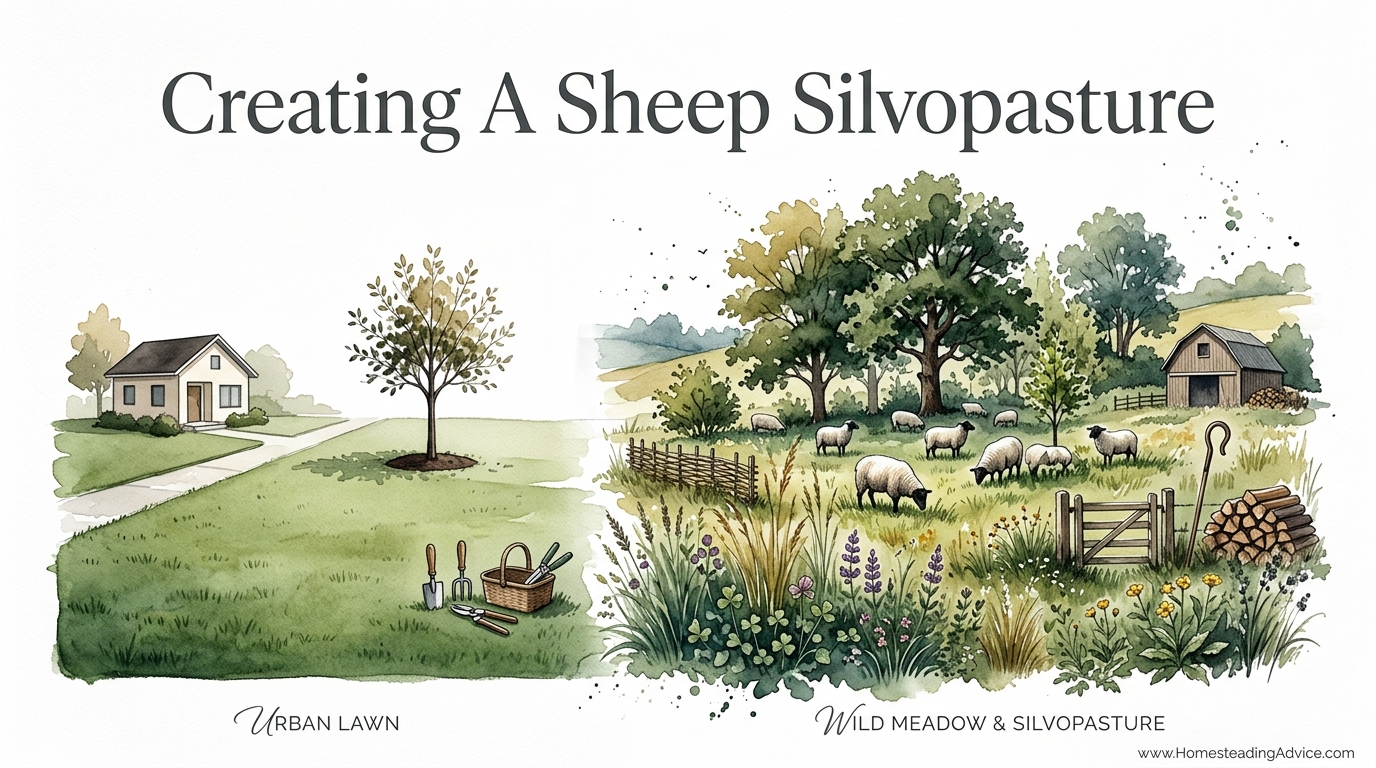
A perfect lawn is a desert for a sheep, but a wild meadow is a five-star pharmacy. A flat green lawn is a biological desert for a ruminant. By rewilding your pasture with native shrubs and fodder trees, you create a self-healing ecosystem that provides medicine and nutrition for your flock 365 days a year.
Livestock keepers often focus on the quality of their grass, yet they ignore the vertical dimension of the landscape. Traditional farming wisdom understood that trees and shrubs are not just shade—they are a critical component of a resilient diet. Modern silvopasture revives this ancestral knowledge to help you build a farm that survives droughts and produces healthier animals without expensive chemical supplements.
Understanding how to integrate woody forage into your grazing plan is the first step toward true self-reliance. This guide will walk you through the species, designs, and management techniques required to turn a monoculture field into a thriving, multi-layered pharmacy.
Creating A Sheep Silvopasture
A sheep silvopasture is the intentional integration of trees, forage, and livestock on the same piece of land. It is not simply turning sheep into a forest, nor is it planting a few ornamental trees in a paddock. It is a managed system where every component serves the others. Trees provide shelter and deep-rooted minerals, while the sheep provide natural fertilization and weed control through managed browsing.
Historically, shepherds across Europe and the Mediterranean relied on “tree hay” and hedgerows to carry their flocks through lean winters and scorched summers. In these systems, trees were often pollarded—cut above the reach of the animals—to ensure a steady supply of fresh leafy matter. This approach exists today in various forms, from the dehesas of Spain to the multi-purpose hedgerows of the British Isles.
Visualizing this on your own land means seeing your pasture in layers. You have the ground layer of grasses and forbs, the shrub layer of berry-producing or medicinal bushes, and the canopy layer of timber or high-fodder trees. This vertical stacking increases the total amount of energy your land can produce per acre (or hectare), making your small-holding or farm significantly more productive.
The Pharmacy in the Leaves: Choosing Fodder Species
Selecting the right trees is the most important decision you will make. Every species brings a different chemical profile to the table, helping your sheep regulate their own health through selective browsing.
Willow (Salix spp.)
Willow is perhaps the most valuable medicinal tree for sheep. It contains salicylic acid, a natural precursor to aspirin, which provides pain relief and anti-inflammatory benefits to the flock. More importantly, willow leaves are exceptionally high in cobalt and zinc. Research has shown that willow can contain up to 17 times the cobalt found in standard pasture grasses, making it a critical tool for preventing “pine” or cobalt deficiency in growing lambs.
Mulberry (Morus spp.)
Often called the “money printing tree” by permaculturists, the mulberry produces leaves with a nutritional profile nearly identical to alfalfa. Crude protein levels in mulberry leaves range from 15% to 28%, making them a high-protein supplement that costs nothing but the time to plant the tree. They are highly palatable and thrive even when pruned aggressively.
Hazel (Corylus avellana)
Hazel is a traditional hedging plant that provides excellent copper and magnesium. Sheep will eagerly strip the leaves and small twigs. Because hazel responds well to coppicing—cutting the tree back to the ground—it is easy to maintain as a dense, leafy shrub that provides both forage and a windbreak.
Hawthorn (Crataegus spp.)
Known for its cardiovascular benefits in traditional herbalism, hawthorn is a hardy native shrub that forms an impenetrable “living fence.” Its leaves are a favorite for sheep in early spring. The thorns protect the inner branches from being over-browsed, ensuring the plant remains healthy even under heavy grazing pressure.
Design and Layout: Engineering the Landscape
Success in silvopasture depends on a layout that allows for both tree growth and efficient livestock management. You must balance the light requirements of your grass with the density of your trees.
- Alley Cropping: Plant trees in wide, straight rows with 15–18 meters (50–60 feet) of open pasture between them. This width allows you to mow or hay the alleys with standard equipment while the trees grow.
- Cluster Planting: Grouping trees in small “islands” of 5–10 plants provides concentrated shade and shelter. This is ideal for hilly or irregular terrain where straight rows are impractical.
- Living Fences: Use high-density hedgerows along your existing fence lines. This maximizes space and provides a continuous windbreak across the property.
Tree spacing within the rows should be between 2–4 meters (6–13 feet) depending on the species. Closer spacing encourages upward growth for timber, while wider spacing encourages a bushy, leaf-heavy habit better suited for fodder.
How to Establish and Protect Your Living Fodder
Young trees are a delicacy for sheep. If you do not protect your investment, the flock will kill your silvopasture before it even begins. Establishing a new system requires a phased approach to protection.
Step 1: Soil Preparation and Planting
Plant your trees during their dormant season, which is typically late autumn or early spring depending on your hemisphere. Use a thick layer of mulch to suppress grass competition around the base of the sapling. Grass is a fierce competitor for moisture and nutrients in the first three years.
Step 2: Physical Barriers
Individual tree guards are mandatory. For sheep, a heavy-gauge weld mesh cylinder at least 1.2 meters (4 feet) tall is usually sufficient. Taller guards are necessary if you also have cattle or deer. Secure these guards with sturdy wooden stakes to prevent the sheep from rubbing against them and knocking the tree over.
Step 3: Temporal Protection
Consider excluding livestock from the new plantation area for the first 24 to 36 months. Using portable electric fencing to “fence out” the tree rows allows the pasture in the alleys to be grazed while keeping the trees safe. Once the bark has thickened and the “browse line” (the height the sheep can reach) is below the main canopy, the trees can handle direct contact.
The Science of Tree Hay and Self-Medication
Ruminants have an innate ability to seek out plants that contain the secondary metabolites they need. This behavior is most visible when sheep are moved into a silvopasture system.
Condensed tannins are a major part of the medicinal magic in tree leaves. These compounds bind to proteins in the rumen, allowing the sheep to absorb more high-quality protein in the small intestine. Furthermore, condensed tannins are a natural anthelmintic. They disrupt the lifecycle of gastrointestinal parasites like the Barber’s Pole worm. Regular access to tannin-rich browse like willow, hazel, and oak (in moderation) can significantly reduce your reliance on chemical dewormers.
Minerals are another key factor. Because trees have deep taproots, they can reach mineral deposits 5–10 meters (16–33 feet) below the surface—depths that grass can never touch. These minerals are pulled up into the leaves, creating a nutrient-dense snack that corrects the deficiencies common in shallow-rooted monocultures.
Benefits of the Wild Meadow Approach
Implementing a silvopasture system offers measurable advantages that affect the bottom line of any farm or homestead.
- Climate Resilience: Trees stay green during summer droughts when grass goes dormant. This provides “emergency fodder” that can save a flock when hay prices spike.
- Animal Welfare: Shade reduces heat stress, which is a major cause of weight loss and reproductive failure in sheep. Shelter from wind in the winter reduces the calories needed for maintenance.
- Parasite Management: Moving sheep to browse higher off the ground keeps them away from the “larval zone” (the first 5cm/2 inches of grass where most parasites live).
- Diversified Income: Over the long term, these trees can provide timber, nuts, fruit, or carbon credits in addition to livestock benefits.
Challenges and Common Mistakes
Failure in silvopasture usually stems from poor planning or underestimating the persistence of a hungry sheep. One common error is planting toxic species. While many trees are safe, others like Yew, Rhododendron, and wilted Cherry leaves can be fatal. Always verify the safety of a species before planting.
Another mistake is neglecting the “light budget.” If you plant your trees too densely, the grass beneath them will eventually die out due to lack of sunlight. This leaves you with bare dirt and a mud problem. Maintaining a “dappled shade” environment—roughly 40% to 60% light penetration—is the sweet spot for keeping both trees and grass productive.
Under-built tree guards are the most frequent cause of tree death. Sheep will lean, rub, and butt against guards to reach the leaves. If the guard is flimsy, it will buckle, and the sheep will ring-bark the tree, killing it in a matter of minutes. Spend the extra money on high-quality mesh and heavy stakes; it is cheaper than replacing the trees three times.
Limitations and Regional Constraints
Silvopasture is not a universal “plug and play” solution. In extremely arid regions, trees may compete with limited grass for water, potentially reducing total forage. In very wet, boggy soils, many high-value fodder trees like Mulberry or Hawthorn will suffer from root rot, though Willow and Alder may thrive.
Establishment time is also a factor. Unlike a new pasture of clover which can be grazed in months, a silvopasture takes 5 to 10 years to reach full maturity and productivity. This is a long-term investment in the land’s health, not a quick fix for this season’s feed bill.
Comparison: Urban Lawn vs. Sheep Silvopasture
| Feature | Urban-Style Grass Lawn | Sheep Silvopasture |
|---|---|---|
| Biological Diversity | Low (Monoculture) | High (Multi-layered) |
| Mineral Access | Shallow (Top 10–20cm) | Deep (5–10 meters) |
| Drought Resistance | Poor (Browns quickly) | Excellent (Trees stay green) |
| Parasite Control | High risk (Ground grazing) | Natural control (Browse & Tannins) |
| Management Effort | Low/Moderate (Mowing) | High (Pruning & Protection) |
Practical Tips for the Modern Shepherd
- Harvest Tree Hay in Late Summer: Cut branches in August or September (Northern Hemisphere) or February or March (Southern Hemisphere) when the leaves are full of nutrients but haven’t started to yellow.
- Dry Branches in the Shade: If making tree hay for winter, dry the bundles out of direct sunlight to preserve the green color and protein content.
- Observe Your Animals: Watch which trees your sheep gravitate toward. They are the best indicators of what minerals your soil is lacking.
- Start Small: Don’t try to rewild 50 acres at once. Start with a single row or a few clusters to master the art of tree protection.
Advanced Considerations: Pollarding and Coppicing
For the serious practitioner, managing the shape of the tree is an art form. Pollarding involves cutting the main trunk at a height of 2 to 3 meters (6 to 10 feet). This creates a “knuckle” from which new shoots grow every year, safely out of reach of the sheep. You then cut these shoots annually or biannually and drop them to the ground for the flock.
Coppicing is the practice of cutting the tree at ground level. This is best used for species like Hazel or Willow in a fenced-off area. The tree responds by sending up dozens of thin, leafy poles. This method produces the highest volume of leaf matter but requires you to keep the sheep away while the regrowth is soft and vulnerable.
Integrating these techniques allows you to “bank” forage. You can let the trees grow during a good grass year and only harvest the “tree hay” during a drought or a particularly hard winter. This creates a living haystack that never rots and only gets more valuable with age.
Example Scenario: The Drought-Proof Orchard
Imagine a 2-acre (0.8 hectare) paddock in a region prone to dry summers. The owner plants four rows of Mulberry and Willow spaced 12 meters (40 feet) apart. For the first three years, the rows are protected by electric tape.
In year five, a severe drought hits. The grass turns brown and brittle by July. Instead of buying expensive hay, the owner spends 30 minutes each morning pollarding a few branches from the Willow and Mulberry trees. The sheep rush to the fresh green leaves, receiving high protein and hydration when they need it most. The flock maintains its body condition, and the owner saves hundreds of dollars in supplemental feed costs.
Final Thoughts
Rewilding your pasture with fodder trees is a return to a more logical, balanced form of agriculture. It acknowledges that sheep are not just grass-eaters, but versatile browsers that thrive on variety. By providing them with a “five-star pharmacy” of native shrubs and trees, you reduce your workload, lower your input costs, and improve the resilience of your land.
The transition from a biological desert to a wild meadow does not happen overnight. It requires a shift in perspective—from seeing trees as obstacles to seeing them as essential infrastructure. Start by planting a few willows near a water source or a hawthorn hedge along a windy ridge. The wisdom of the flock will show you the way forward.
As you watch your sheep reach for the high branches of a mulberry or seek relief under the shade of a willow, you will realize that the most powerful tools for animal health aren’t found in a bottle, but in the soil and the leaves. Experiment with different species, protect your young trees with grit and determination, and your landscape will eventually reward you with a self-healing ecosystem that stands the test of time.