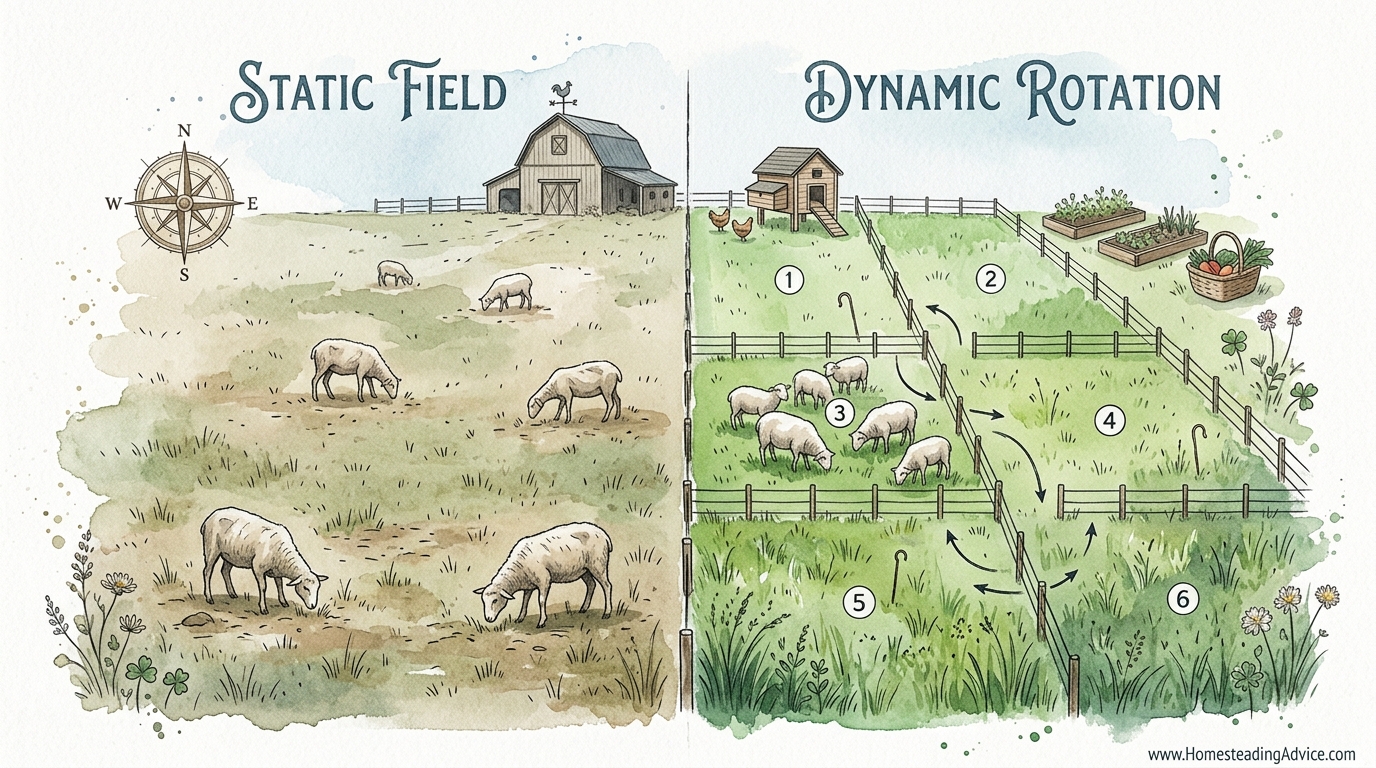
Is your pasture a dead-end street or a moving feast for your flock? A fence that never moves is a recipe for parasites and dust. Discover how mimicking the natural movement of wild herds turns your sheep into land-healing machines rather than simple lawnmowers.
When you look out at your field, do you see a static green carpet or a living, breathing ecosystem that needs to move to survive? For generations, shepherds understood that sheep thrive best when they are constantly on the move, much like the great wild herds of the past. Today, we call this intensive management or rotational grazing, but at its heart, it is simply following the ancestral wisdom of the land. By changing how you think about your fences, you can transform a tired, parasite-ridden paddock into a lush, productive pasture that feeds your flock and builds your soil simultaneously.
The transition from a static field to a dynamic rotation isn’t just about moving fence posts; it’s about becoming a partner with your land. It requires a shift in perspective where you stop being just a livestock owner and start being a grass farmer. When you manage your forage correctly, the sheep do the hard work of fertilizing and pruning, leaving the ground better than they found it. This guide will walk you through the practical steps of sheep pasture management, from the biological principles of grass growth to the gritty details of electric fencing.
Sheep Pasture Management Techniques
Sheep pasture management is the strategic control of where and when your flock grazes to maximize forage health and animal productivity. Unlike cattle, which are relatively indiscriminate grazers, sheep are highly selective “nibblers” that prefer the most tender, nutritious parts of the plant. If left in one place too long—a practice known as set-stocking—they will graze their favorite grasses down to the roots while ignoring weeds, eventually killing off the good forage and leaving a field of dust and thistle.
The most effective management techniques mimic the natural behavior of ruminants in the wild. In nature, predators keep herds bunched together and constantly moving. This high-density, short-duration grazing prevents overgrazing of any single plant and ensures that manure is distributed evenly across the landscape. In a domestic setting, we use “managed intensive rotational grazing” (MIRG) to achieve this same effect. By dividing a large pasture into smaller “paddocks” and moving the sheep frequently, we allow the plants a vital period of rest to recover and regrow.
Real-world application of these techniques varies based on your climate and goals. For a small homesteader with five ewes, it might mean moving a single length of electric netting every three days. For a commercial producer with five hundred head, it might involve complex permanent fencing systems and gravity-fed water troughs. Regardless of the scale, the goal remains the same: use the sheep to improve the pasture, rather than letting the sheep destroy it.
How to Implement Rotational Grazing for Sheep
Implementing a successful rotation requires understanding the “graze-rest” cycle. You aren’t just moving sheep; you are managing the biological clock of the forage. When a sheep bites a blade of grass, the plant must pull energy from its roots to grow a new leaf. If the sheep bites that same plant again before the leaf has fully grown, the plant is weakened. Do this repeatedly, and the roots eventually die. To avoid this, you must follow a disciplined step-by-step process.
Step 1: Assessing Your Forage Height
The golden rule of grazing is “take half, leave half.” You should generally move your sheep into a paddock when the grass is 6 to 8 inches (15 to 20 cm) tall. At this height, the plant is in its most rapid growth phase and is packed with nutrients. You should move them out when they have grazed it down to 2 to 4 inches (5 to 10 cm). Leaving that residual leaf area allows the plant to continue photosynthesis without depleting its root reserves, leading to much faster recovery times.
Step 2: Determining Paddock Size
Paddock size depends on your “stocking density”—the number of animals in a specific area at a specific time. A common starting point is to aim for a density that requires a move every 3 to 5 days. For example, if you have 20 ewes, you might find that a quarter-acre (0.10 hectare) paddock provides enough forage for three days. If they graze it down faster than expected, make the next paddock larger; if they can’t keep up, make it smaller. Observation is your most valuable tool.
Step 3: Managing the Rest Period
The most critical part of the process happens when the sheep are not in the paddock. The “rest period” is when the soil heals and the grass regrows. During the fast-growing spring season, a paddock may only need 20 to 25 days of rest. However, during the heat of summer or the dormancy of winter, that same paddock might need 60 days or more to fully recover. Never return the sheep to a paddock until the forage has reached that 6 to 8-inch (15 to 20 cm) mark again.
Step 4: Providing Mobile Infrastructure
To move sheep effectively, your infrastructure must be as mobile as they are. This includes:
- Electric Netting: High-quality, portable electric mesh is the gold standard for sheep. It provides a visual and physical barrier that keeps even the most determined lamb in place.
- Portable Water: Sheep need constant access to clean water. Use a mobile tank or a long garden hose connected to a portable trough that can follow the flock from paddock to paddock.
- Mineral Access: A portable mineral feeder ensures the flock gets essential nutrients like selenium and salt, which vary by soil type.
Benefits of Managed Pasture
The move toward dynamic pasture management offers measurable benefits that go far beyond simple aesthetics. By breaking the cycle of continuous grazing, you are essentially “farming the sun” and turning solar energy into high-quality protein with minimal external inputs. One of the most immediate benefits is the dramatic reduction in parasite loads. Most internal sheep parasites, like the deadly Barber Pole worm (Haemonchus contortus), live in the first few inches of the grass. By moving sheep out of a paddock before they graze too low, and not returning until the parasite larvae have died off (usually 35-40 days), you can significantly reduce your reliance on chemical dewormers.
Soil health is another major winner. When sheep graze intensively, they stomp old plant material and manure into the ground, acting as a natural biological primer. This increases the organic matter in the soil, which in turn increases the soil’s ability to hold water. In many cases, managed pastures remain green during a drought long after set-stocked pastures have turned brown. Over time, you will see a wider diversity of forage species appearing naturally, as the rest periods allow “hidden” seeds in the soil bank to finally germinate and thrive.
Finally, there is the benefit to the sheep themselves. Sheep are foragers by nature, and the “fresh bite” of a new paddock provides a surge of nutrition that improves lambing rates, weaning weights, and wool quality. A flock on a fresh rotation is a contented flock; they spend less time searching for food and more time ruminating and growing. You’ll also find that your sheep become much easier to handle, as they quickly learn that the sight of you means they are about to get a fresh, delicious salad bar.
Challenges and Common Mistakes
The most common pitfall for beginners is the “calendar trap.” Many people try to set a strict schedule, such as “move every Sunday.” However, grass doesn’t grow on a human schedule. It grows based on rainfall, temperature, and sunlight. If you move sheep purely by the calendar, you risk overgrazing during a dry spell or letting the grass get too “stemmy” and unpalatable during a wet spring. You must learn to read the plants, not the clock.
Another frequent error is making paddocks too large. If the sheep have too much space, they will engage in “patch grazing.” They will eat the most delicious clover in one corner down to the dirt, while ignoring the taller grasses in another corner. This creates an uneven pasture that is hard to manage. To fix this, increase your stocking density—put more sheep in a smaller space for a shorter time. This forces them to graze more evenly and reduces the selection of only their favorite plants.
Water logistics often present the biggest hurdle. Carrying buckets to the back of a 10-acre field is a recipe for burnout. Many producers fail because they don’t invest in a sustainable watering system. Before you start dividing your fields, map out how you will get water to every corner. Whether it’s a “tuba” (a central hub with radiating paddocks) or a long poly-pipe system, water must be easy for you to manage, or the entire system will fail during the first heatwave.
Limitations of Rotational Grazing
While dynamic grazing is powerful, it is not a magic wand for every situation. In extremely arid regions or during severe, multi-year droughts, the rest periods required for forage recovery might be so long that they become impractical for a small acreage. In these cases, you may have to significantly reduce your flock size or rely on supplemental hay to prevent permanent damage to the land. The environment ultimately dictates the ceiling of what your land can produce.
Topography can also be a limiting factor. If your pasture is extremely steep, rocky, or heavily wooded, setting up portable electric fencing can be an exercise in frustration. While sheep are excellent at navigating rough terrain, the humans managing the fences may not be. In these rugged environments, a more “extensive” management style—larger paddocks with longer durations—may be the only realistic option, even if it isn’t as biologically efficient as intensive rotation.
Labor is the final constraint. Managed grazing is more work than just opening a gate and walking away. It requires a daily or semi-weekly commitment to moving fences and checking water. For a weekend farmer or someone with physical limitations, the “intensive” part of intensive grazing can become a burden. It is important to design a system that fits your lifestyle; moving sheep once a week is still vastly superior to never moving them at all.
Comparison: Static Field vs. Dynamic Rotation
Choosing between traditional set-stocking and modern rotational management depends on your goals for soil health, animal performance, and available labor. Below is a comparison of the two approaches based on measurable farm factors.
| Factor | Static Field (Set-Stocking) | Dynamic Rotation (MIRG) |
|---|---|---|
| Parasite Risk | High; sheep graze near manure constantly. | Low; rotation breaks the larval life cycle. |
| Forage Utilization | Low; sheep “cherry-pick” best plants. | High; sheep graze the entire area evenly. |
| Soil Health | Compaction and erosion are common. | Increases organic matter and water retention. |
| Maintenance | Low; set it and forget it. | Moderate; requires moving fences/water. |
| Weight Gains | Plateau as favorite forages disappear. | Consistent; always on “fresh” high-protein forage. |
| Drought Resilience | Poor; plants have no root reserves. | Strong; deep roots survive dry spells better. |
Practical Tips for Success
If you are ready to start, begin by conducting a “pasture walk.” Walk your fields without the sheep. Look for the diversity of plants. Are you seeing bare ground? Are the weeds taking over? This baseline will help you see the progress as you begin your rotation. Start small—perhaps just dividing your main field into four sections with one roll of electric netting—and expand as you become more comfortable with the rhythm of the moves.
Invest in a high-quality fence energizer. Sheep are naturally insulated by their wool, meaning they need a much stronger “bite” from an electric fence than cattle or horses do. Aim for an energizer that delivers at least 3,000 to 4,000 volts at the furthest point of the fence. A “weak” fence is worse than no fence at all, as it teaches the sheep they can push through the netting without consequence. Once a sheep learns to jump or crawl under a fence, it is very hard to untrain that behavior.
- Follow the “Thirds” Rule: Eat a third, trample a third, leave a third. This ensures enough plant matter returns to the soil to feed the microbes.
- Back-Fencing: When moving to a new paddock, use a “back-fence” to prevent sheep from wandering back to the area they just grazed. This protects the new regrowth.
- Night Moves: During extreme summer heat, consider moving sheep to fresh paddocks in the evening so they can graze comfortably during the cooler night hours.
- Shade Management: Ensure every temporary paddock has access to shade, whether it’s a line of trees or a portable shade structure. Sheep can easily overheat in open paddocks.
Advanced Considerations
For those looking to take their management to the next level, consider “multi-species grazing.” Cattle and sheep have different parasite profiles and different grazing preferences. Cattle prefer longer, coarser grasses, while sheep prefer the shorter, finer forages. By running cattle through a paddock first (the “leader”) and following with sheep (the “follower”), you can maximize the utilization of every single plant and further dilute the parasite load. The cattle actually act as biological vacuum cleaners, eating sheep parasite larvae that cannot survive in a bovine gut.
Stockpiling forage is another advanced technique. Instead of grazing every paddock throughout the fall, you can “set aside” several sections to grow tall and then go dormant. This standing hay can be grazed in the late fall or early winter, significantly reducing your hay bill. This “strip-grazing” of stockpiled forage requires careful management to ensure the sheep don’t waste it, but it is one of the most effective ways to increase the profitability of a sheep operation.
Silvopasture—the intentional integration of trees, forage, and livestock—is gaining traction as a way to improve sheep welfare and land productivity. Planting rows of high-protein fodder trees like Willow or Mulberry within your rotation provides the sheep with “vertical forage” that is rich in minerals and offers natural deworming properties (tannins). It also provides vital windbreaks and shade, creating a microclimate that can extend the growing season of your grasses by several weeks.
Example Scenario: The Five-Acre Rotation
Imagine a small farm with 5 acres (2 hectares) of pasture and a flock of 15 ewes. In a traditional setup, these sheep might wander the entire 5 acres all year. By mid-summer, the grass near the water trough is dirt, and the back corner is overgrown with woody weeds. The sheep are thin, and the lambs have high worm counts.
Now, imagine that same farm divided into 10 half-acre (0.20 hectare) paddocks. The shepherd moves the flock every 4 days. In the spring, when the grass is jumping out of the ground, the sheep only make it through 6 paddocks before the first one is ready again. The shepherd mows the remaining 4 paddocks for hay, capturing that excess growth for winter. By mid-summer, the rotation slows down to 40 days, allowing the grass to survive the heat. The lambs are fat, the ewes are healthy, and the pasture looks like a manicured park. This is the power of management over momentum.
Final Thoughts
Transforming your pasture management is one of the most rewarding journeys you can take as a shepherd. It moves you away from the “dead-end street” of static grazing and into a cycle of abundance. While it requires more observation and a bit more footwork, the results—healthier sheep, richer soil, and a more resilient farm—are well worth the effort. You aren’t just raising sheep; you are stewarding a piece of the earth, and the land will reward you for your care.
Remember that every farm is a unique laboratory. What works for a neighbor in a different valley might not work exactly the same way for you. Be patient with yourself and your flock as you learn this new rhythm. Start where you are, use what you have, and watch as your sheep turn from simple lawnmowers into the land-healing machines they were always meant to be. As you master the art of the move, you may find that the most important tool on your farm isn’t the tractor or the truck, but the humble roll of electric wire and your own two eyes.