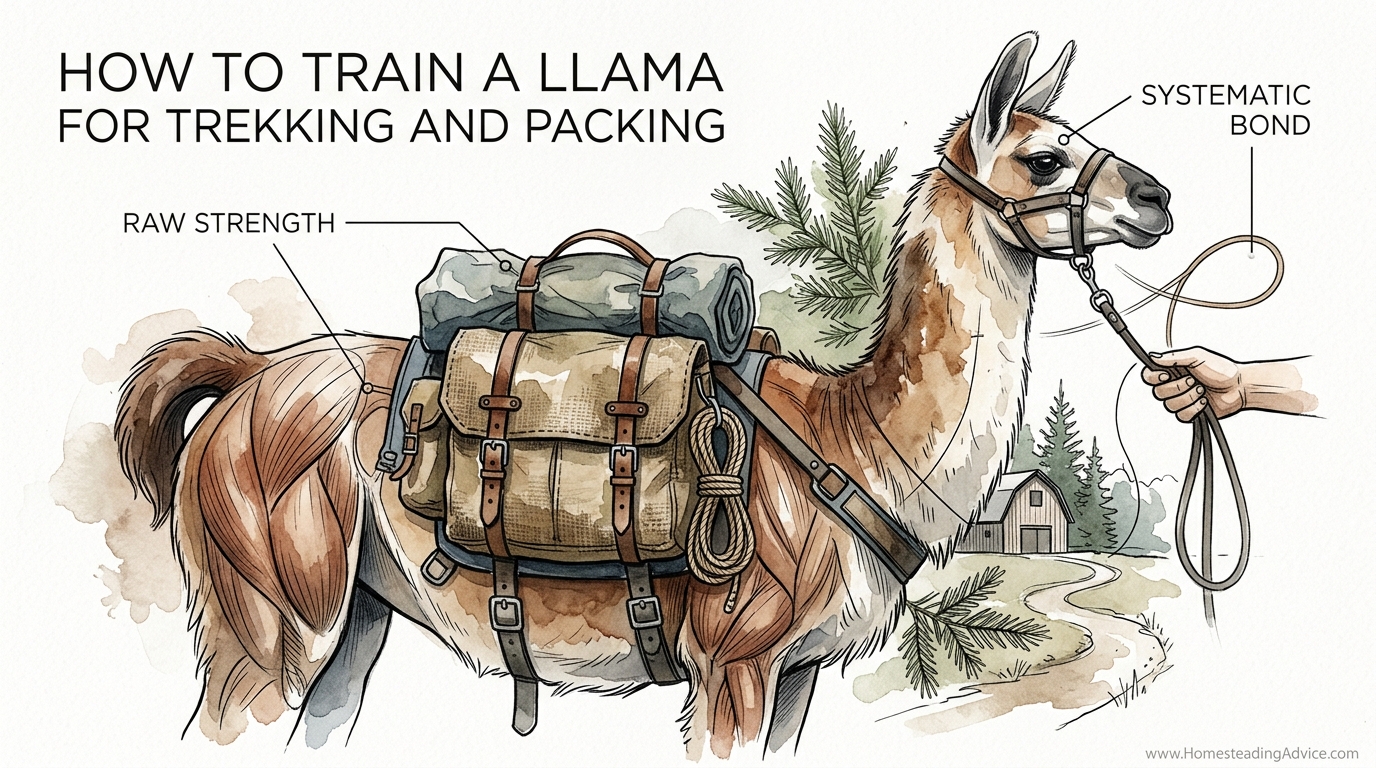
If you are fighting 300 pounds of muscle, you have already lost; here is how to use psychology instead of a lead rope. Llamas are incredibly smart, but they are also prey animals. If you pull, they pull back. Shift your strategy from physical dominance to pressure-release training. You’ll find that a llama who trusts you will carry 70 pounds over a mountain pass without ever tightening the lead.
The bond between a packer and their llama is not built on the strength of a bicep, but on the consistency of the mind. In the high country, where the air is thin and the trails are narrow, you need a partner, not a servant. Taking a llama into the wilderness requires a shift in perspective. You are not “breaking” an animal; you are refining a relationship that has existed for five thousand years, dating back to the Incan empires of the Andes. This guide explores the grit and wisdom required to turn a pasture pet into a seasoned mountain athlete.
How To Train A Llama For Trekking And Packing
Training a llama for the trail is the process of desensitizing a prey animal to human gear while teaching them to yield to subtle pressure. Unlike a horse that might bolt or a mule that might stubbornly plant its feet, a llama processes fear through observation. If you understand how a llama thinks, you can guide them through rushing rivers and over fallen timber with nothing more than a loose rope and a steady voice.
This training exists to transform the llama’s natural flight instinct into a “follow-the-leader” instinct. In the real world, this means your llama remains calm when a grouse flushes from the brush or when a backpacker with a strange-looking rain cover passes by. A well-trained pack llama is a silent, low-impact companion that can traverse terrain that would stop a horse in its tracks. They are “browsers,” meaning they can find their own food along the trail, and their soft, leathery pads leave no more mark on the earth than a deer.
The Psychology of the Lead Rope: How It Works
The core of llama training is the principle of pressure and release. This is the “Systematic Bond” in action. Every time you ask a llama to move, you apply a small amount of pressure—perhaps a slight tug on the lead or a step into their personal space. The moment the llama complies, you must release that pressure immediately. This “release” is the reward. It tells the llama, “Yes, that is what I wanted.”
Llamas are highly sensitive to balance. If you pull their head down and forward, they will lean back to maintain their equilibrium. If you pull them toward you, they will pull away. To lead effectively, you must walk beside them, keeping the lead rope in a “J” loop. This slack signifies trust. If the rope is always tight, the llama lives in a constant state of low-level stress, which eventually leads to “kushing” (sitting down and refusing to move) or spitting.
The Step-by-Step Training Process
Training does not happen in a weekend. It happens in fifteen-minute increments over the course of months. Rushing the process only builds resentment in the animal.
Phase 1: Desensitization and Gentling
Start in a small catch pen. A llama’s “no-go” zones are their ears, their tail, and their legs. You must teach them that your touch is not a threat. Use a soft brush or a towel to stroke their neck and back. Gradually move toward the legs. A pack llama must allow you to pick up its feet to check for stones or to trim toenails. If they cannot handle a brush, they will not handle a cinched saddle.
Phase 2: The Halter and the Lead
The halter must fit properly. A common mistake is placing the noseband too low. Llamas breathe through their noses, and a low noseband can compress the soft tissue, essentially suffocating the animal under stress. The band should sit high on the hard bone of the nose. Once haltered, practice “yielding the hindquarters.” Step toward the llama’s hip; they should step away. This establishes you as the herd leader without using force.
Phase 3: Introducing the Saddle
Introduce the saddle in a familiar environment. Let the llama smell the cinch and the panniers. Place the saddle on their back without tightening the cinch at first. Walk them around. Once they are comfortable, gradually tighten the cinch. It should be snug enough to stay put but not so tight that it restricts breathing. Most packers use a “sawbuck” style saddle or a soft-side internal frame pack.
Phase 4: Weight and Balance
A llama’s bones do not fully fuse until they are about four years old. Loading a young llama too early can cause permanent joint damage.
- Under 24 months: No weight. Only a halter and lead training.
- 24 to 30 months: An empty saddle or very light packs (less than 10 lbs / 4.5 kg) to get used to the “width” of the panniers.
- 3 to 4 years: Light loads, roughly 10% to 15% of their body weight.
- 4 years and older: Full loads. A fit, adult llama can carry 20% to 25% of its body weight. For a 350 lb (158 kg) llama, this is roughly 70 to 80 lbs (31 to 36 kg).
Benefits of the Llama Trail
Choosing a llama over a traditional pack animal like a horse or mule offers distinct advantages for the self-reliant trekker.
Low Maintenance: Llamas are incredibly efficient. They require about one-fourth the food of a horse. On a long trek, they can often subsist on the native “browse” (leaves, shrubs, and weeds) found along the trail. This means you do not have to pack in hundreds of pounds of hay or grain.
Environmental Stewardship: Their soft feet do not tear up trails or meadows. Their manure is “pre-composted” and doesn’t have the heavy odor or weed-seed issues common with horse dung. This makes them the preferred choice for “Leave No Trace” packing.
Transportability: You do not need a massive four-horse trailer. Two or three llamas can fit comfortably in a standard van or a small utility trailer. Some owners even train them to “kush” in the back of a covered pickup truck.
Challenges and Common Mistakes
The most frequent error is anthropomorphizing the llama. They are not dogs. They do not want to be hugged or kissed on the face. In fact, “over-petting” a young llama can lead to “Berserk Llama Syndrome,” where the animal loses its boundary between humans and llamas. When they reach social maturity, they may try to challenge you for dominance as if you were another llama—this involves chest-butting, neck-wrestling, and biting.
Another mistake is imbalanced loads. If one pannier is two pounds (1 kg) heavier than the other, the saddle will shift. This creates “saddle sores” and causes the llama to work much harder to maintain balance. Always use a small hanging scale to ensure your packs are identical in weight.
Limitations: When This May Not Be Ideal
Llamas are mountain specialists, but they have their limits. They are not built for speed. If you are looking to cover thirty miles (48 km) a day, a llama will not keep up. They typically walk at a human pace of 2 to 3 miles per hour (3 to 5 km/h).
Furthermore, they struggle in extreme heat and humidity. Because they are native to high, dry altitudes, they dissipate heat through their “thermal windows”—the wool-less areas on their underbelly and armpits. If the “heat index” (temperature plus humidity) exceeds 150, you risk heatstroke. In such conditions, you must shear them fully before the season starts, leaving only the “classic” wool on the neck and head.
Comparison: RAW STRENGTH vs SYSTEMATIC BOND
The difference between traditional stock handling and modern llama training is stark. One relies on the weight of the handler; the other relies on the weight of the expectation.
| Factor | Raw Strength (Traditional) | Systematic Bond (Psychology) |
|---|---|---|
| Primary Tool | Heavy bits, spurs, and force. | Pressure, release, and trust. |
| Animal Reaction | Submission through fear or fatigue. | Cooperation through understanding. |
| Trail Safety | High risk if the animal panics. | Low risk; animal looks to handler for cues. |
| Maintenance | High calorie, high water needs. | Low calorie, “browser” metabolism. |
Practical Tips for the Field
When you are five miles (8 km) into the backcountry, small details matter.
- The “Hum”: Listen to your llama. A low, rhythmic hum is normal. A high-pitched, persistent hum means the llama is stressed, overheated, or tired.
- Water Crossings: Never pull a llama into a stream. Walk in yourself, leave plenty of slack, and wait. They will usually jump or step through once they see it is safe. Standing downstream of the llama is a mistake; if they jump, they jump toward you.
- Trail Etiquette: Always yield to hikers. Move your llamas 10 feet (3 meters) off the trail to the downhill side. This keeps the llamas calm and gives hikers plenty of room.
- Stakeout: At camp, use a “picket line” or a “stakeout.” Use a 20-foot (6-meter) lead attached to a ground stake. Ensure there are no trees or rocks the rope can wrap around, which could lead to a broken leg.
Advanced Considerations: Technical Terrain
Experienced packers know how to “string” llamas together. In a “string,” the lead rope of the second llama is tied to the back of the first llama’s saddle. The knot must be a “breakaway” knot or a simple loop through a piece of low-strength twine. If the first llama falls or jumps, you don’t want the second llama’s neck to take the force.
When navigating “deadfall” (fallen trees), a llama’s agility is unmatched. They can often jump 3-foot (1-meter) logs even while loaded. However, you must ensure the panniers won’t snag on branches. Training your llama to “step” rather than “jump” is safer for the gear and the animal. Use a verbal cue like “Step, step” and reward the slow movement.
Example Scenario: A Day on the High Divide
Imagine you are standing at a trailhead in the Eagle Cap Wilderness. You have two llamas, “Silas” and “Jasper.” You spend ten minutes brushing them—not for aesthetics, but to ensure no grit is trapped under the saddle blanket. You weigh the panniers: Silas is carrying 35 lbs (16 kg) per side; Jasper is carrying 30 lbs (13.5 kg) per side.
As you ascend the first 1,000 feet (305 meters) of elevation, you notice Silas is lagging. You stop, check his cinch, and realize he’s “huffed” out his chest during saddling. You tighten the cinch by one notch. You don’t yell or pull. You simply adjust the gear. By midday, you reach a narrow rock slide. You shorten the lead, keeping your hand about 18 inches (45 cm) from the halter, and guide Silas through. He trusts your footing, so he follows. At camp, they browse on alpine grasses while you set up your tent—carrying nothing but your own small daypack because the llamas did the heavy lifting.
Final Thoughts
Training a llama for the backcountry is an exercise in patience and ancestral wisdom. It is a return to a way of life where the pace is set by the stride of a companion rather than the ticking of a clock. When you stop fighting the animal’s nature and start working with it, the wilderness opens up in a way that is impossible to experience under the crushing weight of a 70-pound backpack.
Success is not measured by how far you go, but by the state of your llama when you return to the trailhead. A happy llama, ears forward and eyes bright, is the mark of a true packer. Take the time to build the bond. Use your head more than your hands. The mountains are waiting, and there is no better partner for the journey than a llama that trusts you implicitly.