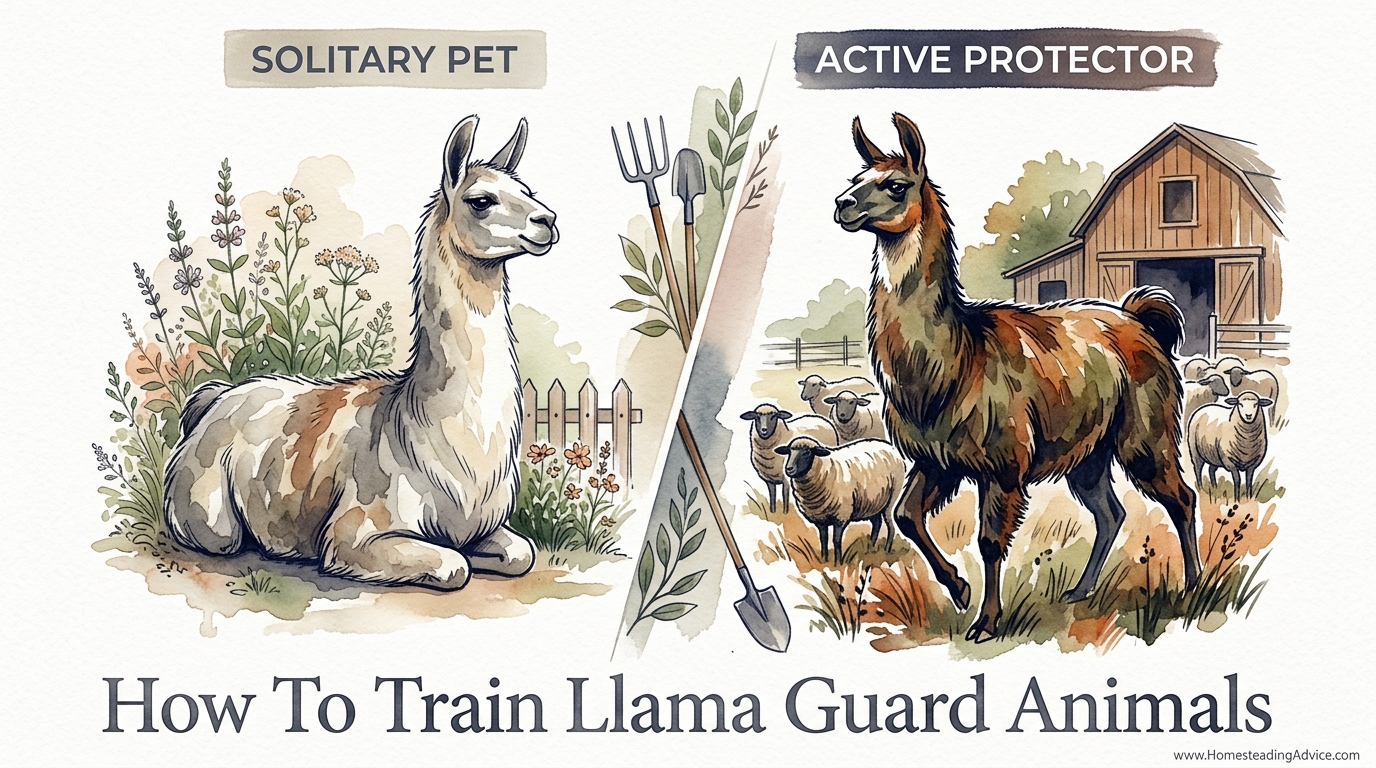
A llama isn’t just a pet; it’s a 24/7 security system that pays for its own food when you stop treating it like a lawn ornament. Why keep a llama in isolation when it was born to lead? Integrating a single llama into your small-stock flock, you eliminate predator losses and give the animal a job that satisfies its natural instincts.
Llamas possess an evolutionary blueprint for protection. High in the Andes, their ancestors developed a keen eye for threats and a fearless response to canines. Bringing that ancestral wisdom to a modern homestead transforms a passive grazer into a sentinel.
This transition requires more than just opening a gate. It demands an understanding of camelid psychology and a commitment to their specific health needs. Once established, a working llama provides a level of quiet, efficient security that few other animals can match.
How To Train Llama Guard Animals
Training a guard llama is less about teaching new tricks and more about harnessing existing instincts. These animals are naturally territorial and possess an innate dislike for dogs, coyotes, and foxes. The goal of “training” is to foster a bond between the llama and the livestock so that the llama views the flock as its own family to defend.
In real-world applications, guard llamas are used primarily with sheep and goats, though they have been successful with cattle, alpacas, and even poultry. Unlike a livestock guardian dog that requires years of expensive training and high-protein feed, a llama often steps into its role within days.
The process begins with the right candidate. A llama that has been properly socialized with its own kind but not over-handled by humans is the ideal worker. They use their height (standing 40 to 44 inches or 101 to 112 cm at the withers) to scan the horizon for anything out of place.
How It Works: The Mechanics of Camelid Defense
A guard llama does not typically go looking for a fight, but it will certainly finish one. Their defense strategy is multi-layered and starts long before a predator makes physical contact. Understanding these stages helps a producer monitor the effectiveness of their animal.
The Alarm Call
Llamas have a distinct vocalization often described as a “rusty hinge” or a high-pitched, pulsating whistle. This “911 call” serves two purposes: it alerts the livestock to flee toward the guardian and warns the predator that its presence is known. Most predators rely on the element of surprise; once that is gone, they often retreat.
The Posture and Charge
If the alarm call does not work, the llama will lower its head and charge. A 300 to 400 pound (136 to 181 kg) animal moving at high speed is a formidable sight. They often use their chest to ram an intruder or their front legs to strike downward.
Herding to Safety
Remarkable observations show that experienced guard llamas will actively gather sheep or goats. They pace between the flock and the threat, effectively acting as a living shield. Some have even been seen nudging newborn lambs away from fence lines during a predator approach.
Selecting the Ideal Guardian
Success starts at the auction or the breeder’s farm. Not every llama has the temperament for the job, and picking the wrong one can lead to more problems than it solves.
Sex and Neutering
Gelded (castrated) males are the industry standard. They are generally larger, more aggressive toward predators, and less expensive than females. Intact males should be avoided as they may attempt to breed the ewes or does, which can lead to serious injury or death for the smaller livestock. Unbred females can also be excellent guardians but usually command a higher price.
Age Matters
Do not buy a “cria” (baby llama) and expect it to work. A llama should be at least 18 to 24 months old before it is put on duty. They need time to reach their full physical size and to develop the territorial maturity required to stand their ground. A young llama placed with sheep is simply another item on the predator’s menu.
Temperament and Background
Look for an animal that is alert but not skittish. It should be respectful of human boundaries. Avoid “bottle-fed” llamas at all costs. These animals often suffer from Berserk Llama Syndrome, where they lose their fear of humans and treat people as rival llamas, leading to dangerous lunging and biting behavior.
The Bonding Process
Integrating the llama into the flock is the most critical stage of its “training.” This process must be handled with patience to ensure the llama identifies with the livestock rather than seeing them as a nuisance.
- Start with a Buffer: Place the new llama in a pen adjacent to the sheep or goats for 2 to 7 days. This allows them to smell and see each other without the risk of a panicked stampede.
- Remove Other Llamas: This is a hard rule for many. If you have two llamas, they will bond with each other and ignore the sheep. To make a llama a guardian, it must be the only camelid in the pasture.
- Monitor the First Interaction: When you finally merge them, do it in a large pasture during daylight hours. Some initial chasing is normal as they establish a hierarchy.
- Check for “Nannying”: Most llamas will eventually settle into a “big brother” role. Within a week, 80% of guard llamas will have formed a permanent bond with their charges.
Benefits of Choosing a Llama
Llamas offer several practical advantages over other types of guardians, such as dogs or donkeys. For a small-scale producer, these benefits often translate directly to lower overhead and less daily stress.
Low Maintenance Costs
Llamas eat exactly what the sheep and goats eat. They do not require a separate, expensive high-protein dog food or specialized feeders. They are efficient “thrifty” grazers that can survive on pasture and hay that might be too coarse for other animals.
Quiet Security
Livestock guardian dogs (LGDs) are famous for barking at everything—leaves, the wind, the neighbor’s car—especially at 3:00 AM. In contrast, llamas are silent guardians. They only sound their alarm when a genuine threat is present. This makes them much more compatible with farms near residential areas.
Longevity
A healthy llama can work for 15 to 20 years. This long service life means your initial investment of $300 to $800 is spread over nearly two decades, making them one of the most cost-effective security measures available.
Challenges and Common Mistakes
Even the best-laid plans can go sideways if you ignore the nuances of camelid behavior. Most “failures” in guard llamas are actually failures in management.
Over-Socializing with Humans
A guard llama is a co-worker, not a pet. If you spend too much time petting it and feeding it treats, it may stop staying with the flock and start hanging out by the gate waiting for you. Keep your interactions professional: haltering for medical care and shearing should be the extent of your relationship.
Ignoring Shearing Needs
Llamas produce a heavy fleece that must be removed annually, typically in the spring before temperatures rise above 80°F (27°C). A heat-stressed llama cannot guard. They will spend their time lying in the shade or at the water trough instead of patrolling the fence line.
Parasite Management
Llamas are susceptible to the Meningeal Worm (Parelaphostrongylus tenuis), which is carried by white-tailed deer and snails. This parasite can cause paralysis and death. Producers in deer-heavy areas must implement a strict deworming schedule, often involving monthly injections of Ivermectin or Doramectin during the wet season.
Limitations: When a Llama Is Not Enough
It is vital to recognize that a llama is not a “silver bullet” for all predator problems. They have physical and behavioral boundaries that must be respected for the safety of the animal.
The “Pack” Problem
Llamas are highly effective against single intruders like a lone coyote or a neighbor’s wandering dog. However, they are easily overwhelmed by a pack. If your area is home to large packs of wolves or coyotes, a single llama will likely be killed.
Apex Predators
Bears and mountain lions are generally too large for a llama to handle. While a llama might alert you to their presence, it cannot physically drive off a 400-pound (181 kg) black bear. In these high-risk environments, you may need to combine llamas with electric fencing or consider multiple livestock guardian dogs instead.
Fencing Requirements
Llamas are athletic and can clear a 4-foot (122 cm) fence if they are motivated. While they usually respect boundaries, your perimeter fence should be at least 5 feet (152 cm) high to keep the guardian in and predators out.
Comparison: Guardian Options at a Glance
Choosing between a llama, a dog, or a donkey depends on your specific acreage and predator load.
| Feature | Guard Llama | Livestock Guard Dog | Guard Donkey |
|---|---|---|---|
| Main Diet | Pasture/Hay | High-protein Kibble | Pasture/Hay |
| Noise Level | Very Low | Very High | Moderate (Braying) |
| Lifespan | 15–20 Years | 8–12 Years | 25–30 Years |
| Predator Capability | Coyotes, Foxes, Dogs | Wolves, Bears, Lions | Dogs, Coyotes |
| Initial Training | Minimal | Extensive (2 years) | Moderate |
Practical Tips for Success
To get the most out of your guard llama, implement these best practices from day one. These adjustments ensure the animal stays healthy and focused on its job.
- Mineral Access: Llamas need specific minerals, particularly Zinc and Selenium. Do not rely on sheep salt blocks, as they often lack the copper that llamas can tolerate (unlike sheep). Provide a loose mineral mix specifically formulated for camelids.
- Toenail Trimming: Unlike sheep with hooves, llamas have two-toed feet with soft pads and a hard nail. Depending on your soil, these nails may need trimming every 6 to 12 months using specialized shears.
- Water Placement: Position your water troughs in the center of the pasture. This forces the llama and the flock to congregate in a safe zone and ensures the llama doesn’t get cornered at the edge of the property while drinking.
- Avoid “Llama Pairs”: It bears repeating. If you feel bad for a “lonely” llama and buy it a friend, you have effectively fired your security guard. They will stand in the corner together and let the coyotes take your lambs.
Advanced Considerations for Serious Producers
For those looking to scale their operations, consider the environmental impact of adding a llama. Their feet are much gentler on the soil than the hard hooves of cattle or donkeys, making them excellent for sensitive or sloping pastures.
Llamas also utilize “communal dung piles.” Instead of spreading manure everywhere, they choose specific spots in the pasture to defecate. This behavior helps in parasite management, as it concentrates the waste in areas that the livestock can then be discouraged from grazing.
Integrating a llama also changes how you work your flock. Many producers find that their sheep become “bolder” and easier to move when the llama is leading the way. However, you must be careful when using herding dogs. A good guard llama will see your Border Collie as a predator and may attack it. You must train the llama to “stand down” or remove it during active herding work.
Scenario: The Night the Sentinel Proved Its Worth
Consider a typical Midwestern farm with 20 ewes and their spring lambs. A lone coyote approach at 2:00 AM usually results in a panicked, scattered flock and at least one dead lamb by dawn.
With a llama on duty, the scenario changes. The llama, sleeping with one eye open, hears the rustle of the tall grass. It stands, lets out a sharp, rhythmic alarm whistle, and the ewes instinctively move behind its large frame. The coyote, facing a 350-pound (158 kg) screaming giant that is charging toward it, decides the risk isn’t worth the reward. The predator leaves, the llama returns to its dung pile, and the shepherd wakes up to a full count of lambs. This isn’t theory; it is the reality for 95% of producers who employ these animals.
Final Thoughts
The transition from viewing a llama as a backyard novelty to a critical farm asset is a hallmark of a resilient homestead. By utilizing their natural instincts, you solve a predator problem while providing the animal with a purposeful life.
Success with a guard llama requires a balance of hands-off management and vigilant health care. Respect their bonding needs, keep them shorn and dewormed, and they will repay you with nearly two decades of silent, effective service.
Experimenting with a guard llama might be the most rewarding decision you make for your livestock. It’s an investment in ancestral wisdom that secures your farm’s future, one quiet night at a time. Apply these principles, and you’ll find that the best security system doesn’t need batteries—it just needs a good patch of grass.