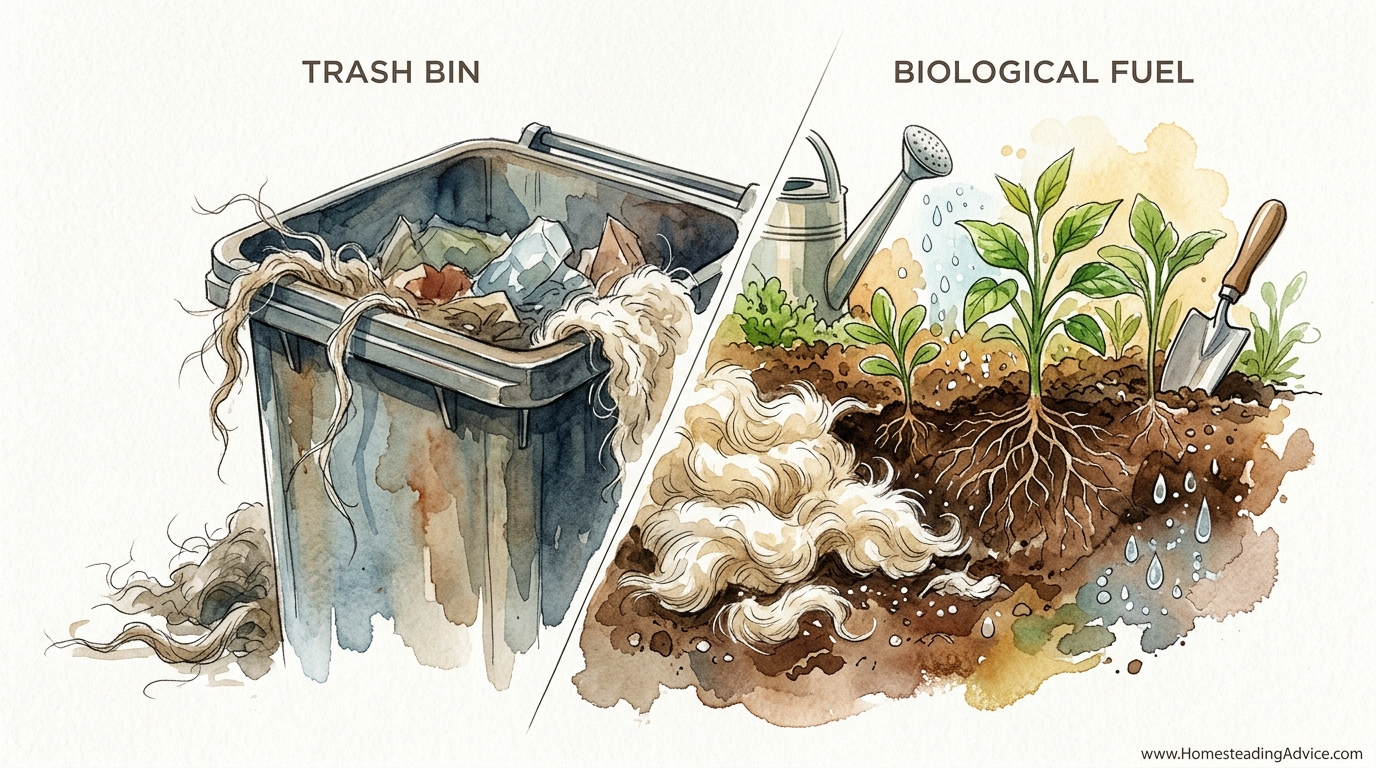
That dirty belly wool isn’t trash; it’s a slow-release nitrogen battery for your most demanding plants. The dusty, hay-filled ‘seconds’ and ‘thirds’ of your shearing day shouldn’t go to the landfill. This fiber is packed with nitrogen and carbon. When used as a garden mulch, it suppresses weeds, retains moisture, and slowly feeds your soil as it breaks down over two seasons.
Most folks see the pile of debris at the end of a shearing day and see a chore. They see the matted, dung-stained locks and the hay-choked neck wool as a waste product that needs hauling away. Our ancestors didn’t have the luxury of viewing biological resources as trash. They understood that every scrap of organic matter was a gift from the land, meant to be returned to the earth to complete the cycle of life.
Llama wool is unique in the world of natural fibers. While it shares many traits with sheep wool, it lacks the heavy lanolin grease, making it easier to handle and faster to integrate into the soil biology. This material is a concentrated form of keratin—a protein that holds a high percentage of nitrogen. When you place it in your garden, you aren’t just mulching; you are installing a long-term fertility system that works while you sleep.
Using this waste fiber is a step toward true self-reliance. It reduces your dependence on store-bought fertilizers and plastic weed barriers. It turns a “problem” into a solution, bridging the gap between animal husbandry and regenerative horticulture. Whether you have a single llama or a whole herd, that waste wool is the most valuable “trash” you will ever produce.
How To Use Waste Llama Wool In The Garden
Waste llama wool refers to any fiber that is unsuitable for spinning, felting, or commercial textile use. This includes “belly wool,” which is often short and dirty; “tags,” which are heavily soiled with manure or urine; and the “seconds” or “thirds” that contain high amounts of vegetable matter like hay, burrs, and straw. While these characteristics make the fiber a nightmare for a weaver, they make it a goldmine for a gardener.
In a real-world setting, this wool acts as a biological blanket. It is used primarily as a heavy-duty mulch, a soil amendment, or a container liner. Imagine a material that can hold 20 to 30 times its weight in water while slowly leaking out nitrogen over a period of 12 to 24 months. That is the power of wool. It exists as a byproduct of necessary animal care, yet it functions as a high-performance agricultural tool.
Think of llama wool like a sponge made of protein. In nature, a llama’s coat protects it from the harsh, high-altitude sun and the freezing Andean winds. In your garden, those same protective qualities shield the soil from erosion and temperature extremes. It is a bridge between the animal kingdom and the plant kingdom, using the structure of the fiber to build the structure of the soil.
The Science of Decomposition and Nitrogen Release
To understand how wool feeds your plants, you have to look at its chemical makeup. Wool is almost entirely protein, specifically keratin. This protein is built from amino acids that are incredibly rich in nitrogen. While a bag of synthetic fertilizer might dump all its nitrogen at once—potentially burning roots or leaching into groundwater—wool is a slow-burn fuel.
Soil microbes, particularly fungi and actinomycetes, are the primary workers that break down keratin. These organisms produce specialized enzymes that “unlock” the nitrogen bonds within the fiber. This process is highly dependent on temperature and moisture. In the warm, damp environment of a spring garden, the microbes work faster, releasing nutrients exactly when your plants are in their peak growth phase. In the cold of winter, the process slows down, preserving the nutrients for the following season.
Research has shown that raw wool can contain anywhere from 9% to 14% nitrogen by weight. For a waste product, this is an extraordinary concentration. In addition to nitrogen, llama wool contains sulfur, potassium, and trace amounts of phosphorus and magnesium. As the fibers break down, they also contribute organic carbon, which improves the “tilth” or texture of the soil, making it more crumbly and hospitable to earthworms.
The physical structure of the fiber plays a role as well. Llama wool is hollow (medullated), which gives it incredible insulating properties. When applied as a thick mulch, it creates an air gap that prevents the sun from baking the soil. This keeps the ground several degrees cooler in the summer and warmer in the fall, extending your growing season and protecting the delicate “rhizosphere”—the area around the roots where all the magic happens.
Practical Benefits for Every Gardener
The first thing you will notice when using llama wool is the drastic reduction in watering needs. Because the fibers are so absorbent, they soak up rainfall and irrigation like a reservoir. In dry climates, this can mean the difference between a thriving harvest and a withered crop. A 5-centimeter (2-inch) layer of wool can reduce evaporation from the soil surface by up to 70%, keeping moisture where it belongs: at the roots.
Weed suppression is another major advantage. Unlike straw or hay, which can often contain seeds that sprout into a new problem, wool is a solid mat. When tucked tightly around the base of tomatoes, peppers, or fruit trees, it blocks sunlight from reaching weed seeds in the soil. Any weeds that do manage to blow in from the top find it difficult to establish roots in the dry, fibrous surface of the wool.
Slugs and snails are a constant battle for many gardeners, but they find llama wool particularly unpleasant. The microscopic barbs and dry, scratchy texture of the fiber act as a physical deterrent. Most soft-bodied pests will turn back rather than cross a barrier of raw wool. It is a natural, non-toxic way to protect your tender lettuce and hostas without resorting to chemicals.
Finally, there is the benefit of soil aeration. As the wool slowly decomposes over two seasons, it creates tiny channels and pockets in the earth. This increases the oxygen levels in the soil, which is vital for root respiration. Heavy clay soils, which often become compacted and “smothered,” benefit immensely from the structural opening that decaying wool provides.
How to Apply Wool in Various Scenarios
Using raw wool isn’t complicated, but a few techniques can help you get the best results. For vegetable beds, the “tuck and cover” method is most effective. After planting your starts, take handfuls of the waste wool and tuck them tightly around the base of the plant. Ensure the wool is at least 5 to 8 centimeters (2 to 3 inches) thick. If you have very long locks, you can “felt” them slightly by walking on the mulch after it is laid down, which helps the fibers knit together and stay in place against the wind.
In container gardening, wool is a secret weapon. Instead of using expensive and environmentally damaging peat moss, use a layer of waste wool at the bottom of your pots. This acts as both a drainage filter and a moisture reservoir. You can also mix chopped wool directly into your potting soil at a ratio of about 10% wool to 90% soil. This provides a long-term food source for the plant and prevents the soil from compacting over time.
For fruit trees and perennials, a “wool donut” is the preferred method. Clear a circle around the base of the tree, extending to the drip line. Lay down a thick layer of waste wool, but keep it a few inches away from the actual trunk to prevent moisture from sitting against the bark. Cover the wool with a light layer of wood chips or bark if you prefer a more traditional aesthetic. The wool will feed the tree’s feeder roots for years as it disappears into the ground.
If you have an abundance of wool, consider “wool tea.” This is essentially a fermented liquid fertilizer. Fill a burlap sack with waste wool and submerge it in a 200-liter (55-gallon) drum of water. Let it sit for 2 to 4 weeks, stirring occasionally. The resulting liquid will be rich in soluble nitrogen and potassium. Use this to water your heavy feeders like corn or giant pumpkins for a significant boost in growth.
Comparison of Common Mulch Materials
| Feature | Llama Wool | Wheat Straw | Wood Chips |
|---|---|---|---|
| Nitrogen Content | High (9-14%) | Very Low (<1%) | Low |
| Water Retention | Excellent (20x weight) | Moderate | Low to Moderate |
| Decomposition Speed | Slow (1-2 years) | Fast (3-6 months) | Very Slow (2-4 years) |
| Pest Deterrence | High (Slugs/Snails) | Low (Can harbor mice) | None |
| Cost (for owners) | Free (Waste) | $5-$12 per bale | Variable |
Challenges and Common Mistakes
One of the most frequent errors is using wool that is “too clean.” If you have beautiful, skirted fleece, save it for spinning. The garden actually thrives on the “dirty” bits. Manure and urine-soaked tags provide an immediate hit of nitrogen that jumpstarts the microbial activity. However, be careful with extremely fresh manure in very high concentrations near sensitive seedlings, as the ammonia could cause temporary stress.
Another mistake is applying the wool too thinly. A sparse layer of wool won’t suppress weeds effectively and will dry out too quickly, slowing down the decomposition process. You want a substantial “mat.” If the wind is an issue in your area, don’t just lay the wool on top; pin it down with landscape staples or weigh it down with a few stones or a light scattering of compost. Once the wool gets wet a few times, it tends to settle and “lock” into the soil surface.
Be aware of the “bird factor.” In the spring, local birds will realize that your garden mulch is the ultimate nesting material. They will happily fly off with large tufts of your llama wool. While this is great for the birds, it can leave your plants exposed. If you see birds raiding your beds, you can lightly cover the wool with a thin layer of straw or a piece of netting until the nesting season passes.
The smell can be an issue for some, especially if the wool is heavily soiled with “llama beans.” While the scent usually dissipates within a few days of being outdoors, it might not be ideal for a small patio garden right next to your back door. For those situations, using wool that has been lightly rinsed or wool that is buried 5 centimeters (2 inches) under a layer of soil or compost is a better approach.
Limitations and Realistic Expectations
Wool is not a “fast-acting” fertilizer. If your plants are showing signs of severe nitrogen deficiency today, wool won’t fix it tomorrow. It is a long-term investment. You should view wool as a way to build soil health over years, not as a quick fix for a failing crop. In the first few months, the wool is primarily providing physical benefits like moisture retention and weed control; the nutritional benefits truly kick in during the second half of the season and into the next year.
In extremely arid, desert environments, wool can struggle to break down. Without some moisture, the microbes that eat the keratin can’t survive. If you live in a place where it never rains, you will need to ensure your irrigation system occasionally wets the wool mulch to keep the biological fire burning. Conversely, in extremely boggy or waterlogged soils, a thick layer of wool might hold too much water, potentially leading to root rot in plants that prefer “dry feet,” such as lavender or Mediterranean herbs.
There is also the matter of availability. If you don’t own llamas or have a neighbor who does, sourcing waste wool can be a challenge. While some commercial companies are beginning to sell wool pellets, the raw waste fiber is usually only available locally. This makes it a site-specific resource rather than a universal solution that every gardener can easily access at a big-box store.
Advanced Considerations: Wool Pellets and Fermentation
For those who want to take their wool usage to the next level, processing the waste into pellets is an option. Wool pellets are made by putting raw wool through a pellet mill, which uses heat and pressure to compress the fibers into small, dense cylinders. These pellets are much easier to distribute with a seed spreader and can be mixed into potting soil more evenly. They also expand when wet, which helps to aerate the soil from the inside out.
Scaling this up requires a bit of machinery, but for a community of llama owners, a shared pellet mill can turn a mountain of waste into a marketable product. Pelleted wool has a much higher surface area for microbes to attack, which can speed up the nitrogen release compared to large, matted clumps of raw fleece. This is an excellent way to use up the “junk” wool that is too full of vegetable matter even for gardening mulch.
Another advanced technique is the use of “bio-char and wool” blends. Bio-char is essentially a biological house for microbes, but it starts out “empty” of nutrients. By mixing raw wool or wool tea with bio-char, you can “charge” the char with nitrogen. This creates a permanent soil amendment that provides both the housing (char) and the food (wool) for a thriving soil ecosystem. It is one of the most effective ways to permanently improve poor, sandy soils.
Example Scenario: The Tomato Patch
Let’s look at how this works in a standard 3-meter by 3-meter (10-foot by 10-foot) tomato patch. Traditionally, you might buy several bags of wood mulch and a bottle of liquid fertilizer. Instead, you use the waste from two llamas’ annual shearing.
In the spring, you plant 12 tomato starts. You take the belly wool and tags—roughly 5 kilograms (11 pounds) of fiber—and create a 10-centimeter (4-inch) thick mat around every plant. Throughout the summer, you notice that while your neighbors are watering every day, you only need to water every three days. The wool holds the moisture from your morning soakings and keeps the soil cool during the 35°C (95°F) heatwaves.
By mid-summer, the bottom layer of the wool has turned a dark, rich brown where it touches the soil. Your tomatoes are deep green and vigorous, showing no signs of the yellowing that often indicates nitrogen depletion. When the season ends, you don’t haul the mulch away. You leave it. By the following spring, the wool has almost completely disappeared, replaced by a layer of rich, worm-filled humus. You have successfully turned an animal byproduct into a high-yield harvest with zero additional cost.
Final Thoughts
Returning llama wool to the garden is an act of stewardship. It honors the animal by ensuring that every part of its yearly growth serves a purpose. This isn’t just about saving money on fertilizer; it’s about shifting our perspective from a “take and discard” culture to a “circular” one. When you see your garden thriving under a blanket of wool, you are seeing a ancient system of fertility at work.
Don’t be afraid to experiment with different types of waste fiber. Every llama has a different coat, and every garden has different needs. You might find that your orchard loves the heavy, matted neck wool, while your flower pots do better with the finer “seconds.” The key is to start small, observe how your soil responds, and adjust your methods as you go.
Self-reliance is built on the ability to recognize value where others see waste. That pile of dirty wool is a testament to the productivity of your land and your animals. By tucking it into your soil, you are closing the loop and building a more resilient, fertile future for your garden. Get out there, gather up those shearing scraps, and let the sheep and llamas feed the earth that feeds you.