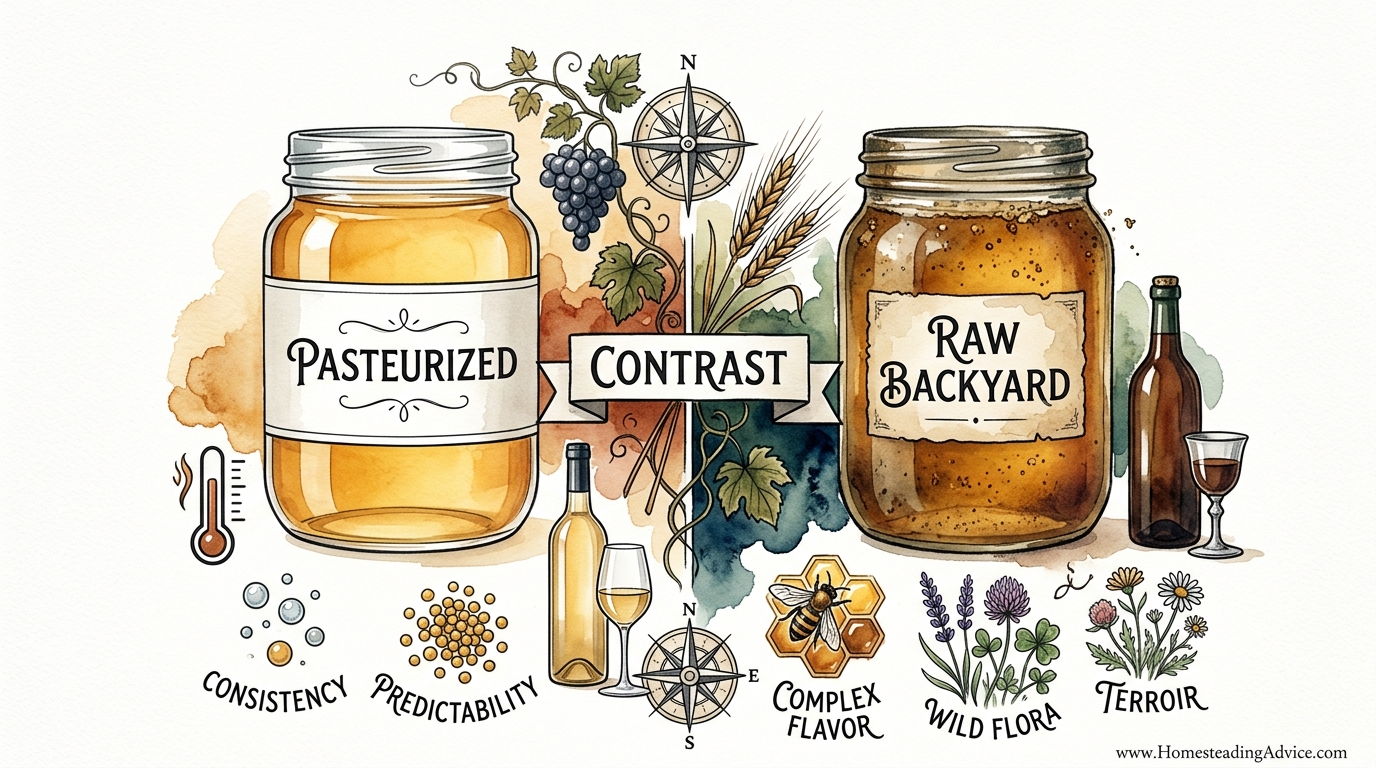
One is a sugary ghost; the other is a biological battery waiting to explode into complex flavors. Most grocery store honey has been heated until it’s biologically dead, stripping away the floral enzymes that create a ‘Grand Cru’ mead. If you want a nectar of the gods, you need to start with honey that still has the life of the hive inside it.
Making mead is a lesson in patience and a testament to the relationship between man and the natural world. For thousands of years, humans have gathered the excess of the hive to create a fermented drink that bridges the gap between a simple agricultural product and a spiritual experience. When you stand over a bubbling carboy, you aren’t just making alcohol; you are preserving a specific moment in time—the exact flowers that bloomed in a specific field during a specific summer.
Choosing the right honey is the most consequential decision you will make in the brewing process. It is the foundation upon which everything else is built. If the foundation is weak or artificial, no amount of expensive yeast or fancy nutrients can save the final result. Understanding the nuances of different nectar sources and the processing methods used to get that honey into your kitchen is the first step toward self-reliance in the cellar.
This guide will walk you through the landscape of honey varieties, the science of how they ferment, and the practical wisdom needed to source the best possible ingredients for your next batch of mead. Whether you are looking for a light, crisp hydromel or a thick, barrel-aged traditional, the answer always begins with the bees.
Best Honey For Mead Making
The term “best” is subjective, but in the world of mead making, it generally refers to honey that retains its floral character and provides a healthy environment for yeast. Honey is essentially concentrated nectar that has been enzymatically altered by bees and dehydrated through the fanning of their wings. This process creates a stable, high-sugar substance that can last for centuries if kept sealed.
For a mead maker, the best honey is one that is raw and minimally processed. Raw honey has never been heated above the natural temperature of the hive—roughly 95°F (35°C). Keeping the temperature low ensures that the volatile aromatic compounds, which give honey its unique scent and flavor, are not boiled away. When you use pasteurized honey, you are often left with a one-dimensional sweetness that lacks the “nose” required for a high-quality traditional mead.
Real-world mead making often categorizes honey into three tiers: base honeys, varietal honeys, and specialty honeys. Base honeys like Clover or Alfalfa are affordable and provide a clean canvas. Varietal honeys like Orange Blossom or Tupelo provide specific, high-end flavors. Specialty honeys like Buckwheat or Meadowfoam are used as bold accents or for very specific, robust mead styles.
Varietal Honey: The Flavor Profiles
Every flower produces a different type of nectar, and those differences are concentrated in the final honey. Here are the most common varietals used by serious mead makers:
- Clover Honey: The gold standard for beginners. It is mild, light in color, and has a classic “honey” taste with a faint floral finish. It is excellent for fruit-forward meads (melomels) where you don’t want the honey to compete with the berries.
- Orange Blossom Honey: Prized for its distinct citrus aroma. It produces a mead that smells like a blooming grove. It is often the preferred choice for traditional meads because of its balanced sweetness and aromatic complexity.
- Buckwheat Honey: This is a polarizing choice. It is very dark, high in minerals, and has a robust, malty flavor that some describe as “barnyard” or similar to blackstrap molasses. It is best used in small quantities or for very bold, aged meads.
- Wildflower Honey: A “catch-all” term for honey produced from multiple floral sources. The flavor can vary wildly depending on the season and geography. Spring wildflower honey is usually light and floral, while fall wildflower honey is often darker and more herbal.
- Tupelo Honey: Known as “Southern Gold,” this rare honey from the swamps of the Southern United States is famous for its high fructose content, which means it rarely crystallizes. It has a mild, buttery, and pear-like flavor that makes a legendary traditional mead.
- Meadowfoam Honey: Often described as tasting like toasted marshmallows or vanilla. It is a premium honey that creates a dessert-like mead with very little additional flavoring needed.
How Honey Fermentation Works
To make mead, you must understand the chemistry of your primary ingredient. Honey is roughly 80% sugar (mostly fructose and glucose) and 17-18% water, with the remaining 2-3% consisting of minerals, proteins, and enzymes. Because honey is so concentrated, it is naturally antimicrobial; bacteria cannot survive in such a low-moisture, high-sugar environment.
When you dilute honey with water to create a “must,” you lower the sugar concentration to a level where yeast can thrive. However, honey is notoriously nitrogen-deficient. Unlike grape juice, which has the nutrients yeast need to build cell walls, honey is a biological desert for yeast. This is why mead makers often talk about “staggered nutrient additions” (SNA). Without supplemental nitrogen, the yeast will become stressed and produce sulfur compounds or “fusel alcohols”—that harsh, jet-fuel taste often found in poorly made mead.
The pH of honey is also a factor. Most honey sits at a pH of around 3.9. During fermentation, the yeast produce organic acids that can drop the pH even further. If the pH falls below 3.0, the yeast may “stall” or stop fermenting altogether. Serious practitioners keep a close eye on these levels to ensure a clean, complete fermentation.
The Role of Enzymes in Raw Honey
Raw honey contains enzymes like glucose oxidase, which produces small amounts of hydrogen peroxide to protect the honey from spoilage, and diastase, which breaks down starches. In the fermenter, these biological components don’t just provide flavor; they assist in the breakdown of complex sugars and provide a more hospitable environment for the yeast than the “sterile” environment of pasteurized syrups.
Benefits of Choosing Quality Honey
The primary benefit of choosing high-quality, raw honey is the preservation of aromatics. In a beverage where honey is the primary ingredient, the “nose” of the mead accounts for a huge portion of the drinking experience. If you use a biological battery that has been “charged” with the essence of a thousand blossoms, that complexity will carry through into the finished bottle.
Another advantage is fermentation health. Raw honey often contains trace amounts of pollen and propolis. While these can sometimes cause clarity issues (cloudiness), they also provide microscopic amounts of nutrients and minerals that contribute to a more robust fermentation. Traditionalists argue that the “impurities” in backyard honey are exactly what give the mead its soul.
Finally, there is the benefit of transparency and ethics. When you source honey from a local beekeeper, you know exactly where it came from. You are supporting local agriculture and ensuring that the bees were treated well. This ancestral connection to the source is a key part of the mead-making philosophy.
Challenges and Common Mistakes
One of the most frequent errors beginners make is over-heating the honey. Old recipes often call for boiling the honey and water together to “sanitize” the must. Do not do this. Boiling honey destroys every delicate floral note and kills the beneficial enzymes. Modern mead making relies on high-quality yeast and proper sanitation of equipment rather than boiling the ingredients. If you must warm your honey to make it easier to pour, keep it below 110°F (43°C).
Another common pitfall is ignoring the moisture content. Honey should have a moisture content below 18.6% to prevent natural fermentation in the jar. If you buy “green honey” (honey harvested before the bees have fully cured it), it may spoil or begin to ferment with wild yeast before you are ready to use it. Always ensure your source is reliable and understands the curing process.
Lastly, many new brewers fail to adjust for honey density. One gallon of honey weighs approximately 12 pounds (5.4 kg). If you are following a recipe that calls for pounds but you measure in gallons, your original gravity (OG) will be wildly off, leading to a mead that is either too weak or so strong that the yeast cannot finish the job.
Limitations and Constraints
While raw, local honey is superior in flavor, it does come with practical limitations. Consistency is the biggest challenge. A wildflower honey harvested in June will taste different from one harvested in August, even from the same hive. This makes it difficult for commercial producers to replicate the exact same mead year after year. For the homebrewer, however, this is often seen as a feature of the “vintage.”
Cost is the other major hurdle. Quality varietal honey can cost three to four times as much as bulk “baker’s honey.” If you are making a 5-gallon (19L) batch of mead, you will need roughly 15 pounds (6.8 kg) of honey. At local prices, this can represent a significant investment. This is why many brewers use a “base” honey for the primary fermentation and save their expensive, high-quality honey for “backsweetening” at the end of the process to preserve the most flavor.
Comparing Honey Sources
When deciding where to buy your honey, consider the trade-offs between price, flavor, and convenience.
| Source Type | Average Cost | Flavor Intensity | Purity/Trust | Best Use Case |
|---|---|---|---|---|
| Grocery Store (Bulk) | Low | Low | Variable (Risk of Fraud) | Fruit meads / Cooking |
| Online Bulk (e.g., Dutch Gold) | Medium | Medium-High | High | Large 5-gallon batches |
| Local Beekeeper (Raw) | High | High | Highest | Traditional Meads |
| Specialty Varietal (e.g., Tupelo) | Very High | Very High | High | Show Meads / Competitions |
Practical Tips for the Cellar
Working with honey requires a few specific techniques to ensure you aren’t wasting your “liquid gold.”
- The Warm Water Bath: If your honey has crystallized (turned into a solid), do not microwave it. Place the jar in a pot of warm water (not boiling) and let it sit. The crystals will eventually dissolve back into liquid form without damaging the aromatics.
- Rinsing the Jars: After pouring your honey into the fermenter, there will always be some left sticking to the sides. Use a portion of your brewing water to rinse the jars and pour that “honey water” into the must. Every drop counts.
- Aeration: Honey needs oxygen in the early stages of fermentation. Use a drill-mounted stirring rod or a sanitized whisk to vigorously aerate your must for the first 48 hours. This helps the yeast build healthy cell walls.
- Degassing: Because mead is thick, CO2 can get trapped in the liquid. Gently stirring your mead once or twice a day during the first week releases this gas and prevents the pH from dropping too sharply.
Advanced Considerations
For the serious practitioner, honey selection goes beyond just flavor. You should consider the Pollen Count and its effect on clarity. Highly filtered honey will clear faster but may lack body. Unfiltered honey will have more mouthfeel but might require “fining agents” like bentonite or sparkalloid to achieve that brilliant, glass-like clarity sought in competitions.
Consider also the Fructose-to-Glucose Ratio. Honeys high in glucose (like Alfalfa or Clover) crystallize quickly. Honeys high in fructose (like Tupelo or Sage) stay liquid longer. This ratio also affects how the yeast “finish” the fermentation. Some yeast strains prefer glucose and may struggle to finish a high-fructose must, leading to unexpected residual sweetness.
Finally, think about Terroir. Just as with wine, the soil and climate affect the nectar. A clover honey from the high plains of Montana will have a different mineral profile than a clover honey from the humid Southeast. This mineral content acts as a micro-nutrient for the yeast, potentially affecting the fermentation speed and the production of esters.
Example Scenarios
Scenario 1: The Budget Batch
A brewer wants to make 5 gallons (19L) of a “Berry Melomel.” Because the primary flavor will come from 15 pounds of blackberries, the brewer chooses a bulk Wildflower honey from a reputable online supplier. This saves money while still providing a natural, raw base that won’t be completely overshadowed by the fruit.
Scenario 2: The Competition Traditional
A brewer aims to win a local mead competition with a “Traditional Show Mead” (honey, water, and yeast only). They source 3 pounds (1.4 kg) of Orange Blossom honey from a local apiary known for its high aromatic standards. They use a low-and-slow fermentation temperature to ensure that the citrus notes are preserved, resulting in a complex, floral masterpiece.
Scenario 3: The Medicinal Metheglin
Seeking to recreate an ancestral recipe, a brewer uses Buckwheat honey and a blend of spices (ginger, cloves, and cinnamon). The robust, medicinal qualities of the Buckwheat honey stand up to the strong spices, creating a “winter warmer” mead that is dark, thick, and highly shelf-stable.
Final Thoughts
The journey from a field of blossoms to a finished glass of mead is one of the most rewarding paths a home producer can take. By choosing raw, high-quality honey, you are honoring the labor of the bees and the wisdom of the brewers who came before you. You are moving away from the “sugary ghosts” of industrial production and toward a biological reality that is as complex as it is delicious.
As you experiment, keep detailed notes on your honey sources. You will soon find that your palate develops an appreciation for the subtle differences in nectar sources and regional variations. Mead making is as much an art of sourcing as it is an art of brewing. Once you find a honey that speaks to you, the rest of the process is simply a matter of stewardship.
Do not be afraid to reach out to local beekeepers and ask about their processes. Most are proud of their work and happy to share their knowledge. In the end, the best mead is the one that tells a story—not just of your skill as a brewer, but of the land where the honey was born. Happy brewing.