Are you brewing a science experiment or a living nectar of the gods? Modern mead-making has become a game of chemicals and sterile packets, but the ancients didn’t have a laboratory. They used the ‘bloom’ on the fruit and the magic in the air to create complex, terroir-driven ferments that modern labs simply cannot replicate. Here is how to reclaim the ancient wisdom of the wild ferment.
Making mead without a store-bought packet of yeast might seem like a gamble. However, this is exactly how humanity enjoyed fermented honey for at least 9,000 years before the first laboratory-isolated strain ever touched a carboy. When you step away from the sterile industrial approach, you begin to see honey not just as a sugar source, but as a living medium teeming with dormant life.
Every jar of raw, unpasteurized honey contains a microscopic world of wild yeast. Because honey has extremely low water content and high osmotic pressure, these yeast cells remain in a state of suspended animation. They are waiting for one thing: dilution.
The moment you add spring water to raw honey, you lower that pressure and wake the ‘honey bugs’ from their slumber. This guide will walk you through the discipline of the wild ferment, where patience and observation replace chemical additions and sterile plastic.
How To Make Mead With Wild Yeast
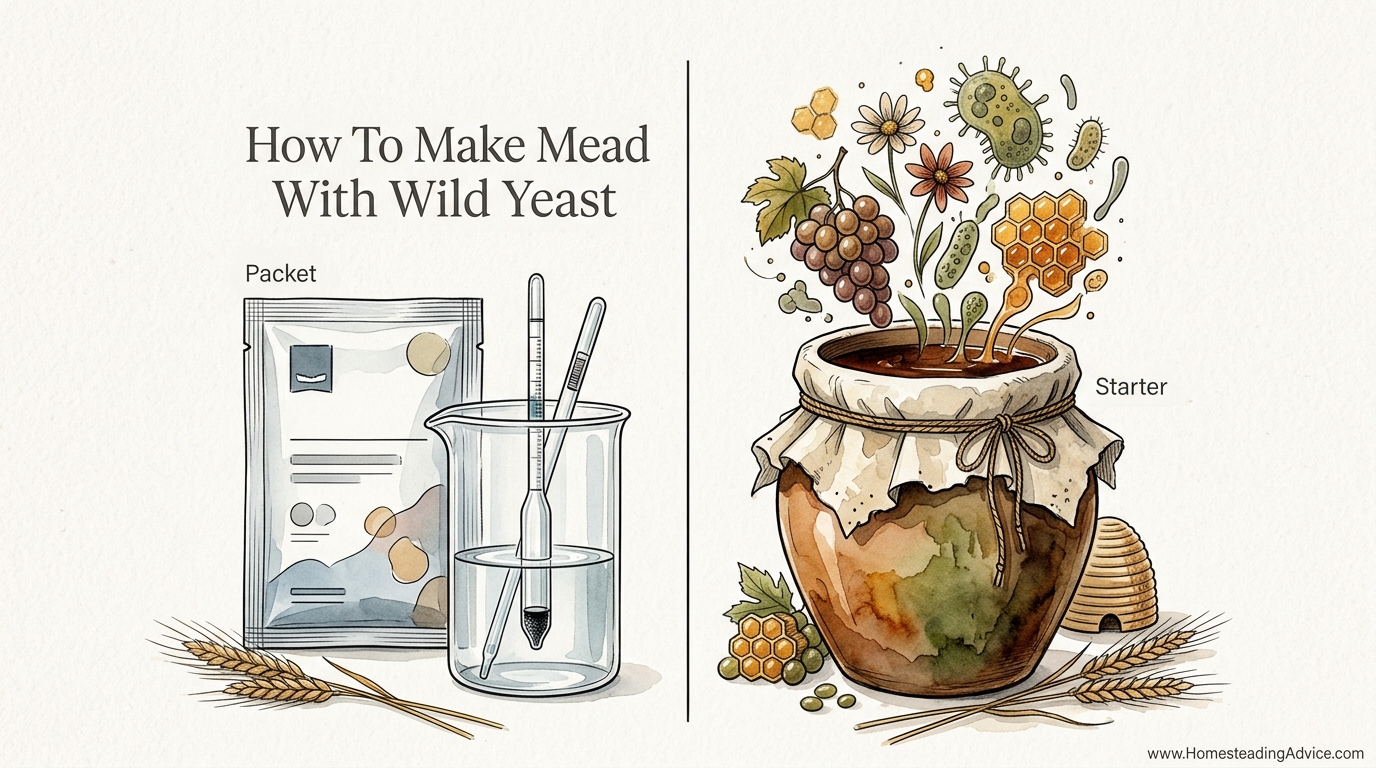
Wild yeast mead, often called spontaneous fermentation mead, is the process of creating an alcoholic beverage by relying solely on the microorganisms naturally present in the ingredients or the environment. Unlike modern brewing which uses a MODERN PACKET of isolated yeast like Saccharomyces cerevisiae, wild fermenting invites a diverse community of yeasts and beneficial bacteria into the vessel.
In the real world, this is the ultimate form of self-reliance. If the supply chains for brewing supplies were to vanish tomorrow, the knowledge of how to capture the ‘bloom’ on a handful of berries or the dormant life in a comb of honey would remain. This approach produces a beverage with terroir—a flavor profile that is unique to your specific location, your local bees, and the season in which you brew.
Wild fermentation is used by traditionalists and homesteaders who value the ancestral wisdom of the ANCIENT STARTER. It is for the practitioner who wants to taste the complexity of their local forest or garden, rather than the predictable, one-dimensional profile of a laboratory-grown strain.
How It Works: Capturing the Magic
The process of wild mead-making begins with the “Starter.” Since you aren’t opening a packet, you must build up a healthy population of yeast before pitching it into your main batch of honey-water (known as the ‘must’). There are three primary ways to do this.
1. The Honey Bug (The Purest Method)
Because raw honey already contains dormant yeast, you can create a starter by mixing 1 part raw honey with 3 parts non-chlorinated water in a small jar. Shake it vigorously several times a day to introduce oxygen. Within 3 to 7 days, you should see small bubbles forming at the surface, signaling that the indigenous yeast is active and ready.
2. The Fruit Bloom
Have you ever noticed the white, powdery dust on the skin of grapes, blueberries, or plums? This is not dirt; it is a concentrated colony of wild yeast. You can drop a handful of unwashed, organic, or foraged berries into a small jar of honey-water to “jumpstart” the fermentation. Elderberries and juniper berries are particularly famous in ancestral lore for their high yeast counts.
3. The Ginger Bug
Similar to the fruit method, you can use the skin of fresh ginger root. Finely grate a tablespoon of ginger (with the skin on) and add it to a jar with a tablespoon of honey and a cup of water. Feed it a little more ginger and honey every day until it begins to hiss and bubble like a carbonated soda. This is a powerful ANCIENT STARTER that can handle even high-sugar meads.
Step-by-Step Wild Mead Process
Once you have a bubbling starter, it is time to scale up to a full batch. Follow these steps to ensure the wild microbes stay in control of the environment.
- Step 1: Clean Your Equipment. While we are not aiming for laboratory sterility, cleanliness is vital. Scrub your vessels with hot water and a natural soap, or use a vinegar-water rinse. Avoid using heavy chemical sanitizers that might kill the very wild yeast you are trying to cultivate.
- Step 2: Prepare the Must. Use a ratio of 1 part raw honey to 4 parts spring water (1:4) for a dry, crisp mead. For a sweeter, heavier mead, use a 1:3 ratio. Ensure the water is free of chlorine, as chlorine will stunt or kill wild microbes.
- Step 3: Mix and Aerate. Stir the honey and water until fully dissolved. For the first 72 hours, you must stir the mixture vigorously or shake the vessel twice a day. Yeast needs oxygen to build strong cell walls during the initial growth phase.
- Step 4: Pitch the Starter. Pour your active honey bug or fruit starter into the main vessel. If you used berries, you can leave them in or strain them out.
- Step 5: The Waiting Game. Place a clean cloth over the opening of the vessel and secure it with a rubber band. This allows the mead to breathe while keeping out vinegar flies. Once the vigorous bubbling slows down (usually after 1-2 weeks), you can move the mead to a secondary vessel with an airlock to protect it from oxidation.
Benefits of the Wild Approach
Choosing the wild path offers more than just bragging rights; it provides a measurably different experience for the palate and the spirit.
Unmatched Complexity: A commercial yeast packet is a monoculture—it is one single strain of yeast. A wild ferment contains multiple strains of yeast (like Lachancea and Hanseniaspora) along with lactic acid bacteria. These work in shifts, creating layers of flavor, acidity, and mouthfeel that a single lab strain cannot produce.
True Terroir: When you brew with wild yeast, you are literally drinking the essence of your environment. The yeast on your foraged elderberries or inside your neighbor’s beehive is different from the yeast in the next county over. This makes every batch a unique, unrepeatable piece of art.
Cost and Independence: There is no need to rely on a specialty shop for nutrients, stabilizers, or packets. By mastering the ANCIENT STARTER, you remove yourself from the consumer cycle and return to a craft that is powered entirely by nature.
Challenges and Common Mistakes
The most common pitfall for the beginner is impatience. Wild yeast often has a “lag phase” that lasts longer than commercial yeast. A commercial packet might show activity in 6 hours, while a wild ferment might take 3 days. Do not panic and dump the batch; give the natural microbes time to establish their colony.
Another error is the use of conventional produce. Store-bought fruit is often treated with fungicides or irradiated to extend shelf life. These processes kill wild yeast. If you cannot forage your own fruit, always opt for organic, unwashed produce to ensure the ‘bloom’ is still intact.
Neglecting temperature is also a common cause of failure. Wild yeast is most active between 18°C and 24°C (65°F to 75°F). If the room is too cold, the fermentation will stall, leaving the sweet liquid vulnerable to spoilage bacteria. If it is too hot, the yeast may produce “fusel alcohols” that taste like rocket fuel.
Limitations of Wild Fermentation
It is important to understand that wild yeast has an alcohol ceiling. Most wild strains are not as hardy as commercial champagne yeasts. While a lab strain can easily reach 18% ABV, a wild ferment will often “poop out” between 8% and 12% ABV. If you are looking to make a high-octane mead that will knock you sideways, the wild approach may not be ideal.
Consistency is the other major trade-off. Because you are working with an unknown population of microbes, Batch A might taste like floral nectar, while Batch B has a slight “funky” or farmhouse character. For the serious practitioner, this variety is a feature, not a bug, but it can be frustrating for those who want every bottle to taste identical.
Comparison: Wild Yeast vs. Commercial Packets
| Feature | Wild Yeast (Ancient) | Commercial Packet (Modern) |
|---|---|---|
| Flavor Profile | Complex, Funky, Terroir-driven | Clean, Predictable, Varietal-specific |
| Alcohol Tolerance | Typically 8% – 12% ABV | Up to 18% – 21% ABV |
| Starting Speed | Slow (2-5 days lag) | Fast (6-24 hours lag) |
| Nutrient Needs | Natural (Fruit, Pollen, Herbs) | Chemical (DAP, Go-Ferm) |
| Cost | Free | $1 – $5 per batch |
Practical Tips and Best Practices
To improve your chances of success, implement the Viking Stir Stick technique. Historically, brewers used a specific wooden branch or “magic stick” to stir their mead. Over time, this stick would become caked with dried yeast from previous successful batches. By using the same wooden spoon or stick for every batch, you effectively “seed” your new mead with the best-performing microbes from your history.
Another tip is to use raw honey with the “cappings” included. If you can source honey that still has bits of wax and pollen in it, use it. The pollen provides the nitrogen that the yeast needs to multiply, acting as a natural alternative to modern chemical nutrients.
- Use spring water or well water rather than distilled water. Distilled water lacks the minerals necessary for yeast health.
- Keep your fermenting vessel in a dark place. UV light can damage delicate wild yeast strains.
- Smell your mead daily. A healthy ferment smells like bread, flowers, or fruit. If it smells like rotten eggs, it needs more oxygen or nutrients (add a few more raisins or a slice of organic apple).
Advanced Considerations: Metheglin and Tannins
For the serious practitioner, wild mead-making is often about more than just honey and water. Metheglin is the term for spiced or herbal mead, and in the ancient world, these herbs were chosen for both flavor and to aid the fermentation process. Herbs like rosemary, thyme, and bay leaves were often added to provide essential minerals and to suppress spoilage bacteria.
Tannins are another critical element often missing in modern mead. In the laboratory, we use chemical additives, but the ancients used oak leaves, black tea, or grape skins. Adding a cup of strong-brewed black tea to a 5-liter (1.3-gallon) batch of mead provides the “structure” and mouthfeel that balances the sweetness of the honey. This also helps the mead clear faster as the tannins bind to proteins and settle to the bottom.
Example Scenario: The Forager’s Batch
Imagine it is late summer. You have foraged 2 cups of wild blackberries covered in a thick white bloom. You have 1.5 kilograms (3.3 lbs) of raw wildflower honey from a local keeper and 4 liters (1 gallon) of spring water.
First, you crush the blackberries in a small jar with a tablespoon of honey and a splash of water. You shake this “fruit starter” for two days until it is fizzing. Then, you mix your honey and water in a large glass crock, pour in the berry mixture, and stir it with your favorite wooden spoon. You cover it with a linen cloth and stir it every morning while the sun rises.
After ten days, the bubbling has calmed. You siphon the liquid into a narrow-necked bottle and fit an airlock. Three months later, you have a deep purple, sparkling mead that tastes of the summer heat and the wild berries—a drink that cost you nothing but a walk in the woods and a bit of patience.
Final Thoughts
Wild mead-making is a return to a rhythm of life that values the invisible forces of nature over the sterile control of the laboratory. It requires you to trust your senses—your nose to detect a healthy ferment, your eyes to see the bloom on the fruit, and your palate to understand the terroir of your region. By reclaiming this ancient wisdom, you transform mead from a mere alcoholic drink into a living connection to the land.
Experimentation is the heart of the wild ferment. Don’t be afraid of a batch that takes an unexpected turn; every “failure” is simply a lesson in microbiology and environmental awareness. Start small, use the best raw honey you can find, and let the magic in the air do the rest. Once you taste the complexity of a truly wild nectar, you may find it hard to ever return to a sterile packet again.