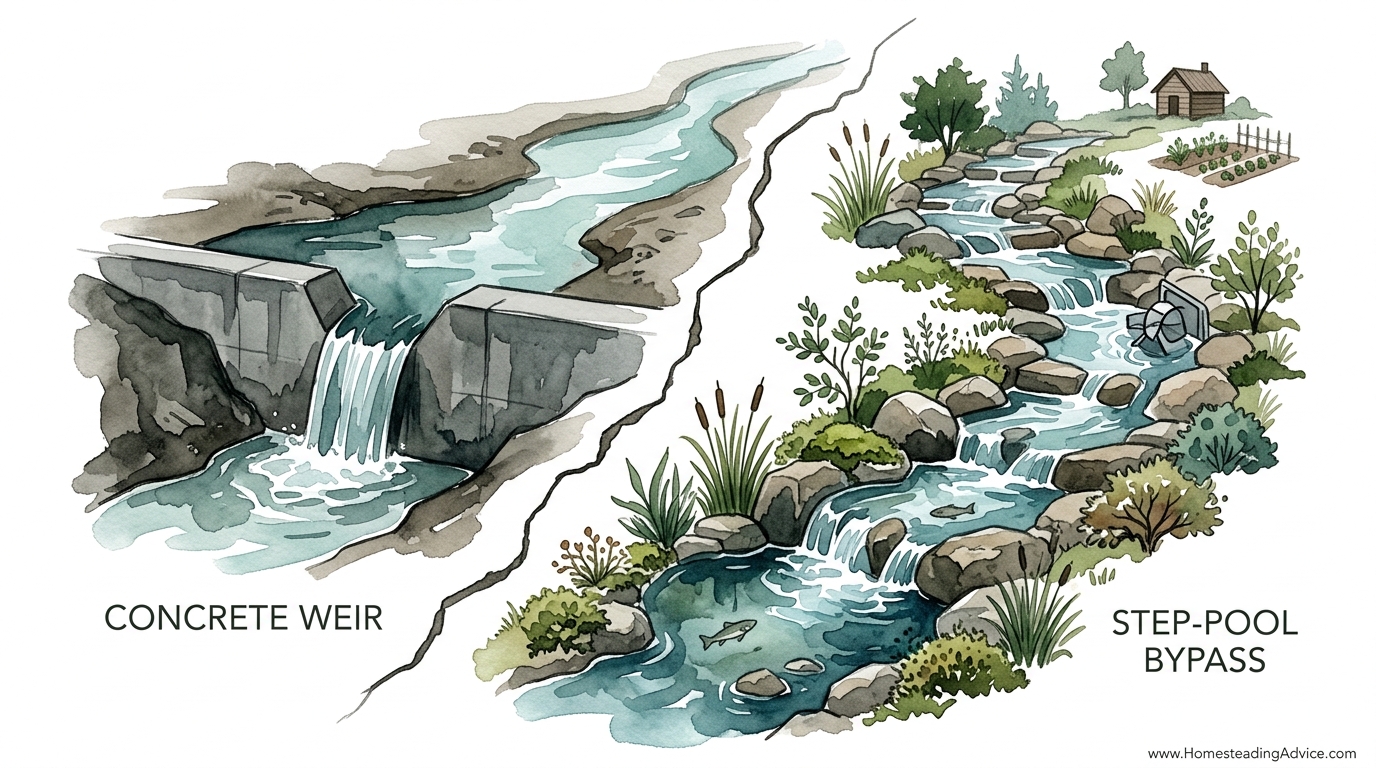
You can dam a stream to control it, or you can design a system that works with the water’s natural soul. Traditional hydro is ‘urban’ thinking – concrete and control. But ‘wild’ hydro uses the stream’s own geography to create a bypass that generates 24/7 power while actually improving the aquatic habitat. Power and preservation aren’t enemies.
The modern homesteader knows that a rushing creek is more than just a source of electricity; it is a living artery. When we talk about micro-hydro power, we often picture massive concrete walls and flooded valleys. That is the old way of thinking. Today, we look toward the Eco-friendly Micro Hydro Intake, specifically the step-pool bypass, to harvest energy without breaking the spirit of the land.
This article guides you through the transition from invasive engineering to a system that mimics the natural rhythms of a mountain brook. Whether you are looking to power a remote cabin or a full working farm, understanding how to sip from the stream without choking it is the first step toward true self-reliance.
Eco Friendly Micro Hydro Intake
An eco-friendly micro-hydro intake is a diversion system designed to capture a portion of a stream’s flow for power generation while maintaining the ecological and physical integrity of the waterway. Unlike a traditional dam that creates a reservoir and blocks the entire channel, an eco-friendly intake is often a “run-of-river” setup. It works by taking only what is needed and leaving the rest for the fish, the silt, and the seasons.
These systems exist to solve a fundamental conflict: the need for a consistent water level (head) versus the need for a healthy, connected river. In real-world applications, these are used in mountain streams where steep gradients provide natural energy. Instead of a concrete weir, practitioners use step-pool sequences and bypass channels that look like natural rapids.
Imagine a mountain staircase made of stone and water. Each “step” is a boulder sill that slows the water down, and each “pool” is a place where energy dissipates. An eco-friendly intake sits quietly to the side of this staircase, catching water behind a rock or inside a submerged screen. It is an agreement between the person and the planet—an honest way to live off the land’s bounty.
How the Step-Pool Bypass Works
The genius of a step-pool bypass lies in its ability to manage water energy. In steep terrain, water gains a terrifying amount of momentum. If you simply block it with a wall, the water will eventually find a way under, over, or around that wall, often taking your investment with it. A step-pool system breaks that energy into smaller, manageable chunks.
To create this system, you arrange large anchor boulders across the stream. These boulders, often 1 meter (3.3 feet) or more in diameter, act as the “bones” of the intake. They create a small drop in the water level—usually between 0.15 and 0.45 meters (6 to 18 inches). Behind each row of boulders, a pool forms. This pool serves two purposes: it creates a stable area of water for your intake to draw from, and it provides a resting place for migrating fish.
Water enters the intake through a side-channel or a specialized screen, such as a Coanda screen. This screen uses the “Coanda effect”—the tendency of a fluid to follow a curved surface—to pull clean water into the penstock while sweeping leaves, twigs, and gravel over the top. This “self-cleaning” action is the hallmark of a wild hydro system. You aren’t fighting the debris; you are using the water’s own velocity to keep your pipes clear.
The Practical Benefits of Wild Hydro
Choosing an eco-friendly intake provides measurable advantages over traditional concrete structures. The most immediate benefit is the preservation of longitudinal connectivity. Fish and other aquatic life must move upstream to spawn or find food. A step-pool bypass provides a series of “ladders” that allow them to pass easily, whereas a concrete weir creates an impassable wall.
Sediment transport is another critical factor. Rivers are meant to move dirt, sand, and stones. When a dam stops this movement, the water downstream becomes “hungry” for sediment and begins to scour the banks, leading to erosion. An eco-friendly intake allows natural sediment to flow over the structures during high-water events. This maintains the health of the entire watershed, protecting downstream property and habitats.
Maintenance is often lower for these systems in the long run. Concrete is rigid; it cracks during freeze-thaw cycles and can be undermined by shifting streambeds. Rock-based systems are flexible. They can settle and shift slightly without losing their function. If a major flood moves a stone, you can simply move it back with a crowbar or a winch. This is “pioneer-grit” engineering at its finest—working with materials provided by the earth.
Challenges and Common Mistakes
Building a system that looks “wild” requires more foresight than pouring a slab of concrete. One of the most common mistakes is underestimating the size of the anchor boulders. If your stones are too small, the first spring runoff will turn your intake into a pile of rubble. You must use stones that are larger than anything the stream naturally moves during a flood.
Another frequent error is failing to account for the “thalweg”—the deepest, fastest part of the channel. If you place your intake in a spot where the stream naturally deposits silt, your screens will be buried within a week. You want your intake to be located where the water is moving fast enough to clear debris but slow enough to be captured.
Ignoring the hands-off flow (the minimum amount of water that must remain in the creek) is a legal and ethical pitfall. If you suck a stream dry during a summer drought to keep your lights on, you kill the very ecosystem you are trying to live within. Always design your intake so that it sits slightly higher than the streambed, ensuring that the first few inches of water always stay in the natural channel.
Limitations of the Eco-Friendly Approach
This method is not a universal solution for every site. In very low-head environments—where the land is flat and the water moves slowly—a step-pool bypass may not create enough of a height differential to be useful. You need a certain amount of “drop” to make the hydraulics work. If your site has less than 2 meters (6.5 feet) of total fall over a long distance, a more traditional low-head turbine might be necessary.
Extreme flood zones also present a boundary. In narrow canyons where water levels can rise 5 meters (16 feet) in an hour, even the largest boulders can be swept away. In these cases, a submerged intake or an infiltration gallery buried deep in the gravel bed might be the only way to protect your equipment.
Finally, there is the limitation of labor. Building a stone-and-pool sequence is physically demanding. It requires moving tons of rock, often in wet and slippery conditions. If you lack the equipment or the physical stamina to work with heavy stone, the cost of hiring help can make this approach more expensive than a simple pipe-and-screen setup.
Comparison: Concrete Weir vs. Step-Pool Bypass
| Feature | Concrete Weir | Step-Pool Bypass |
|---|---|---|
| Environmental Impact | High; blocks fish and sediment. | Low; mimics natural stream features. |
| Construction Material | Concrete, rebar, forms. | Native boulders, cobble, gravel. |
| Flexibility | Rigid; prone to cracking. | Flexible; adjusts to ground movement. |
| Maintenance | Requires sediment dredging. | Mostly self-cleaning with proper design. |
| Aesthetics | Industrial; looks like a dam. | Natural; looks like a waterfall. |
Practical Tips for a Successful Build
When you begin your build, start by identifying a “reference reach.” Find a nearby section of the stream that already has natural pools and drops. Measure the distance between the pools and the size of the rocks the stream has naturally placed there. Your design should copy what the water has already proven it can build.
Use geotextile fabric under your smaller stones to prevent the water from “piping” or washing out the fine material between the boulders. This fabric acts as a filter, keeping your structure solid while allowing the water to flow over the top where it belongs.
Winter preparation is essential for those in cold climates. Ensure your intake is deep enough that the “frazil ice” (tiny ice crystals that form in turbulent, super-cooled water) doesn’t clog your screens. A submerged intake, where the water is taken from below the surface of a deep pool, is often more resistant to freezing than an exposed weir.
Advanced Considerations for Serious Practitioners
Serious practitioners should look into the Froude number—a dimensionless value that describes the flow regime of water. For a stable step-pool system, you want to maintain “subcritical flow” in the pools and “supercritical flow” only as the water passes over the crest of the boulders. This ensures the pools remain effective at dissipating energy.
Managing turbidity is also vital during the construction phase. Use sandbags or temporary diversions to keep the water clear while you are moving rocks. This prevents silt from washing downstream and suffocating fish eggs or damaging the gills of local trout. A responsible builder leaves the water as clean as they found it.
For those looking to maximize efficiency, consider a multi-stage filtration system. Use the step-pool sequence as your primary “trash rack” to stop large branches. Then, use a settling tank or a vortex silt separator before the water enters your turbine. This will significantly extend the life of your turbine runner by removing abrasive sand and fine grit.
Example: The Appalachian Side-Channel
Consider a homestead in the Appalachian Mountains with a stream flowing at 150 liters per minute (40 gallons per minute) and a total head of 30 meters (100 feet). The owner chose not to dam the creek. Instead, they identified a natural 1.5-meter (5-foot) drop over a rocky ledge.
They placed three massive “anchor” rocks across the ledge to create a 0.3-meter (1-foot) deep pool. Off to the side, they dug a small channel that led to a Coanda box. During a heavy autumn storm, the main creek swelled, carrying mud and leaves. The boulders forced the bulk of the debris over the ledge, while the Coanda screen allowed only the clean, high-velocity water into the 4-inch penstock.
The system generated a consistent 500 watts—enough to power the home’s LED lights, a high-efficiency refrigerator, and a satellite internet connection. The fish continued to move through the center of the stream, and the owner spent only twenty minutes a month checking the intake for stray sticks.
Final Thoughts
Building an eco-friendly micro-hydro intake is an act of stewardship. It requires us to step back from the “conquer the nature” mindset and instead adopt the role of a partner. By using step-pool sequences and bypass channels, we can generate reliable power while keeping our streams vibrant and full of life.
The transition to wild hydro is a journey of observation. It asks you to spend time by the water, learning its moods and its strength before you ever move a single stone. This patience is rewarded with a system that lasts for decades, providing clean energy with minimal intervention.
If you are ready to start, begin by measuring your head and flow. Look at the stones in your creek. Imagine the staircase the water wants to build. When you finally flip the switch and see your home glow with light generated by the very stream you are protecting, you will understand that true power comes from working with the natural soul of the land.