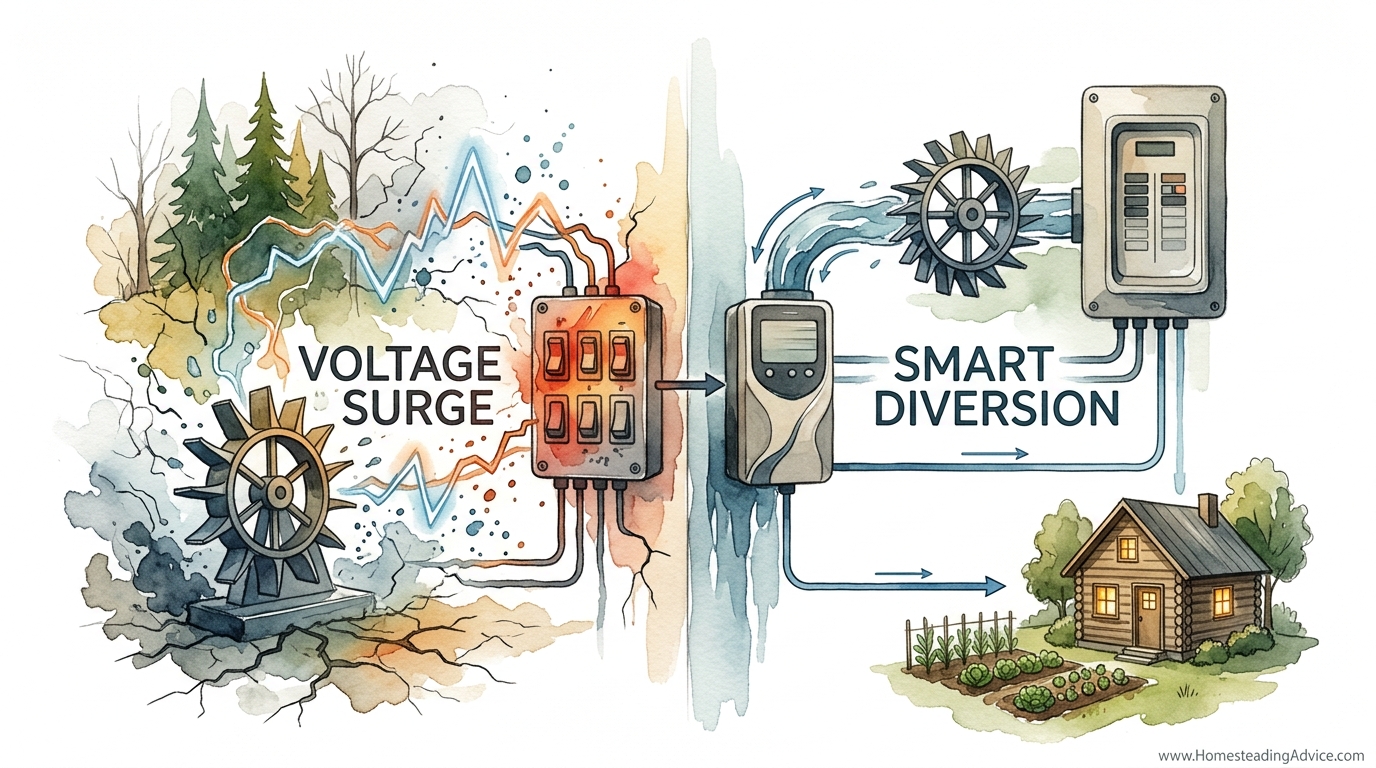
Don’t spend your life chasing a voltmeter; let your excess energy boil your tea for you. Manual hydro is a full-time job of switching appliances on and off to stay balanced. Strategic hydro uses an Electronic Load Controller to ‘dump’ excess power into useful assets like hot water, keeping your grid perfectly stable while you sleep.
Managing a micro hydro system requires a shift in perspective. Most people are used to the national grid, where the supply is massive and your tiny toaster doesn’t make a dent in the stability of the system. In a home-scale hydroelectric setup, you are the utility company, the maintenance crew, and the consumer all at once. Without proper load management, your lights will flicker, your motors will groan, and your expensive electronics will eventually let out the magic smoke.
This article dives deep into the heart of stable off-grid power: the Electronic Load Controller (ELC). We will explore how these devices act as the brain of your powerhouse, ensuring that the energy your stream provides is never wasted and never dangerous. Whether you are installing a 500-watt stream-side unit or a 50-kilowatt village system, understanding load management is the difference between a reliable utility and a constant headache.
Micro Hydro Load Management
Micro Hydro Load Management is the art and science of keeping a generator’s electrical output in perfect equilibrium with the mechanical energy provided by falling water. In a traditional fossil fuel generator, a governor physically moves a throttle to match the engine speed to the load. If you turn on a saw, the engine revs up. If you turn it off, the engine throttles down.
Water is different. It is heavy, it has immense momentum, and it doesn’t like to be stopped or started suddenly. Closing a valve too fast can create a water hammer that bursts a 200-meter (656-foot) penstock like a balloon. Because of this, we often prefer to keep the water flowing at a constant rate. Since the water flow is constant, the energy being produced is also constant.
If your turbine is producing 2,000 watts and you are only using 100 watts for a lightbulb, that remaining 1,900 watts has to go somewhere. If it doesn’t have an electrical path, the turbine will speed up, or “run away.” As the RPM increases, the voltage and frequency (measured in Hertz) climb to dangerous levels. Load management is the system that takes that excess 1,900 watts and “shunts” it into a secondary destination, often called a dump load.
In real-world terms, this means your generator always “thinks” it is running at full capacity. The Electronic Load Controller monitors the incoming frequency and, in a fraction of a second, decides how much power to send to your house and how much to send to the water heater in the basement. This keeps the turbine spinning at a rock-steady speed, protecting your equipment and providing you with a “free” source of thermal energy.
How Micro Hydro Load Management Works
The primary goal of an Electronic Load Controller (ELC) is to maintain a stable frequency, typically 50 Hz or 60 Hz depending on your region. Frequency is directly tied to the rotational speed of the generator. If the generator spins faster, the frequency goes up; if it slows down, the frequency drops. The ELC acts as a high-speed electrical brake.
Most modern ELCs use a process called Pulse Width Modulation (PWM) or phase-angle firing to divert power. The controller is wired in parallel with your main household loads. It constantly “sniffs” the voltage and frequency of the AC lines. When it detects the frequency rising even slightly above the set point (say, 60.5 Hz), it begins to open the “gate” to the dump loads.
The Role of the Dump Load
A dump load, or ballast load, is usually a resistive heating element. These are simple, robust components like the heating rods in a domestic hot water tank or baseboard space heaters. The ELC sends the “leftover” electricity to these heaters. As you turn on appliances in your kitchen, the ELC senses the slight drop in frequency and instantly reduces the power going to the dump load.
This happens thousands of times per second. To the user, the lights stay steady and the clocks run on time. Behind the scenes, the energy is performing a constant dance between your active use and your thermal storage. This is why many micro hydro owners have the “luxury” of unlimited hot water; their system is literally forced to create heat to stay stable.
Sensors and Logic
Inside the ELC box, a micro-processor or a dedicated analog circuit compares the actual output to a reference crystal or timing circuit. If the deviation exceeds a certain threshold—usually within +/- 0.5%—the power electronics (such as Triacs, Thyristors, or IGBTs) are triggered. These components are capable of switching large amounts of current without the wear and tear of mechanical relays.
In 3-phase systems, the management becomes more complex. The ELC must often balance the load across all three phases to prevent the generator from vibrating or overheating. Advanced controllers can manage multiple dump loads in a priority sequence, heating the house first, then the hot water, and finally venting excess heat outside through an air-cooled resistor bank.
Benefits of Strategic Load Management
The most immediate benefit is the protection of your investment. High-quality generators and turbines are expensive, and running them at overspeed (unloaded) can destroy bearings and windings in a matter of hours. A well-tuned load management system ensures the machine never exceeds its design limits, extending the life of the hardware by decades.
Convenience and Automation
Without an ELC, you are a slave to the system. You would have to manually switch on a heater every time you finished using the vacuum cleaner. Strategic load management provides a “set it and forget it” experience. You can go to bed knowing that even if every light in the house is off, the system will keep itself balanced and provide you with a hot shower in the morning.
Efficient Energy Utilization
In many renewable systems, “excess” energy is simply lost. In a micro hydro setup with an ELC, that excess is captured. Because the turbine runs 24 hours a day, the cumulative amount of “dumped” energy is significant. A 1 kW system produces 24 kWh per day. If your household consumption averages 10 kWh, you have 14 kWh of heat energy to play with. That is enough to heat 300 liters (about 80 gallons) of water from 10°C to 55°C (50°F to 131°F) every single day.
Grid-Like Stability
For electronics like computers, microwave ovens, and LED drivers, frequency stability is non-negotiable. Poorly regulated systems can cause power supplies to buzz or fail prematurely. An ELC provides “utility-grade” power that is often cleaner and more stable than what is found in rural areas of the national grid. This allows you to use standard off-the-shelf appliances without worrying about “off-grid” compatibility issues.
Challenges and Common Mistakes
One of the most frequent errors in micro hydro load management is undersizing the dump loads. Your dump load must be capable of absorbing the **entire** output of the generator plus a safety margin of at least 20%. If your generator produces 3,000 watts and your dump load can only handle 2,000 watts, the system will still overspeed if all household loads are turned off. Always ensure your resistive heaters are rated for the maximum possible turbine output.
Thermal Management of the Controller
Electronic Load Controllers generate heat themselves while they are working. The power transistors (IGBTs or Triacs) need substantial heat sinks. A common mistake is mounting the ELC in a small, unventilated box in a warm powerhouse. If the controller overheats, it may shut down for self-protection, which immediately unloads the generator and causes a runaway. Always mount the ELC in a cool, well-ventilated area and ensure the heat sink fins are clean.
Incompatible Loads
Not all heaters work well as dump loads. You must use “dumb” resistive loads. Modern “smart” space heaters with digital displays or remote controls often contain internal electronics that can be damaged by the chopped-up waveform of an ELC. Stick to simple, mechanical thermostats or bypass the thermostats entirely and let the ELC be the sole controller of the heating element.
Wiring and Distance
Locating the dump loads too far from the ELC can cause voltage drop and interference issues. High-power switching creates electromagnetic interference (EMI) that can play havoc with radios or sensitive sensors. It is a best practice to keep the ELC and the primary dump loads relatively close together, using appropriately gauged copper wire to handle the full current of the generator.
Limitations of Load Management Systems
While ELCs are robust, they are not a magic bullet for a poorly designed civil engineering setup. For instance, if your water flow varies wildly with the seasons, an ELC cannot “create” power that isn’t there. It can only manage what the turbine produces. In low-flow periods, you may still need to manually shed loads to keep the frequency from sagging below 45 Hz or 55 Hz.
Reactive Power and Induction Motors
ELCs are designed to manage “real” power (watts). They are less effective at managing “reactive” power (VARs) caused by large induction motors, such as those found in heavy-duty shop tools or old-style well pumps. When a large motor starts, it draws a massive “inrush” current that can momentarily pull the frequency down faster than the ELC can react. This can lead to a momentary brownout that an ELC alone cannot prevent.
Cost and Complexity
For very small “pico” systems (under 300 watts), the cost of a high-quality ELC can sometimes exceed the cost of the turbine itself. In these cases, users often look for cheaper DIY alternatives or simple “zener diode” regulators, which are less precise and can be prone to failure. High-end ELCs for larger systems can also be complex to program, requiring a firm grasp of electrical theory to set the “proportional-integral-derivative” (PID) gains correctly.
Comparing Control Methods
Choosing the right way to stabilize your system depends on your generator type and your budget. The table below compares the three most common methods for micro hydro regulation.
| Feature | Electronic Load Controller (ELC) | Mechanical Governor | Induction Generator Controller (IGC) |
|---|---|---|---|
| Main Use | Synchronous Alternators (Standard AC) | Large, high-flow turbines | Asynchronous Motors (Induction) |
| Complexity | Moderate (Solid-state electronics) | High (Linkages and valves) | Moderate (Capacitor banks) |
| Maintenance | Low (No moving parts) | High (Oiling, adjusting) | Low (Electrical only) |
| Response Time | Instantaneous (Milliseconds) | Slow (Seconds) | Fast (Milliseconds) |
| Energy Use | Diverts excess to heat | Restricts water flow | Diverts excess to heat |
While a mechanical governor saves water by closing a valve when demand is low, it is usually too expensive and slow for micro-scale systems. The ELC remains the champion for home-scale setups because of its reliability and ability to provide domestic heating.
Practical Tips for Best Performance
If you want your load management system to be bulletproof, start with the “Rule of Priority.” Not all dump loads are created equal. Use a controller that allows for multi-stage diversion. Stage 1 could be your domestic hot water tank. Stage 2 could be a thermal mass heater in your living room floor. Stage 3 could be a massive air-cooled resistor bank in the powerhouse to shed the final bits of energy during a “no-load” emergency.
Redundancy is Safety
Never rely on a single heating element. If the element in your water heater burns out, your ELC effectively loses its ability to control the generator. Always split your dump load across at least two or three separate elements. If one fails, the others can still keep the system from overspeeding. Regularly test these elements with a multimeter to ensure they haven’t “gone open.”
Tuning the “Window”
Most ELCs allow you to set the frequency window. If you set it too tight (e.g., exactly 60.0 Hz), the controller may “hunt” or oscillate, causing the lights to flicker rapidly. A slightly wider “deadband” (e.g., 59.5 Hz to 60.5 Hz) usually results in a much smoother experience. This allows for small variations without triggering the power electronics into a frenzy.
Earthing and Lightning Protection
Because your penstock is a long metal pipe and your turbine is connected to a stream, your system is a giant lightning rod. Ensure your ELC and generator are tied to a robust grounding system. Use surge arrestors on the AC lines. A lightning strike miles away can travel down the stream and blow the sensitive electronics in your controller if you haven’t provided a better path to the earth.
Advanced Considerations for the Serious Practitioner
For those looking to push their system further, consider integrating your ELC with a modern “smart home” system. Some advanced ELCs now offer Modbus or Wi-Fi connectivity. This allows you to monitor your turbine’s health from your phone or log data to see your “Peak Water” versus “Peak Usage” times. This data is invaluable when deciding whether to add more nozzles to your turbine or invest in more insulation for your home.
Phase Balancing in 3-Phase Systems
If you are running a 3-phase generator, you must be careful not to “dump” all your energy into a single phase. This creates an unbalanced magnetic field in the generator, causing it to growl and heat up unevenly. High-end 3-phase ELCs monitor all three lines and distribute the dump load proportionally. If you are using three single-phase ELCs, ensure they are calibrated to work in harmony.
The “Black Start” Scenario
What happens if the system shuts down completely? A “black start” is when you have to bring the system back online from zero. If you open the water valves while the house is fully connected, the initial surge can be tricky. A best practice is to have a “Start-Up” switch that directs all power to the dump loads first. Once the frequency is stabilized at 50 or 60 Hz, you can then “bleed” the house loads in.
Example Scenario: The 5 kW Mountain Stream
Consider a homestead with a Pelton turbine running at 150 meters (492 feet) of head. The turbine produces a steady 5,000 watts of 240V AC power. The family uses about 800 watts for lights, a fridge, and a Starlink terminal during the day.
The ELC is the unsung hero here. It takes the remaining 4,200 watts and sends it to a 5 kW heating element in a large 500-liter (132-gallon) insulated tank. This tank acts as a “thermal battery.” Throughout the day, the water temperature rises from 15°C (59°F) to 80°C (176°F).
In the evening, when the family turns on a 1,500-watt electric stove and a 1,000-watt toaster, the ELC instantly drops the diversion to the water tank to 1,700 watts (5,000 – 800 – 1,500 – 1,000). The generator never feels a change in load; it continues to “see” 5,000 watts of demand. The family has cooked their dinner and still has a tank full of scalding hot water for showers and floor heating, all without ever touching a switch or checking a meter.
Final Thoughts
Mastering micro hydro load management is the final step in moving from a “science project” to a truly livable off-grid home. By using an Electronic Load Controller, you stop fighting the physics of the water and start working with it. The ELC provides the stability that modern life requires while turning the “waste” of a constant-flow turbine into a valuable domestic resource.
While the initial setup of an ELC can be intimidating—involving heat sinks, dump loads, and frequency tuning—the rewards are decades of hands-off power. A well-designed system doesn’t just provide electricity; it provides peace of mind. It allows you to forget that you are living miles from the nearest power line.
As you plan your system, remember that the goal is balance. Respect the momentum of the water, size your dump loads generously, and treat your ELC as the vital brain that it is. When the system is dialed in, you won’t be chasing voltmeters. You’ll be sitting on your porch, listening to the hum of the turbine, and waiting for the whistle of a tea kettle powered entirely by the gravity of the hills.