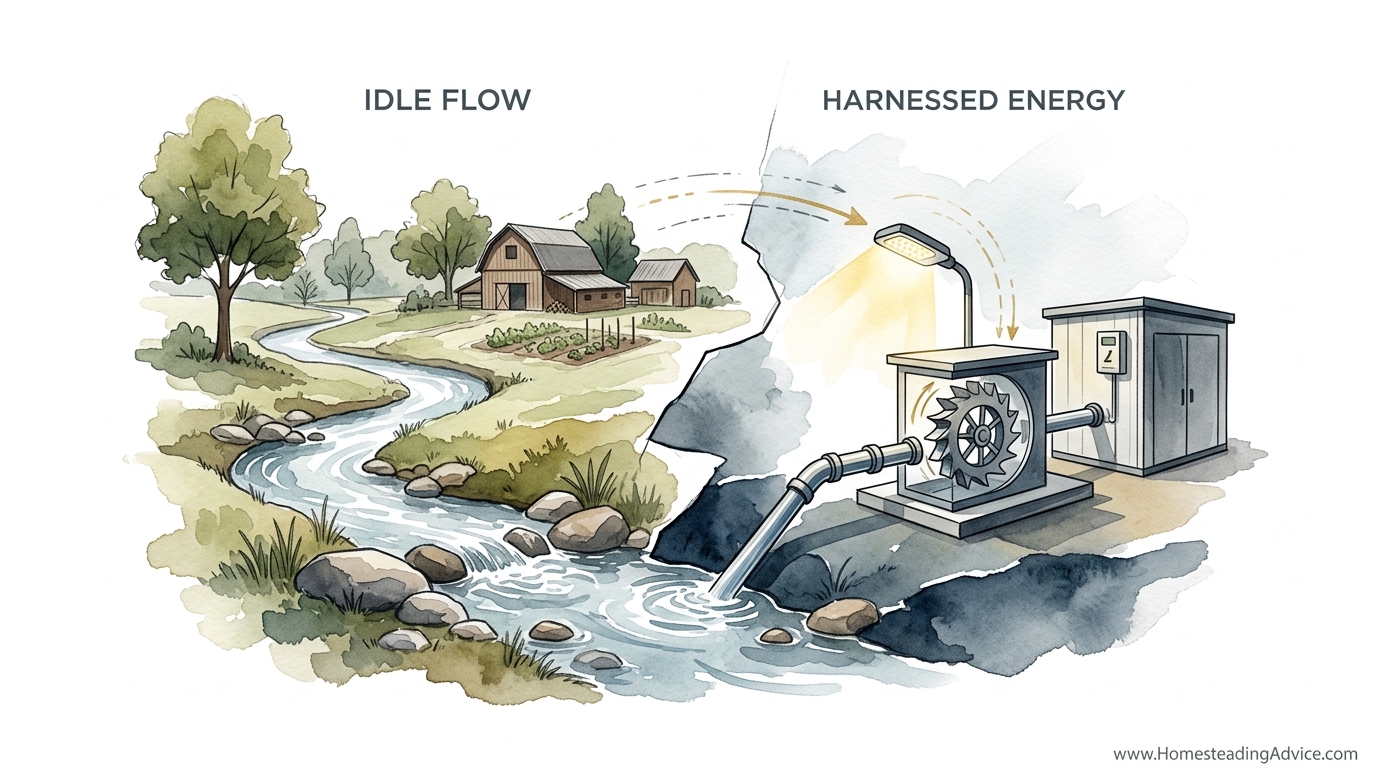
You see a pretty creek; I see a 24/7 bank account of energy waiting to be unlocked. Most people walk past a flowing creek and see nature. A micro-hydro enthusiast sees a dynamic energy source that never turns off. Unlike solar that sleeps at night, your creek is a constant pressure of potential. Learn how to stop letting that energy wash away and start turning it into home-grown power.
Micro Hydro Power Generation Basics
Micro hydro power generation is the process of capturing the kinetic and potential energy of falling water to produce electricity on a small scale. Generally, “micro” refers to systems that produce up to 100 kilowatts (kW) of power, though most homesteaders and small-scale practitioners deal with systems ranging from 500 watts to 10 kilowatts. Unlike massive dams that flood valleys, micro-hydro typically uses a “run-of-river” approach. This means you divert only a portion of the stream, run it through a turbine, and return it to the original bed downstream.
Water is an incredibly dense energy carrier. It is roughly 800 times denser than air, which is why a small, steady stream can often produce more usable electricity over a year than a massive wind turbine or an expensive array of solar panels. While solar depends on the sun and wind depends on the breeze, gravity never takes a day off. If your creek flows year-round, your power plant works year-round.
The physics of this system rely on two fundamental pillars: head and flow. Head is the vertical distance the water falls from the intake to the turbine. Flow is the volume of water passing through the system in a given amount of time. Understanding the relationship between these two factors is the first step toward self-reliance. High head with low flow can produce the same amount of power as low head with high flow, but the equipment you need for each will be vastly different.
How Micro Hydro Systems Work
Harnessing energy from a stream follows a logical path from the water’s surface to your home’s electrical panel. The process begins at the intake. This is where you divert water from the main stream into your system. A well-built intake includes a “trash rack” or screen to keep out leaves, sticks, and fish. It often features a “settling tank” or forebay, which allows sand and silt to sink to the bottom before the water enters your pipe.
Once the water is cleaned, it enters the penstock. This is a sealed pipe that carries the water down the hill to the turbine. Pressure builds as the water moves lower. This pressure is the “potential energy” of the system. At the bottom of the penstock, the water is squeezed through a nozzle or a guide vane, turning that pressure into high-velocity kinetic energy that strikes the turbine wheel.
The turbine spins a shaft connected to an alternator or generator. This generator creates the electricity. Depending on your needs, this electricity might go directly to a battery bank for storage or through an inverter to power your appliances. Any excess energy produced is usually sent to a “dump load”—often a water heater or a large bank of resistors—to ensure the system remains under load and does not over-spin.
Measuring Your Potential: Head and Flow
Before you buy a single foot of pipe, you must know what your site can actually provide. Measuring head and flow is the most critical part of the planning stage. Small errors here lead to expensive mistakes later.
Measuring Head (Vertical Drop)
Total head is the vertical distance between where the water enters the pipe and where it hits the turbine. You are not measuring the length of the pipe, but the actual height difference. There are several ways to do this:
- The Pressure Gauge Method: Run a small garden hose from your intake point down to your proposed turbine location. Fill it with water and ensure there are no air bubbles. Attach a pressure gauge to the bottom. For every 2.31 feet of vertical drop, the gauge will show 1 pound per square inch (psi). In metric units, every 10 meters of drop equals approximately 1 bar (14.5 psi).
- The Altimeter Method: Using a high-quality barometric altimeter or a GPS with a vertical accuracy of 3 feet (1 meter) can give you a rough idea, though it is less precise than other methods.
- The Sight Level Method: Using a contractor’s level or a “peashooter” sight level on a tripod, you can leapfrog down the hill, measuring 5-foot (1.5-meter) increments at a time. This is often the most reliable method for rugged terrain.
Measuring Flow (Volume)
Flow is usually measured in gallons per minute (gpm) or liters per second (l/s). Because stream flow changes with the seasons, you should measure it during the driest part of the year to ensure your system works year-round.
- The Bucket Method: For small streams, build a temporary dam to channel all the water into a single pipe. Time how long it takes to fill a 5-gallon (19-liter) bucket. Divide the volume by the time to get your flow rate.
- The Weir Method: For larger streams, you can build a weir—a temporary wall with a notched opening. By measuring the depth of the water flowing over the notch, you can use standardized charts to calculate the flow with high accuracy.
The Core Equipment: Turbine Selection
Choosing the right turbine depends almost entirely on your head and flow measurements. Turbines are generally split into two categories: impulse and reaction.
Impulse Turbines
Impulse turbines use a high-speed jet of water to strike buckets on a wheel. These are the workhorses of the micro-hydro world because they are simple, durable, and easy to maintain.
- Pelton Wheels: These are the most common for high-head, low-flow sites. They feature double-cup buckets that split the water jet to maximize torque. They work best when you have at least 50 feet (15 meters) of drop.
- Turgo Wheels: Similar to Pelton wheels but angled so the jet hits multiple buckets at once. They can handle higher flow rates than a Pelton wheel of the same size.
- Crossflow Turbines: These look like a cylindrical squirrel cage. Water passes through the blades twice. They are excellent for medium-head sites with fluctuating flow.
Reaction Turbines
Reaction turbines stay completely submerged and use the pressure difference across the blades to create rotation—much like a boat propeller. These are typically used for low-head, high-flow sites.
- Kaplan or Propeller Turbines: These are ideal for sites with only 5 to 20 feet (1.5 to 6 meters) of head but a large volume of water. They are more complex and often more expensive to install correctly.
The Role of the Penstock
The penstock is more than just a pipe; it is the delivery system for your power. If the pipe is too small, friction will “eat” your energy before it reaches the turbine. This is known as “friction loss.”
Choosing the right material is vital. High-Density Polyethylene (HDPE) is a favorite among pioneers because it is flexible, resists freezing, and comes in long rolls that minimize joints. PVC is cheaper and easier to find but can become brittle in the sun and may shatter if water hammers occur. Steel is the strongest but is heavy and prone to rust if not treated.
When sizing your pipe, aim for a water velocity between 5 and 7 feet per second (1.5 to 2 meters per second). If the water moves too fast, friction losses skyrocket. If it moves too slow, sediment will settle in the pipe and clog it. A 4-inch (100mm) pipe can carry much more energy than a 2-inch (50mm) pipe with significantly less loss, often making the extra investment worth every penny.
Benefits of Micro Hydro Power
Harnessing a stream offers advantages that no other renewable source can match. The reliability of a well-designed system is its greatest strength.
- Continuous Power: While solar panels average 4 to 6 hours of peak production a day, a hydro system provides 24 hours of power. This means you need a much smaller battery bank to stay off the grid.
- High Capacity Factor: The “capacity factor” is the ratio of actual energy produced over a period compared to the maximum possible. Hydro systems often have capacity factors above 80%, while solar sits around 15-20%.
- Long Life Span: A high-quality turbine and a well-protected penstock can last for 30 to 50 years with basic maintenance. This makes the “cost per kilowatt-hour” over the life of the system incredibly low.
- Ease of Integration: Hydro systems produce a steady stream of power that is easy to manage. You can use excess power for “opportunistic loads” like heating your home, drying grain, or charging an electric vehicle without worrying about depleting your batteries.
Challenges and Common Pitfalls
Building a hydro system requires grit and a willingness to get your hands dirty. Nature is a powerful force and will constantly try to reclaim your intake.
Leaves and debris are the number one enemy of the hydro enthusiast. A single leaf stuck in a nozzle can drop your power output by half. Without a proper trash rack and a settling tank, your turbine buckets will eventually be sandblasted by silt or clogged by organic matter. Intakes must be designed so that debris flows over them rather than into them.
Air locks in the penstock are another common issue. If your pipe has “high spots” where air can trap, the water flow will be restricted or stopped entirely. Your penstock should have a continuous downward slope. If you must have a high spot, you must install an air release valve at that point.
Legal hurdles can be just as daunting as the physical ones. In many regions, you do not “own” the water even if it flows through your land. You may need an abstraction license or a permit from the local environmental agency. Always check local water rights before investing in a system. Environmental agencies are particularly concerned with “minimum bypass flow”—the amount of water you must leave in the creek to support the local ecosystem.
Limitations of Micro Hydro
Not every creek is a gold mine. Site requirements are strict. If your land is flat, you will need a massive amount of water (flow) to make up for the lack of vertical drop (head). Conversely, if you have a tiny spring with a high head, you might only produce enough to light a few bulbs.
Seasonal variation is a major limitation. Many streams that roar in the spring become a trickle in the late summer. If your power needs are constant, you must size your system based on the “minimum flow” of the year. This means that for six months of the year, your system might be significantly undersized for the amount of water available, but it ensures you aren’t left in the dark during the dry season.
Distance is another factor. If your turbine site is 1,000 feet (300 meters) from your house, the cost of the electrical wire can be more than the turbine itself. Transmitting power over long distances requires higher voltages to reduce “line loss,” which adds complexity and cost to the electrical side of the project.
Comparing Energy Sources
Choosing between hydro, solar, and wind depends on your specific acreage. Each has a different profile of maintenance and reliability.
| Feature | Micro Hydro | Solar PV | Small Wind |
|---|---|---|---|
| Reliability | Constant (24/7) | Intermittent (Day only) | Highly Intermittent |
| Maintenance | Moderate (Intake cleaning) | Low (Cleaning panels) | High (Moving parts) |
| Lifespan | 30+ Years | 20–25 Years | 10–15 Years |
| Best Location | Steep terrain with water | Unshaded open areas | High, windy ridges |
Hydro requires more upfront manual labor than solar. You have to dig trenches for pipes and build concrete or stone intakes. However, once that infrastructure is in place, the “harnessed energy” is far more consistent than the “idle flow” of sunlight that disappears every evening.
Practical Tips for System Optimization
Small tweaks can make a big difference in how much power you actually get at the house. Optimization starts at the nozzle and ends at the battery.
- Use Multiple Nozzles: If you use an impulse turbine, having two or four nozzles allows you to turn some off during the dry season. This keeps the water pressure high and the turbine running at its most efficient speed even when flow is low.
- Install a Pressure Gauge: Keep a gauge at the powerhouse permanently. If the pressure drops, you know your intake is clogged. If the pressure is high but the power is low, your nozzle might be obstructed.
- Smooth Your Pipe: Every 90-degree elbow in your penstock adds friction. Use 45-degree bends or long sweeps instead. The smoother the path, the more energy reaches the wheel.
- Manage the Load: Use an Electronic Load Controller (ELC). This device monitors the voltage and diverts extra power to a heater. This prevents the turbine from speeding up when you turn off a light, which protects your electronics from voltage spikes.
Advanced Considerations: Going Battery-Less
For those with a very steady and powerful stream, it is possible to skip the battery bank entirely. This is known as an AC-direct system. In this setup, the turbine spins a specialized alternator that produces 120V or 240V AC power directly.
An AC-direct system relies heavily on a high-speed load controller to maintain the exact 60Hz (or 50Hz) frequency needed for modern appliances. If the load changes, the controller must react in milliseconds to divert power to the dump load. This setup is more efficient because you avoid the losses associated with charging and discharging batteries, but it requires a very consistent water source. If the stream stops, your power stops instantly.
Battery-based systems are generally more “forgiving” for beginners. The batteries act as a buffer, soaking up the turbine’s steady output and providing high bursts of power when you turn on a heavy appliance like a well pump or a saw. This allows you to use a turbine that produces only 500 watts to run a 2,000-watt toaster for a few minutes at a time.
Real-World Scenario: The 500-Watt Homestead
Imagine a homestead with a small creek that drops 40 feet (12 meters) over a distance of 300 feet (91 meters). During the summer, the flow is measured at 100 gallons per minute (6.3 liters per second).
Using the formula: (Head in feet × Flow in gpm) / 10 = Watts, we can estimate the potential.
(40 × 100) / 10 = 400 Watts.
In a 24-hour period, this system produces 9.6 kilowatt-hours (kWh).
For a typical energy-efficient home, 9.6 kWh per day is more than enough. A standard American home uses about 30 kWh per day, but that includes massive loads like electric heating and air conditioning. A self-reliant homesteader using propane or wood for heat and efficient LED lighting will find 9.6 kWh to be a luxurious amount of power. This system would keep the lights on, the fridge cold, and the internet running without ever needing to check a weather report.
Winterizing and Maintenance
Cold weather presents the greatest physical threat to your investment. If water stops moving in a pipe during a hard freeze, the penstock will shatter. In regions with deep freezes, you must bury your penstock below the frost line—often 3 to 4 feet (1 meter) deep.
If burying the pipe isn’t possible, you must keep the water moving. Never shut off the turbine completely during a freeze. If you need to stop power production, bypass the water so it continues to flow through the pipe and exits safely. Large volumes of moving water carry enough thermal energy from the earth to resist freezing, but a slow-moving trickle will turn to ice quickly.
Maintenance should be performed on a schedule. Check your intake once a week during the autumn when leaves are falling. Grease your turbine bearings every few months with high-quality waterproof grease. Inspect the penstock for leaks or signs of shifting soil. A small leak can quickly turn into a washout that undermines your pipe’s foundation.
Final Thoughts
Micro-hydro power is the ultimate goal for the self-reliant individual. It represents a transition from being a consumer of energy to being a steward of a natural resource. While the initial setup requires significant labor and a deep understanding of your land’s topography, the reward is a quiet, reliable, and incredibly long-lived source of home-grown power.
The transition from “idle flow” to “harnessed energy” is a profound shift in how you view your environment. A creek is no longer just a boundary or a scenic feature; it becomes the heartbeat of your home. By taking the time to measure your site accurately and choosing the right equipment for your specific head and flow, you can secure an energy future that is independent of the grid and the rising costs of fuel.
Do not be intimidated by the physics or the plumbing. Start small, observe your stream through the seasons, and build with the intention of lasting decades. The energy is already there, washing away every second. It is simply waiting for you to unlock it.