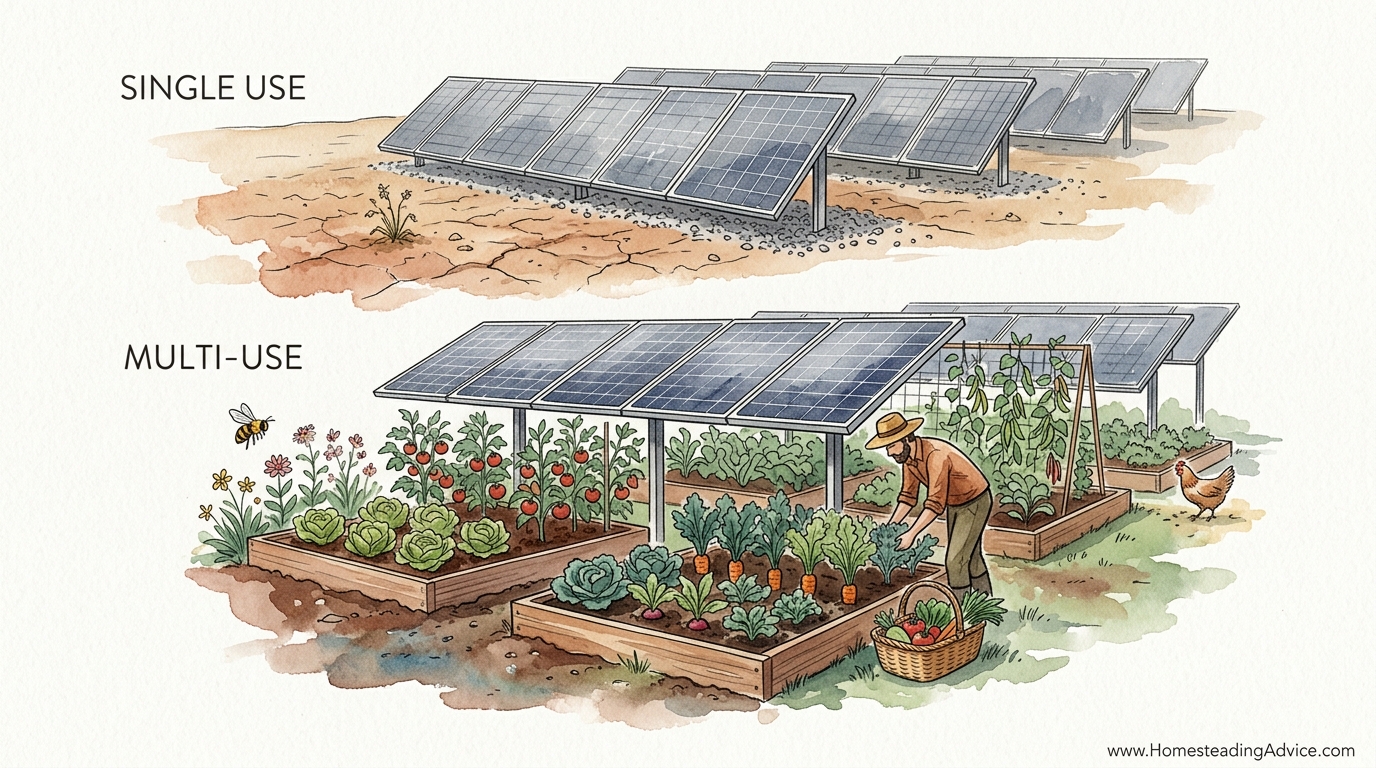
Your solar panels are hogging the best sun on your property; here is how to make them work for your garden too. Why choose between a power plant and a garden? Agrivoltaics is the secret to getting more out of every square foot. The panels keep the plants cool, the plants keep the panels efficient, and you get two harvests for the price of one.
Growing Vegetables Under Solar Panels
Agrivoltaics is the practice of co-locating solar energy production and agriculture on the same piece of land. Instead of treating a solar array like a sterile industrial zone, you treat it like a living ecosystem. This approach recognizes that plants and solar panels can have a symbiotic relationship where both perform better together than they do apart.
In a standard solar farm, the land is often “bladed” or cleared of all vegetation to prevent shading and reduce maintenance. This creates a single-use environment that can lead to soil erosion and heat islands. Agrivoltaics transforms this into a multi-use space where the shade from the panels protects crops from the punishing midday sun, while the moisture evaporating from the plants cools the panels from below.
Real-world examples of this are popping up everywhere from the desert research plots at the University of Arizona to the lush fields of Jack’s Solar Garden in Colorado. In drylands, this setup has been shown to reduce the amount of water needed for irrigation while simultaneously boosting the yields of certain sensitive crops. It is a way of returning to a more balanced, ancestral way of land management using modern tools.
You might think of it like the old-fashioned “three sisters” planting method, but with a high-tech twist. Instead of corn providing shade for squash, your silicon panels provide the canopy. This allows you to grow food in places that might otherwise be too hot or too dry for traditional gardening.
How It Works: The Science of Solar Sharing
The core principle behind growing food under solar panels is the “light saturation point.” Most plants can only process so much sunlight before they hit a limit. Once they reach that point, extra sun doesn’t help them grow faster; it just stresses them out, forcing them to spend energy on staying cool rather than producing fruit.
Solar panels are designed to capture that high-intensity light. By placing them above the garden, you intercept the harshest rays. The plants below receive “diffused” or “dappled” sunlight, which is often exactly what they need to thrive without wilting. This creates a microclimate that is cooler and more humid than the surrounding open field.
To do this effectively, you must consider the height and spacing of your array. For a home gardener, this might mean raising your panels to a height of 7 to 8 feet (2.1 to 2.4 meters). This allows enough clearance for you to walk underneath with a hoe or a wheelbarrow. For larger operations, panels are often raised 10 to 15 feet (3 to 4.5 meters) to accommodate tractors and mechanical harvesters.
Spacing is equally important. If the panels are packed too tightly, the ground becomes too dark for most vegetables. By leaving gaps between the rows of panels—often referred to as the “pitch”—you allow “light patches” to move across the garden as the sun travels across the sky. This ensures that every plant gets a daily dose of direct light followed by a period of cooling shade.
Benefits of the Dual-Harvest System
One of the most measurable benefits is water conservation. Research from Oregon State University found that areas under solar panels maintained higher soil moisture and saw a 328% increase in water-use efficiency. Because the panels block the wind and direct sun, the soil doesn’t bake into a crust, and the plants don’t “sweat” or transpire nearly as much water into the air.
The solar panels also benefit from the presence of the garden. Solar panels are actually less efficient when they get too hot. On a blistering summer day, a panel can lose significant power output just from the heat. However, plants naturally release moisture through their leaves, a process called transpiration. This act of “breathing” creates a cooling effect that can lower the temperature of the panels above by up to 20°F (11°C), keeping them in their “sweet spot” for energy production.
Yields for specific crops can be surprising. In various studies, cherry tomato production doubled under solar panels, and certain pepper varieties, like the chiltepin, saw yields triple. The shade prevents “sunscald” on the fruit and extends the growing season for cool-weather crops like spinach and lettuce, which would normally bolt and turn bitter as soon as the June heat hits.
Finally, there is the benefit of protection. Solar panels act as a hard canopy, shielding your delicate crops from heavy downpours and devastating hail. Instead of your lettuce being shredded by a sudden summer storm, the panels take the hit, and the water is channeled into the rows where it can be collected or directed toward the roots.
Challenges and Common Mistakes
The biggest hurdle for most people is the initial cost. Building a raised structure that can withstand high winds while holding heavy glass panels is more expensive than a standard ground-mount system. You need more steel, more engineering, and more labor. For a large farm, these “soft costs” can be 52% higher than a traditional solar installation.
A common mistake is choosing the wrong crops for the level of shade provided. If you try to grow sun-loving “heavy feeders” like corn or large watermelons in a densely packed solar array, you will likely end up with stunted plants and no harvest. These crops need the full, unadulterated energy of the sun to produce sugars. Agrivoltaics is about matching the plant to the light profile.
Maintenance can also be a headache if you don’t plan for it. If you build your panels too low, you’ll be stooping over all day, which defeats the purpose of a productive garden. Furthermore, you have to be careful with your tools. A stray rock from a weed-whacker or an accidental bump from a tractor can shatter a solar panel, turning your energy investment into a pile of glass shards.
Another pitfall is “water shedding.” When it rains, the water runs off the panels in concentrated streams. If you don’t manage this, you’ll end up with deep trenches eroded into your garden beds and “dry zones” directly under the middle of the panels where the rain never reaches. You must plan your irrigation and bed layout to account for this uneven watering.
Limitations: When This May Not Work
Agrivoltaics is not a “one size fits all” solution. In regions with very little sunlight or long, overcast winters, the additional shade from the panels might be too much for even shade-tolerant crops. If you are already struggling to get enough light for a basic garden, adding solar panels on top will only make the problem worse.
Environmental constraints also play a role. In areas with extremely high snow loads, the structural requirements for elevating panels can become prohibitively expensive. The sheer weight of the snow combined with the height of the racks creates a “lever” effect that can buckle standard supports if they aren’t heavily over-engineered.
Space is another boundary. To get a good balance of light and energy, you need enough room to space out the rows. If you have a tiny backyard, a small solar array might not leave enough “light gaps” to support a vegetable garden. This method works best on a quarter-acre or larger where you have the freedom to design the layout for optimal light penetration.
Choosing Your Layout: Fixed vs. Tracking
How you mount your panels determines what you can grow. Different systems offer different “shading signatures” on the ground. Below is a comparison of common mounting types used in agrivoltaics.
| System Type | Complexity | Light Distribution | Best For |
|---|---|---|---|
| Fixed Tilt (South Facing) | Low | Static shade; dark zones under panels. | Root veg, leafy greens, small herbs. |
| Single-Axis Tracking | Moderate | Shade moves throughout the day; more even light. | Peppers, tomatoes, berries. |
| Vertical Bifacial | Moderate | Minimal ground footprint; light hits both sides. | Pasture grass, hay, mechanical farming. |
Fixed-tilt systems are the most reliable and affordable for the home pioneer. They don’t have moving parts to break. However, you have to be more strategic about planting, putting your most shade-loving plants directly under the panels and your sun-seekers in the gaps between the rows.
Practical Tips for Success
- Select “Shade-Beneficial” Crops: Focus on leafy greens (lettuce, kale, chard), root vegetables (carrots, beets, radishes), and brassicas (broccoli, cauliflower). These crops often produce more tender leaves and better flavors when protected from the heat.
- Manage the Drip Line: Install gutters on the bottom edge of your panels or use a layer of gravel/mulch where the water sheds. This prevents soil erosion and helps distribute the water more evenly.
- Use Bifacial Panels: These panels have glass on both sides and can collect light that reflects off the ground. When you grow plants with light-colored mulch or reflective soil, you can actually increase your energy harvest.
- Check Your Spacing: Ensure your rows are wide enough for your widest piece of equipment. If you use a 4-foot (1.2m) rototiller, make sure your rows are at least 5 to 6 feet (1.5 to 1.8m) wide to avoid clipping the solar supports.
- Monitor Soil Temperature: You will find that the soil under the panels stays warmer in the winter and cooler in the summer. Use this to your advantage to plant earlier in the spring or keep crops going later into the fall.
Advanced Considerations for Serious Practitioners
For those looking to scale up, consider the role of the soil microbiome. The reduced soil temperature under solar panels can actually foster a healthier community of beneficial fungi and bacteria that would otherwise be scorched by direct sun. This can lead to more resilient plants that require less fertilizer over time.
You might also look into semi-transparent or “thin-film” solar modules. These panels allow certain wavelengths of light (like green light, which plants use less of) to pass through to the garden while capturing the red and blue light for electricity. While these panels are currently less efficient at making power, they are much better at making food.
Automation is another frontier. Sensors that monitor soil moisture can be linked to your solar inverters. When the panels detect it’s a high-heat day, they can adjust their tilt (if you have a tracking system) to provide maximum shade to the plants, prioritizing the survival of the crop over a few extra watts of power. This is the ultimate expression of a “smart” garden.
Example Scenario: The Half-Acre Homestead
Imagine a small homestead in a region with hot, dry summers. The owner installs a 10kW solar array raised to 8 feet (2.4 meters). The panels are spaced with 6-foot (1.8m) gaps between the rows.
Under the panels, they plant a rotation of spinach and lettuce. Because of the shade, these crops don’t bolt in July, allowing for a continuous harvest all through the summer. In the light gaps between the rows, they plant “transitional” crops like tomatoes and peppers. These plants get 4 to 5 hours of direct sun at midday but are shaded during the hottest part of the late afternoon.
The result is a homestead that produces enough electricity to power the house and the well pump, while simultaneously producing 30% more food than they could have grown in the open sun with the same amount of water. The solar panels paid for themselves in energy savings, and the garden provided a “bonus” harvest that required less labor and less irrigation than a traditional plot.
Final Thoughts
Agrivoltaics is more than just a trend; it is a return to a sensible way of living. By stacking our needs—energy and food—into the same space, we reduce our footprint on the earth and build a more resilient home. It requires a bit more planning and a higher upfront investment, but the long-term rewards are undeniable.
Whether you are a hobby gardener or a serious producer, the principle remains the same: stop fighting the sun and start sharing it. When you give your plants a break from the heat and your panels a break from the “fever” of the day, everybody wins. It is a practical, common-sense way to secure your own power and your own plate.
Don’t be afraid to experiment with your layout. Every piece of land has its own rhythm of light and shadow. Start small, watch how the light moves, and soon you’ll find that your solar array isn’t just a power plant—it’s the most productive part of your garden.