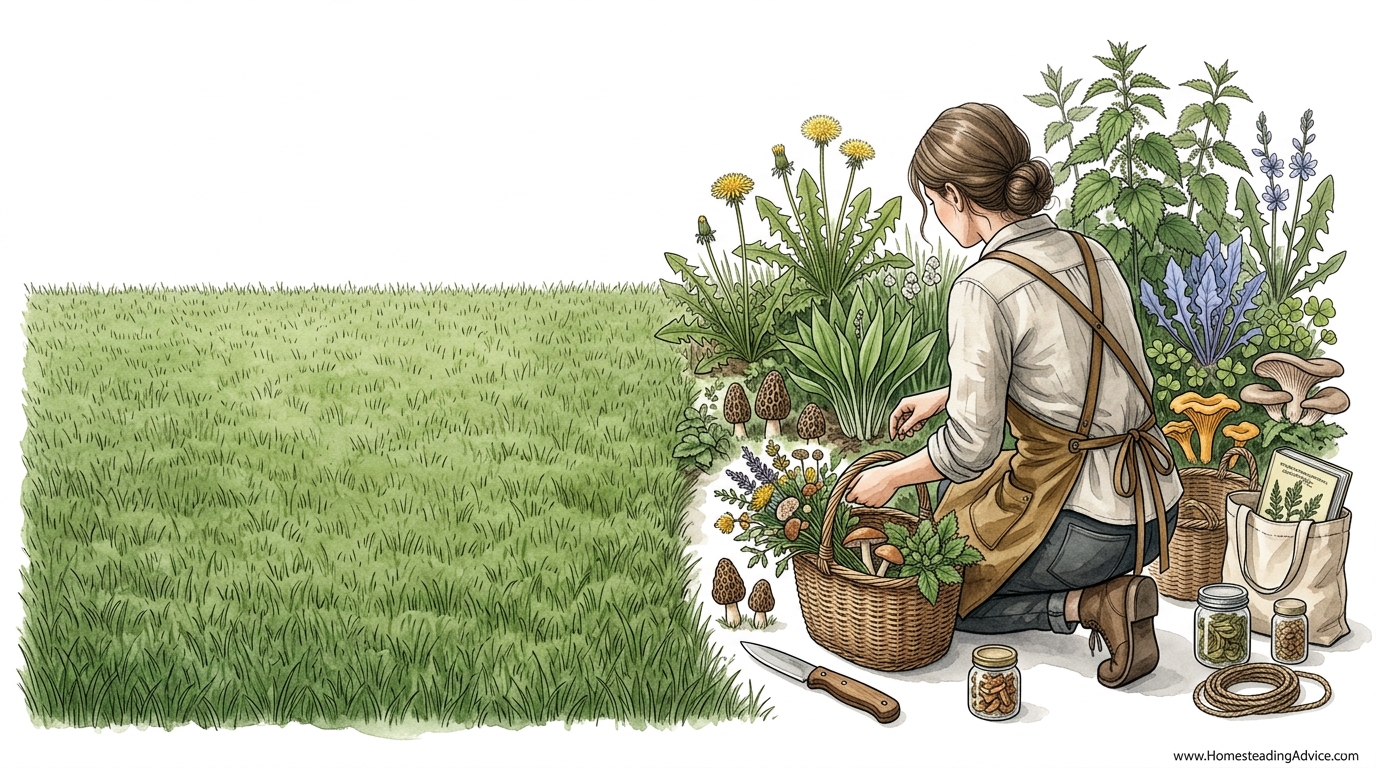
Your neighbors see a yard that needs mowing; a professional forager sees a $100-a-plate salad bar. The most expensive salad mixes in the world aren’t grown in rows; they are found in the wild edges of your property. Chefs are desperate for the nutrient density and complex flavors of foraged greens. It’s time to stop mowing your profits and start bagging them.
Wild edibles are no longer just survival food for the desperate or the eccentric. They have become the cornerstone of high-end culinary experiences, valued for their “terroir”—the unique flavor of a specific piece of land. While industrial agriculture focuses on shelf life and uniformity, wild greens offer a rotating seasonal palette of peppery, lemony, and umami notes that cannot be replicated in a greenhouse.
Walking into a restaurant with a basket of perfectly cleaned, vibrant wild greens is like walking into a bank with a bag of gold. But success in this field requires more than just knowing what is edible. It requires a deep understanding of the market, a commitment to rigorous safety standards, and a respectful relationship with the land itself. This guide will show you how to identify the high-value “weeds” in your path and turn them into a legitimate, sustainable income stream.
Selling Wild Foraged Edibles
Selling wild foraged edibles is the act of harvesting uncultivated plants from their natural habitat and supplying them to commercial buyers like restaurants, farmers’ markets, or specialty grocers. It is a business built on observation and timing rather than tilling and fertilizing. Unlike traditional farming, which fights against nature to maintain a monoculture, the forager works within the existing ecosystem to find what is already thriving.
This market exists because wild plants are often superior to their domestic counterparts in both nutrition and flavor. For example, wild lamb’s quarters contain significantly more calcium and protein than commercially grown spinach. Purslane, often cursed by gardeners, is one of the highest plant-based sources of omega-3 fatty acids. Chefs use these ingredients to create “plates with a story,” connecting diners to the local landscape and the current season.
Real-world applications range from fine-dining garnishes to medicinal teas and bulk greens for pestos. A single pound (0.45 kg) of high-quality wild ramps can fetch $20 to $30 at retail, while delicate greens like chickweed or wood sorrel are prized as high-value garnishes that require minimal space to transport but command a premium price. You are not just selling “weeds”; you are selling a curated, nutrient-dense, and ecologically responsible alternative to the industrial food system.
The Forager’s Portfolio: Plants That Sell
Success starts with knowing which plants have a market. While hundreds of plants are technically edible, only a handful have the flavor profiles and “name recognition” that make them easy to sell to chefs. Focus your efforts on these high-value species first.
Ramps (Allium tricoccum)
Often called “wild leeks,” ramps are the gold standard of foraged goods. They appear in early spring and have a fleeting season that lasts only a few weeks. Their flavor is a potent cross between garlic and onion with a sweet, earthy finish. Ramps are so popular that they have achieved a cult-like status in the culinary world, with prices often exceeding $25 per pound ($55 per kg) in urban markets. Because they are slow-growing, they must be harvested with extreme care—taking only the leaves or thinning clumps rather than clear-cutting a patch.
Stinging Nettles (Urtica dioica)
Despite their painful reputation, nettles are a favorite among chefs for their deep, iron-rich flavor similar to spinach but more complex. Once blanched or dried, the “sting” is neutralized. They are exceptionally hardy and can be harvested multiple times throughout the spring. Selling nettles requires careful processing—handling them with thick gloves and presenting them in clean, breathable bags. They are often used in soups, gnocchi, and teas.
Purslane (Portulaca oleracea)
This succulent “weed” thrives in the heat of mid-summer when other greens are wilting. It has a crunchy texture and a mild, lemony tang. High-end restaurants use it in salads or as a garnish for seafood. Because it is a succulent, it has a better shelf life than many other wild greens, making it a reliable product for delivery. Prices for high-quality, clean purslane can reach $15 to $20 per pound ($33 to $44 per kg) in specialty markets.
Chickweed (Stellaria media)
Chickweed is a delicate, cool-weather green that tastes like corn silk or mild pea shoots. It is a favorite for “micro-salad” mixes. Because it is fragile, it must be harvested and stored with great care. It is often found in late autumn or very early spring, filling a gap in the seasonal calendar when few other fresh greens are available.
Lamb’s Quarters (Chenopodium album)
Known as “wild spinach,” this plant is a relative of quinoa. Its leaves have a slightly salty, nutty flavor and a dusty, water-repellent coating. It is highly versatile and can be used anywhere spinach is used. It grows in massive quantities on disturbed soil, making it a high-volume crop for foragers who want to supply restaurants with bulk cooking greens.
How It Works: From Field to Kitchen
Turning a wild plant into a professional product involves a rigorous three-step process: scouting, harvesting, and post-harvest handling. Each step must be executed with precision to maintain the quality and safety that commercial buyers expect.
Scouting and Land Management
Professional foragers do not just wander aimlessly. They manage “routes” and keep detailed records of when specific plants emerge in different microclimates. Scouting happens weeks before the harvest. You must ensure the area is free from contamination—avoid roadsides where runoff may contain lead or oils, and never harvest from land that has been sprayed with pesticides or herbicides. Developing relationships with landowners is essential; always get written permission before harvesting on private property.
Sustainable Harvesting Techniques
The goal is to harvest in a way that encourages the plant to grow back stronger. For leafy greens like nettles or lamb’s quarters, “pinching” the top few inches of the plant encourages branching and provides the most tender growth for the buyer. For slow-growing perennials like ramps, the “rule of twentieths” is often recommended—never taking more than 5% of a given patch in a single year to ensure the colony survives. Use clean, sharp shears or knives to make clean cuts that heal quickly.
Post-Harvest Cooling and Cleaning
The “cold chain” is the most critical part of the business. Wild greens respire quickly and will wilt within minutes if left in the sun. Bring a cooler with ice packs directly into the field. As soon as a bag is filled, it should be placed in the cooler. Once home, most greens require a “triple wash” in cold water to remove forest debris, insects, and soil. After washing, use a large commercial salad spinner to remove excess moisture. Damp greens rot; dry, cold greens stay crisp.
Benefits of Selling Foraged Goods
Choosing to forage for profit offers several unique advantages over traditional market gardening or standard employment. It is a low-overhead business that rewards deep local knowledge and ecological stewardship.
- Zero Input Costs: You do not buy seeds, fertilizer, or irrigation equipment. Nature provides the “inputs” for free, allowing for high profit margins.
- Nutritional Density: Wild plants are often more nutrient-dense than cultivated ones, providing a superior product that health-conscious chefs and consumers value.
- Ecological Service: By harvesting invasive species like Garlic Mustard or Japanese Knotweed, you are helping to manage the ecosystem while getting paid for it.
- Market Differentiation: Anyone can grow a tomato, but few people can provide a consistent supply of perfectly picked Wood Sorrel or Milkweed Broccoli. This exclusivity gives you leverage in pricing.
Challenges and Common Mistakes
The most common reason foraged businesses fail is a lack of professionalism. Chefs are busy; they need a reliable supplier, not a hobbyist who shows up occasionally with dirty plants.
Identification Errors: This is the most dangerous pitfall. Misidentifying a plant can lead to serious illness or death. For example, Water Hemlock can look superficially like wild parsnip or carrot. You must be 100% certain of your identification using multiple botanical features (leaves, stems, roots, and flowers). If you have any doubt, do not harvest it.
Poor Post-Harvest Handling: Delivering a bag of wilted, bug-ridden greens will ensure you never get a second order. If the product isn’t restaurant-quality, don’t try to sell it. Investing in a high-quality cooler and learning proper drying techniques is just as important as knowing the plants themselves.
Overharvesting: It is easy to get greedy when you find a large patch of a high-value plant. However, destroying your source means you have no business next year. Professional foragers think in decades, not seasons. They leave enough for the plant to go to seed and for local wildlife to thrive.
Limitations and Constraints
Foraging is not a “get rich quick” scheme, and it has several realistic boundaries that every practitioner must acknowledge. It is highly dependent on the whims of the weather and the local legal landscape.
Seasonality is the biggest constraint. Unlike a greenhouse that can produce year-round, foraged goods are strictly seasonal. If there is a late frost or a severe drought, your “crop” may vanish for the year. This requires foragers to be versatile, shifting their focus from spring shoots to summer succulents, fall mushrooms, and winter roots.
Legal restrictions are also significant. In many regions, selling “wild” food falls into a grey area of food safety law. Some states in the US classify mixed wild greens as “potentially hazardous” once they are cut, requiring them to be processed in a certified commercial kitchen. Public lands often have strict “no-commercial-foraging” rules, and trespassing on private land is a quick way to end your career. You must do the legwork to ensure your operation is legal in your specific jurisdiction.
Comparison: Monoculture Lawn vs. Edible Edges
Comparing the management of a standard lawn to the cultivation of “edible edges” highlights the difference in both cost and potential return. A standard lawn is a financial drain, while an edible edge is a productive asset.
| Factor | Monoculture Lawn | Edible Wild Edges |
|---|---|---|
| Maintenance Cost | High (Mowing, fertilizer, gas) | Zero to Low (Observation only) |
| Revenue Potential | Negative (Direct expense) | $20–$50 per hour of harvesting |
| Biodiversity | Low (Biological desert) | High (Supports pollinators/birds) |
| Risk | Low (Reliable aesthetic) | Moderate (Weather dependent) |
Practical Tips for Success
If you are ready to start selling, follow these best practices to build a professional reputation from day one. Efficiency in the field translates directly to higher hourly earnings.
- The Sample Strategy: Do not just ask a chef if they want to buy something. Bring a small, perfectly cleaned sample in a glass jar or professional bag. Let them taste the quality.
- Morning Harvest: Harvest as early as possible after the dew has dried but before the heat of the day. The plants have the highest turgor pressure (crispness) in the morning.
- Standardize Your Weights: Use a digital scale to weigh your product. Sell by the pound (0.45 kg) or by the “unit” (e.g., 4 oz / 113g clamshells for delicate garnishes). Professionalism in packaging wins more sales than the plants themselves.
- Keep a Phenology Journal: Record when plants emerge each year. Over time, you will develop a “forager’s calendar” that allows you to predict exactly when your revenue will start flowing.
- Identify Your “Clean” Zones: Spend time identifying areas that are far from pollution sources. Land trust properties, organic farms, and deep woods are prime locations.
Advanced Considerations: Scaling Up
For those looking to move beyond a few restaurant accounts, scaling requires a shift from pure foraging to “wild stewardship.” This involves managing the land to increase the yield of wild species without tilling it. For example, you might thin out competing non-edible plants to give a patch of ramps or stinging nettles more room to spread.
Consider value-added products. Selling fresh ramps is profitable, but selling “Wild Ramp Salt” or “Nettle Pesto” allows you to preserve your harvest and sell it year-round. This requires more complex licensing and a commercial kitchen but can significantly increase your revenue per pound of raw material.
Scaling also involves networking. Some foragers act as “aggregators,” buying high-quality finds from other local foragers to fulfill large orders from regional distributors. This requires a deep understanding of food safety and a reliable system for verifying the identification of all products entering your supply chain.
Example Scenario: A Morning on the Wild Edge
Imagine a Tuesday morning in mid-May. You wake up at 5:00 AM and head to a known stinging nettle patch on the edge of a local organic orchard. Wearing thick leather gloves and using sharp garden snips, you harvest 10 pounds (4.5 kg) of the tender top four inches of the plants in about an hour. You immediately place them in a pre-chilled cooler.
By 7:00 AM, you are home. You triple-wash the nettles in a large tub of cold water, spin them dry in batches, and pack them into 1-pound (0.45 kg) breathable produce bags. At 9:00 AM, you visit three local farm-to-table restaurants. Because you have a standing relationship, the chefs are expecting you. You sell the 10 pounds at $12 per pound. By 10:30 AM, you have $120 in cash or a check, and your “workday” is done, leaving the afternoon for scouting new locations for the upcoming summer purslane season.
Final Thoughts
The transition from a yard-owner to a professional forager is a journey of re-education. It requires looking past the standard definitions of “weed” and “lawn” to see the biological wealth that already exists. This path is not just about making money; it is about reclaiming ancestral wisdom and building a food system that is resilient, diverse, and deeply connected to the earth.
Start small by identifying three plants on your own property. Master their identification, learn how they taste at different stages of growth, and practice the art of the perfect clean. Once you can provide a product that is cleaner and fresher than anything a chef can buy from a corporate distributor, you will have a business that no market crash can take away. The wild edges are waiting; it is time to stop mowing and start harvesting.