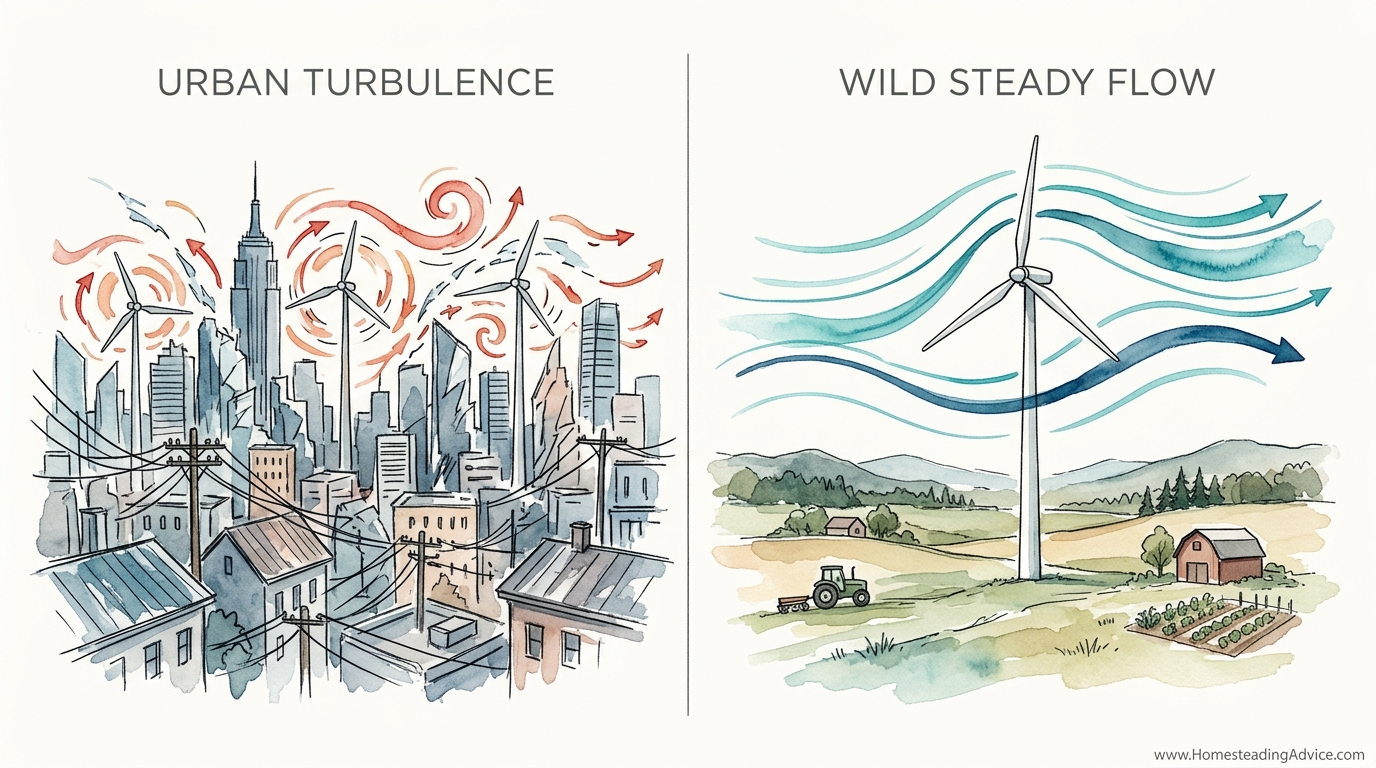
Why does the exact same turbine produce three times more power just by moving it away from the city’s chaotic air? Most people install wind turbines where they live, but that’s usually the worst place for power. Urban obstacles create ‘dirty’ air that kills efficiency. Learn how to find the ‘Wild Flow’ even in small spaces to unlock the energy you’re currently wasting.
Harnessing the wind is an ancient practice, a craft passed down through generations of folks who knew that working with nature required more than just the right tools. It required a deep understanding of the land and the invisible currents flowing over it. Today, we often look at a shiny new turbine and assume it will do all the work, but the truth is far grittier. Wind energy is a fickle beast. If you place your machine in the middle of a chaotic, turbulent environment, you are essentially asking it to swim against a riptide. You might see the blades spinning, but the actual work getting done is minimal.
The secret to successful wind power isn’t just about the turbine itself. It is about the placement. Think of a wind turbine like a sail on a ship. A sailor doesn’t drop anchor in a narrow, walled-off harbor and expect to catch the trade winds. They head for the open sea where the air is steady and strong. To get the most out of your investment, you need to find what we call the “Wild Flow”—that smooth, laminar air that hasn’t been broken apart by rooftops, fences, and tree lines. This guide will walk you through the hard-won wisdom of wind placement, ensuring your blades catch the energy they deserve.
Best Wind Turbine Placement Guide
Successful wind turbine placement is the art and science of locating your equipment where the wind is most frequent, fastest, and least turbulent. In the world of renewable energy, wind is often misunderstood because we cannot see it. We feel a breeze on our face and think it is “windy,” but for a turbine to generate meaningful electricity, it needs a specific type of air. This section defines the fundamental goals of siting and explains why the physical location of your tower is the single most important factor in your energy harvest.
To understand placement, you must first understand the “Cube Law” of wind power. This law states that the power available in the wind increases with the cube of the wind speed. If you double your wind speed, you don’t get double the power; you get eight times the power. Because of this, even a small improvement in placement that increases average wind speed by just 10% or 20% can result in a massive jump in electrical output. High-quality placement seeks to maximize this speed while minimizing “dirty air,” or turbulence, which causes wear and tear on the machine’s bearings and electronics.
Real-world wind placement involves looking at your property not as a flat map, but as a three-dimensional landscape of obstacles. Every house, barn, and oak tree creates a “wake” of turbulent air behind it, much like a rock in a rushing stream. This wake can extend far further than most people realize. Proper placement moves the turbine outside of these wakes, either by going higher into the sky or further out into the open field. Whether you are on a small homestead or a large ranch, the principles of finding the “Wild Flow” remain the same: seek height, seek distance from obstructions, and seek the prevailing path of the air.
Understanding Urban Turbulence vs. Wild Flow
Air moves like water. When it flows over a smooth surface, like a calm lake or a flat prairie, it moves in layers. This is called laminar flow, or what we refer to as Wild Flow. It is predictable, steady, and packed with energy. When that same air hits a city or a suburban neighborhood, it strikes buildings, hits sharp corners, and tumbles over fences. This turns the smooth flow into a chaotic mess of swirls and eddies known as urban turbulence.
Turbulence is the enemy of wind power for two reasons. First, it robs the wind of its velocity. The energy that could have been turning your blades is instead spent bouncing off shingles and swirling around chimneys. Second, turbulent air changes direction and speed rapidly. A turbine caught in this “dirty air” will constantly hunt for the wind, yawing back and forth and straining its internal components. This leads to premature failure and very little actual power generation. If you’ve ever wondered why a turbine in a backyard seems to spin frantically but produces almost no volts, turbulence is the culprit.
Finding the Wild Flow means getting above or away from this ground-level chaos. Even in a built-up area, there are pockets of better air, but they are almost always found at heights that clear the surrounding rooflines. For the self-reliant individual, the goal is to identify where the ground friction ends and the true wind begins. This boundary layer is where the real work happens.
The Golden Rule: The 30/500 Law of Placement
In the wind industry, there is a tried-and-true standard known as the 30/500 rule. This rule is the baseline for anyone serious about harvesting wind energy. It states that the bottom of your turbine blades should be at least 30 feet (about 9 meters) above any obstacle within a 500-foot (150-meter) radius. This includes trees, houses, silos, and even neighboring structures that might be outside your property line.
Why 500 feet (150 meters)? When wind hits an object, the disturbance doesn’t just vanish immediately behind it. The “wind shadow” or turbulence zone can extend horizontally for a distance up to 20 times the height of the object. If a tree is 50 feet (15 meters) tall, it can create “dirty air” for nearly 1,000 feet (300 meters) downwind. While we can’t always clear 1,000 feet (300 meters) on a private lot, the 500-foot (150-meter) mark is the minimum threshold where the air begins to stabilize enough for efficient use.
The 30-foot (9-meter) vertical clearance is just as critical. The wind speed near the ground is always slower due to “surface roughness”—the friction caused by grass, bushes, and soil. By reaching 30 feet (9 meters) above the highest local obstacle, you pierce through the most chaotic part of the boundary layer and enter the zone where wind speeds are significantly higher and more consistent. If you ignore this rule and mount a turbine on a short pole or a roof, you are essentially trying to fish in a puddle instead of a lake.
How to Map the Wind on Your Property
You don’t need a degree in meteorology to understand how wind moves across your land, but you do need to be a keen observer. The first step is identifying the prevailing wind direction. In most regions, the strongest winds come from one or two primary directions depending on the season. You can find this data through local airport weather stations or online wind roses, but nothing beats standing on your land during a storm and seeing where the gusts originate.
Look for “biological indicators” on your property. Trees are the best wind gauges nature provides. If you see trees that lean permanently in one direction, or if their branches grow mostly on one side (a phenomenon called “flagging”), you have found a high-wind corridor. These areas are prime candidates for a tower. Conversely, if you have a spot where the snow always drifts deep or where leaves collect in stagnant piles, that is a wind “dead zone” to be avoided at all costs.
Another technique is to use a simple “wind flag” or a temporary pole with streamers. Move this around different parts of your property on a windy day. Observe the streamers—are they snapping straight and steady, or are they flapping wildly in circles? The steadier the streamer, the better the air. For a more scientific approach, you can install a small anemometer (a wind speed meter) at your proposed height and log the data for a few months. This data will tell you exactly what kind of power you can expect before you spend a dime on a permanent tower.
The Science of Topography: Ridges, Gaps, and Flats
The shape of the land can either be your greatest ally or your worst enemy. If your property is not perfectly flat, you must account for how hills and valleys funnel the air. This is where the “Venturi Effect” comes into play. When wind is forced through a narrow gap, like a pass between two hills or the space between a house and a barn, it speeds up. This is because the same volume of air is being squeezed into a smaller space. If you can place your turbine in one of these “squeeze points,” you can harvest much more energy than you would in an open field.
Ridges are also highly prized locations. As wind approaches a hill, it is forced upward. This compression increases the wind speed right at the crest of the hill. However, you must be careful with placement on a ridge. If you place the turbine too far back from the edge on the leeward side (the side away from the wind), you will be caught in the “rotor” or the tumbling air that rolls over the peak. The ideal spot is usually right on the crest or slightly toward the windward side.
Flat land offers its own challenges. While there are no hills to cause turbulence, there is also nothing to accelerate the wind. On flat plains, height is your only tool. Every foot (30 cm) of elevation you gain on a flat landscape translates directly into smoother, faster air. In these environments, tall lattice towers or guyed poles are the standard, as they allow you to reach the “Wild Flow” without the interference of local topography.
Benefits of Proper Placement
Investing the time and effort into proper placement yields tangible rewards that go far beyond just “more power.” When a turbine is sited correctly, the benefits ripple through the entire life of the system. Here is why placement is the most critical part of your setup:
- Dramatic Increase in Power: As mentioned, the cube law means that small increases in speed result in massive increases in watt-hours. A well-placed turbine can often outperform a poorly placed one that is twice its size.
- Reduced Mechanical Wear: Turbulent air causes the turbine to vibrate and the tail to hunt. Smooth air keeps the turbine steady, significantly extending the life of bearings, bushings, and the alternator.
- Quieter Operation: Most of the “whooshing” or “thumping” noise associated with small wind turbines is caused by the blades hitting turbulent pockets of air. In a smooth, laminar flow, the turbine operates much more quietly, which keeps neighbors happy.
- Faster Return on Investment: A turbine that produces 300% more power pays for itself in one-third of the time. The cost of a taller tower is almost always offset by the increased energy production.
- Predictable Charging: Off-grid systems rely on predictability. Steady wind allows for more consistent battery charging, reducing the depth of discharge and extending your battery bank’s lifespan.
Common Mistakes and Pitfalls
Even well-intentioned folks often fall into traps when setting up their first wind system. The most common mistake is mounting a turbine directly to a roof. It seems convenient and cheap, but it is almost always a disaster. Roofs are zones of extreme turbulence. Furthermore, the vibration from the turbine can resonate through the structure of the house, creating a constant hum that is impossible to live with. Worst of all, the structural stress of a high-wind event can actually damage your roof or rafters.
Another frequent error is underestimating the height of trees. You might look at a 40-foot (12-meter) tree and think your 50-foot (15-meter) tower is plenty high. However, trees grow. Over the 20-year lifespan of a turbine, those trees might reach 60 or 70 feet (18-21 meters), eventually “shading” your turbine from the wind. Always plan for the future height of the landscape, not just the current state.
Finally, many people place their turbine too close to their battery house to save on wire costs, even if it means putting the tower in a wind-shadow. While “voltage drop” in the wires is a real concern, it is much easier to buy thicker wire than it is to fix bad wind. Never compromise the turbine’s location for the sake of a shorter wire run. You can always bump up the wire gauge, but you can’t make the wind blow through a building.
Limitations and Realistic Constraints
While we all want the perfect site, reality often gets in the way. It is important to recognize the limitations of wind power so you don’t set yourself up for disappointment. If you live in a deep valley surrounded by high mountains, you may simply not have enough “fetch” (the distance wind travels unimpeded) to make wind power viable. In such cases, solar or micro-hydro might be a better use of your resources.
Environmental factors also play a role. Areas with frequent ice storms or hurricanes require specialized turbines and towers that can be lowered or tilted down for safety. Additionally, local zoning laws and “setback” requirements may dictate where you can place a tower. A common rule is that a tower must be far enough from the property line that if it were to fall, it would land entirely on your own land. These legal boundaries can sometimes force you out of the “ideal” wind spot and into a “good enough” spot.
Lastly, consider the “roughness” of the surrounding miles. If you are 500 feet (150 meters) from a dense forest, even a tall tower will struggle. The cumulative friction of miles of trees or buildings slows down the entire air mass near the ground. Wind power is most effective in “open” landscapes—coastal areas, Great Plains, or high desert—where the air has had miles to settle into a smooth, fast-moving flow.
Practical Comparison: Urban vs. Rural Wind Siting
The following table illustrates the stark differences in expectations and requirements for wind turbine placement in different environments. This highlights why “Wild Flow” is so much easier to find in open country.
| Factor | Urban/Suburban Setting | Rural/Open Setting |
|---|---|---|
| Wind Quality | High Turbulence (Dirty Air) | Laminar Flow (Wild Flow) |
| Average Tower Height | 60-100 ft (18-30 m) required to clear roofs | 30-60 ft (9-18 m) often sufficient |
| Efficiency Loss | 50% to 80% due to obstacles | Minimal (10% to 20%) |
| Noise Impact | High concern; turbulence creates noise | Low concern; natural wind masks sound |
| Maintenance Needs | Frequent (vibration damage) | Standard interval |
Practical Tips for Optimizing Your Setup
Once you have chosen a general area, there are small adjustments you can make to squeeze every last watt out of the breeze. These “pro tips” come from years of field experience and can make the difference between a system that just “works” and one that thrives.
- Tilt-Up Towers: If possible, use a tilt-up tower design. These allow you to perform all your maintenance and inspections on the ground. A turbine that is easy to service is a turbine that stays running. If it’s a chore to climb a 100-foot (30-meter) lattice tower, you’ll find yourself ignoring minor issues until they become major failures.
- Watch the “Shedding” Point: When wind passes over a sharp edge (like the peak of your house), it creates a vortex. Never place a turbine in the direct path of these vortices. If you must be near a building, ensure you are significantly above or well to the side of the prevailing “shedding” path.
- Foundation Strength: A tower is only as good as the ground it stands on. In soft or sandy soil, you need significantly larger concrete footings. In rocky ground, you might use rock anchors. A vibrating tower is an inefficient tower; the foundation must be rock-solid to keep the energy going into the alternator, not the ground.
- Wire Sizing for Low Voltage: If you are running a 12V or 24V system, the voltage drop over a long distance is massive. If your ideal “Wild Flow” spot is 300 feet (90 meters) away, consider using a higher voltage turbine (48V or higher) and a “step-down” MPPT controller at the battery bank. This allows you to use thinner, cheaper wire without losing your hard-earned power to heat.
Advanced Considerations: The Power Law Profile
For those who want to truly master the air, you must understand the Wind Power Law. This mathematical formula describes how wind speed increases as you move away from the ground. The earth’s surface acts as a drag on the air, creating a “velocity profile.” Near the grass, the wind might be 5 mph (8 km/h). At 30 feet (9 meters), it might be 10 mph (16 km/h). At 100 feet (30 meters), it could be 18 mph (29 km/h).
The “Roughness Exponent” is a value used to calculate this increase. Over smooth water, the exponent is very low (about 0.10), meaning the wind doesn’t speed up much as you go higher because it’s already fast near the surface. In a forest or a city, the exponent is high (0.25 to 0.40), meaning the wind speed increases dramatically as you get above the “clutter.” This is why height is even more critical in “rough” environments than it is on the coast. If you are in a wooded area, every extra 10 feet (3 meters) of tower height is worth its weight in gold.
Scaling your system also requires looking at the “swept area” of the blades. If you double the diameter of your turbine, you quadruple the area that catches the wind. However, a larger turbine also catches more “load.” This means your placement needs to be even more precise. A large turbine in turbulent air is a recipe for a structural catastrophe. If you go big, you must go high.
Real-World Scenario: The Ridge vs. The Yard
Consider a homesteader named Elias. Elias has a house in a small valley with a 60-foot (18-meter) ridge about 400 feet (120 meters) behind the home. Initially, Elias wants to put the turbine on a 20-foot (6-meter) pole in the backyard to save money on wire and tower costs. The backyard is surrounded by the house and a few sheds.
In the backyard, the average wind speed is 7 mph (11 km/h) due to the “shadows” of the buildings. Using a standard small turbine, Elias generates about 50 kilowatt-hours (kWh) per month. After a year of frustration, Elias moves the turbine to a 50-foot (15-meter) tower on the ridge. The wind on the ridge is unimpeded and benefits from the hill’s compression, averaging 14 mph (22.5 km/h).
Because of the Cube Law, doubling the wind speed (from 7 to 14 mph) increases the power potential by eight times. However, accounting for turbine efficiency and less turbulence, Elias now generates nearly 400 kWh per month—eight times the power from the exact same turbine. The extra 400 feet (120 meters) of wire and the taller tower paid for themselves in less than six months. This is the power of finding the Wild Flow.
Final Thoughts
Capturing the wind is a journey that requires patience and respect for the elements. It is easy to get caught up in the specs of a turbine—the magnets, the blade shape, the controller—but none of that matters if the machine is starving for air. By moving away from the chaotic, “dirty” air of our immediate surroundings and reaching for the steady, powerful Wild Flow, we honor the logic of the pioneers who used windmills to settle the plains. They didn’t put their mills in the lee of the barn; they put them where the wind had room to run.
Take the time to observe your land. Watch the way the wind moves the grass and the trees. Use the 30/500 rule as your North Star, and don’t be afraid of the height. A tall tower is not an eyesore; it is a gateway to energy independence. As you apply these principles, you’ll find that your wind system becomes a reliable, quiet, and powerful partner in your quest for self-reliance. The wind is there, moving over the landscape with incredible energy. Your job is simply to put your machine where that energy can finally be caught.